Spearmint extract (Mentha spicata, leaf) is a water-soluble botanical concentrate used in functional beverages, desserts and supplement formulations. It is characterised by the phenolic compound rosmarinic acid (HPLC) alongside its signature aroma actives L-carvone and limonene, and rosmarinic-acid-standardised spearmint extracts carry human RCT evidence for cognitive-performance support. Bionutricia manufactures spearmint extract in Malaysia as a bulk B2B ingredient under JAKIM halal certification.
- Botanical: Mentha spicata (spearmint), leaf
- Format: liquid concentrate (3:1); spray-dried powder also produced
- Marker compound: rosmarinic acid (HPLC); aroma actives L-carvone & limonene
- Character: green, water-soluble, characteristic mint profile
- Made by: Bionutricia Manufacturing Sdn. Bhd., Sungai Buloh, Selangor — patented enzymatic + ultrasonic extraction process (MY-188945-A)
- Pack sizes: 1 kg, 5 kg, 25 kg · MOQ & pricing on quotation
What is spearmint extract?
Spearmint is the milder, sweeter member of the mint family — distinct from peppermint (Mentha × piperita), which is dominated by menthol. Spearmint leaf owes its aroma chiefly to L-carvone with supporting limonene, while its non-volatile phenolic fraction is dominated by rosmarinic acid, a caffeic-acid ester that has become the standardisation marker for the modern generation of “cognition-grade” spearmint ingredients.
Bionutricia produces spearmint extract from the leaf as a green, water-soluble 3:1 liquid concentrate, with a spray-dried extract powder also manufactured in-house — both under the same seven-certification quality system and the patented enzymatic + ultrasonic extraction process (MY-188945-A, “Process for Preparing Nutritional Powder Extract”). The commercial product page is here: https://bionutriciaextract.com/product/spearmint-mentha-spicata-extract-liquid-concentrate/.
Which active compounds characterise spearmint extract?
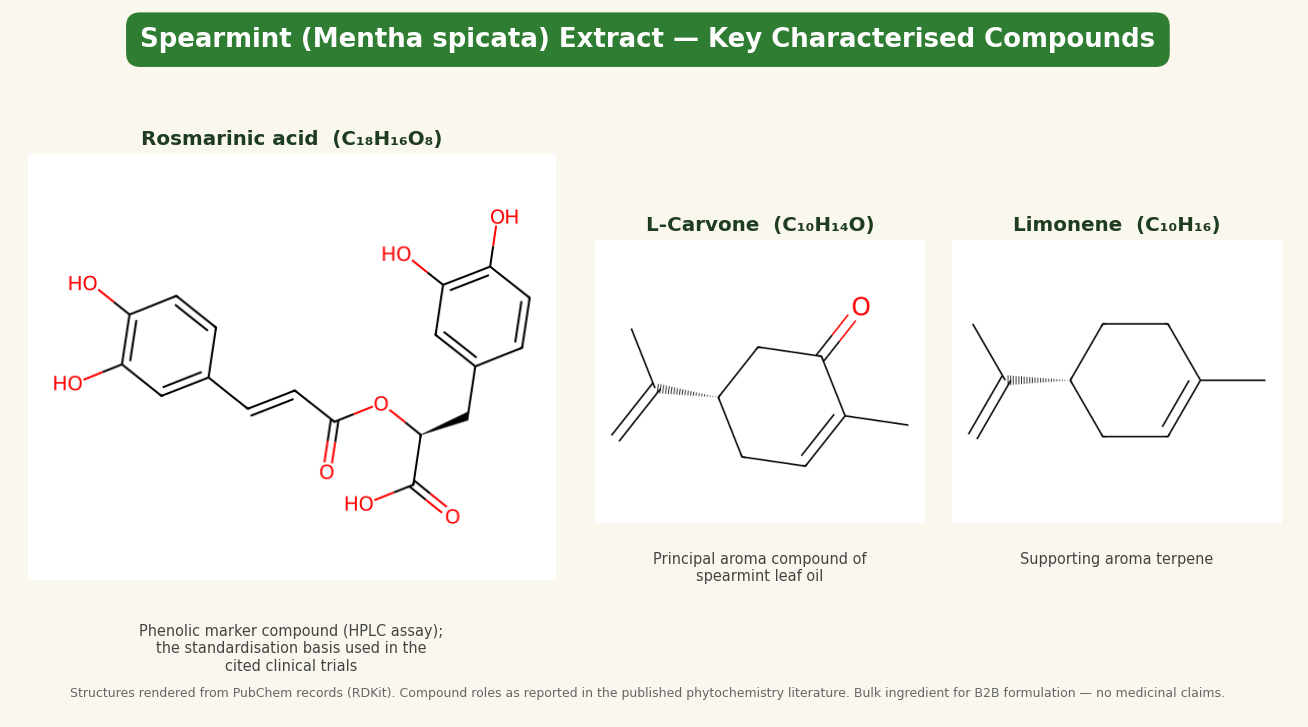
Three compounds do most of the work in a well-made spearmint extract. Rosmarinic acid (C₁₈H₁₆O₈) is the phenolic marker, assayed by HPLC; it is the compound the published cognitive trials standardised their test materials against. L-carvone (C₁₀H₁₄O) is the principal aroma compound that makes spearmint taste like spearmint, and limonene (C₁₀H₁₆) rounds out the citrus-fresh top note. A buyer specifying spearmint for a functional application should ask for the rosmarinic acid figure on the batch certificate of analysis, not just an aroma spec.
What does the human clinical evidence say?
The strongest data sit behind proprietary rosmarinic-acid-standardised spearmint extracts studied for cognitive performance. The results below belong to the cited studies and their specific test materials — they are reported here as category evidence, not as claims for any Bionutricia product.
| Study | Design | Dose & duration | Reported outcome |
|---|---|---|---|
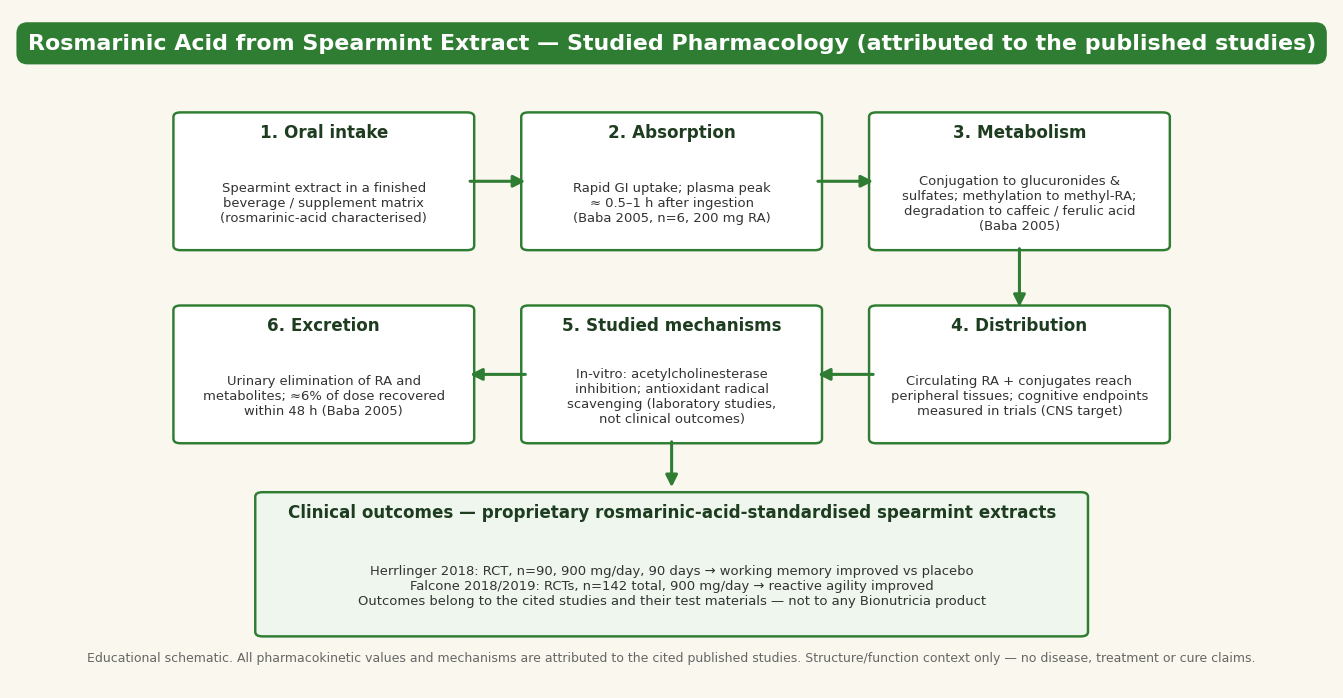
| Herrlinger et al., 2018 | Randomised, double-blind, placebo-controlled; n=90 adults with age-associated memory impairment | 900 mg/day spearmint extract, 90 days | Working-memory quality improved significantly vs placebo (~15% vs baseline) |
| Falcone et al., 2018 / 2019 | Randomised controlled trials in healthy, recreationally active adults; n=142 across studies | 900 mg/day spearmint extract | Improved reactive agility / sustained attention measures vs placebo |
| Baba et al., 2005 | Human pharmacokinetic study; n=6 | Single intake of 200 mg rosmarinic acid | Rapid absorption, extensive conjugation; ~6% of dose recovered in urine within 48 h |
Honest limits: the cognitive trials used one proprietary extract at a defined rosmarinic-acid standardisation, sample sizes are moderate, and effects were measured on specific cognitive test batteries. That is exactly why the marker matters — a spearmint ingredient without a stated rosmarinic acid value cannot borrow this evidence base.
How does rosmarinic acid behave in the body?
Human pharmacokinetic work (Baba et al., 2005) shows rosmarinic acid is absorbed quickly — plasma levels peak roughly 30–60 minutes after ingestion — then undergoes extensive phase-II metabolism: conjugation to glucuronides and sulfates, methylation to methyl-rosmarinic acid, and partial degradation to caffeic and ferulic acids. Elimination is chiefly urinary. Mechanistic laboratory studies report acetylcholinesterase inhibition and antioxidant radical scavenging for rosmarinic acid; these are in-vitro findings that provide the proposed rationale for the cognitive endpoints measured in the clinical trials above.
Which finished formats do brands build with spearmint extract?
Bionutricia supplies the bulk ingredient for B2B formulation; brand owners and manufacturers formulate it into their chosen finished format. The water-soluble liquid concentrate drops directly into ready-to-drink beverages, cordials and syrups, dairy and plant-based desserts, ice cream, jelly and confectionery, while the extract powder suits capsules, tablets, gummies, sachet premixes, bakery and dry-blend applications. Typical usage sits around 0.5–1.5% for the liquid concentrate depending on the flavour and phenolic target of the finished product.
Specifications and quality assurance
| Parameter | Specification |
|---|---|
| Botanical / part | Mentha spicata, leaf |
| Extraction ratio | 3:1 (liquid concentrate) |
| Appearance | Green, slightly viscous liquid; characteristic odour |
| Solubility | Soluble in water |
| Brix | 40–50% |
| pH | 6–8 |
| Heavy metals | As < 0.1 ppm · Pb < 0.2 ppm · Hg < 0.1 ppm |
| Microbiology | APC < 10⁴ cfu/g · yeast & mould < 10³ cfu/g · coliforms < 10² cfu/g · E. coli absent (1 g) |
| Suitability | Vegan; non-GMO; not irradiated; no Annex II allergens; gluten-free (<20 ppm) |
| Marker assay | Rosmarinic acid (HPLC) — stated on the batch certificate of analysis |
| Pack sizes | 1 kg, 5 kg, 25 kg — MOQ & pricing on quotation |
Every batch is produced in Bionutricia’s Sungai Buloh facility under FSSC 22000, GMP, HACCP, MeSTI and US FDA registration, is JAKIM halal certified, and ships with Bionutricia’s own specification and batch certificate of analysis. The extraction uses the patented enzymatic + ultrasonic process (MY-188945-A) for higher active yield with a greener footprint.
Why does the extraction process matter?
Two spearmint ingredients with identical labels can behave very differently in a finished product, because phenolics like rosmarinic acid are sensitive to how the leaf is processed. Bionutricia runs its patented enzymatic + ultrasonic extraction process (MY-188945-A, “Process for Preparing Nutritional Powder Extract”) — enzymes open the leaf matrix gently while ultrasound accelerates mass transfer, so more of the phenolic fraction is recovered at lower thermal stress than conventional long hot-water boiling. For a formulator this shows up in three places: a higher and more consistent marker value on the certificate of analysis, a cleaner, fresher mint profile in the finished beverage, and a greener process footprint to report in your own sustainability documentation. The same in-house system produces both the 3:1 liquid concentrate and the spray-dried extract powder, so a brand can prototype in liquid and scale into powder without changing supplier.
Related guides
- Top 10 Questions B2B Buyers Ask Before Choosing a Botanical Extract Manufacturer in Malaysia
- Knowledge: Spearmint Extract Liquid — spearmint leaf basics
Frequently asked questions
Is spearmint extract halal?
Yes. Bionutricia’s spearmint ingredients are JAKIM halal certified and produced in a halal-certified facility in Selangor, Malaysia.
What is the difference between spearmint and peppermint extract?
Spearmint (Mentha spicata) is carvone-dominant — softer, sweeter, low in menthol; peppermint (Mentha × piperita) is menthol-dominant and cooling. The published cognitive-performance RCTs were run on rosmarinic-acid-standardised spearmint, not peppermint.
Which marker should I specify on a purchase order?
Rosmarinic acid by HPLC. Ask for the value on the batch certificate of analysis; an aroma or Brix spec alone does not define a functional-grade spearmint extract.
Can I use the liquid concentrate in beverages?
Yes — it is water-soluble and designed for beverages, desserts, ice cream and jelly at roughly 0.5–1.5% usage, with flavour, colour and phenolic contribution in one dose.
What pack sizes and MOQ apply?
Standard bulk packs are 1 kg, 5 kg and 25 kg; MOQ, pricing and lead times are provided on quotation. Pre-order packing (freshly made) needs 1 to 2 weeks lead time.
Request the current specification, batch certificate of analysis and a quotation for bulk spearmint extract liquid concentrate or powder: https://bionutriciaextract.com/contact/ · Product page: Spearmint (Mentha spicata) Extract Liquid Concentrate
This article is for B2B ingredient information only. Spearmint extract is supplied as a bulk raw material; it is not a finished consumer product and no disease prevention, treatment or cure claims are made or implied. All clinical findings are attributed to the cited published studies and their specific test materials.