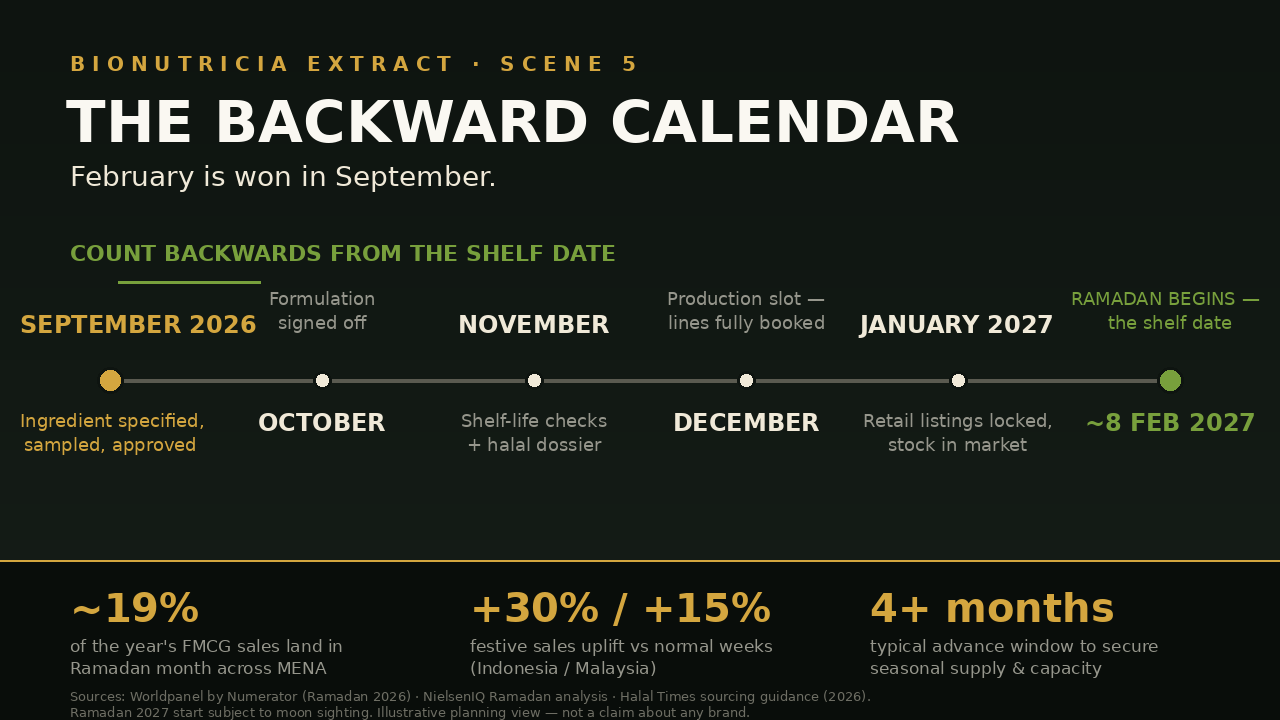
Direct answer: Ramadan 2027 is expected to begin around 8 February 2027 (subject to moon sighting). For a food or supplement brand that intends to be on the Ramadan shelf, the practical deadline for choosing and approving ingredients is September–October 2026 — because retail listings, halal-certified production slots, shelf-life verification and formulation sign-off each consume their own weeks, and they only run in one order: backwards from the shelf date.



The one-month year
Ramadan is not just another promotion window. Across the Middle East and North Africa, roughly 19% of annual FMCG sales land in the Ramadan period (Worldpanel by Numerator). In Southeast Asia, Ramadan remains Indonesia’s biggest retail moment, and NielsenIQ has measured festive sales spikes of up to 30% in Indonesia and 15% in Malaysia versus normal trading weeks. For many halal brands, the season decides the year.
The paradox is that none of that February demand is winnable in February. Every product on the festive shelf was listed, produced, tested and formulated months earlier. The shelf is an output; the inputs all have deadlines of their own.
The backward calendar
The reliable way to plan a seasonal launch is to count backwards from the first day of fasting and let each step claim its real duration:
- January 2027 — stock is in distribution; retail listings are locked and promotions committed.
- December 2026 — production runs. Halal-certified filling and packing capacity is booked solid, because every competing brand wants the same slots in the same window.
- November 2026 — shelf-life checks on the finished recipe, artwork, and the halal documentation for every market you ship to.
- October 2026 — formulation signed off: taste, colour, stability and cost all agreed.
- September 2026 — the ingredient: specified, sampled, approved and contracted.
Miss the ingredient date and every later date slips — but the shelf date does not move. Ramadan will not wait for a supply chain. That asymmetry is the whole argument for starting now: industry sourcing guidance consistently recommends locking seasonal supply at least four months before the season, before capacity tightens and prices climb.
Where the ingredient decision sits — and why it is the compressible step
Most steps in the backward calendar have fixed durations: a stability check takes the weeks it takes; a booked production line runs when it runs. The one step with genuinely elastic duration is ingredient approval. The difference is documentation.
An ingredient that arrives dossier-ready — a complete specification, a valid halal certificate, and a Certificate of Analysis issued for every lot — can clear a brand owner’s quality gate in days. The same botanical bought as an undocumented trading sample can absorb months of back-and-forth: identity queries, missing test methods, halal status chased across intermediaries. In a seasonal calendar, that difference is the launch.
This is also why serious suppliers publish their commercial mechanics openly — see our guide to botanical extract MOQ, lead times and sampling for how the buying process itself works. The calendar above is about when to run that process; the guide is about how.
A worked example from the Ramadan pantry
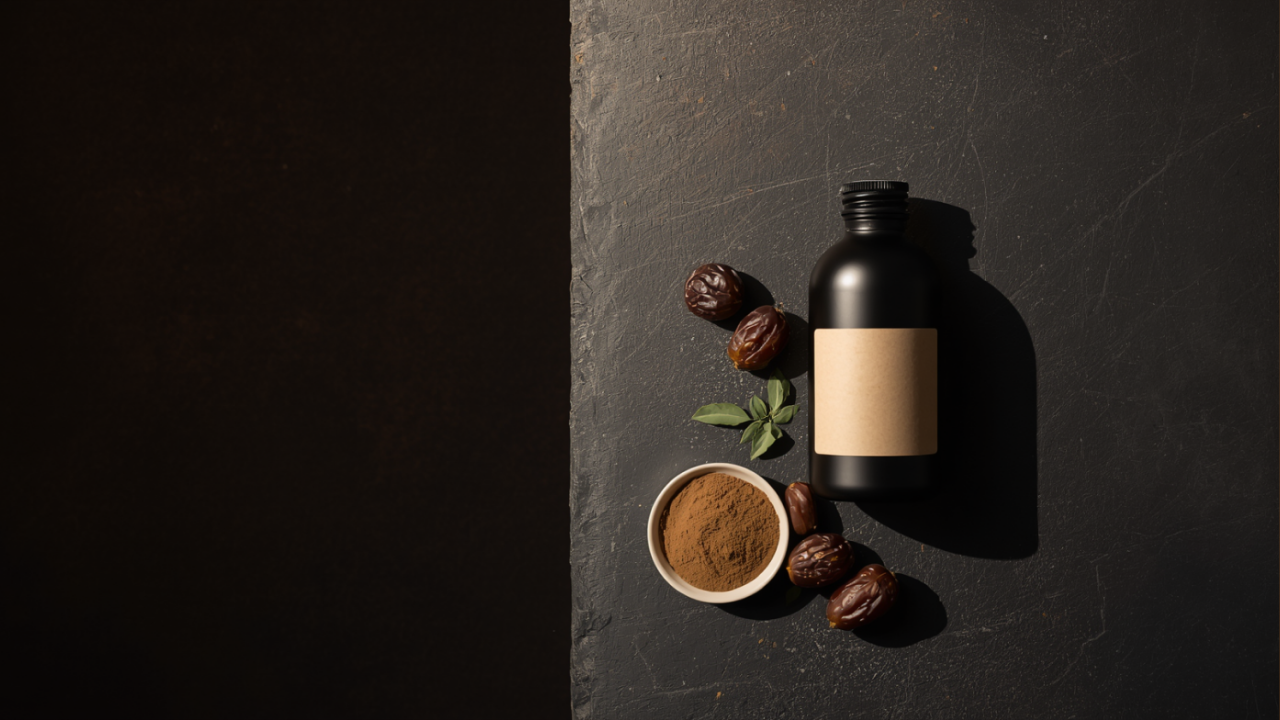
Take dates — the season’s defining ingredient. A brand building a dates-based drink, paste or premium gift product for Ramadan 2027 needs its kurma (dates) extract powder or Ajwa dates extract specified and sampled now, so that October’s formulation work starts from an approved ingredient rather than an open question. The same logic applies to any botanical in the festive range — colourants, flavours, functional extracts alike.
How to run September
- Shortlist the ingredients your Ramadan 2027 range depends on — this week, not after the concept deck.
- Request the specification, halal certificate and per-lot CoA at first contact, together with the sample.
- Sample immediately and run identity and application checks in parallel, not in sequence.
- Lock the spec and the supply agreement, then book the production slot before the seasonal crunch.
- Keep one rule visible on the planning wall: February is won in September.
Frequently asked questions
When should a brand start planning Ramadan 2027 products?
September–October 2026. Ramadan 2027 is expected to begin around 8 February 2027 (subject to moon sighting). Counting backwards through retail listing deadlines, production slots, shelf-life verification and formulation sign-off, the ingredient decision needs to happen roughly five months before the first day of fasting.
Why do Ramadan retail listings close months before Ramadan?
Retailers plan festive ranges, planograms and promotions as a single seasonal reset. Stock must be in distribution centres weeks before the season starts, so category decisions are finalised months ahead — after that window, shelf space is spoken for.
How big is the Ramadan sales opportunity?
Worldpanel by Numerator data puts Ramadan at roughly 19% of annual FMCG sales across MENA, and NielsenIQ has measured festive-period sales spikes of up to 30% in Indonesia and 15% in Malaysia versus normal trading weeks. Ramadan is widely described as Indonesia’s biggest retail moment.
What is a dossier-ready ingredient?
An ingredient supplied with its full documentation up front: a complete specification (identity, botanical name and plant part where relevant, marker or quality parameters, and test methods), a valid halal certificate, and a Certificate of Analysis issued per lot. Complete documentation lets a brand’s QA team approve the ingredient in days instead of months.
What documents should a halal brand request from an ingredient supplier?
At minimum: the product specification, the supplier’s halal certificate (e.g. JAKIM in Malaysia), a per-lot Certificate of Analysis, and the food-safety certifications of the manufacturing site. Requesting all of them at first contact — not after sampling — is what keeps a seasonal timeline intact.
About Bionutricia Extract
Bionutricia (est. 2006) manufactures standardized botanical extracts, active fractions, natural colourants and flavours, and liposomal vitamin ingredient systems in Malaysia, holding FSSC 22000, GMP, HACCP, JAKIM Halal, US FDA and MeSTI certifications plus NanoVerify verification. Bionutricia supplies the bulk ingredient for B2B formulation; brand owners and manufacturers formulate it into their chosen finished format — capsules, tablets, sachets, beverages, bakery, dairy or confectionery.
This article discusses commercial planning only. Nothing here is a nutrition or health claim about any ingredient or finished product.