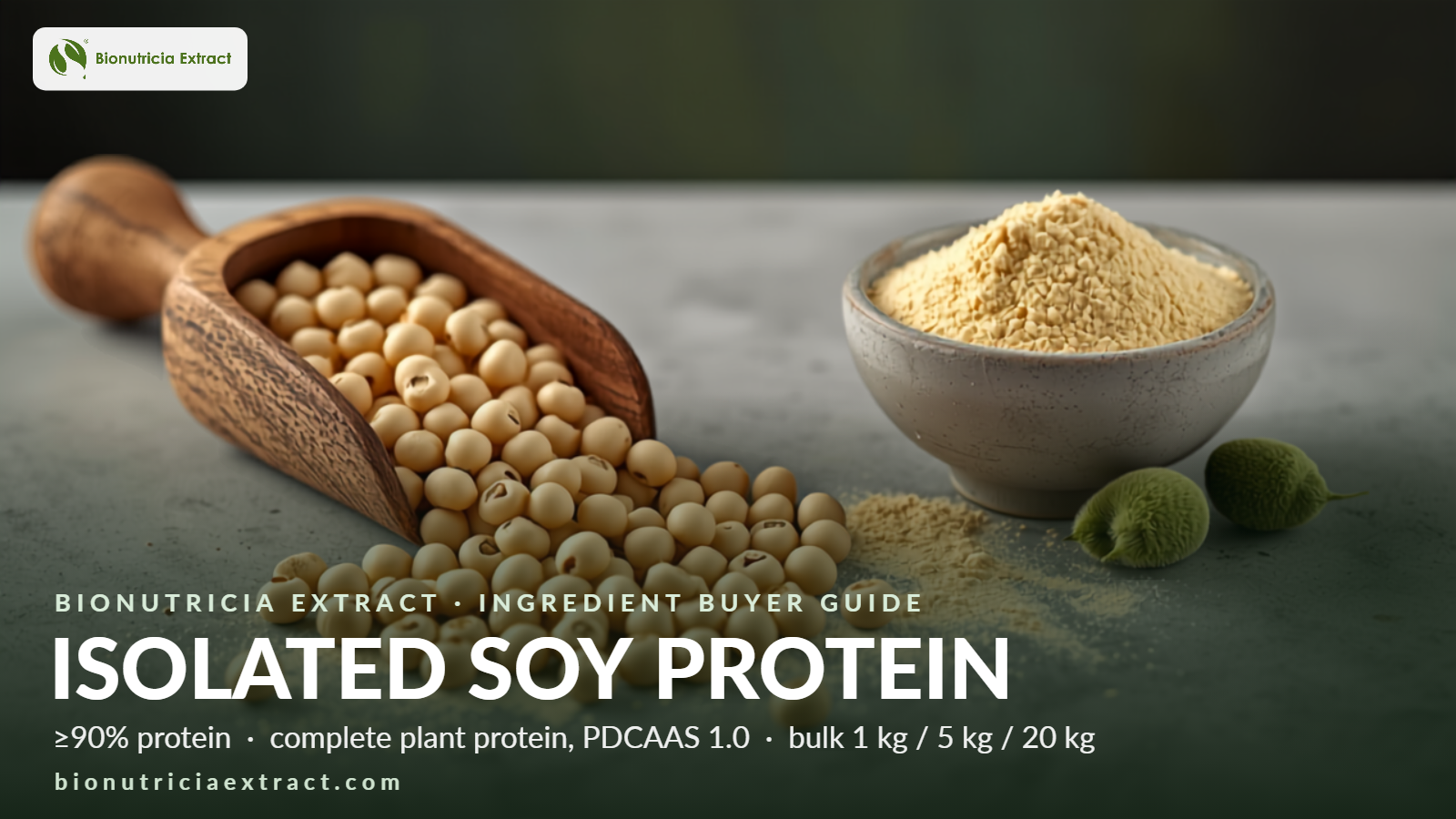
Isolated soy protein (ISP) is the most concentrated commercial form of soy protein: purified from non-GMO defatted soybean flakes to ≥90% protein (Kjeldahl, N × 6.25), it is a complete plant protein with a PDCAAS of 1.0. The grade Bionutricia supplies is a hydrolysed isolate — it stays fluid even above 40% protein in solution, does not coagulate at low pH and carries only a minimal beany note. Bionutricia supplies Isolated Soy Protein Powder in bulk from Malaysia for supplement, beverage and functional-food formulation.
Quick facts — Isolated Soy Protein (Glycine max)
Protein ≥90% (N × 6.25) · complete amino acid profile, PDCAAS 1.0 · hydrolysed isolate: no gelling even above 40% protein in solution · acid-stable (no coagulation at low pH) · minimal beany note · light-yellow, water-soluble free-flowing powder · low flatulence vs soy flour · vegan · JAKIM halal certified · non-GMO, non-irradiated · typical dosage 1–5% of formulation · pack sizes 1 kg, 5 kg, 20 kg · MOQ & pricing on quotation · origin Malaysia
What is isolated soy protein?
Isolated soy protein is produced from defatted soybean (Glycine max) flakes by aqueous extraction followed by isoelectric precipitation, which strips away most of the carbohydrate and fat fractions. The result is the highest-purity soy protein sold commercially — ≥90% protein on a dry basis, compared with roughly 65–70% for soy protein concentrate and about 50% for soy flour. Because the non-protein fractions are removed, ISP has a neutral flavour profile and causes less flatulence than soy flour, making it far easier to formulate into beverages, sports powders and clinical nutrition products.
Here is where grades genuinely differ. A standard isolate gels when heated, thickens at high concentration and coagulates around its isoelectric point (~pH 4.5) — behaviour that suits meat analogues but ruins beverages. Bionutricia’s grade is a hydrolysed isolate: the soy globulins are enzymatically cleaved into shorter peptides, so it does not gel even above 40% protein in solution, it does not coagulate at low pH, and it carries a minimal beany smell. That combination is what lets it run in acidic and high-solids liquid systems where a standard isolate curdles or sets.
Active fraction and standardisation marker
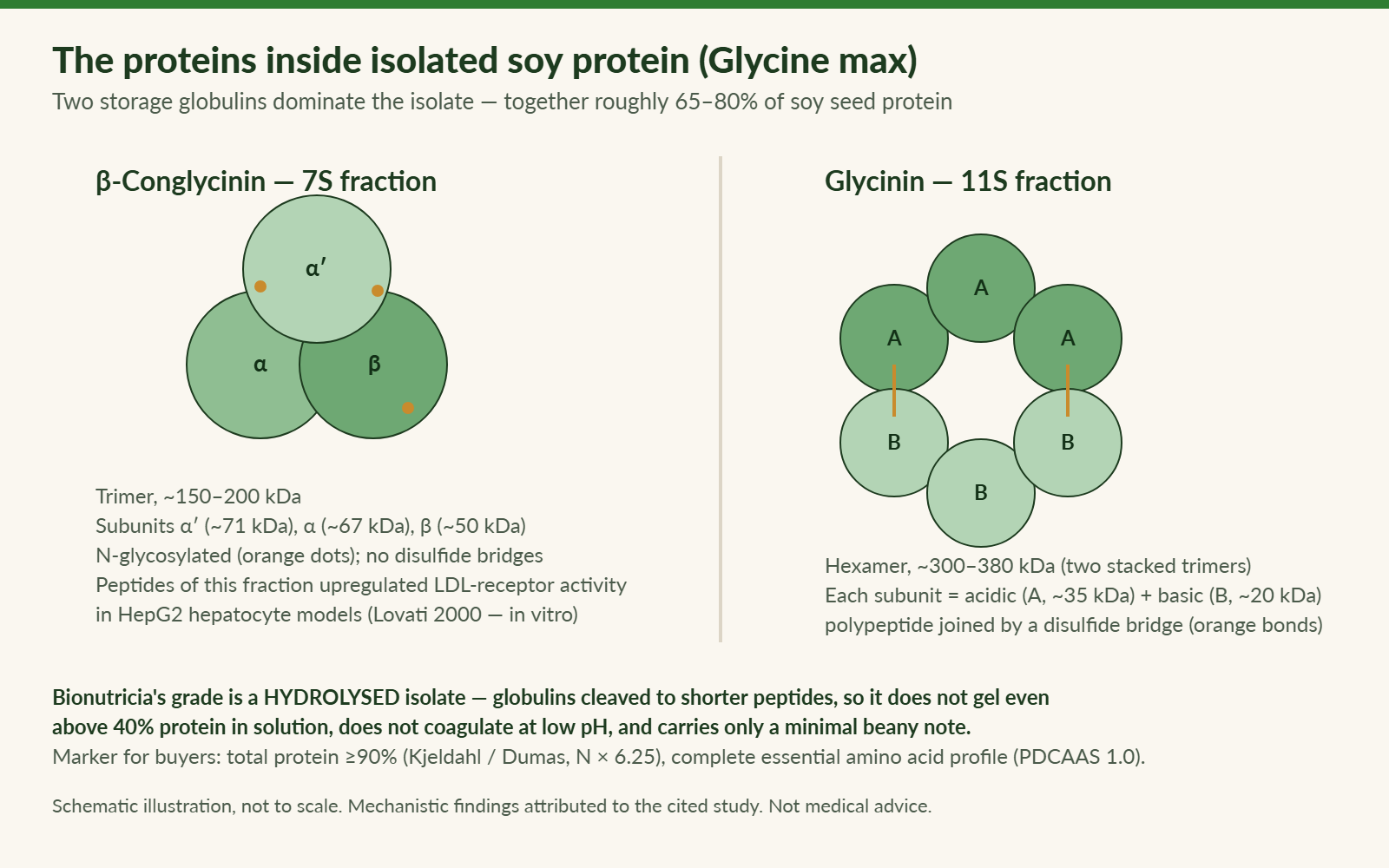
The “active” of ISP is the protein fraction itself, dominated by two storage globulins: β-conglycinin (7S fraction, ~150–200 kDa trimer of α, α′ and β subunits) and glycinin (11S fraction, ~300–380 kDa hexamer of disulfide-linked acidic and basic polypeptides). Together they typically make up 65–80% of soy seed protein and drive both the nutritional value and the functional behaviour of an isolate. In Bionutricia’s hydrolysed grade these globulins are cleaved into shorter peptides — the reason it stays fluid at high concentration and in solution at low pH, where intact globulins would gel or precipitate.
The standardisation marker buyers should specify is simple and assayable: total protein ≥90% by Kjeldahl or Dumas combustion (N × 6.25, dry basis), supported by an amino acid profile (ion-exchange chromatography or HPLC) confirming all nine essential amino acids. Protein quality is scored as PDCAAS 1.0 (FAO/WHO method); by the newer DIAAS method soy protein isolate scores about 0.84–0.90 (Rutherfurd 2015, Journal of Nutrition) — below dairy proteins but the highest of the mainstream plant proteins.
What does the clinical evidence actually say?
Soy protein carries one of the longest and most instructive clinical trails in food science — and an honest reading includes how the effect size shrank as the evidence matured.
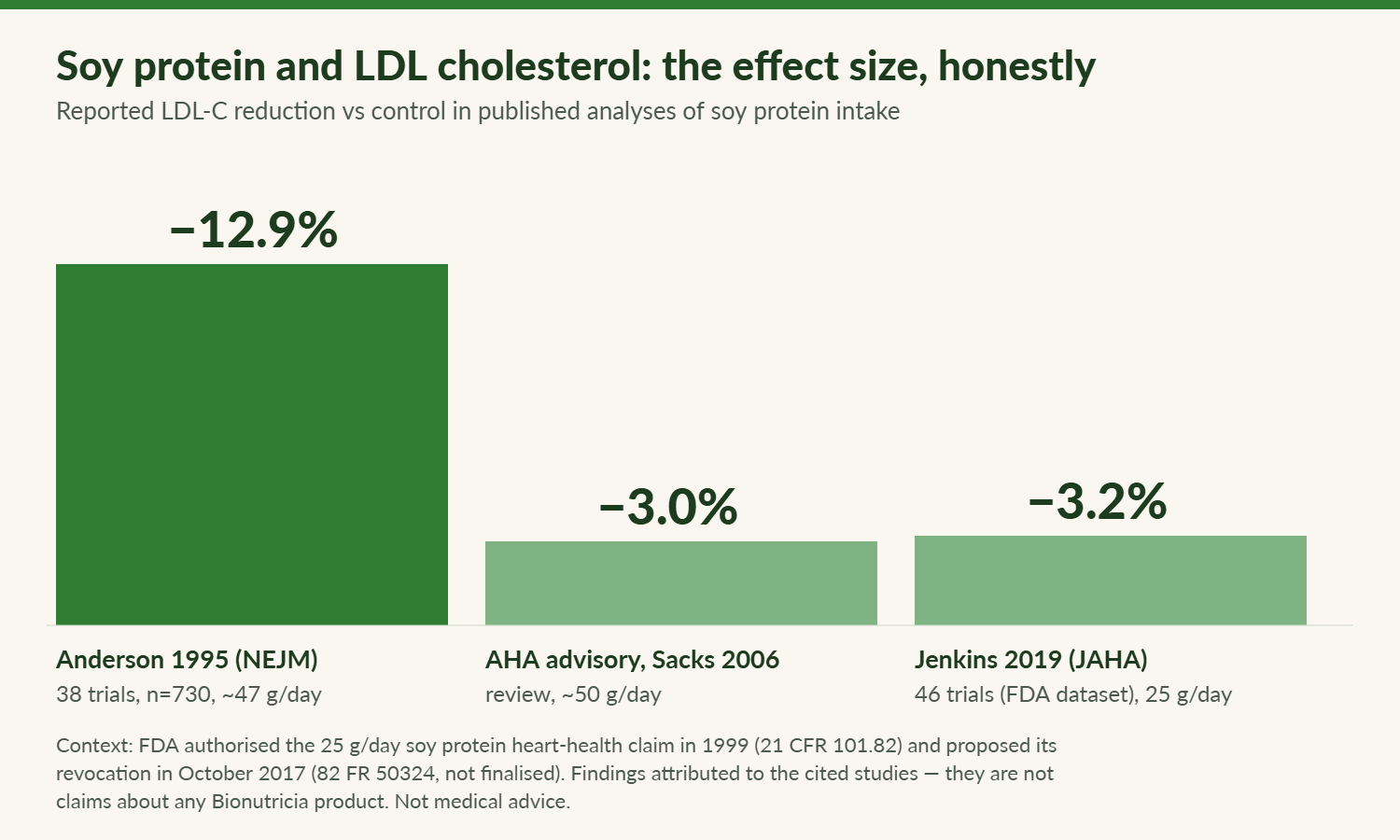
Anderson 1995 (New England Journal of Medicine): a meta-analysis of 38 controlled trials (n = 730) found that substituting soy protein for animal protein — average intake 47 g/day — reduced total cholesterol by 9.3%, LDL cholesterol by 12.9% and triglycerides by 10.5%, without lowering HDL. This paper drove the US FDA’s 1999 authorised health claim (21 CFR 101.82): 25 g of soy protein per day, as part of a diet low in saturated fat and cholesterol, may reduce the risk of coronary heart disease.
The honest negative: later, better-controlled trials found much smaller effects. The American Heart Association’s 2006 advisory (Sacks et al., Circulation) concluded large soy protein intakes lowered LDL by only about 3%, and in October 2017 the FDA proposed to revoke the soy protein heart-health claim (82 FR 50324) on the grounds of inconsistent evidence — the first time the agency has moved to withdraw an authorised claim. The rulemaking has not been finalised, so the claim technically remains on the books, and FDA has indicated a qualified claim would still be permitted. Jenkins 2019 (Journal of the American Heart Association) re-analysed the 46 trials in FDA’s own dataset and found soy protein at a median 25 g/day still produced a small but statistically significant LDL reduction of about 3–4% (−4.76 mg/dL, p = 0.006).
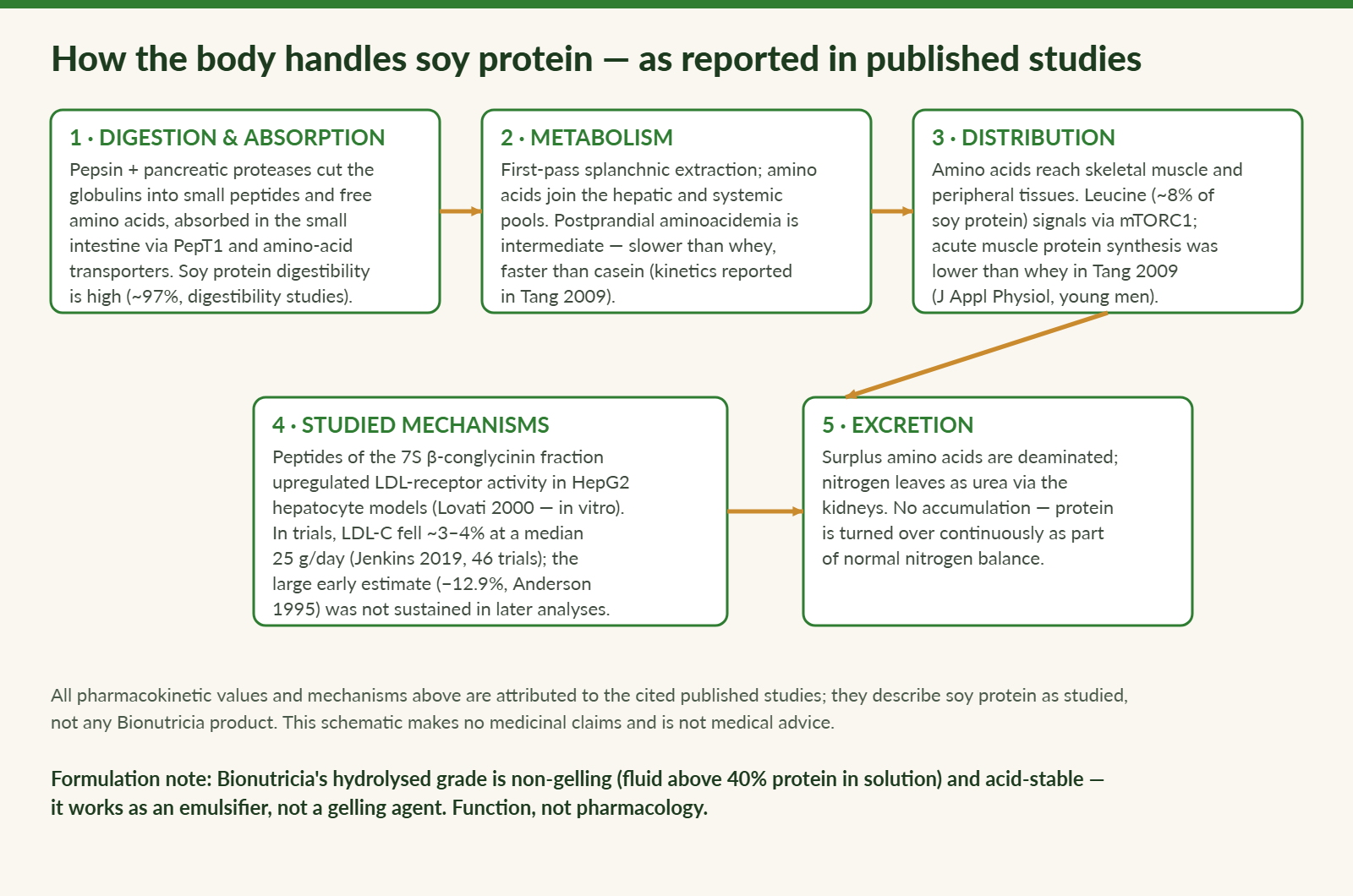
The mechanism most studied for the lipid effect is attributed to peptides of the 7S β-conglycinin fraction, which upregulated LDL-receptor activity in human hepatocyte (HepG2) models in the work of Lovati and colleagues (Journal of Nutrition, 2000) — an in-vitro finding, not a clinical claim.
Protein quality and muscle outcomes — soy vs whey
For sports and active-nutrition briefs the comparison buyers ask about is soy versus whey. The acute data favour whey: Tang 2009 (Journal of Applied Physiology) showed whey hydrolysate stimulated post-exercise muscle protein synthesis more than soy in young men, consistent with soy’s lower leucine content (~8% vs ~11% in whey). But over full training programmes the gap largely disappears: Messina 2018 (International Journal of Sport Nutrition and Exercise Metabolism), a meta-analysis of 9 resistance-training studies, found no significant difference in lean-mass or strength gains between soy and animal-protein supplementation. For dairy-free, vegan and lactose-intolerant positioning, ISP remains the best-evidenced plant protein at the price point.
How is ISP used in finished products?
Typical inclusion as a functional ingredient is 1–5% of the formulation, and far higher in protein-centric products. Because this grade is hydrolysed — non-gelling above 40% protein in solution, acid-stable, minimal beany note — its sweet spot is liquid and acidic systems: high-protein RTD beverages, juice-based and low-pH protein drinks, clear-style protein waters, meal replacements and clinical nutrition. It also runs cleanly in protein powders, high-protein bakery and snacks, dairy alternatives and creamers — and, because ISP is an effective emulsifier, it does double duty binding fat and water in processed systems. Bionutricia supplies the bulk ingredient for B2B formulation; brand owners and manufacturers formulate it into their chosen finished format — capsules, tablets, sachets, gummies, beverages, bakery or dairy applications.
Label honesty: soy is a declarable allergen in Malaysia and under EU Annex II — finished-product labels must declare it. The ingredient itself is vegan, non-GMO, gluten-free (<20 ppm) and JAKIM halal certified.
Claims wording for Malaysian and export buyers
Because bulk ISP is sold as a food ingredient, the classification question (food vs registered product) arises at your finished-product stage, not at the ingredient stage — and the wording on your finished label decides most of it. Structure/function language (“protein contributes to the growth and maintenance of muscle mass” style wording) sits in a very different regulatory lane from disease-risk claims; the US soy heart-health claim is a US-market authorisation and does not transfer to Malaysian or GCC labels. Bionutricia’s technical team routinely supports customers on ingredient documentation for their market submissions — ask for the spec pack when you enquire.
Related guides and the wider Bionutricia range
If you are formulating with plant proteins and functional carbohydrates, these guides pair well with ISP:
- Oat powder & beta-glucan — bulk buyer guide
- Barley powder — mixed-linkage beta-glucan guide
- Liposomal collagen ingredient guide
Across the wider range, ISP slots alongside Pea Protein Powder, Almond Protein Powder, Brown Rice Powder and the savoury-side Soy Hydrolysed Vegetable Protein (HVP) — a practical shortlist for complete plant-protein blends, where complementary amino acid profiles (soy + rice, soy + pea) smooth out individual limiting amino acids.
FAQ: isolated soy protein for B2B buyers
How is Bionutricia’s ISP different from a standard isolate?
It is a hydrolysed isolate: it does not gel even above 40% protein in solution, does not coagulate at low pH (a standard isolate precipitates near pH 4.5), and has only a minimal beany smell — so it works in acidic and high-solids beverages where standard ISP thickens or curdles.
What protein content should I specify for ISP?
≥90% protein on a dry basis (Kjeldahl or Dumas, N × 6.25). That purity is what separates an isolate from a concentrate (~65–70%) or soy flour (~50%).
Is isolated soy protein a complete protein?
Yes — it supplies all nine essential amino acids with a PDCAAS of 1.0. Its leucine content is lower than whey’s, which matters for acute muscle-protein-synthesis endpoints (Tang 2009) but not, per the Messina 2018 meta-analysis, for long-term training outcomes.
Can my finished product carry the FDA soy heart-health claim?
The 1999 claim (21 CFR 101.82) technically remains authorised in the US, but FDA proposed its revocation in 2017 and the file is unresolved — brands should plan around a qualified claim in the US and market-specific wording elsewhere. Malaysian and GCC labels follow their own rules; the US claim does not transfer.
Is ISP suitable for vegan and halal formulations?
Yes. It is entirely plant-derived, free of animal products, and JAKIM halal certified. Note that soy itself is a declarable allergen on finished-product labels.
What pack sizes and MOQ does Bionutricia offer?
Powder pack sizes are 1 kg, 5 kg and 20 kg; MOQ and pricing are on quotation. Shelf life is 2 years when stored sealed, cool and dry.
Source Isolated Soy Protein Powder in bulk
Hydrolysed grade — ≥90% protein, acid-stable, non-gelling, minimal beany note. Vegan, JAKIM halal certified, non-GMO. Spec sheet, amino acid profile and quotation on request — 1 kg, 5 kg and 20 kg packs from Malaysia.
Reviewed by Nur Ayunis Binti Che Daud, Nutritionist (BSc Hons Nutrition, Universiti Sains Malaysia), Bionutricia. All clinical findings above are attributed to the cited published studies and relate to soy protein as studied; they are not claims about Bionutricia’s product. This article is for B2B ingredient information and is not medical advice.