Do you need third-party verification to sell dietary supplements through major retail channels in 2026? Increasingly, yes. Amazon’s dietary-supplement policy now applies to every seller on its US marketplace and requires a certificate of analysis that has been verified by an Amazon-approved testing, inspection and certification (TIC) organisation — a seller’s own attestation no longer passes — while CVS already third-party tests every vitamin and supplement it stocks under its Tested to Be Trusted programme. The practical consequence for brand owners: market access now depends on a documentation file, and a large part of that file is generated at the ingredient level, by your supplier, before your brand writes a single word. This briefing walks through the retailer-verification wave and the ingredient file that passes it. (Retailer policies evolve; always confirm current requirements directly with the channel before acting.)
The retailer is now the regulator
The toughest supplement rules of 2026 weren’t written by a government agency. They’re Amazon’s.
Every seller. Every category.
Since December 2025, Amazon’s dietary-supplement policy covers every listing — not just the “high-risk” ones. Your certificate of analysis now goes to an approved third-party verifier. Attestation alone no longer passes.
The shelf tests you back
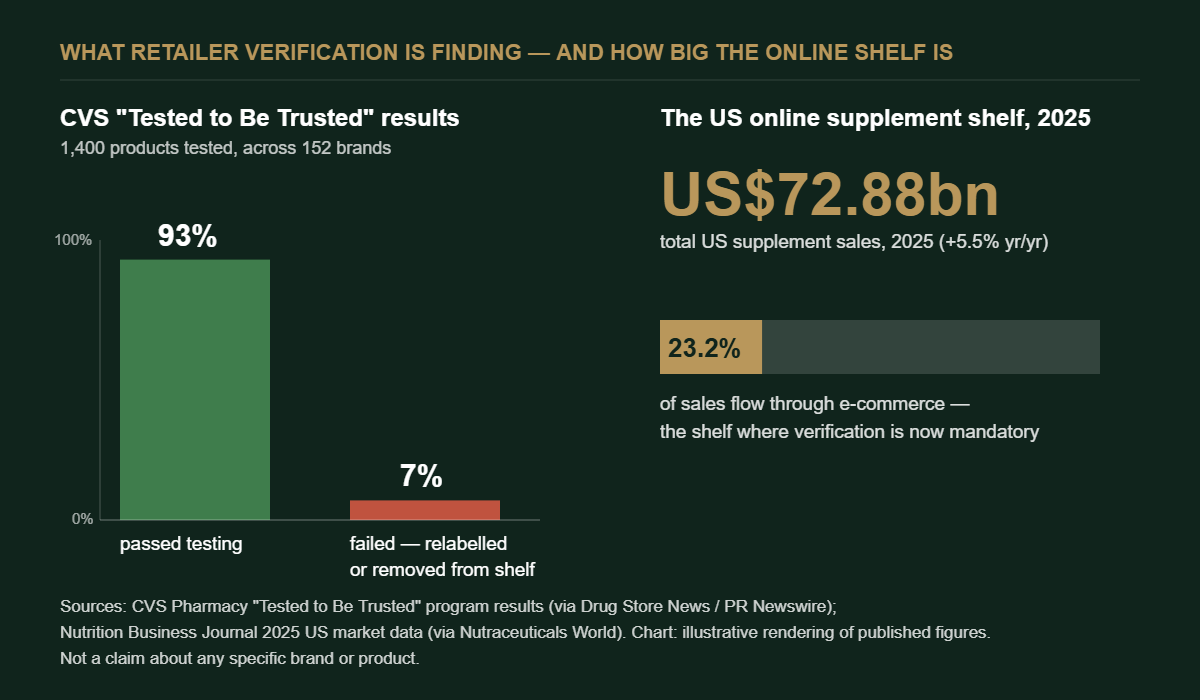
CVS third-party tests every supplement it stocks — 1,400 products across 152 brands went through the programme. 7% failed and were relabelled or removed. Retailer-driven standards are spreading into a patchwork.
Verified, not declared
An approved TIC laboratory now checks the certificate of analysis and manufacturing evidence behind a listing. The question changed from “do you have a document?” to “does it survive checking?”
The verified shelf, in four figures
Fail the paperwork, lose the shelf
A listing can be deactivated over a claim that doesn’t match the Supplement Facts Panel. The product may be fine — the file wasn’t. Either way, the pallet doesn’t move.
Half your audit is your supplier’s
Portable specification with a named marker compound, certificate of analysis for every lot, ingredient-level halal certificate, identity and stability data — the file starts at the ingredient. If your supplier can’t produce it in days, neither can you.
Documentation-ready ingredients
Standardized botanical extracts, natural colourants and flavours, and liposomal vitamin systems — supplied with the specification, per-lot certificate of analysis and ingredient-level halal certificate your next audit will ask for. bionutriciaextract.com
Why the strictest supplement rules of 2026 come from retailers
Government regulators mostly police the supplement market after products are already on sale. Retailers control the shelf itself — and they have started using that control as a quality gate. Trade press now describes a growing patchwork of retailer-driven supplement standards: Amazon requiring third-party-verified documentation, CVS testing every bottle before it is stocked, and other chains building their own entry requirements on top of the law, not instead of it.
The commercial weight behind this is simple. US supplement sales reached US$72.88 billion in 2025, growing 5.5% on the year, and 23.2% of those sales flow through e-commerce (Nutrition Business Journal data). Amazon dominates that online shelf. When the largest single shelf in the category changes its entry rules, the rules of the category change — whoever writes the law.
For a brand owner, this lands as a shift in where risk lives. The old failure mode was a regulator’s warning letter after launch. The new failure mode is quieter and faster: a listing that never activates, or a deactivation email over a documentation gap, while a compliant competitor inherits your search ranking and your shelf space.
What Amazon’s policy actually requires
Amazon introduced its current US dietary-supplements policy in 2024 and has been widening it since; as of December 2025 it applies to every dietary-supplement listing, not only selected high-risk categories. In outline, as published by NSF and Certified Laboratories:
- Products must demonstrate compliance with current good manufacturing practice (cGMP), verified through an Amazon-approved testing, inspection and certification (TIC) organisation — sellers no longer submit certificates of analysis directly; the TIC body receives and verifies them.
- Products already certified to recognised third-party standards such as NSF/ANSI 173 or NSF 229 are treated as compliant.
- Every ingredient claim on the product detail page must match the Supplement Facts Panel; listings with misleading or mismatched claims face deactivation, with enforcement tightening through 2026.
- Sellers typically get a fixed window (around 90 days from notification) to complete documentation once a product is flagged.
This is a description of publicly announced retailer policy, not legal or regulatory advice — and retailer policies move quickly. Confirm the current requirements in your own seller documentation before making commercial decisions.
The wider wave: when the shelf tests you back
Amazon is the loudest example, but it did not invent the idea. CVS Pharmacy’s Tested to Be Trusted programme requires third-party testing of every vitamin and supplement sold in its stores and online, checking that the ingredients on the Supplement Facts Panel are present in the stated amounts and that contaminants sit below specified limits. In the programme’s published results, some 1,400 products from 152 brands were tested — and 7% failed, forcing a label correction or removal from the shelf.
Read that number the way a buyer does: these were established, stocked brands — not fly-by-night listings — and one in fourteen could not survive a documentation-and-testing check. That is the gap retailer verification exists to close, and it is why the model is spreading.
Half your audit file is your supplier’s homework
Here is the part most brand teams meet too late: a large share of what a verifier asks for cannot be produced by the brand at all, because it is generated at the ingredient level. The brand and its contract manufacturer own the cGMP evidence, the finished-product certificate of analysis and the label file. But the identity, composition and safety story of each ingredient starts with the ingredient supplier — and simply flows downstream.
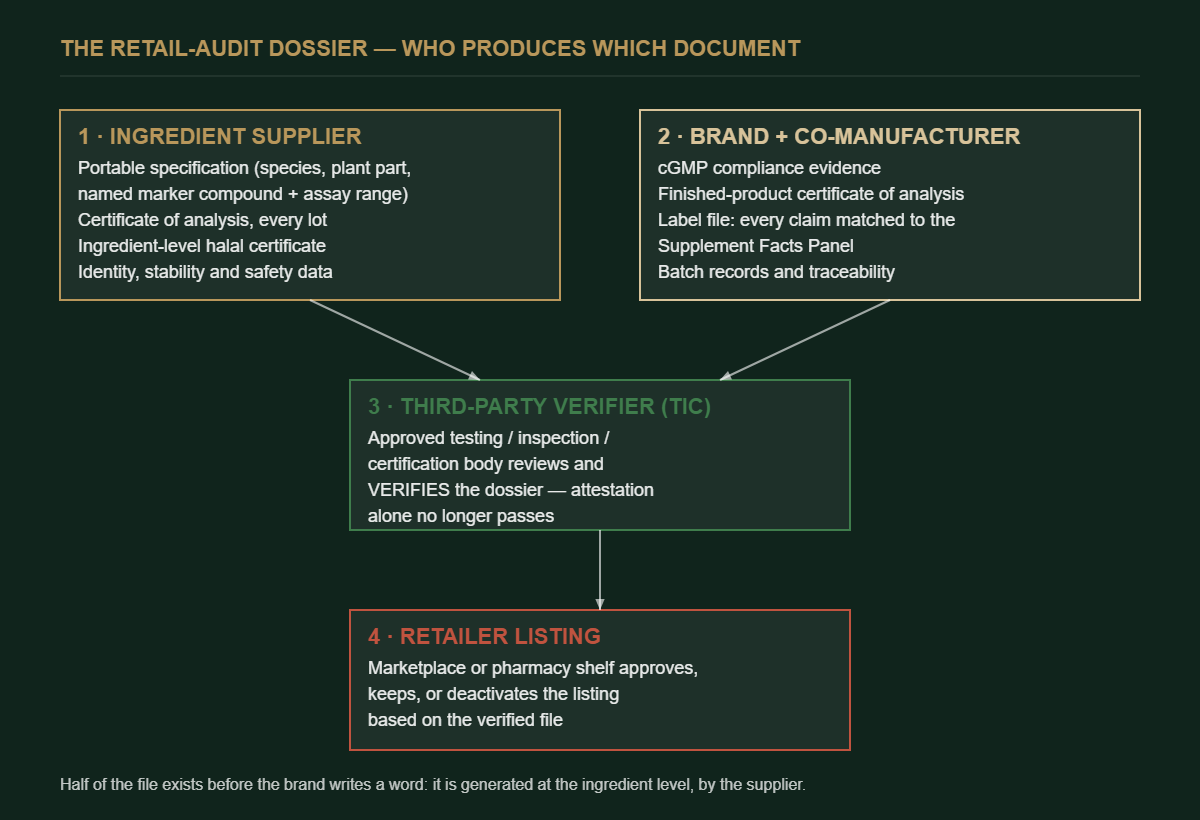
A worked example makes it concrete. Suppose your hero ingredient is a standardized botanical extract. A verification-ready ingredient file looks like this:
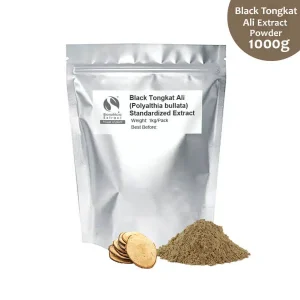
- A portable specification — genus and species, plant part, extraction ratio, and a named marker compound with an assay range and method (for instance, a tongkat ali extract standardised to a stated eurycomanone percentage, or a berry extract standardised to anthocyanins). A spec written in chemistry is testable by any competent laboratory — which is exactly what a TIC verifier is. Our guide to choosing the right active marker covers how these specs are written.
- A certificate of analysis for every lot — not a one-time “typical values” sheet. Retailer programmes test what is in the bottle now, so the paper trail has to follow every batch.
- Identity evidence — chromatographic fingerprinting and related methods that confirm the powder is the declared species and grade; our authentication and adulteration guide explains the toolbox.
- Contaminant data against named limits — heavy metals, microbiology and related panels, specified per market as covered in our contaminant-spec checklist.
- An ingredient-level halal certificate — issued for the ingredient itself, not just the finished product, so the same file also serves halal-market gatekeepers.
None of this is exotic. It is the ordinary output of a documentation-disciplined ingredient supplier — and it is precisely the half of the retail dossier your brand cannot write for itself.
The Retail-Audit Map: who is asked for what
Use this as a pre-flight decision tool before committing to a launch on a verified channel. It pairs with the four-question ingredient brief we published for evaluating ingredient quality — but it answers a different question: not “is this ingredient good?”, but “can its paperwork survive an audit?”
One dossier, many gatekeepers
The deeper lesson of the retailer-verification wave is that it is not really about Amazon. The same ingredient-level file — portable spec, per-lot certificate of analysis, identity evidence, contaminant data, ingredient-level halal certificate — is what a US marketplace verifier asks for, what a pharmacy chain’s testing programme leans on, what Indonesia’s mandatory BPJPH halal regime expects at the ingredient level, and what any serious private-label customer’s quality team requests before a first purchase order. Build the dossier once, at the ingredient decision, and every later gatekeeper gets faster. Build it late, and every gatekeeper becomes a delay.
That also reframes supplier selection. The cheapest quote that arrives without a portable spec or per-lot documentation is not cheaper — it just moves the cost into your audit, at the worst possible moment. As we argued in Who Owns Your Formula?, the brands that move fastest are the ones whose paperwork travels with them.
Documentation-ready ingredients across the range
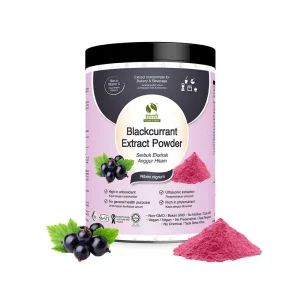
This is the standard we build to across the whole bionutriciaextract.com catalogue, not for one hero SKU: standardized botanical extracts with named marker compounds (from tongkat ali standardised on eurycomanone to misai kucing standardised on rosmarinic acid and sinensetin), a berry and fruit anthocyanin range (bilberry, elderberry, blackcurrant, cranberry and more), natural colourants such as butterfly pea and roselle, natural flavours such as pandan, and liposomal vitamin systems — each supplied with the portable specification, per-lot certificate of analysis and ingredient-level halal certificate described above. Bionutricia supplies the bulk ingredient for B2B formulation; brand owners and manufacturers formulate it into their chosen finished format — capsules, tablets, gummies, sachets, beverages, bakery and dairy applications and beyond.
Related guides
- Botanical Extract Authentication & Adulteration: A B2B Buyer’s Guide
- Your Next Competitor Won’t Own a Factory: The Ingredient-Spec Moat
- Who Owns Your Formula? The Captive-Spec Trap
- Heavy-Metal & Microbial Limits: A Contaminant-Spec Checklist
- Indonesia’s Mandatory Halal Certification (BPJPH)
References
- NSF — Amazon’s New Dietary Supplements Policy: Enhancing Safety & Compliance. https://www.nsf.org/knowledge-library/amazon-new-dietary-supplements-policy-enhancing-safety-compliance
- Certified Laboratories — Amazon Supplements Update 2026: What Sellers Need to Know. https://certified-laboratories.com/blog/amazon-supplements-update-2026-what-sellers-need-to-know/
- Food Label Maker Regulatory Hub — Amazon’s Supplement Update 2026: What Supplement Brands Need to Know. https://foodlabelmaker.com/regulatory-hub/fda/dietary-supplements/amazon-supplement-update-2026/
- My Amazon Guy — Amazon Dietary Supplement Enforcement Risks Listing Removal. https://myamazonguy.com/news/amazon-dietary-supplement-policy/
- Drug Store News / PR Newswire — CVS Pharmacy launches “Tested to Be Trusted” programme. https://drugstorenews.com/pharmacy/cvs-pharmacy-launches-tested-to-be-trusted-program-intros-300-health-and-wellness-items
- Nutritional Outlook — Patchwork of new retailer-driven dietary supplement standards alarms some industry members. https://www.nutritionaloutlook.com/view/patchwork-of-new-retailer-driven-dietary-supplement-standards-alarms-some-industry-members
- Nutraceuticals World — U.S. Supplement Sales Hit $72.88 Billion (Nutrition Business Journal data). https://www.nutraceuticalsworld.com/exclusives/u-s-supplement-sales-hit-72-88-billion-as-sports-nutrition-and-digital-discovery-drive-growth/
Frequently asked questions
Does Amazon require third-party testing for dietary supplements?
Yes. Under Amazon’s US dietary-supplements policy — applied to all supplement categories since December 2025 — products must demonstrate cGMP compliance and supporting documentation verified through an Amazon-approved testing, inspection and certification (TIC) organisation. Products certified to standards such as NSF/ANSI 173 or NSF 229 are recognised. Requirements evolve, so always confirm current policy in Amazon’s own seller documentation.
What is a TIC organisation?
A testing, inspection and certification body — an independent third party that examines a product’s documentation and testing evidence and verifies it against the retailer’s requirements. The key shift is that sellers no longer self-attest: the verifier, not the seller, tells the retailer the file checks out.
Which documents in a retail audit come from the ingredient supplier?
The ingredient-level half of the file: a portable specification naming species, plant part and a marker compound with an assay range; a certificate of analysis for every lot; chromatographic identity evidence; stability and contaminant data; and an ingredient-level halal certificate where halal market access matters. The brand and its contract manufacturer then build the finished-product half on top of these.
Do retailer verification programmes replace government regulation?
No. They sit on top of the law, not instead of it. A brand selling in the US still answers to FDA requirements, and a product made or sold in Malaysia still answers to the applicable national framework. A retailer pass is a channel-access decision by a private company — it is not a regulatory approval, and failing it is a commercial event rather than a legal one.
How does a standardized botanical extract make retailer verification easier?
Because standardisation turns identity into a testable number. A spec that names the species, plant part and a marker compound with an assay range gives the verifying laboratory something objective to confirm, and gives the label a number the powder can prove. An unstandardised “herbal powder” with a typical-values sheet gives the verifier nothing to check — and audits do not reward ambiguity.
Does Bionutricia supply finished supplements for marketplace sellers?
Bionutricia supplies the bulk ingredient for B2B formulation; brand owners and manufacturers formulate it into their chosen finished format — capsules, tablets, gummies, sachets or beverages — through their own manufacturing partners. What travels with the ingredient is the documentation file this article describes: portable specification, per-lot certificate of analysis and ingredient-level halal certificate.