


Description
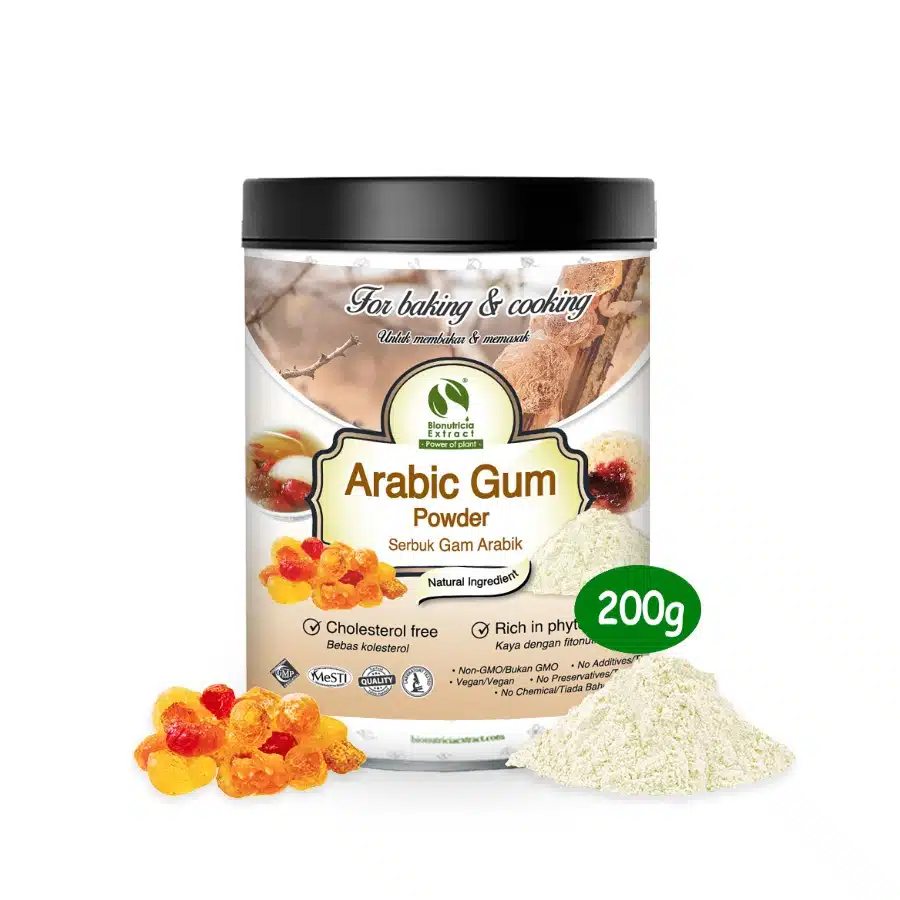
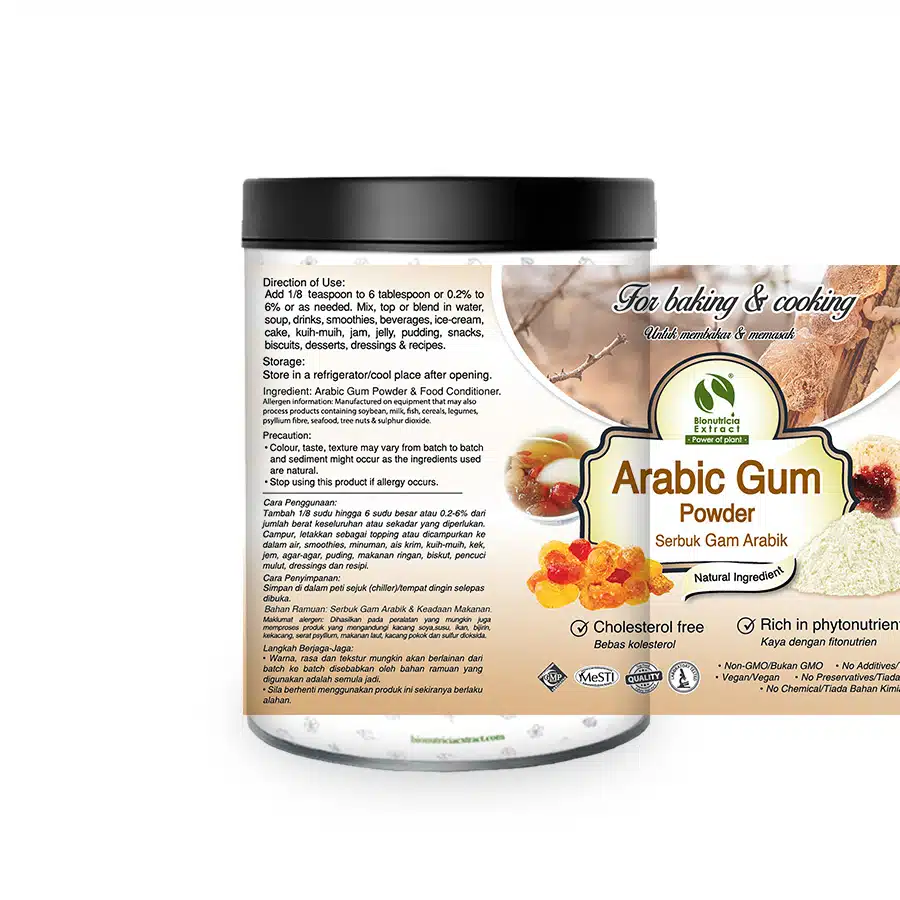
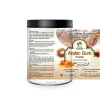
Our Arabic gum powder is produced from pulverized raw Arabic gum resins. It is dissolved in hot water and then filtered before spray dried into powder. It does not contain any binder or filler therefore its emulsifying properties are strong. It can be used in products with low pH. It is also relatively easy to dissolve in water due to its big particle size to form a viscous solution with no sediment.
Arabic gum, also known as acacia gum, acacia, Senegal gum, Indian gum etc, is a natural gum consisting of the hardened sap of two species of the acacia tree, namely Senegalia senegal and Vachellia seyal.
The Arabic gum is harvested from Sudan, Senegal and Somalia. Arabic gum is a combination of glycoproteins and polysaccharides, mainly arabinose and galactose. Arabic gum has a unique emulsifying property, which can efficiently stabilize a food system, and contribute to a superior texture and a good mouthfeel. In pastries, it is typically used in fillings or frosting to emulsify the fat/water interfaces. It is traditionally used on gingerbread products to give a glossy and tacky shine. When used in making gluten-free bread, it improves the softness of bread by 25% and extends commercial product shelf life by 50%.
Arabic gum is high in soluble dietary fibre — more than 85% total dietary fibre on a dry basis — and is widely used in fibre-enriched formulations. In published research, gum arabic is studied as a fermentable fibre that gut microbes convert to short-chain fatty acids; those findings are reported by the cited studies and are not claims for any finished product.
Format, Packaging and Storage
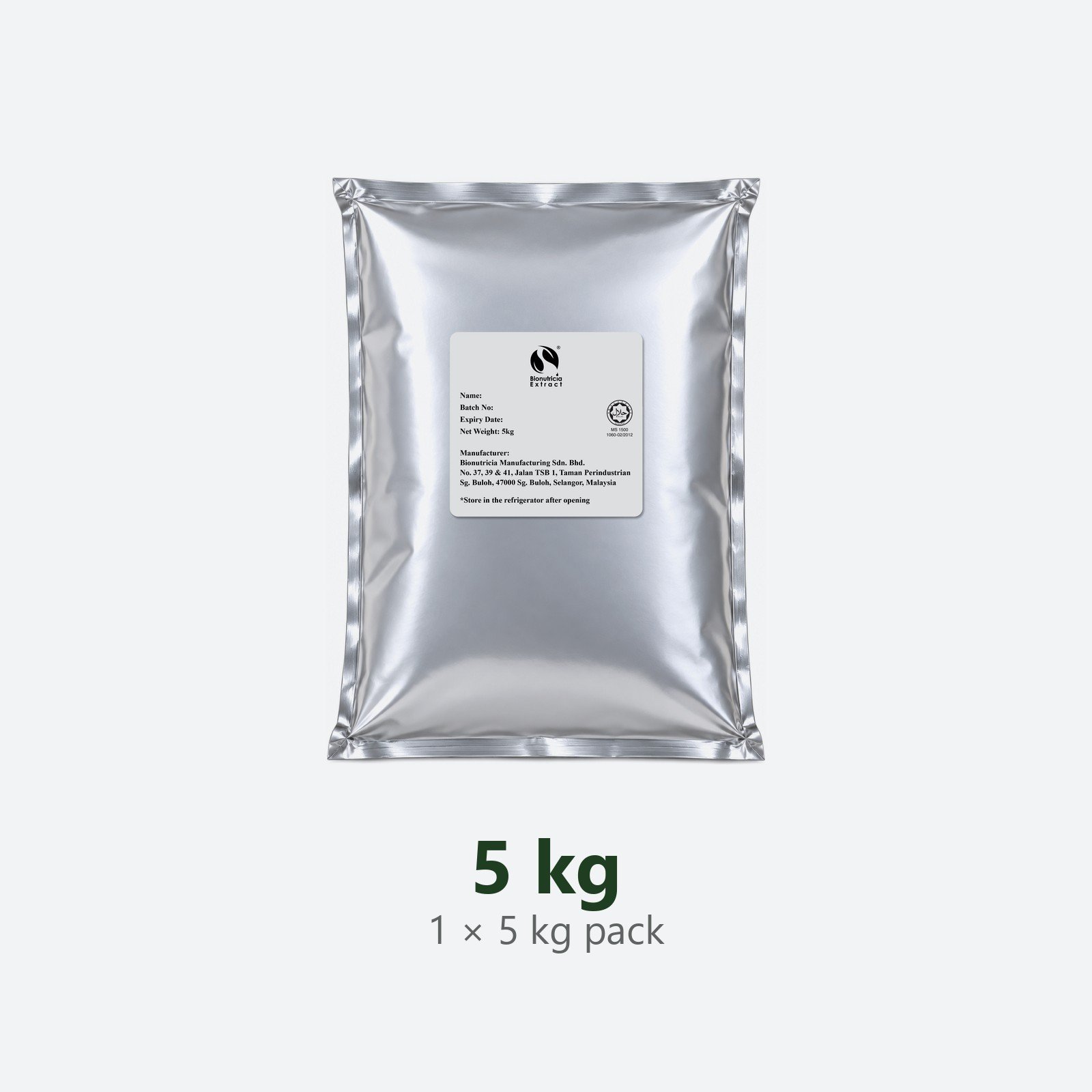
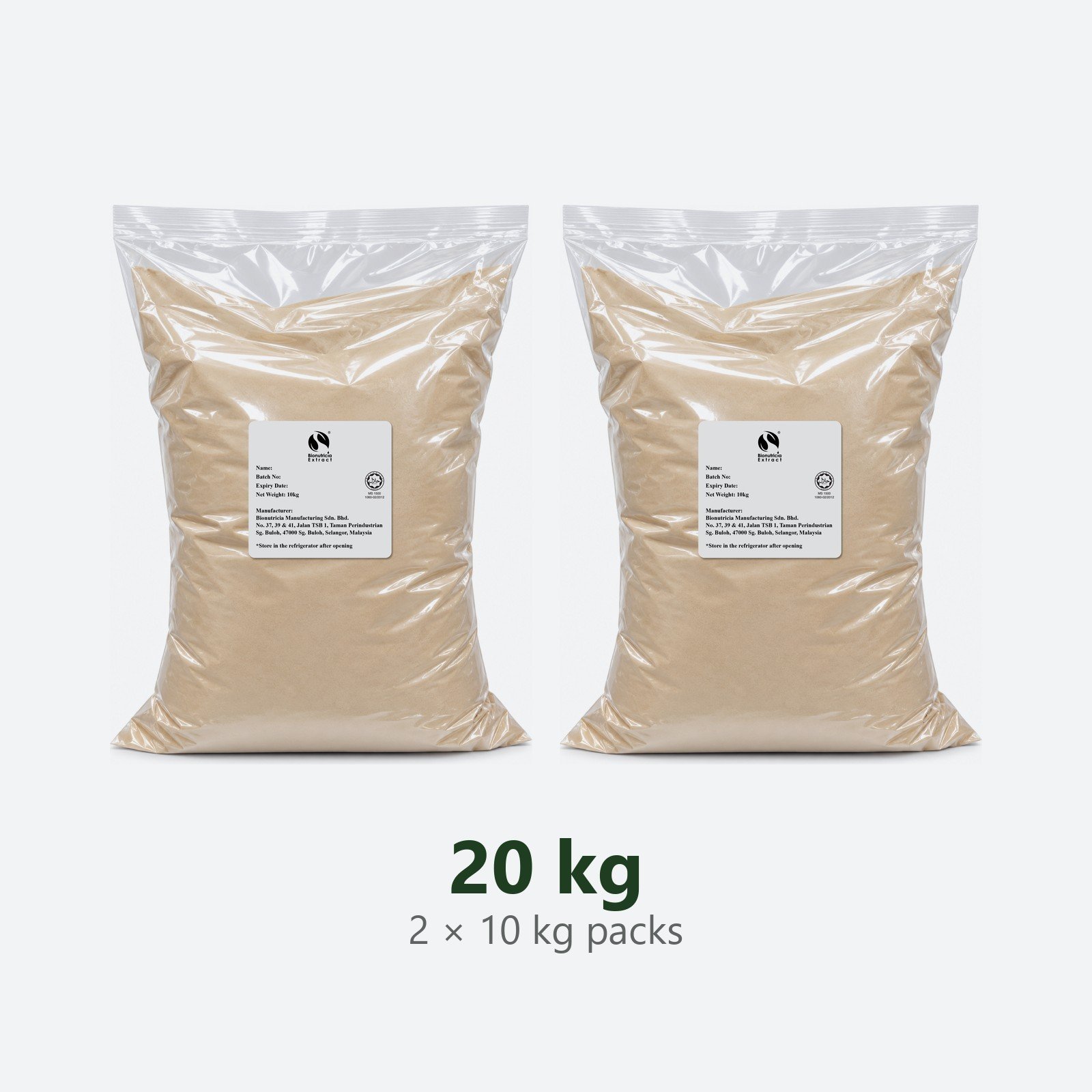
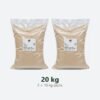
25 kg vacuum-sealed kraft bags with inner liners, or lined drums for palletised container loads. R&D sample quantities available for specification testing. Packaging options include vacuum-sealed kraft bags, lined drums, or customer-specified primary packaging for private-label projects. Palletised and shrink-wrapped for export. Store in original sealed packaging below 25°C, relative humidity below 65%, in odour-free conditions away from direct sunlight. Shelf life is 24 months from manufacture date in original sealed packaging under specified storage conditions.
No harm/chemicals/preservatives, just harmony, manufactured naturally
- Vegan
- Non-GMO
- No Fillers
- No Flavors
- No Additives
- No Preservatives
- No Artificial Colours
- Soy and Gluten Free
Storage
- Keep in a cool & dry place. Avoid sunlight. Fridge would be best.
- Keep away from children.
- Has a shelf life of 24 months, in the original sealed packaging below 25°C, relative humidity below 65% and odour-free conditions.
- Packages should not be in direct contact with walls or floors.
Precaution
- Powder texture may vary. Some powder is fine, while some powder is coarser. Please consider this when ordering.
- Due to the nature of plant / herbal extract, powder may clump due to heat or moisture.
- Food supplements should not be used as a substitute for a varied and balanced diet.
- If you are pregnant, lactating or taking medications, please consult a physician before taking any nutritional products.
- Colour, taste, and texture may vary from batch to batch.
- Stop using this product if an allergy occurs.
Click here for more product information
What is Arabic Gum?
Arabic gum, also known as acacia gum or gum acacia, is a natural gum exuded by the acacia tree (Senegalia senegal and Vachellia seyal). It is harvested primarily in Sudan, Senegal and Somalia, where the sap is collected, dried and milled or spray-dried into powder. Arabic gum is a complex of glycoproteins and polysaccharides, predominantly arabinose and galactose. Its functional properties — emulsification, stabilisation, film-forming and fibre content — make it a widely used ingredient in food, beverage and supplement manufacturing. Our arabic gum powder is supplied as a dry bulk ingredient with full specification and batch documentation for B2B customers.
Applications for food, beverage and supplement manufacturers
– Emulsifier and stabiliser in beverages, dairy products and confectionery
– Fibre enrichment in functional foods and dietary supplements
– Encapsulation carrier for flavours and bioactive ingredients
– Binding and coating agent in baked goods and snacks
– Technical datasheets with recommended inclusion ranges available on request
Bulk buying checklist (documents and analytical checks)
– Certificate of Analysis (COA) for identity and batch purity
– Heavy metals report (lead, cadmium, arsenic, mercury)
– Microbial limits (total plate count, yeast & mould, E. coli, Salmonella)
– Moisture, ash, particle size and specification
– Allergen declaration and processing aids list
– Packing list and commercial invoice for customs clearance
Supplier & packaging details (B2B terms)
– MOQ and pack sizes: R&D samples to 25 kg vacuum-sealed bags, drums with liners and palletised container loads — contact sales for current MOQ and lead times
– Pack formats: Vacuum-sealed kraft bags, lined drums, or customer-specified primary packaging for private-label projects
– OEM & private-label: Bulk supply, private-label packing and co-packing available; formulation support and finished-product OEM can be arranged through our partner services
– Documentation: COA, specification sheet, packing list and export documentation provided with shipments; halal and other certificates available where applicable
Certifications and quality systems
– Facility-level JAKIM Halal certification where applicable
– GMP and HACCP food-safety management systems in place at manufacturing sites
– FSSC 22000 implemented at primary processing facilities
– Batch COA and analytical reports provided with shipments
B2B FAQ
Q: Can you provide a COA and specification sheet before purchase?
A: Yes. We provide a recent COA and full specification sheet to support regulatory checks and in-house testing.
Q: Are samples available for specification testing?
A: Yes. Production samples and small evaluation packs are available. Contact sales with your intended application so we can match the right product grade.
Q: What are typical lead times?
A: Lead times vary with order size, current stock and destination. Provide required quantity, packaging and delivery address for an accurate estimate.
Q: Do you provide private-label packaging and OEM services?
A: Yes. Private-label and OEM services are available; contact sales to discuss formulation, packaging and regulatory labelling requirements.
Supplier & packaging details
Bionutricia Manufacturing supplies arabic gum as a bulk ingredient for food and beverage manufacturers. We provide COA and full specification sheets for every lot, MOQ-friendly pack sizes and private-label/OEM services. Export documentation and halal certificates are available for international shipments.
- COA availability: COA and full specification sheets are provided for every shipped lot on request.
- Specifications: Gum acacia origin, particle size, moisture, ash, and soluble fibre content are supplied on the specification sheet.
- MOQ & pack sizes: R&D samples, 25 kg vacuum-sealed bags, drums with liners, and palletised container loads — contact sales for current MOQ.
- Packing options: Vacuum-sealed kraft bags, drums with inner liners, or customer-specified primary packaging for private-label projects.
- OEM & private label: Private-label blending and finished-product OEM services are available via our formulation partners and in-house R&D team.
- Samples: Evaluation samples and R&D packs are available for specification testing.
Application — for food and beverage manufacturers
Arabic gum powder is used as an emulsifier, stabiliser, fibre source and encapsulation carrier across food, beverage and supplement formulations. Typical applications include beverages and dairy products, confectionery and baked goods, dietary fibre supplements, and flavour and bioactive encapsulation systems. Technical datasheets describing recommended inclusion ranges for formulation stability testing are available on request.
Certifications
- JAKIM Halal certification (facility-level)
- GMP and HACCP food-safety systems
- FSSC 22000 at the manufacturing facility
- COA and batch analytical reports provided with shipments
Frequently asked questions (B2B)
What is the MOQ for arabic gum powder?
MOQ depends on the product format and current stock. We supply single-bag R&D quantities up to full drum, pallet and container loads. Contact sales with your target volume and packaging to receive an MOQ and quotation.
Can you provide a COA and specification sheet before purchase?
Yes. We provide a recent COA for the suggested lot and a full specification sheet to support regulatory checks and in-house testing.
Are samples available for specification testing?
Yes. Production samples and small evaluation packs are available for testing. Contact sales to request a sample and advise the intended application so we can match the right product.
What lead times should I expect?
Lead times vary with order size, stock and destination. Provide required quantity, packaging and delivery address for an accurate delivery estimate.
Read the arabic gum bulk buyer’s guide — specifications, MOQ, certifications and OEM details.
OEM / contract manufacturing: Bionutricia Extract supplies this as a bulk ingredient. For finished-product OEM & contract formulation, please visit our sister company bionutricia.com.
Chemistry of Arabic Gum — Arabinogalactan Complex
The functional core of gum arabic is a high-molecular-weight arabinogalactan-protein complex (PubChem CID 439552). The polysaccharide backbone is built from galactose residues linked in a β-(1→3) chain, with branched side chains of arabinose, rhamnose, and glucuronic acid. This branched structure gives gum arabic its characteristic compact, roughly spherical molecular conformation, with a molecular weight range of approximately 250–1,000 kDa depending on the botanical variety and processing method.
A small but functionally critical glycoprotein fraction (approximately 2% by weight) is covalently anchored within the polysaccharide matrix. This protein component is responsible for the gum’s emulsifying mechanism: the polysaccharide chains extend into the aqueous phase providing steric stabilisation, while the protein anchor adsorbs at oil-water interfaces. The result is a stable oil-in-water emulsion at low inclusion rates — typically 1:1 gum-to-oil ratios — without the need for synthetic emulsifiers. This is why gum arabic remains the preferred encapsulation carrier for flavour oils and spray-dried bioactive ingredients.
For formulators, these molecular properties translate directly into performance: low viscosity in solution even at high concentrations (unlike xanthan or guar gum), excellent film-forming ability for coating applications, and resistance to acidic conditions down to pH 2. The molecular weight distribution and protein content vary between Senegalia senegal and Vachellia seyal exudates, which is why the botanical origin and specification values must be confirmed on the COA before formulation work begins.
Typical Specification Parameters
| Parameter | Why It Matters to a Buyer |
|---|---|
| Moisture | Excess moisture promotes caking, microbial growth, and degradation during storage. Typical spray-dried powder should be below 5%. |
| Ash content | Indicates mineral residue after incineration. High ash suggests contamination or incomplete purification. Typical specification is below 4%. |
| Particle size | Affects dispersibility, dissolution rate, and mouthfeel. Finer particles dissolve faster but may generate dust during handling. |
| Mesh size | Defines the screen specification (e.g. 80 mesh, 100 mesh). Consistency in mesh size ensures uniform behaviour across batches in automated dosing systems. |
| Bulk density | Determines volume-to-weight ratios for packaging, silo storage, and dosing equipment calibration. Low bulk density increases packaging volume per kilogram. |
| Tannin content | Excess tannins cause astringency and discolouration in finished products. Must be within specification for dairy and beverage applications where taste clarity matters. |
| Soluble fibre content | Gum arabic is over 85% soluble dietary fibre on a dry basis. Confirms the material meets fibre-enrichment claims for nutritional labelling. |
| Heavy metals (Pb, Cd, As, Hg) | Regulatory compliance for food safety. Limits must meet destination-market standards (e.g. EU, US FDA, Codex Alimentarius). Verified on the COA for every lot. |
| Microbial limits | Total plate count, yeast & mould, E. coli, and Salmonella must be within specification. Spray drying reduces bioburden, but post-processing handling must maintain limits through to delivery. |
| Viscosity | Low viscosity even at high concentrations is a defining property of gum arabic. Specification confirms the material will not thicken excessively in solution, which is critical for beverage and spray-drying applications. |
Quick Facts for Formulators
- Botanical name: Senegalia senegal and Vachellia seyal
- Key compounds: Arabinogalactan-protein complex (PubChem CID 439552)
- Polysaccharide composition: Arabinose, galactose, rhamnose, glucuronic acid
- Glycoprotein fraction: ~2% by weight (drives emulsifying function)
- Molecular weight range: 250–1,000 kDa
- Extraction method: Dissolved in hot water, filtered, spray-dried
- Appearance: Off-white to pale cream fine powder
- Emulsifying properties: Stable oil-in-water emulsions at low inclusion rates
- Soluble fibre content: Over 85% total dietary fibre on a dry basis
- Shelf life: 24 months in original sealed packaging below 25°C
- Documentation: COA and specification sheet provided with every shipped lot
- Certifications: JAKIM Halal, GMP, HACCP, FSSC 22000, MeSTI
How to Qualify an Arabic Gum Powder Supplier
- Request a recent COA with moisture, ash, tannin content, soluble fibre, heavy metals, and microbial results for the offered lot
- Verify the specification sheet lists particle size, mesh size, bulk density, and viscosity values
- Confirm the supplier provides emulsifying capacity data or functional performance test results
- Check that heavy metals meet destination-market regulatory limits (EU, US FDA, Codex Alimentarius)
- Validate microbial limits include total plate count, yeast & mould, E. coli, and Salmonella
- Request an allergen declaration and list of processing aids used during dissolution and spray-drying
- Ask for evaluation samples to test emulsifying performance and solubility in your specific formulation matrix
- Confirm halal, GMP, HACCP, and FSSC 22000 certifications are current and facility-level
- Verify export documentation, packing lists, and lead-time commitments for your order volume
- Confirm the supplier can provide private-label packaging and OEM services if required
FSSC 22000
GMP
HACCP
JAKIM Halal
US FDA
MeSTI
NanoVerify