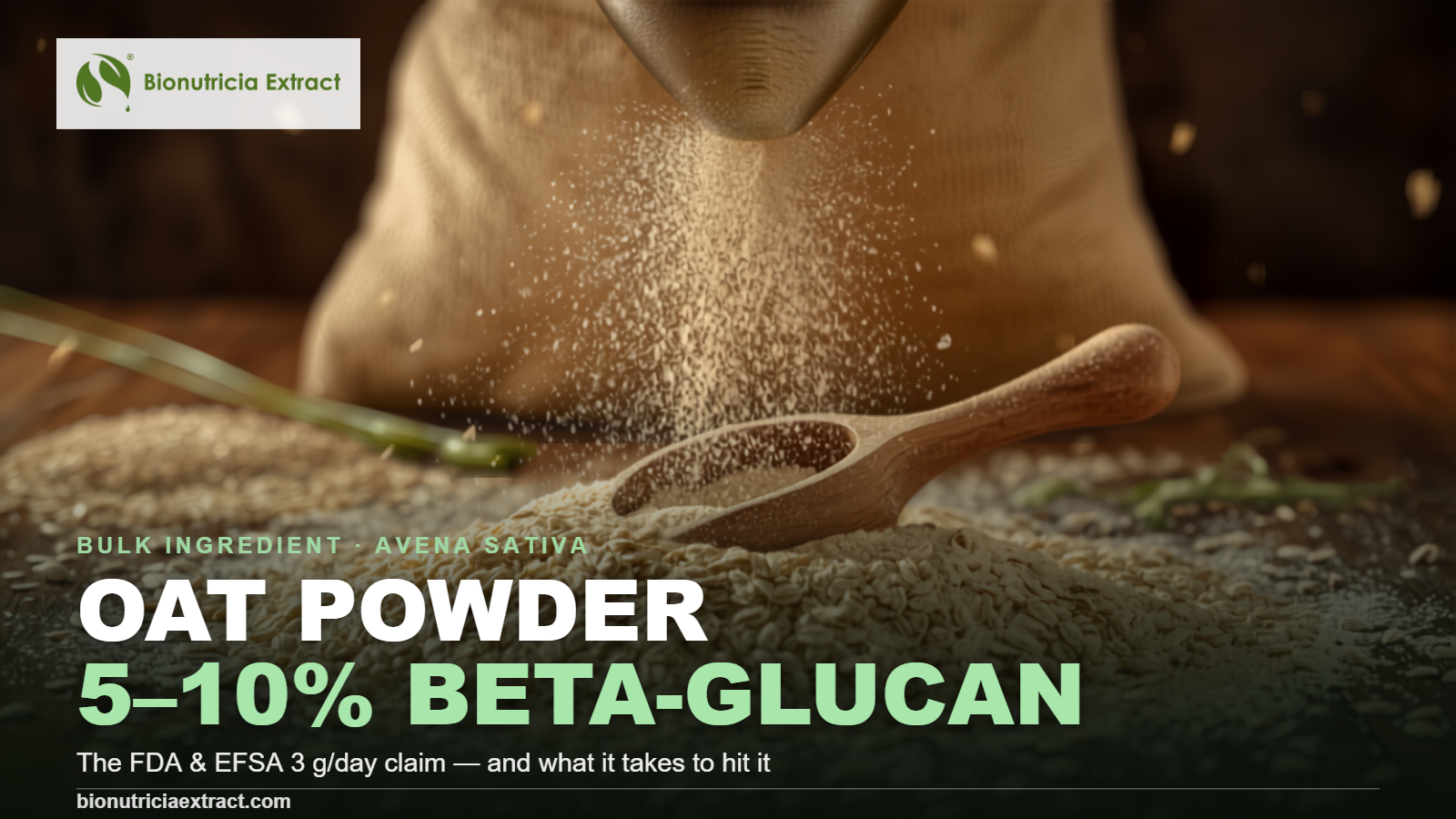
Oat powder (Avena sativa) standardised at 5–10% beta-glucan is the only ingredient in the Bionutricia catalogue whose active carries an authorised health claim in both the United States and the European Union. The FDA and EFSA both recognise 3 g of oat beta-glucan per day. Bionutricia manufactures it in Malaysia in 1 kg, 5 kg and 20 kg.
Quick facts
- Botanical: Avena sativa
- Active / assay: beta-glucan 5–10%
- Form: creamy-white free-flowing powder, milled from instant oat flakes
- Solubility: soluble in water with sediment; swellable
- Particle size: ~90% through 40 mesh · pH 5–7
- Typical inclusion: 1–5% of the finished formula
- Pack sizes: 1 kg, 5 kg, 20 kg · Shelf life: 2 years
- Halal: JAKIM certified · Origin: Malaysia
What is the active compound in oat powder?
The active is beta-glucan — specifically mixed-linkage (1→3),(1→4)-β-D-glucan, the soluble fibre concentrated in the oat endosperm cell wall. It is not a vague “antioxidant complex”: it is a defined polysaccharide with an official assay method, AOAC 995.16, which means it can be put on a specification and a certificate of analysis as a number.
Bionutricia’s oat powder assays at 5–10% beta-glucan. That is the native concentration of milled whole oat — this is a food-grade milled powder, not a concentrated extract, and we say so plainly because it changes how you must formulate with it.
Beta-glucan works by viscosity. In solution it forms a viscous layer in the gut lumen, and that physical property is the mechanism the regulators recognised. Viscosity is also why processing matters: excessive shear, extreme pH or prolonged heat can depolymerise beta-glucan and reduce molecular weight, which reduces the functional effect even though the assay figure stays the same. Ask for the assay, then protect it in your process.
What does the clinical evidence show?
Oat beta-glucan has one of the deepest randomised-trial evidence bases of any food ingredient. These are published findings attributed to their authors, at the doses stated.
| Evidence | Scale | Dose | Reported outcome |
|---|---|---|---|
| Meta-analysis of randomised controlled trials (Whitehead et al., Am J Clin Nutr 2014) | 58 RCTs, n = 3,974 | 3.5 g/day | LDL cholesterol −4.2%, non-HDL cholesterol −4.8%, apolipoprotein B −2.3% |
| Systematic review and meta-analysis in hypercholesterolaemic adults (2022–2023) | 17 RCTs | ~3 g/day | Significant reduction in total and LDL cholesterol |
| Pooled RCT range | Multiple trials | ~3 g/day | Total cholesterol −0.25 to −0.66 mmol/L; LDL −0.24 to −0.60 mmol/L |
| BELT study | Randomised, placebo-controlled | Oat fibre, medium-term | Lipid profile, glycaemia and intestinal-health endpoints |
| Meta-analysis in diabetic patients | RCTs | Oat beta-glucan | Effects on glycaemic control and insulin sensitivity |
The part that matters commercially: an authorised claim
Most botanical ingredients give a brand owner research to reference. Oat beta-glucan gives them a claim a regulator has already authorised.
- US FDA — authorised health claim: consumption of 3 g or more per day of beta-glucan soluble fibre from whole oats or barley, as part of a diet low in saturated fat and cholesterol, may reduce the risk of heart disease.
- EFSA — opinion adopted 2010 on oat beta-glucan and blood cholesterol; claim approved in the EU in 2011–2012 at 3 g/day.
Now the arithmetic that decides your format. To deliver 3 g of beta-glucan from a powder assaying 5–10%, the finished product must carry:
| Assay of your lot | Powder needed for 3 g beta-glucan | Realistic format |
|---|---|---|
| 10% | 30 g | Beverage premix, instant porridge, meal replacement |
| 7.5% | 40 g | Beverage premix, cereal, bakery inclusion |
| 5% | 60 g | Porridge, breakfast cereal, baked goods |
Read that table before you plan a capsule. A claim-bearing beta-glucan dose is a food dose, not a supplement dose — it cannot be delivered in capsules or tablets at any sane count. This ingredient belongs in beverage premixes, instant cereals, bakery and meal replacements. Below the 3 g threshold it remains an excellent soluble-fibre, texture and mouthfeel ingredient, but the authorised claim does not travel with it. We would rather tell you that at enquiry stage than at launch.
The claim belongs to your finished product and its market. Confirm wording and qualifying conditions with your regulatory counsel in each destination.
Oat powder specification
| Parameter | Specification |
|---|---|
| Product name | Oat Powder |
| Scientific name | Avena sativa |
| Constituent | Phyto-nutrient |
| Description | Powder milled from instant oat flakes |
| Beta-glucan | 5–10% |
| Colour | Creamy white |
| Appearance | Free-flowing powder |
| Odour | Characteristic |
| Moisture content | < 10% |
| Solubility | Soluble in water with sediment |
| Swellability | Swellable |
| Particle size | ~90% through 40 mesh |
| pH | 5 – 7 |
| Dosage | 1 – 5% of formula |
| Arsenic | < 0.1 ppm |
| Lead | < 0.2 ppm |
| Mercury | < 0.05 ppm |
| Aerobic plate count | < 104 CFU/g |
| Yeast and mould | < 103 CFU/g |
| Coliforms | < 102 CFU/g |
| Escherichia coli | Absent |
| Pack sizes | 1 kg, 5 kg, 20 kg |
| Shelf life | 2 years when properly stored |
| Country of origin | Malaysia |
Dosable on a quantum satis basis in the final application. Store in sealed hygienic containers, cool and dry, away from pest infestation.
Contaminant testing on a cereal raw material
Oats are a field cereal, so the meaningful contaminant risks are mycotoxins and pesticide residues, not just heavy metals. Bionutricia holds current third-party reports on this material covering pesticide residues, mycotoxins and tin (SGS) and aflatoxin and ochratoxin A, alongside the routine heavy-metal and microbiological panels. Request the current reports with your specification — on a cereal ingredient this is the documentation that should decide your supplier, and it is the question most buyers forget to ask.
Applications in finished formats
Bionutricia supplies the bulk ingredient for B2B formulation; brand owners and manufacturers formulate it into their chosen finished format. Typical inclusion is 1–5%, higher where a beta-glucan claim is the objective:
- Instant beverage premixes and oat drinks — the most efficient route to a claim-bearing dose
- Instant porridge, cereals and granola
- Bakery — breads, muffins, biscuits, where the swelling behaviour also improves crumb moisture retention
- Meal replacements and nutritional shakes
- Desserts and confectionery, as a texturiser and fibre carrier
Certifications and documentation
Manufactured under FSSC 22000, GMP, HACCP and MeSTI, with US FDA facility registration, JAKIM halal certification and NanoVerify. Declarations on the current specification: non-GMO; not irradiated; not a novel food under Regulation (EC) No 258/97; suitable for vegetarians and vegans; gluten-free (<20 ppm) under Regulation (EC) No 41/2009. Not classified as dangerous under Regulation (EC) 1272/2008 (CLP). Documentation on request: specification, batch CoA, MSDS, contaminant reports, GMO and allergen statements.
Sourcing, pack sizes and how to order
Manufactured in Sungai Buloh, Selangor and exported through Port Klang, in 1 kg, 5 kg and 20 kg. MOQ and pricing on quotation. Request the current specification and batch certificate of analysis with your enquiry, and build your beta-glucan maths on the assayed lot value — the difference between a 5% and a 10% lot doubles the powder you need for a claim.
Frequently asked questions
Q: What is the beta-glucan content of your oat powder?
A: 5–10%, the native level in milled whole oat. The figure for your lot is stated on the batch certificate of analysis. Beta-glucan is assayable by AOAC 995.16.
Q: Is this an oat extract or a milled oat powder?
A: A milled powder, produced from instant oat flakes. It is not a concentrated beta-glucan extract, and we do not market it as one.
Q: How much powder is needed for the authorised 3 g beta-glucan claim?
A: Between 30 g and 60 g of powder per day, depending on whether your lot assays at 10% or 5%. That is a food-format dose — a beverage premix, porridge or cereal, not a capsule.
Q: Can I make a cholesterol claim on my finished product?
A: Both the FDA and EFSA have authorised claims for oat beta-glucan at 3 g/day, subject to their own qualifying conditions. Whether your product qualifies depends on its dose, composition and market. Confirm the wording with your regulatory counsel.
Q: Is it gluten-free?
A: The specification states gluten-free at <20 ppm under Regulation (EC) No 41/2009. Request the current test report if you intend to make a gluten-free label claim.
Q: Is it halal certified?
A: Yes. Bionutricia is a JAKIM-certified manufacturer and this ingredient is halal certified. The certificate is included in the documentation pack on request.
Q: What contaminant testing do you hold on it?
A: Current third-party reports covering pesticide residues, mycotoxins and tin, plus aflatoxin and ochratoxin A, alongside routine heavy-metal and microbiological panels.
Q: What pack sizes and MOQ do you offer?
A: 1 kg, 5 kg and 20 kg. MOQ and pricing on quotation.
Related guides
- What is Herbosomal® encapsulation?
- Centella asiatica extract — actives, clinical evidence and spec sheet
Technically reviewed by Cindy Chua Shiu Sinn, Dietitian (Flinders University; Dip. Chinese Medicine & Acupuncture). Published by Bionutricia Manufacturing Sdn Bhd, founded 2006 by Ts. Ng Kuak Ping.