Hydrolyzed vegetable protein (HVP) is a plant protein — most often soy, corn or wheat — broken down into free amino acids and short peptides, then dried into a savoury powder used as a flavour base and seasoning. Its function comes mainly from the free glutamate released during that breakdown, which delivers umami. The single most important thing a formulator should establish about any HVP is how the protein was broken down — because that one process decision determines whether the material carries a regulated process contaminant.
(Both spellings are in common use — hydrolyzed vegetable protein in US English, hydrolysed vegetable protein in UK/EU documentation. Same ingredient, same HVP abbreviation.)
The three production routes — and why the route decides everything
| Route | How it works | 3-MCPD risk |
|---|---|---|
| Acid hydrolysis (industry default) | Strong hydrochloric acid at high temperature cleaves the protein rapidly and cheaply | Yes. Residual lipids in the raw material react with chloride to form 3-MCPD — the route the regulations were written for |
| Enzymatic hydrolysis | Isolated proteases cleave peptide bonds under mild conditions | No acid-chloride pathway |
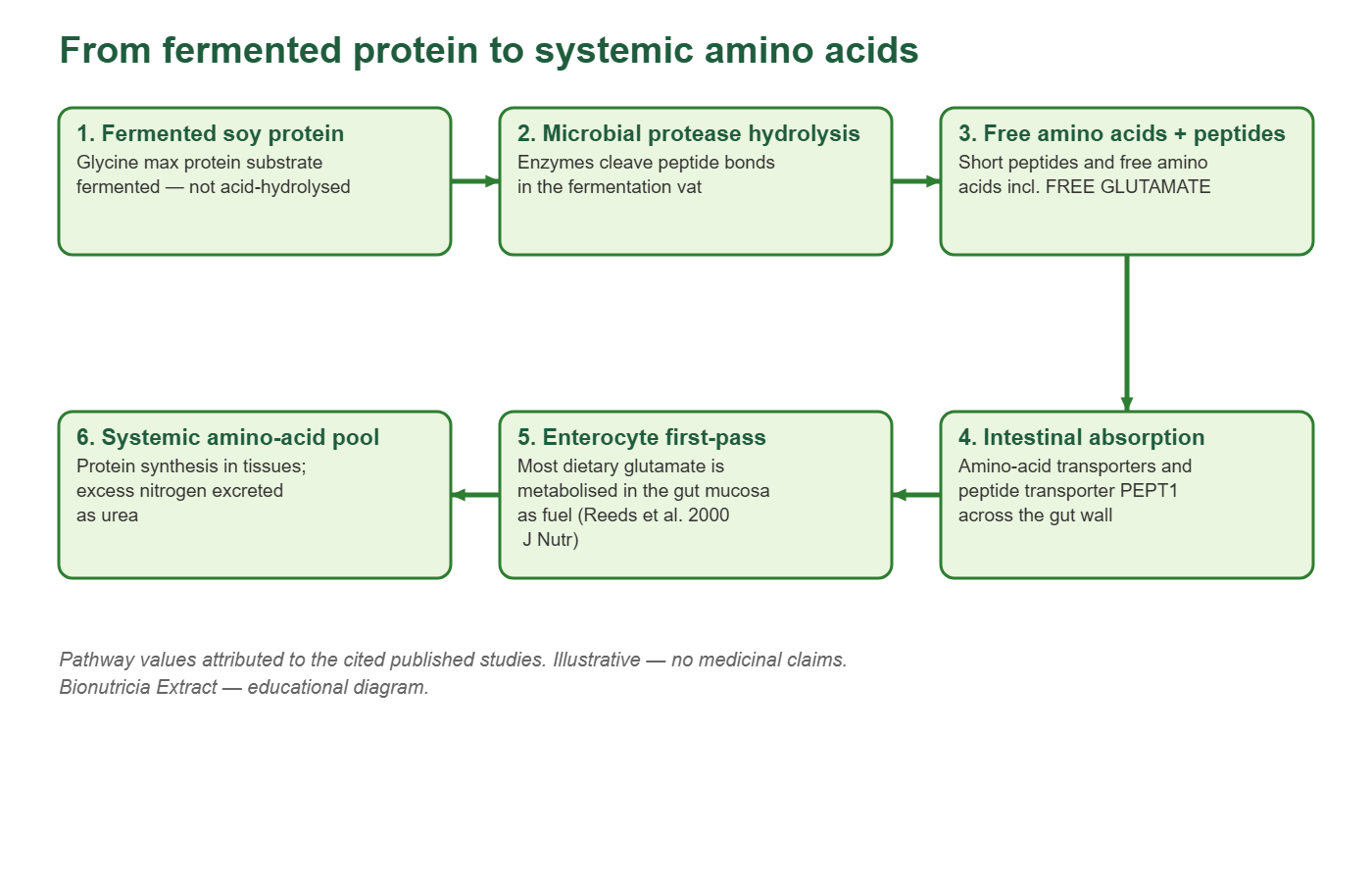
| Fermentation — Bionutricia’s route | A live microbial culture secretes its own proteases and breaks the protein down over time — the same principle behind naturally brewed soy sauce and miso | No acid-hydrolysis step, so the chemistry that forms 3-MCPD in acid-HVP is not part of the process |
Where the umami comes from
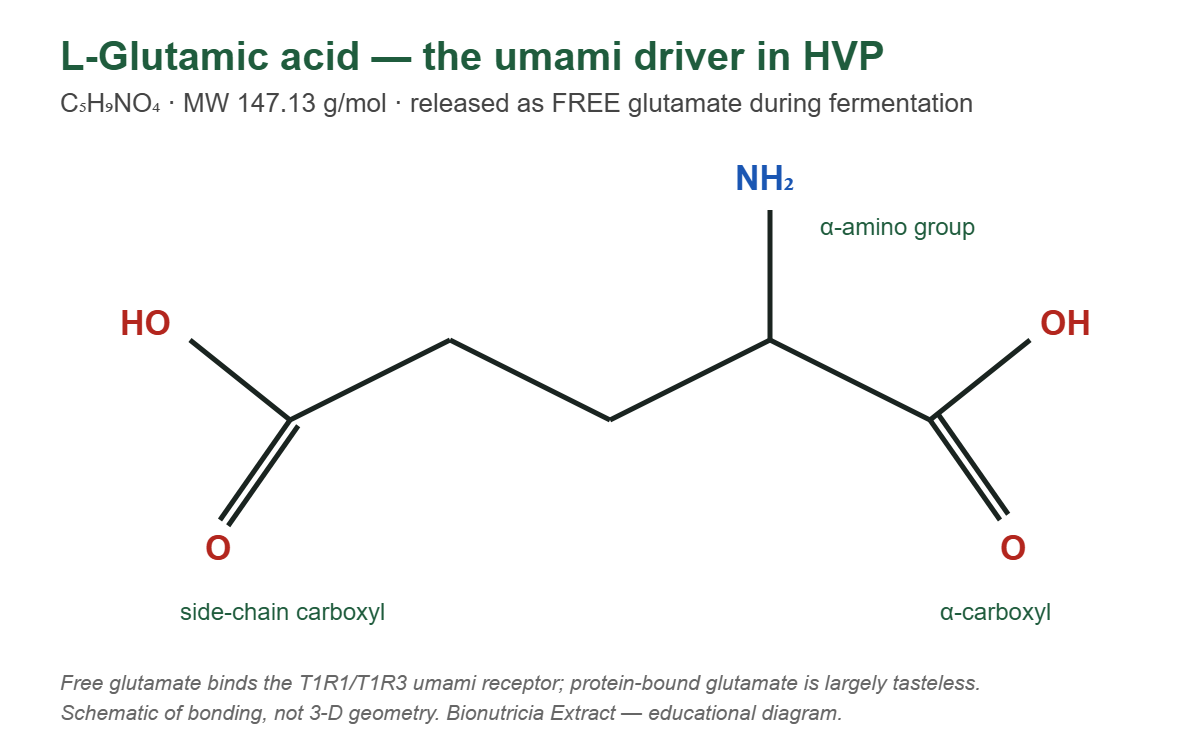
Hydrolysis — whether driven by acid, isolated enzymes or a fermenting culture — liberates bound glutamic acid into its free form. Free glutamate is what the umami taste receptor responds to; glutamate locked inside an intact protein chain is largely tasteless. This is why degree of hydrolysis, not crude protein, predicts flavour performance.
Fermentation additionally develops a broader secondary flavour profile — organic acids, small peptides and aroma compounds generated by the culture — which is why fermented savoury bases are typically described as rounder and less harsh than sharply acid-hydrolysed material.
What HVP is not
Two points of confusion worth clearing up. First, HVP is not monosodium glutamate. MSG is a single purified salt of glutamic acid; HVP is a compositionally complex hydrolysate containing many amino acids, peptides, carbohydrates and salt, of which free glutamate is one contributor. Second, HVP is not a protein supplement in the nutritional sense — it is used at seasoning-level inclusion, typically 1–5% or fractions of a percent, so it is bought for flavour function, not protein contribution.
The specification that matters: amino nitrogen, not just protein
Buyers who specify HVP only on total protein are specifying the wrong thing. The parameters that actually predict performance:
| Parameter | Why it matters | Typical method |
|---|---|---|
| Total nitrogen (TN) | Overall protein load of the hydrolysate | Kjeldahl |
| Amino nitrogen (AN) | Nitrogen present as free amino groups — the fraction that carries taste | Formol titration |
| AN/TN ratio (degree of hydrolysis) | The best single predictor of umami intensity — higher means more completely hydrolysed and more savoury | Calculated |
| Sodium chloride (NaCl) | HVP can carry substantial salt; count it in the finished product’s sodium budget | Argentometric titration |
| Moisture, solubility, particle size | Dosing, caking and dispersion in dry blends (HVP powder is hygroscopic) | Standard |
| 3-MCPD | Process contaminant of the acid route — see below | GC-MS |
Bionutricia’s house specification commits total nitrogen at 4.3–4.6%, alongside moisture <5%, pH 5–5.5 and full heavy-metal and microbiological limits. Amino nitrogen, sodium chloride and 3-MCPD batch values are issued on the CoA per production lot — request the current specification and a lot CoA for the committed figures.
3-MCPD: the question every serious buyer will ask
This is the most important safety topic in the HVP category, and a supplier who cannot discuss it clearly should be treated with caution.
When vegetable protein is hydrolysed with strong acid at high temperature, residual lipids in the raw material react with chloride to form 3-monochloropropane-1,2-diol (3-MCPD). It is a by-product of the acid route specifically — not an inherent property of hydrolysed protein — and it is why regulations single out acid-hydrolysed vegetable protein.
The European Union caps free 3-MCPD in hydrolysed vegetable protein and soy sauce at 20 µg/kg for liquid products at 40% dry matter (equivalent to 50 µg/kg on dry matter) under Regulation (EC) No 1881/2006; Commission Regulation (EU) 2020/1322 added limits for 3-MCPD fatty-acid esters and glycidyl esters. The Codex Committee on Food Additives and Contaminants treats 3-MCPD in acid-HVPs as a distinct category.
Because our material is fermented rather than acid-hydrolysed, that formation pathway is not part of the process. We still recommend buyers verify rather than assume — ask for the tested result on the CoA, from us or from any supplier.
What to ask any HVP supplier:
- Which route is used — acid, enzymatic, or fermentation?
- Is 3-MCPD tested on the finished powder, and at what frequency?
- Is the result reported on the CoA, and against which limit?
- How is it expressed — as-is or on dry matter? The two differ by more than a factor of two, and buyers are routinely caught out by this.
Umami as a sodium-reduction tool: what the trials actually show
The strongest formulation argument for HVP is not “it tastes savoury” — it is that umami lets a formulator cut sodium while holding palatability. This has real human trial evidence, and that evidence belongs to the published studies, not to any supplier.
A large randomised, double-blinded experiment across multiple regions of Japan (n = 584) tested salt solutions with and without added glutamate: the saltiness of a 0.3% NaCl solution containing MSG was rated significantly higher than the same solution without it, and palatability was rated higher with glutamate present across all NaCl concentrations tested — meaning the perceived-saltiness gap created by cutting sodium can be partially closed by umami (Validation of preferred salt concentration in soup, multi-region randomised blinded study, Japan). A separate pilot randomised, single-blind, placebo-controlled cross-over trial placed participants on a ten-day sodium-restricted diet with or without L-glutamate, with sodium reduction verified objectively by 24-hour urinary sodium excretion (Foods 2021;10(8):1739). An Academy of Nutrition and Dietetics Evidence Analysis Center scoping review has since examined umami tastants for sodium reduction in food.
Honest limits of this evidence: these trials studied glutamate and MSG in model solutions and controlled diets — not HVP powder in a finished commercial product. The mechanism transfers, because HVP’s savoury function is glutamate-driven, but the sodium reduction achievable in any specific formulation must be established by that manufacturer’s own sensory work. HVP also contributes its own sodium chloride, so the net benefit depends on inclusion rate and the grade’s salt content. These findings are attributed to the cited studies and are not claims about Bionutricia’s product.
Applications and typical use
- Seasoning blends and rubs — the core application; body and savoury depth
- Instant-noodle and soup bases, stocks, bouillon and gravy powders
- Snack seasonings and coated nuts
- Retort and ready-meal sauces, where heat stability matters
- Plant-based meat analogues, where it supplies savoury notes plant proteins lack
Typical inclusion is 1–5% of the formulation. Bionutricia supplies the bulk ingredient for B2B formulation; brand owners and manufacturers formulate it into their chosen finished format — seasonings, sauces, instant meals, snacks and beyond.
Sourcing checklist
- Establish the production route first — the highest-leverage question.
- Specify the AN/TN ratio, not just protein.
- Get the NaCl figure and build it into your sodium budget.
- Require a 3-MCPD result on the CoA and confirm the basis (as-is vs dry matter).
- Confirm the protein source — soy, corn, wheat or a blend; soy and wheat are declarable allergens (wheat also carries gluten). Bionutricia’s HVP is fermented from Glycine max (soy).
- Confirm halal status at facility level, not just a product letter.
- Request a retain sample and run your own sensory comparison at your true inclusion rate.
Why buyers work with Bionutricia
Bionutricia Manufacturing Sdn Bhd has produced standardised plant extracts and functional powders in Malaysia since 2006, supplying 239+ brand partners. Our hydrolysed vegetable protein is made by fermentation, avoiding the acid-hydrolysis step associated with 3-MCPD formation. The facility holds JAKIM Halal, FSSC 22000, GMP, HACCP, MeSTI and NanoVerify certification with a US FDA food facility registration, and our powder preparation runs under the granted process patent MY-188945-A (“Process for Preparing Nutritional Powder Extract”). Bulk powder ships in 1 kg, 5 kg and 20 kg packs with a CoA issued on every production lot; MOQ and pricing are quoted per enquiry.
Related ingredients and guides
- Hydrolyzed Vegetable Protein (HVP) Powder — product page
- Hydrolysed Isolated Soy Protein (ISP): ≥90% Protein, Acid-Stable Bulk Buyer Guide — the nutritional soy protein, where HVP is the flavour one
- Pea (Pisum sativum) Protein Powder — allergen-lighter plant protein for the same formulation space
- Botanical Extract Authentication & Adulteration: a B2B guide
Frequently asked questions
Is hydrolyzed vegetable protein the same as MSG?
No. MSG is a single purified salt of glutamic acid. HVP is a complex hydrolysate containing many amino acids, peptides, carbohydrates and salt; free glutamate is one component and the main driver of its umami character. Different ingredients, different labels, different functional profiles.
How is fermented HVP different from acid-hydrolysed HVP?
Acid hydrolysis uses hot hydrochloric acid to cleave the protein quickly. Fermentation uses a live microbial culture whose own proteases break the protein down over time — the same principle as naturally brewed soy sauce. Fermentation avoids the acid-and-chloride chemistry that forms 3-MCPD and develops a rounder secondary flavour profile.
Is 3-MCPD present in all hydrolysed vegetable protein?
No. 3-MCPD is a process contaminant associated with acid hydrolysis, where residual fat reacts with chloride under heat. The EU limit for free 3-MCPD in HVP and soy sauce is 20 µg/kg for liquid products at 40% dry matter, equivalent to 50 µg/kg on dry matter (Regulation (EC) No 1881/2006). Fermented material does not go through that step — but always ask for the tested result and the basis it is expressed on.
Does HVP contain allergens?
It depends on the protein source. Soy and wheat are declarable allergens under EU Annex II and equivalent regimes, and wheat-derived HVP is not gluten-free. Bionutricia’s HVP is fermented from soy (Glycine max) — soy must be declared on your finished-product label.
Can HVP help reduce salt in a formulation?
Published human trials on glutamate — including a randomised double-blinded study in 584 participants — found umami raises both perceived saltiness and palatability of reduced-salt solutions, and a randomised cross-over trial verified sodium reduction by 24-hour urinary excretion. Those findings are attributed to the studies and were conducted on glutamate, not on HVP powder in a finished product; HVP also contributes its own sodium chloride, so establish the net effect in your own sensory work.
What pack sizes and MOQ does Bionutricia offer for bulk HVP?
Bulk powder ships in 1 kg, 5 kg and 20 kg packs, with a CoA issued per production lot. MOQ and pricing are on quotation — contact us with your application and required volume.
Bionutricia supplies fermented hydrolysed vegetable protein powder in bulk to food manufacturers in Malaysia and for export. For the current specification, CoA and a quotation, visit https://bionutriciaextract.com/contact/.