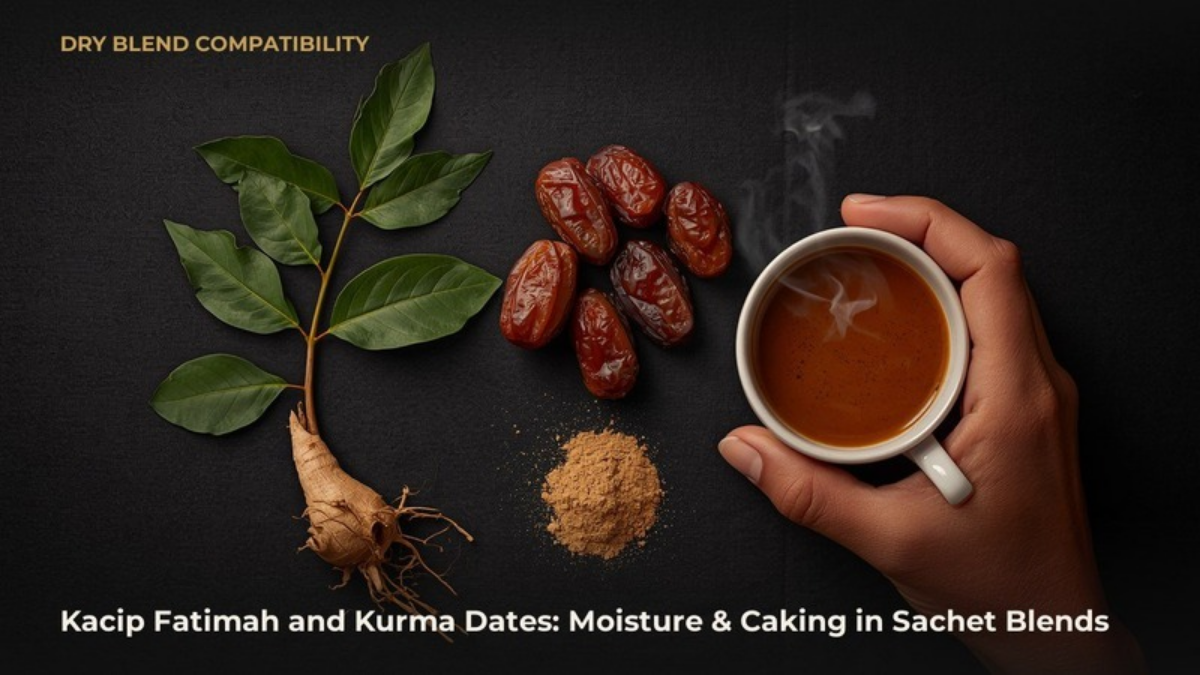
Combining Kacip Fatimah and Kurma Dates in Sachet Mixes: Moisture and Stability Rules
Formulator’s summary: For dry sachet blends combining Kacip Fatimah (Labisia pumila) extract powder and Kurma Dates (Phoenix dactylifera) extract powder, assess moisture pickup and caking in the finished blend rather than predicting performance from ingredients alone. Measure moisture and water activity (aw), then track flow and lumping in sealed sachets under defined storage conditions.
Quick facts for formulators
- Physical format: dry powder matrix for sachet drink mixes
- Dispersion behaviour: not established for the combined matrix; qualify the blend in the intended preparation system
- Certifications: FSSC 22000, JAKIM Halal, GMP, HACCP, MESTI, and US FDA facility registration
What is the proposed Kacip Fatimah and Kurma Dates matrix?
This is a formulation concept pairing Kacip Fatimah (Labisia pumila) extract powder with Kurma Dates (Phoenix dactylifera) extract powder as a dry blend for sachet drink mixes. The blend ratio and batch-specific powder values must be set from the current formulation brief and lot documentation; neither ingredient page establishes combined-matrix performance.
The scope here is limited to dry-blend compatibility: moisture pickup, water activity, caking, flow and packaging checks. It does not assume either powder will cake, nor that the materials have identical moisture behaviour. The separate product records describe Kacip Fatimah extract powder as capable of clumping under heat or moisture and Kurma Dates powder as subject to variation in texture; these are reasons to include handling checks, not predictions of the finished blend.
Why should moisture content and water activity be reviewed separately?
Moisture content measures the amount of water in a material, while water activity (aw) indicates the availability of water in the material under the measurement conditions. One result does not replace the other. The United States Food and Drug Administration’s technical guide, “Water Activity (aw) in Foods”, describes water activity as equilibrium relative humidity divided by 100 and distinguishes it from total moisture content.
For incoming qualification, record the moisture and aw values for each component separately if they are available in the current lot documents or by an agreed test. Then measure the finished blend after mixing and after it has equilibrated in a closed test container. Use the same documented method, sample handling and temperature for comparisons; exposure to room air during preparation can change a powder sample before measurement.
How should a formulator assess moisture pickup and caking?
A practical assessment compares each ingredient alone with the proposed blend and the finished sachet. Use the intended blend ratio, production handling and package, then define controlled temperature and relative-humidity conditions relevant to storage and distribution. At planned intervals, record moisture content, aw, visible lumping and a repeatable flow observation. The time points and acceptance criteria belong to the product development protocol; they are not universal limits for these powders.
| Sample or stage | Checks to record | Interpretation |
|---|---|---|
| Each incoming powder | Lot identity, available moisture and aw results, appearance, and relevant particle or carrier information where documented | Defines the starting condition of each separate material. |
| Freshly blended powder | Blend ratio, mixing record, moisture and aw using the chosen method, initial flow and lumping observations | Establishes the finished blend’s initial profile. |
| Blend in a controlled exposure test | Condition, elapsed time, mass or moisture change, aw, clumping and flow at each scheduled observation | Shows how the blend responds to the selected humidity and temperature challenge. |
| Sealed sachet samples | Package integrity, appearance, flow after opening, moisture and aw at scheduled checks | Evaluates the blend together with the selected packaging system. |
Keep open exposure samples separate from sealed-package samples. The first can help characterise powder response to the chosen environment; the second assesses the actual package. A controlled protocol should also state how samples are handled before measurement so test-to-test differences are not caused by inconsistent exposure.
Which caking and flow observations should be documented?
Use an observation method that can be repeated across batches: note visible lumps, whether the powder breaks apart under a defined gentle handling step, and whether it discharges consistently from a test funnel or the intended filling equipment. A laboratory may choose a validated flowability method suited to the powder and equipment. Record method, sample conditioning and result rather than relying on descriptions such as “free-flowing” without a defined check.
The article “Flowability Properties of Labisia pumila Herbal Powder” reports that flowability of herbal powder was examined, but the returned record did not provide sufficient bibliographic details or a specific result to use as a quantitative benchmark. It therefore does not establish a caking threshold or acceptance limit for this extract or the Kacip Fatimah–Kurma Dates blend.
How should packaging and storage be included in the test?
Compare the actual sachet material and seal configuration selected for the product, rather than drawing a conclusion from the powder alone. Store sealed samples under the intended conditions and include a defined humidity challenge if it is relevant to the distribution route. Inspect seals and packaging condition alongside the blend’s appearance, flow and measured results.
Both product pages provide storage guidance for the individual ingredients, but individual ingredient storage statements do not establish a shelf life for a combined sachet blend. The finished blend and its packaging need their own stability assessment. The water activity versus moisture content guide provides related background on keeping these measurements distinct, while the coffee and MCT sachet matrix article illustrates why separate ingredient descriptions should not be treated as proof of finished-matrix behaviour.
What does ingredient documentation establish for this blend?
A current certificate of analysis (COA) and specification sheet can establish the lot-specific results and acceptance criteria documented for each ingredient. For this proposed matrix, request those records for both powders and check whether they include moisture, aw, particle-size information, carrier details or handling notes relevant to the project. Do not assume that a data point for one lot applies to another, or that a component result predicts the finished blend.
Kacip Fatimah is a standardised extract only to the extent established by the current product specification. The live product page identifies gallic acid at 0.3–0.8%; however, the article does not use that range as a matrix target or as a performance claim. A standardised extract specification differs from crude herb powder because it defines a marker and assay range that can be checked lot by lot. For the paired Kurma Dates ingredient, do not infer a marker percentage from general date-fruit information; consult its current lot documents.
For both ingredients, retain the current lot COA, specification version and blend batch record together. A purchase specification should state the required documents and the project’s own acceptance criteria; the criteria must not be substituted with values taken from unrelated powders.
How should the first dry-blend trial be organised?
Begin with the proposed ratio from the product brief and use small, clearly identified trial batches. Record ingredient lot numbers, blend order, equipment, mixing conditions, room conditions and packaging details. Take representative samples immediately after blending and from sachets filled using the intended process. Do not interpret visual uniformity as evidence that the blend is stable in storage.
Where the current documents do not establish compatibility, compare the individual powders and the combined blend using the same sampling and measurement plan. If the blend shows a change in moisture, aw, flow or lumping during the defined test, review the formulation, handling and packaging variables systematically. Any change to an ingredient, ratio, package or process should be evaluated against the same written criteria before the blend specification is finalised.
- Record the proposed ratio and identify both ingredient lots.
- Obtain the current specification and COA for each powder.
- Measure moisture and aw using a consistent method where the data are available or testing is agreed.
- Define storage conditions, observation intervals and repeatable flow/caking checks before starting.
- Test the filled sachet and package integrity; assess the finished blend separately from the individual powders.
Supplying Kacip Fatimah and Kurma Dates powders for dry sachet mixes
The catalogue lists Kacip Fatimah (Labisia pumila) Extract Powder and Kurma Dates (Phoenix dactylifera) Extract Powder as separate bulk ingredients. Two companion products on the same line suit dry sachet drink briefs: Stevia (Stevia rebaudiana) Extract Powder, a natural sweetener option for sachet blends, and Coconut Water Powder, a spray-dried base for beverage and bakery blends.
Published supply information describes bulk ingredient supply, custom specification and extract ratio, spray-dried and powder forms, COA per lot, documentation and export paperwork, and packing options. Published quality credentials include FSSC 22000, JAKIM Halal, GMP, HACCP, MESTI and US FDA facility registration. For Malaysian and Indonesian manufacturing, buyers can include JAKIM Halal documentation in the qualification file where relevant. Each ingredient and the finished blend should be assessed against the buyer’s written specification and intended sachet conditions.
Frequently asked questions
How can a formulator check whether this powder blend picks up moisture? Measure moisture and aw for each component and the finished blend using a consistent method, then track results under defined conditions. Include both exposed powder samples and filled sachets if those represent the intended handling and storage.
Are individual COA values enough to predict caking in the blend? No. They describe the tested ingredient lots, not the finished matrix. Assess the planned blend ratio and package directly with repeatable flow and lumping observations.
What should be recorded during a caking check? Record sample identity, conditioning, temperature and humidity conditions, elapsed time, visible lumping and a repeatable flow observation. Set project-specific criteria before testing rather than applying a universal threshold.
Do the individual powder storage statements establish the sachet blend’s shelf life? No. The finished blend and selected sachet package require their own stability assessment under the intended conditions.
Can the article specify a moisture or aw acceptance limit for these two powders? No product-specific limit is stated here. Use the current ingredient specifications and lot documents, then define finished-blend criteria from the formulation and test plan.
Request a custom premix brief for dry sachet mixes — Kacip Fatimah (Labisia pumila) Extract Powder, Kurma Dates (Phoenix dactylifera) Extract Powder.