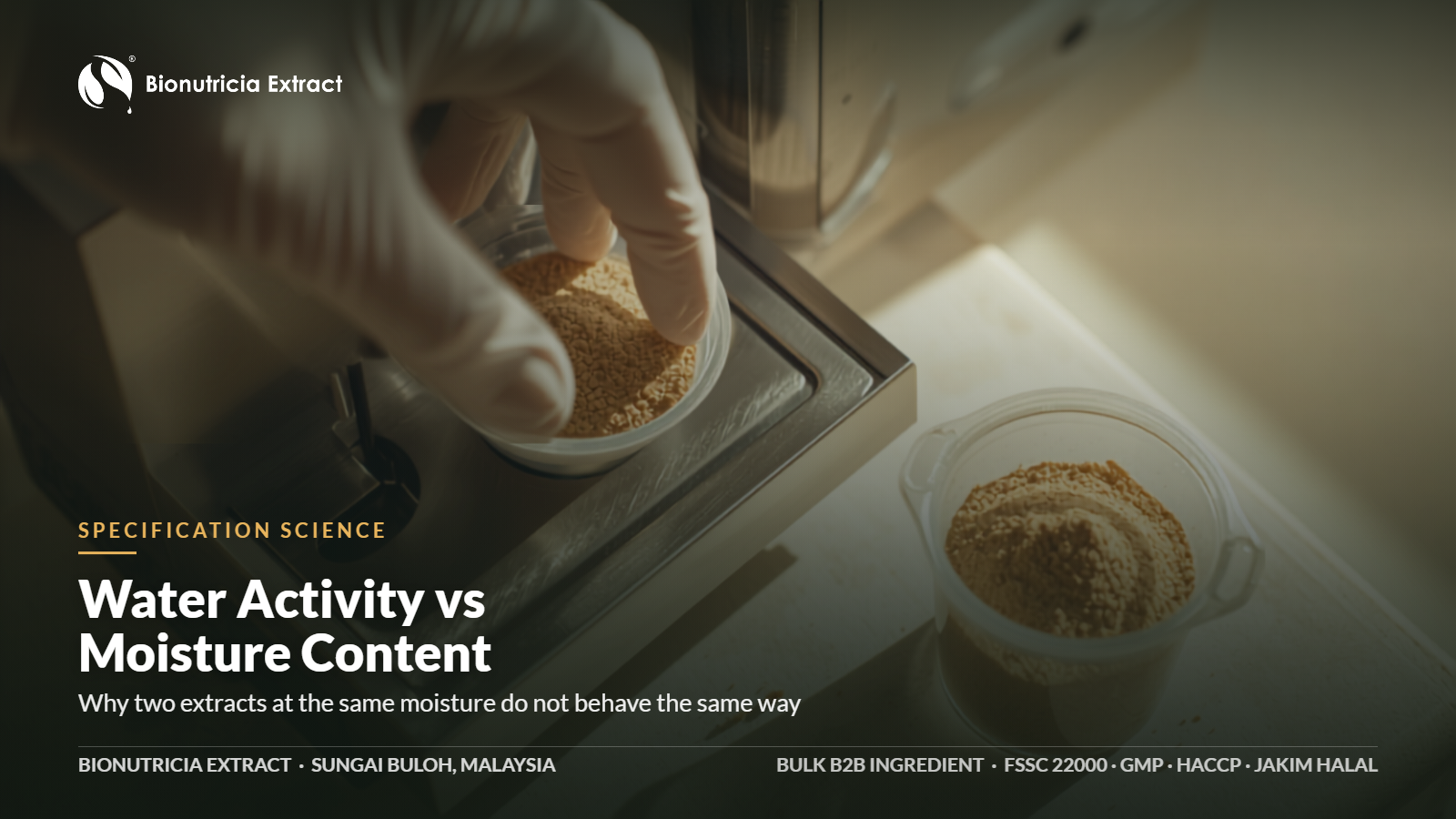
Moisture content and water activity are not the same measurement, and only one of them predicts how a powder will behave. Moisture content tells you how much water is present. Water activity (aw) tells you how much of that water is free to do damage — to support microbial growth, to migrate into a co-blended ingredient, to trigger caking or browning. Two extract powders can both report 5 per cent moisture and sit at completely different water activities, and they will not have the same shelf life.
What is the actual difference?
Moisture content is a mass measurement: grams of water per 100 grams of product, usually determined by loss on drying or by Karl Fischer titration. It counts every water molecule, including water chemically bound into sugars, proteins and carrier matrices where it is unavailable to microorganisms.
Water activity is a thermodynamic ratio: the vapour pressure of water in the product divided by the vapour pressure of pure water at the same temperature. It runs from 0 to 1.0 and is dimensionless. It measures only the free water — the fraction that can move, react and be used by a microorganism.
The bridge between the two is the sorption isotherm, which is specific to each material. That is why the relationship cannot be generalised: a maltodextrin-carried fruit extract and a high-polyphenol leaf extract have different isotherms, so the same 5 per cent moisture sits at different aw on each.
Why water activity is the number that governs stability
| Water activity | What becomes possible |
|---|---|
| Below 0.60 | No microbial growth of any kind. The generally accepted microbiological safety threshold for dry powders. |
| 0.60 to 0.65 | Xerophilic moulds and osmophilic yeasts can grow, slowly |
| 0.70 to 0.80 | Most moulds; non-enzymatic browning accelerates |
| 0.80 to 0.90 | Most yeasts, some bacteria |
| Above 0.90 | Most bacteria, including pathogens |
Microorganisms respond to available water, not to total water. A powder holding 8 per cent moisture that is tightly bound may sit at aw 0.35 and be microbiologically inert. A powder at 4 per cent moisture whose water is largely free may sit at aw 0.62 and support mould over a two-year shelf life. This is the single most useful reason to measure both.
Four failures that moisture content alone will not predict
Caking and loss of flowability
Caking is driven by glass transition, and glass transition temperature falls as water content rises — an effect known as plasticisation. When a powder is stored above its glass transition temperature it moves from a brittle glassy state into a rubbery one, particle surfaces become sticky and bridges form between them. Sugar-rich extracts are especially vulnerable because their glass transition temperatures are already low. A specification that controls moisture but not aw can pass a powder that will cake into a solid block in a warm warehouse. This is closely tied to how the powder behaves in tabletting and blending.
Moisture migration in a dry blend
Put two powders in one sachet and water moves from the higher aw component to the lower one until the two equilibrate — regardless of which has more total moisture. This is why a blend can fail when both of its inputs passed their individual specifications. A hygroscopic botanical extract blended with an effervescent or a mineral salt is the classic case: the extract donates water, the salt takes it up, and the blend hardens or begins to react. If you are blending, specify aw on every component and keep them close together.
Non-enzymatic browning
Maillard browning is not fastest at high water activity. It peaks in an intermediate band, broadly aw 0.60 to 0.80, because reactants need enough mobility to meet but excessive water dilutes them. An extract that browns in storage while its moisture result looks acceptable is very often sitting in that band. Colour drift on a natural-colour ingredient usually traces back here.
Loss of a hygroscopic active
Some actives degrade through hydrolysis, which needs free water. Controlling total moisture does not necessarily control the free fraction, so a potency loss over shelf life can occur on a powder whose moisture specification never moved.
How each is measured
| Parameter | Method | Practical notes |
|---|---|---|
| Moisture content | Loss on drying (oven or halogen balance) | Fast and cheap, but it also drives off volatiles, so aromatic botanicals can over-report |
| Moisture content | Karl Fischer titration | Water-specific, so it is the right choice for volatile-rich or oil-carrying powders |
| Water activity | Chilled-mirror dew point | Fast, typically under five minutes, and does not need calibration against the sample |
| Water activity | Capacitance or resistive electrical hygrometer | Lower cost, needs regular salt-standard calibration, slower to equilibrate |
Temperature matters and is routinely ignored. Water activity is temperature-dependent, so a result is meaningless without the temperature it was measured at. Always report aw with temperature, conventionally 25 °C. A result quoted bare is not a usable specification.
What to write into the specification
For a bulk botanical extract powder intended for a two-year shelf life, a workable pairing is a moisture limit appropriate to the material, plus a water activity limit at or below 0.60 measured at 25 °C. Specify both, because each catches something the other misses: moisture protects yield and economics, aw protects microbiological stability and physical form.
Two further points worth writing in. First, state the method — loss on drying and Karl Fischer will not agree on the same sample, and a specification that does not name the method invites a dispute at goods-in. Second, if the powder is going into a dry blend, agree the aw of the other components too. Most blend failures are not a supplier problem; they are an equilibration problem nobody specified against.
Both numbers should appear on the Certificate of Analysis. If a supplier’s COA reports moisture but not water activity, ask for it — it is a five-minute test, and its absence on a powder sold for long shelf life is a reasonable question to raise.
Related guides
Frequently asked questions
Can water activity be calculated from moisture content?
No. The relationship between the two is described by a sorption isotherm that is specific to each material and each temperature. Without that isotherm for the exact product, one cannot be derived from the other. They are separate measurements and both belong on the specification.
What water activity is safe for a botanical extract powder?
Below 0.60 at 25 °C is the generally accepted threshold below which no microorganism grows, including xerophilic moulds. Many manufacturers specify below 0.50 to leave headroom for moisture pick-up during transport, opening and repacking.
Why did my blend cake when both ingredients passed specification?
Almost always moisture migration. Water moves from the component with the higher water activity to the one with the lower, until they equilibrate. Both ingredients can be individually compliant on moisture and still be badly mismatched on aw. Specify water activity across every component of the blend.
Does loss on drying over-report moisture in aromatic botanicals?
It can. Loss on drying measures all mass lost at temperature, which includes volatile oils and other volatiles alongside water. For essential-oil-rich or volatile-rich extracts, Karl Fischer titration is the more accurate method because it responds specifically to water.
Does water activity need to be reported with a temperature?
Yes. Water activity varies with temperature, so a figure without its measurement temperature is not a usable specification. The convention is to report at 25 °C, and the COA should state it.
Need moisture and water activity on your extract specification?
Bionutricia Extract manufactures standardised botanical extract powders in Sungai Buloh, Selangor, with both parameters reported on the batch Certificate of Analysis.
Reviewed by Dr Yong Yi Yi, Operation Manager, PhD Food Science & Technology. General technical information for B2B formulators and ingredient buyers. Not regulatory advice.