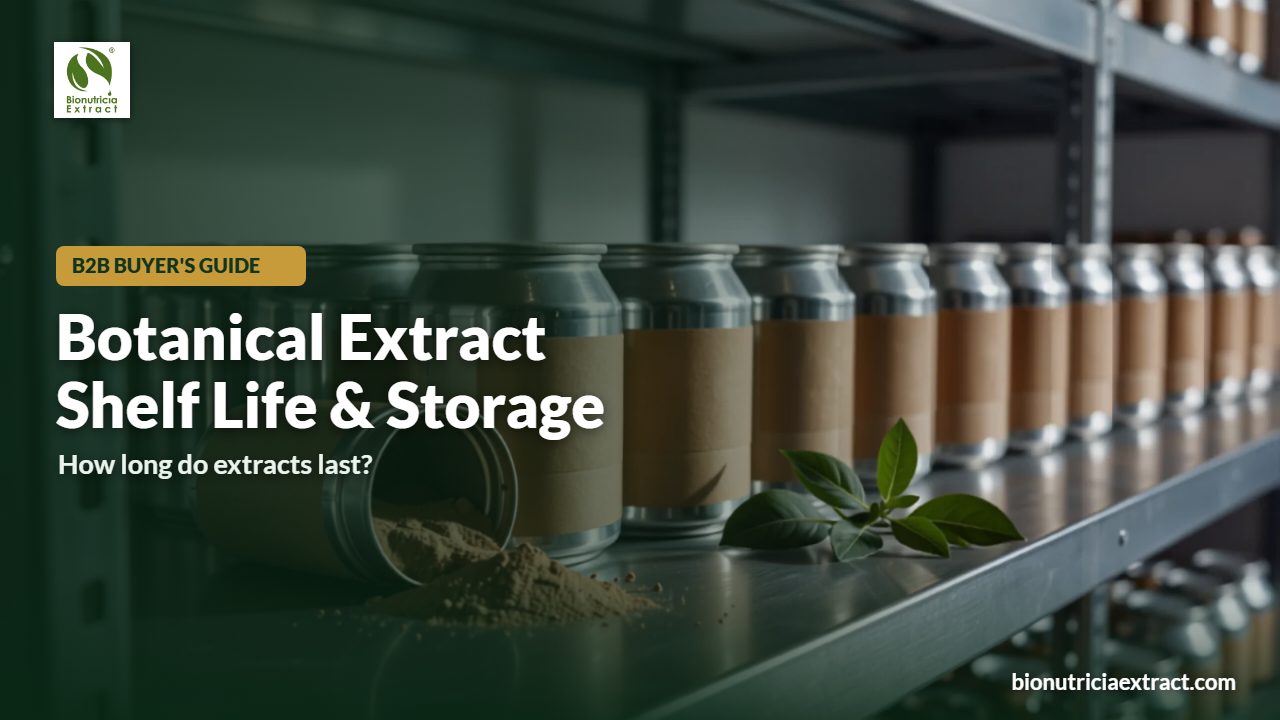
Most standardized botanical extract powders keep a shelf life of about 18–24 months when stored sealed in a cool, dry place away from direct light. Real-world stability depends on moisture, oxygen, heat, light and packaging — and every Bionutricia batch states its own shelf life and storage conditions on the product specification and Certificate of Analysis.
- Typical shelf life: 18–24 months for spray-dried powders (stated per batch on the COA)
- Recommended storage: cool, dry, ideally ≤25 °C, sealed, out of direct sunlight
- Target moisture: commonly <10% (per product specification)
- Bulk pack sizes: 1 kg, 5 kg and 20 kg in food-grade sealed packaging
- Stability drivers: moisture, oxidation, heat, light and packaging
- Quality framework: FSSC 22000, GMP, HACCP, JAKIM Halal, US FDA registration, MeSTI, NanoVerify
How long do botanical extract powders last?
As a working rule, a standardized botanical extract powder holds its declared specification for 18 to 24 months from the manufacturing date when it is kept sealed, cool and dry. That figure is not universal: a light, hygroscopic anthocyanin powder behaves differently from a robust fibre powder, and an oil-based powder is governed mainly by how well its fat fraction resists oxidation. For this reason the authoritative number is always the shelf life printed on each product’s specification sheet and reflected on the batch Certificate of Analysis (COA), not a generic industry average.
Liquid concentrates and extracts generally carry a shorter usable life than dried powders because water activity supports both chemical breakdown and microbial growth. Where a longer, more predictable shelf life is required, drying the extract into a powder is usually the more stable format for shipping and storage.
What determines a botanical extract’s shelf life?
Shelf life is the outcome of several interacting factors. Understanding them helps a brand owner or formulator specify the right grade, packaging and storage for their supply chain.
Moisture and hygroscopicity
Water is the single biggest driver of degradation. Many botanical powders are hygroscopic — they draw moisture from humid air — which can cause caking, colour shift and faster loss of actives. Keeping residual moisture within the specification (commonly <10%) and protecting the powder from ambient humidity with sealed, low-permeability packaging is central to a stable shelf life.
Oxidation from oxygen and light
Polyphenols, carotenoids, chlorophyll-rich greens and oil fractions are all sensitive to oxygen and ultraviolet light. Oxidation dulls colour, changes aroma and reduces the marker compounds a standardized extract is sold on. Opaque or foil-lined packaging, minimal headspace and, for sensitive materials, protection from air all slow this process.
Temperature
Every 10 °C rise in storage temperature accelerates chemical reactions. Storing extracts in a cool, stable environment — away from heaters, direct sun and uninsulated warehouse roofs — meaningfully extends the period over which they meet specification.
Microbial stability
Low moisture also keeps microbial counts in check. Extracts manufactured under FSSC 22000, GMP and HACCP controls carry defined microbial limits on the COA, and dry, sealed storage keeps them within those limits through the stated shelf life.
Carrier and packaging
The carrier used to spray-dry an extract, and the packaging it ships in, both shape stability. A well-chosen carrier protects the actives during drying and storage; robust food-grade packaging is the barrier that keeps moisture, oxygen and light out once the material leaves the facility.
The table below summarises how the main factors affect stability and how each is controlled in practice.
| Stability factor | Effect on the extract | How it is controlled |
|---|---|---|
| Moisture / hygroscopicity | Caking, colour shift, faster loss of actives | Keep moisture within spec (commonly <10%); sealed, low-permeability packaging |
| Oxygen & light | Oxidation, dulled colour and aroma, marker-compound loss | Opaque or foil-lined packaging, minimal headspace, protection from air |
| Temperature | Accelerated chemical reactions at higher temperatures | Cool, stable store, ideally ≤25 °C, away from direct sun and heat |
| Microbial load | Spoilage risk if moisture rises | FSSC 22000 / GMP / HACCP limits on the COA; dry, sealed storage |
| Format & carrier | Sets the baseline stability of the material | Powder over liquid for shelf life; arabic-gum emulsification for oil powders |
How should bulk botanical extracts be stored?
Good storage practice is straightforward and repays itself in retained quality:
- Keep material sealed in its original food-grade packaging until use, and re-seal promptly after part-use.
- Store in a cool, dry, well-ventilated area, ideally ≤25 °C, away from direct sunlight and heat.
- Control humidity; where ambient humidity is high, keep packs closed and consider a conditioned store.
- Practise first-in, first-out (FIFO) stock rotation and respect the retest or best-before date on the COA.
- Avoid repeated opening and large temperature swings, which invite condensation inside the pack.
- Keep extracts away from strong odours, as some powders can pick up ambient aromas.
Refrigeration is not usually required for dried extract powders and can even be counter-productive if it causes condensation when packs are opened and re-warmed. A stable, cool ambient store is generally the best environment; a small number of especially heat- or oxidation-sensitive materials may benefit from cold storage, which will be noted on the specification.
Powders, liquids and oil powders: how stability differs
Format has a direct effect on how long an extract lasts. Spray-dried powders are typically the most shelf-stable and the easiest to ship, because removing water suppresses both chemical and microbial change. Liquid extracts and concentrates are convenient for beverage and syrup applications but generally have a shorter usable life and tighter storage needs.
Oil powders are a special case. Their stability is dominated by protecting the oil from oxidation during and after drying. Bionutricia emulsifies every oil powder on arabic gum — never sodium caseinate or synthetic emulsifiers — which forms a protective matrix around the oil droplets while keeping the finished powder dairy-free, vegan-suitable and free of declarable milk allergens. That emulsification choice is one reason our oil powders travel and store well as bulk ingredients.
How shelf life is documented and verified
A credible supplier does not ask a buyer to take shelf life on trust. Each Bionutricia batch ships with a Certificate of Analysis stating the manufacturing date, the shelf life or retest date, moisture, and microbial and heavy-metal results against the product specification. Storage conditions are printed on the specification and pack. Where a buyer needs formal stability data for a registration dossier or a specific market, that can be provided as part of the documentation pack. Reading these documents carefully — and matching storage on your own site to what they state — is the most reliable way to protect the actives you are paying for.
Frequently asked questions
What is the typical shelf life of a botanical extract powder?
Most standardized botanical extract powders carry an 18–24 month shelf life when stored sealed, cool and dry. The exact figure for each grade is stated on its product specification and batch Certificate of Analysis.
Do botanical extracts need to be refrigerated?
Dried extract powders generally do not need refrigeration and store well in a cool, dry ambient environment (ideally ≤25 °C). A small number of especially heat- or oxidation-sensitive materials may specify cold storage, which is noted on the spec.
How is shelf life determined and documented?
Shelf life is set from the material’s composition, format and stability behaviour, and is recorded with the manufacturing and retest dates on the Certificate of Analysis. Formal stability data can be supplied where a market or dossier requires it.
Can the shelf life of an extract be extended?
Storage does not extend the declared shelf life, but poor storage can shorten it. Keeping material sealed, cool, dry and out of direct light is what allows an extract to reach its full stated life.
What packaging and pack sizes does Bionutricia use for bulk extracts?
Bulk extracts are supplied in sealed, food-grade packaging in 1 kg, 5 kg and 20 kg pack sizes, designed to protect the powder from moisture, oxygen and light in transit and storage.