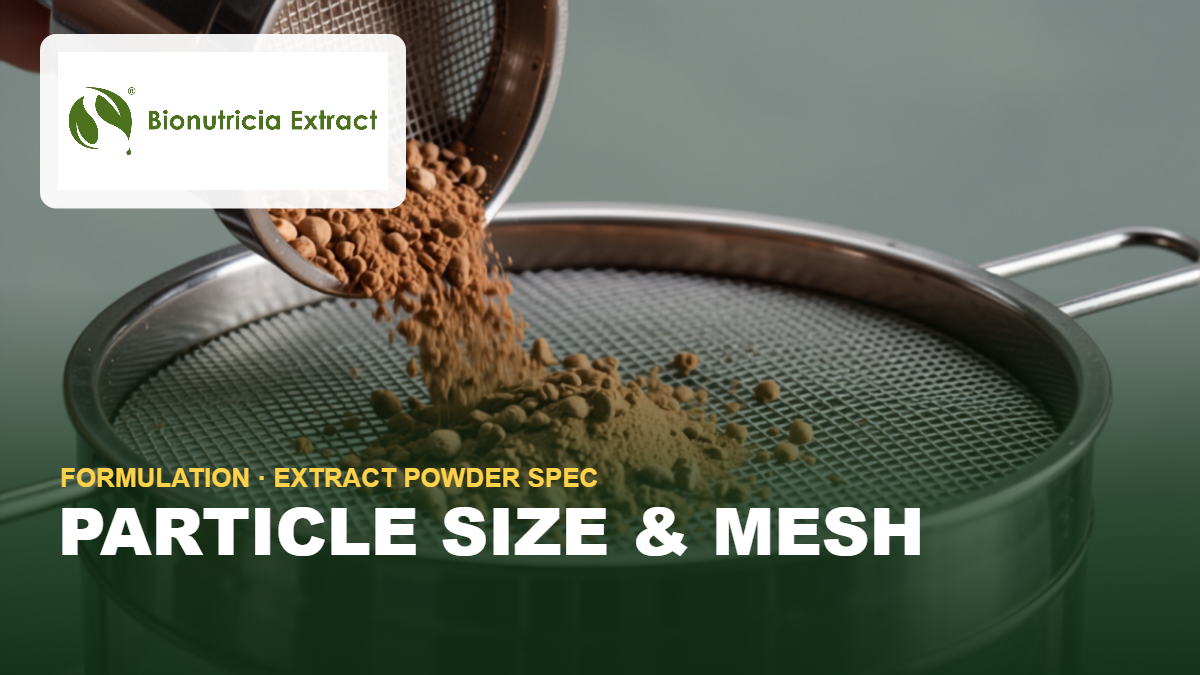
Particle Size and Mesh in Extract Powders: A Formulator’s Guide
Particle size and mesh describe how fine an extract powder is, and they quietly decide whether your ingredient flows, blends, dissolves and compresses the way your process needs. “Mesh” refers to the number of openings per linear inch in a test sieve — a higher mesh number means a finer powder. Specifying the right particle size on your purchase order prevents blend segregation, capsule-fill variation and tabletting problems downstream.
Particle size is one of the most overlooked lines on a specification sheet, yet it affects almost every processing step after the powder arrives. This guide explains what mesh actually means, how particle size influences flowability, blend uniformity, dissolution and compression, and the specs a buyer should request from an extract supplier.
What does “mesh” mean?
A mesh size is defined by a test sieve: it is the number of wire openings per linear inch. An “80 mesh” sieve has 80 openings per inch, and “pass 80 mesh” means the powder falls through that sieve. Because the openings get smaller as the count rises, a higher mesh number means a finer powder. A common way to write the spec is, for example, “≥95% through 80 mesh,” which tells you both the fineness and how tightly it is controlled.
Mesh is a practical shorthand; the underlying property is the particle-size distribution, sometimes reported as D50 (the median particle size in microns) with D10 and D90 to describe the spread.
Mesh to approximate opening size
| 40 mesh | ~420 microns (coarse/granular) |
| 60 mesh | ~250 microns |
| 80 mesh | ~180 microns (common extract-powder spec) |
| 100 mesh | ~150 microns |
| 200 mesh | ~75 microns (fine) |
| 325 mesh | ~45 microns (very fine) |
Approximate US standard sieve equivalents; use for orientation, confirm the exact spec with your supplier.
Why particle size matters in formulation
Flowability and dosing accuracy
Very fine powders can cake and bridge, while overly coarse ones may flow inconsistently. Poor flow shows up as inconsistent capsule fill weights and tablet weight variation. A controlled, well-characterised particle size supports steady flow through hoppers, fillers and presses.
Blend uniformity
When you combine ingredients of very different particle sizes and densities, the blend can segregate — fine particles migrate down while coarse ones rise, so the mix at the start of a run differs from the end. Matching particle sizes across the components of a blend keeps the active evenly distributed, which is critical when the extract is a small fraction of the total formula.
Dissolution and dispersibility
Finer particles have more surface area, so they generally wet and dissolve faster — useful for beverages and effervescents. But ultra-fine powders can also clump on the surface of water (“fish-eyes”) if not properly instantised. For beverage applications, particle size is specified alongside solubility behaviour.
Compression and tabletting
Tablet presses are sensitive to particle size and flow. Too fine, and the powder may trap air (capping/lamination) or stick to punches; too coarse, and content uniformity suffers. The right particle size, sometimes achieved through granulation, gives consistent die filling and robust tablets.
Particle size by finished format
- Capsules — free-flowing, moderately fine powder for consistent fill weight.
- Tablets — controlled particle size and good compressibility; may require granulation.
- Beverages / stick packs — finer, well-dispersing or instantised grades for fast wetting.
- Gummies — fine powder that disperses evenly into the hot slurry.
- Dry blends — particle size matched to the other components to prevent segregation.
What to request on the specification
- A mesh spec with a percentage (e.g. “≥95% through 80 mesh”), not just a single mesh number.
- Where relevant, a particle-size distribution (D10/D50/D90 in microns).
- Bulk and tapped density, which affect fill volume and flow.
- Moisture content, since it interacts with flow and caking.
- The carrier used in any spray-dried powder, as it influences particle characteristics.
- Confirmation that particle size is verified per lot on the COA, not just a nominal target.
How Bionutricia controls particle size
Bionutricia manufactures botanical extract powders with controlled particle-size specifications suited to the customer’s finished format, from free-flowing capsule grades to fine, well-dispersing beverage grades. Spray-dried oil powders are emulsified on arabic gum for clean-label, allergen-friendly handling. As a manufacturer holding FSSC 22000, GMP, HACCP, JAKIM Halal, US FDA registration and MeSTI (plus NanoVerify), we can align particle size, density and moisture to your process and document them on each lot’s certificate of analysis.
Frequently asked questions
Does a higher mesh number mean a finer or coarser powder?
Finer. Mesh counts the openings per inch of a test sieve, so a higher number means smaller openings and a finer powder. For example, 200 mesh (~75 microns) is much finer than 40 mesh (~420 microns).
What is a typical particle size for extract powders?
Many botanical extract powders are specified around “pass 80 mesh” (~180 microns), but the right target depends on your format — beverages usually need finer grades, while capsules need good flow. Always specify a mesh plus a percentage.
Why does my blend separate during filling?
Usually because the components have mismatched particle sizes or densities, allowing fine and coarse particles to segregate. Matching particle sizes across the blend and controlling flow reduces this.
Can particle size affect how fast a powder dissolves?
Yes. Finer particles have more surface area and generally wet and dissolve faster, though ultra-fine powders may clump on water unless instantised. Particle size is specified alongside solubility for beverages.
Should particle size be on the COA?
Ideally yes — request that particle size (mesh or distribution) is verified per lot and reported on the certificate of analysis, not just quoted as a nominal target.
Need an extract powder matched to your fill, blend or beverage process?
Bionutricia manufactures halal-certified botanical extracts with controlled particle-size specs. Talk to our team about your process requirements.
This article is B2B manufacturing and formulation education. Approximate mesh/micron equivalents are for orientation only; confirm exact specifications with your supplier for your application.