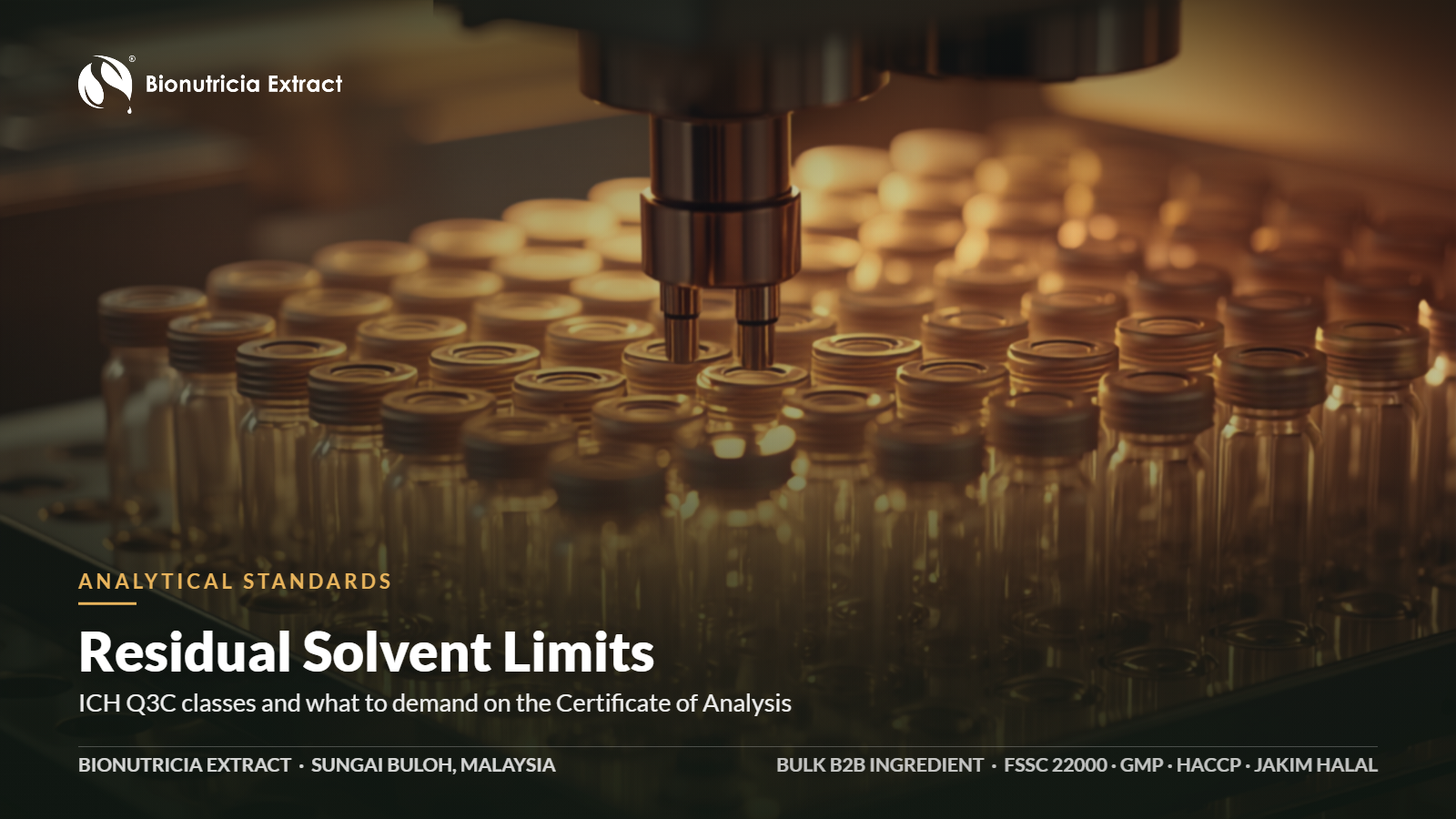
Residual solvents are the traces of processing solvent left behind in a finished extract, and they are classified by toxicity, not by how much is present. The reference framework is ICH Q3C, mirrored in pharmacopoeial chapters such as USP <467>. It sorts solvents into three classes: Class 1 to be avoided outright, Class 2 to be limited to defined concentrations, and Class 3 regarded as low risk with a general limit of 5,000 ppm. A botanical extract buyer should require the class, the named solvent, the limit and the method on the Certificate of Analysis.
Why residual solvents matter in a botanical extract
Extraction moves target compounds out of plant material and into a solvent. That solvent is then removed — by evaporation, distillation, or during drying — but removal is never absolute. What remains is the residual solvent, and because it is a processing aid rather than an ingredient, it usually does not appear on a label. It appears, if anywhere, on the Certificate of Analysis.
The risk is not hypothetical. Residual solvent is one of the few extract parameters where a compliant-looking product can carry a genuine toxicological issue, because the quantity involved is invisible and the buyer has no way to detect it by inspection. It is also a parameter where a buyer’s own regulatory exposure is real: in most jurisdictions the brand owner placing the finished product on the market carries responsibility for it, not the upstream extractor.
The three ICH Q3C classes
Class 1 — solvents to be avoided
Known or strongly suspected human carcinogens, or environmentally hazardous. These should not be used in the manufacture of ingredients for human consumption. Where they appear at all it is normally as a contaminant of another solvent rather than as a deliberate choice.
| Class 1 solvent | Concentration limit (ppm) | Basis |
|---|---|---|
| Benzene | 2 | Known human carcinogen |
| Carbon tetrachloride | 4 | Toxic and environmentally hazardous |
| 1,2-Dichloroethane | 5 | Toxic |
| 1,1-Dichloroethene | 8 | Toxic |
| 1,1,1-Trichloroethane | 1,500 | Environmentally hazardous |
Class 2 — solvents to be limited
Non-genotoxic animal carcinogens, or solvents linked to other irreversible toxicity. Permitted, but capped. These are the ones that matter most in practice, because several are genuinely used in botanical extraction and the limits vary widely between them.
| Class 2 solvent (selected) | Concentration limit (ppm) |
|---|---|
| Methanol | 3,000 |
| Toluene | 890 |
| Dichloromethane | 600 |
| Acetonitrile | 410 |
| Hexane | 290 |
| Chloroform | 60 |
Note the spread: methanol is permitted at more than ten times the level of hexane, and fifty times the level of chloroform. A buyer who writes a single blanket residual solvent limit into a specification has written something that is simultaneously too loose for one solvent and too tight for another.
Class 3 — low toxic potential
Solvents with low acute and subchronic toxicity, for which no health-based exposure limit is needed at typical levels. The general limit is 5,000 ppm, equivalent to 0.5 per cent, unless a higher level is justified. Ethanol, acetone, ethyl acetate and isopropanol sit here.
How residual solvents are tested
The standard technique is static headspace gas chromatography. The sample is sealed in a vial and heated so volatile residues partition into the headspace above it; that gas is then injected onto a GC column and quantified, usually by flame ionisation detection, with mass spectrometry used for confirmation of identity.
Two points a buyer should check on the report. First, the method must be able to detect the specific solvent at a level meaningfully below its limit — a limit of quantitation of 30 ppm is useless against a chloroform limit of 60 ppm. Second, the panel tested must be the right one. A generic Class 3 screen says nothing about whether a Class 2 solvent is present, and a “residual solvents: complies” line with no named analytes is not evidence of anything.
What to demand on the Certificate of Analysis
| Ask for | Why |
|---|---|
| The solvent class used, declared | A supplier can decline to name the exact solvent as proprietary, but the class is not a trade secret and drives your risk |
| Named analytes with individual limits | “Complies” without named solvents is unverifiable |
| Actual results, not just pass or fail | A result trending upward across lots is an early warning that a drying step is drifting |
| Limit of quantitation for each analyte | Confirms the method can actually see below the limit |
| Method reference | USP <467> or an equivalent validated headspace GC method |
| Testing frequency | Every lot, or a justified skip-lot plan — decide which you are buying |
A supplier is entitled to treat its exact solvent system as confidential; that is normal commercial practice across the industry. What is not reasonable is refusing to state the class, or issuing a Certificate of Analysis that reports residual solvents without naming a single analyte. Those two things are the buyer’s minimum.
Where the question does not arise the same way
Not every extraction route carries the same residual solvent burden. Water-based, enzyme-assisted and ultrasound-assisted extraction, supercritical carbon dioxide, and mechanical processes such as pressing all reduce or remove reliance on organic solvents — which is one reason buyers with clean-label or export-sensitive positions ask about the process, not only the result.
Bionutricia Extract manufactures under a granted Malaysian process patent, MY-188945-A, “Process for Preparing Nutritional Powder Extract”, covering an enzymatic and ultrasonic extraction and powder preparation process. The specific solvent system used is proprietary and is not published; residual solvent status is confirmed on the batch Certificate of Analysis, which is the document that should carry it. You can read more on ultrasonic extraction compared with conventional solvent extraction.
Related guides
Frequently asked questions
What is the residual solvent limit for a Class 3 solvent like ethanol?
Class 3 solvents carry a general limit of 5,000 ppm, or 0.5 per cent, unless a higher level is justified with supporting data. They are regarded as having low toxic potential at levels normally encountered in manufacture.
Can a supplier refuse to name the extraction solvent?
Yes, and many do — the solvent system is commonly treated as proprietary process knowledge. What a buyer should still obtain is the ICH class, the named analytes tested with their results and limits, and the method reference. Those satisfy the risk question without disclosing the process.
Does “residual solvents: complies” satisfy a specification?
No. Without named analytes, individual limits and reported results, that statement cannot be verified and does not demonstrate which solvents were even looked for. Treat it as an incomplete Certificate of Analysis and ask for the underlying report.
How are residual solvents measured?
By static headspace gas chromatography, most commonly following USP <467>, with flame ionisation detection for quantitation and mass spectrometry for confirmation. The sample is heated in a sealed vial so volatile residues move into the headspace, which is then injected onto the column.
Do water-based or supercritical CO2 extracts still need residual solvent testing?
Testing is normally still specified, for two reasons: to confirm the absence of solvents rather than assume it, and because incoming raw materials or processing aids can introduce traces independently of the main extraction step. The panel may be narrower, but a documented result is stronger than an assumption.
Need residual solvent data on your extract specification?
Bionutricia Extract supplies standardised botanical extracts in bulk from Sungai Buloh, Selangor, with batch Certificates of Analysis for B2B formulation.
Reviewed by Vitthia Rama Murti, Lab Pharmacist, BSc (Hons) Pharmacy. General technical information for B2B ingredient buyers. Limits cited follow ICH Q3C and pharmacopoeial references and may be superseded; verify against the current text for your market. Not regulatory advice.