Reviewed by Cindy Chua Shiu Sinn, Bionutricia
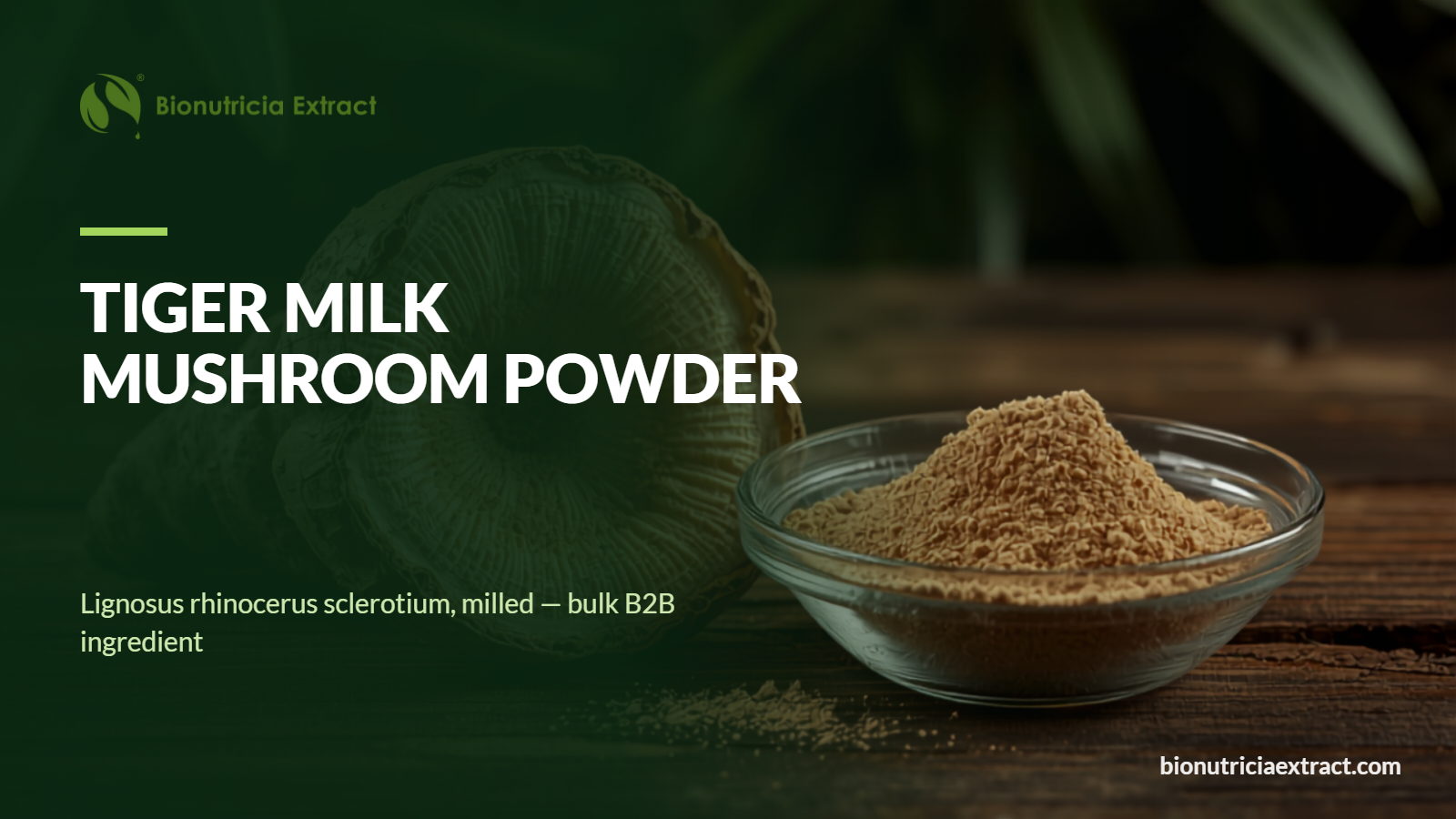
Tiger milk mushroom powder is the milled sclerotium of Lignosus rhinocerus, a mushroom native to the rainforests of Malaysia and the surrounding region. Bionutricia manufactures it as a light brown bulk powder at our Sungai Buloh facility, released against a house specification and a batch-specific Certificate of Analysis, in 1 kg, 5 kg and 20 kg packs for B2B formulation.
Quick facts for formulators
- Botanical: Lignosus rhinocerus — part used: sclerotium (tuber)
- Form: milled powder, light brown, characteristic odour — not a standardised extract
- Particle size: >95% through 60 mesh · moisture <10% · pH 5–7
- Solubility: dissolves in water with sediments
- Typical use level: 2–5 g
- Clean label: non-GMO · not irradiated · not a novel food · vegan · gluten-free · no Annex II allergens
- Packs: 1 kg, 5 kg, 20 kg · shelf life 2 years unopened · origin Malaysia
What is tiger milk mushroom?
Tiger milk mushroom, Lignosus rhinocerus, is a polypore mushroom found in the rainforests of Malaysia and neighbouring Southeast Asia. Unlike culinary mushrooms, the part of interest is not the cap or the stalk but the sclerotium — a compacted underground mass of fungal tissue, described on our specification as the tuber, from which the fruiting body eventually emerges.
It carries an unusually long record of traditional use among indigenous and rural communities in Peninsular Malaysia, and it appears in the historical literature of the region: it was described scientifically in the nineteenth century from a Penang specimen, and it is listed among the botanicals of economic importance in the classic reference works on the Malay Peninsula. That heritage, and the fact that it grows here, is why it has become one of Malaysia’s more recognisable indigenous ingredients.
The mushroom is genuinely scarce in the wild — it grows solitary and is difficult to locate — which is why commercial supply today rests on cultivated material rather than wild collection. Cultivation is also what makes a consistent, testable ingredient possible at all: a wild-collected supply cannot be held to a stable specification.
What is it used for in formulation?
Our specification records the application plainly: as a raw ingredient for cooking and health supplements. In practice, brand owners and manufacturers formulate tiger milk mushroom powder into:
- Capsules and tablets, alone or in a mushroom blend alongside other fungal ingredients
- Sachets and instant granule drinks, typically with a soluble carrier to carry the insoluble fraction
- Soups, broths and traditional culinary preparations, where the powder format replaces slicing a dried sclerotium
- Botanical beverage premixes and functional powders
Bionutricia supplies the bulk ingredient for B2B formulation; brand owners and manufacturers formulate it into their chosen finished format. Because it is a whole milled sclerotium rather than a purified extract, it behaves in a formula like a fine botanical powder: it disperses, it contributes colour and a characteristic aroma, and it will leave sediment in a clear liquid.
A note on claims. We describe this ingredient by its composition, its specification and its traditional context only. We make no therapeutic, disease or treatment claims for it, and we would encourage any brand owner to hold the same line: the regulatory position on medicinal mushrooms is tightening in most export markets, and structure-function and traditional-use framing is the defensible ground.
Typical specification
| Parameter | Specification |
|---|---|
| Product name | Tigermilk Mushroom Powder |
| Scientific name | Lignosus rhinocerus |
| Part used | Sclerotium (tuber) |
| Form / appearance | Powder, light brown, characteristic odour |
| Moisture content | <10% |
| pH | 5–7 |
| Particle size | >95% through 60 mesh |
| Solubility in water | Dissolves with sediments |
| Typical use level | 2–5 g |
| Heavy metals | Arsenic ≤5 ppm · Lead ≤10 ppm · Cadmium ≤0.3 ppm · Mercury ≤0.5 ppm |
| Microbiology | TPC ≤104 CFU/g · Yeast & mould ≤103 CFU/g · Enterobacteriaceae ≤102 CFU/g · E. coli, Salmonella, S. aureus absent |
| Status declarations | Non-GMO · not irradiated · not a novel food (EC 258/97) · suitable for vegetarians and vegans · free of animal products and derivatives · gluten-free <20 ppm · no Annex II allergens (EC 1169/2011) |
| Pack sizes | 1 kg, 5 kg, 20 kg |
| Shelf life | 2 years, unopened, stored as recommended |
| Country of origin | Malaysia |
Figures are taken from the current house specification. The values for the lot you receive are stated on its batch-specific Certificate of Analysis. Pricing and minimum order quantity are on quotation.
How to specify it on your purchase order
| State this | Why it matters |
|---|---|
| Powder, not extract | Say explicitly whether you want milled sclerotium powder or a standardised extract — they are different materials with different behaviour and different cost. |
| Particle size | The standard grade is >95% through 60 mesh. If your tabletting, blending or sachet-filling process needs finer or tighter control, specify it up front. |
| Intended format | Capsule, tablet, sachet, beverage or culinary — this determines whether the sediment behaviour is acceptable and whether a carrier is needed. |
| Pack size | 1 kg, 5 kg or 20 kg. It affects packing and lead time. |
| Market and documentation | Name the destination market and the document set you need, in the correct legal entity name, before the first shipment rather than after it. |
Quality control and documentation
Every lot is released against the house specification and a batch-specific Certificate of Analysis carrying the actual lot number you receive, with confirmatory testing performed by ISO/IEC 17025-accredited third-party laboratories rather than in-house alone. The routine panel covers appearance and identity, moisture, particle size, heavy metals and the full microbial panel above.
Screening beyond that panel — pesticide residues and mycotoxins in particular — is risk-based rather than universal. It is applied where the matrix carries meaningful risk or where the destination market requires it. If your market needs a specific residue or mycotoxin result on this material, ask at the enquiry stage and we will confirm what is already in place and arrange the rest.
Manufacturing sits inside a certified food-safety system — FSSC 22000, GMP, HACCP, US FDA registration and MeSTI, together with NanoVerify certification — operated from our Sungai Buloh, Selangor facility, with export through Port Klang. A Safety Data Sheet is available on request.
Storage, shelf life and handling
Store in sealed hygienic containers in a cool, dry place, away from direct sunlight and protected from pest ingress. Shelf life is two years from manufacture for unopened material held under those conditions.
Reseal promptly after sampling and bring cold packs to ambient temperature before opening, so condensation does not form on the powder — the most common cause of a failed moisture retest is a container left open on a humid production floor, not a fault in the material. Product discharged from a pack should not be returned to the original container. Retain a sealed sample of each lot for the shelf life of your finished product; it is the quickest way to settle a question about a batch later.
Need the specification and a batch COA for tiger milk mushroom powder?
Related guides
Frequently asked questions
What is tiger milk mushroom powder?
It is the dried sclerotium (the underground tuber-like mass) of Lignosus rhinocerus, milled into a light brown powder. Bionutricia supplies it as a bulk B2B ingredient with a house specification and a batch-specific Certificate of Analysis.
Is this a powder or a standardised extract?
It is a milled powder, not a standardised extract. There is no extraction ratio and no marker assay attached to it, and we do not present one. If your formulation requires a standardised extract rather than whole milled sclerotium, tell us at the enquiry stage.
Which part of the mushroom is used?
The sclerotium, referred to on our specification as the tuber. This is the underground portion, and it is the part traditionally sought after rather than the cap or stalk.
Does it dissolve in water?
Only partially. The specification states that it dissolves in water with sediments, which is what you would expect from a milled whole-sclerotium powder rather than a purified extract. Plan for a suspension or a matrix that tolerates sediment, and trial it in your actual formula before committing to a clear beverage.
What particle size and moisture should I expect?
More than 95 percent passes 60 mesh, moisture is below 10 percent and pH sits between 5 and 7. If your process needs a finer or more tightly controlled particle size, specify it at enquiry rather than assuming the standard grade will suit.
What contaminant limits are on the specification?
Arsenic 5 ppm, lead 10 ppm, cadmium 0.3 ppm and mercury 0.5 ppm as maxima, with total plate count no more than 10,000 CFU/g, yeast and mould no more than 1,000 CFU/g, Enterobacteriaceae no more than 100 CFU/g, and Escherichia coli, Salmonella and Staphylococcus aureus absent. Results for the lot you receive are on its Certificate of Analysis.
Is it suitable for vegan and clean-label products?
Yes. The specification records it as non-GMO, not irradiated, not a novel food under European Regulation (EC) No 258/97, suitable for vegetarians and vegans, free of animal products and derivatives, gluten-free below 20 ppm, and free of the allergens listed in Annex II of Regulation (EC) No 1169/2011.
What pack sizes and documentation are available?
Bulk packs of 1 kg, 5 kg and 20 kg. Documentation available to qualified B2B buyers includes the product specification, a batch-specific Certificate of Analysis and a Safety Data Sheet on request. Pricing and minimum order quantity are on quotation.