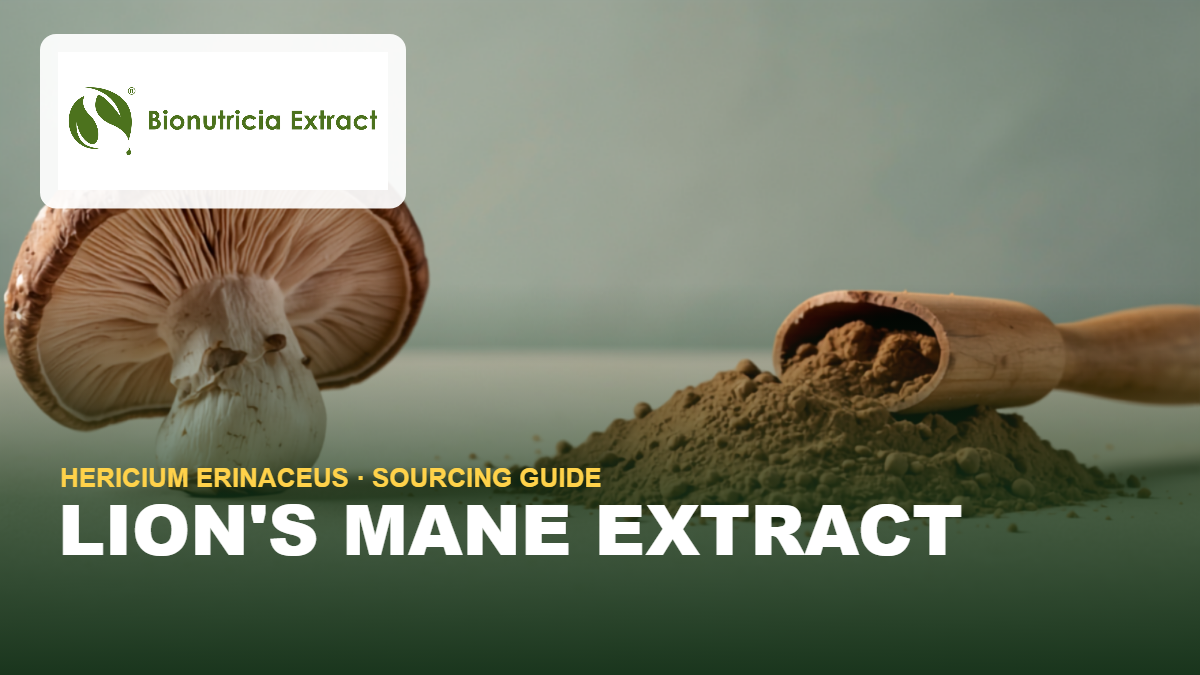
Lion’s Mane (Hericium erinaceus) Extract: A Formulator’s Sourcing Guide
Lion’s Mane extract is a concentrated powder made from the fruiting body and/or mycelium of the mushroom Hericium erinaceus, standardized to markers such as polysaccharides and beta-glucans (and, in some grades, hericenones and erinacines). For B2B buyers, the sourcing decision comes down to which part of the mushroom is used, how the extract is standardized, and which analytical method sits behind the numbers on the certificate of analysis.
Lion’s Mane has moved from a niche functional mushroom to one of the most-requested nootropic ingredients in supplements, functional beverages and blends. That demand has also produced a wide spread of quality on the market — from genuine fruiting-body extracts to starch-heavy mycelium-on-grain powders sold on the same label. This guide explains what actually differentiates one Lion’s Mane extract from another, and the specification questions a brand owner or contract manufacturer should ask before committing to a supplier.
What is Lion’s Mane extract?
Lion’s Mane (Hericium erinaceus) is an edible and traditionally-used mushroom recognizable by its cascading white spines. An extract is produced by processing the raw mushroom — most commonly by hot-water extraction, alcohol extraction, or a dual (hot-water plus ethanol) process — to concentrate the target compounds and remove bulk fibre and water. The result is a fine powder with a defined extract ratio (for example 8:1) or a standardized active percentage.
Two things determine what you are actually buying: the starting material (fruiting body, mycelium, or a blend) and the standardization target. Both belong on the specification sheet, not just in the marketing copy.
The bioactive compounds that matter
Beta-glucans are polysaccharides shared by most functional mushrooms, but the compounds most associated with Lion’s Mane are the hericenones and erinacines.
- Polysaccharides & beta-glucans — the most common standardization marker. Beta-1,3/1,6-D-glucans are the immunologically active fraction. Grades are frequently offered at polysaccharides ≥30% with beta-glucan around 5%, or standardized directly to a beta-glucan percentage.
- Hericenones (A–H) — aromatic compounds concentrated in the fruiting body; more soluble in alcohol, so dual or alcohol extraction captures them.
- Erinacines (A–I) — cyathane diterpenoids found primarily in the mycelium.
- Ergothioneine — a naturally-occurring antioxidant amino acid present in the mushroom.
Because hericenones and erinacines sit in different parts of the organism, the extract’s source material directly changes its compound profile. This is why “fruiting body vs mycelium” is a real sourcing question and not just marketing.
Lion’s Mane extract — quick reference for buyers
| Botanical / part | Hericium erinaceus — fruiting body, mycelium, or blend (state which) |
| Common standardization | Polysaccharides 10–50%; beta-glucan % (method-dependent) |
| Speciality markers | Hericenones (fruiting body), erinacines (mycelium) |
| Typical extract ratios | e.g. 8:1, 10:1 — confirm alongside any % assay |
| Extraction methods | Hot-water, alcohol, or dual extraction |
| Finished formats (customer) | Capsules, tablets, sachets, functional beverages, gummies, blends |
Fruiting body vs mycelium: the key distinction
Fruiting-body extracts are generally preferred for a defensible beta-glucan claim, because mycelium is often grown on a grain substrate and harvested together with it. That “mycelium-on-grain” biomass can carry a high level of residual starch, which inflates total polysaccharide readings without contributing true beta-glucan. If a specification shows a high polysaccharide number but no separate beta-glucan figure, ask why.
Neither material is “wrong” — mycelium is a legitimate source of erinacines — but the buyer needs to know which one they are paying for, and the label and COA should agree with each other.
Why the beta-glucan assay method matters
A beta-glucan percentage is only meaningful alongside the method used to generate it. Enzymatic assays (such as the Megazyme mushroom/yeast beta-glucan method) specifically distinguish true beta-glucan from alpha-glucan (starch), whereas some generic polysaccharide methods do not. Two suppliers can quote very different numbers for the same material simply because they measured different things. For a fair comparison, match the method — and request the actual COA, not just a headline figure.
Applications and finished formats
Lion’s Mane extract powder is a bulk ingredient that brand owners and manufacturers formulate into their chosen finished format. Common applications include:
- Nootropic and focus capsules and tablets
- Functional coffee, cocoa and mushroom-blend beverages
- Stick packs and sachets for on-the-go mixes
- Gummies and functional confectionery
- Multi-mushroom blends (with reishi, cordyceps, chaga, etc.)
Bionutricia supplies bulk standardized botanical and functional ingredients for B2B formulation; brand owners and manufacturers formulate them into their chosen finished dosage form. Water-soluble grades disperse cleanly into beverages, while free-flowing powders suit capsule and tablet lines.
Sourcing questions to ask your supplier
- Is the extract from fruiting body, mycelium, or a blend — and does the COA state it?
- What is the standardization marker and level (polysaccharide %, beta-glucan %), and by which assay method?
- Is there a true beta-glucan figure distinct from total polysaccharide/starch?
- What is the extract ratio, and does it reconcile with the assay?
- Are heavy metals and microbial limits tested on the finished lot? (Mushrooms can accumulate heavy metals.)
- Is a halal certificate available at facility level, and is the extraction carrier disclosed?
- What documentation pack ships with each lot — spec, COA, SDS, allergen and halal statements?
Halal-certified sourcing and quality
For buyers serving Muslim-majority and export markets, halal status matters at the facility level, not just the ingredient. Bionutricia operates a JAKIM Halal–certified facility and holds FSSC 22000, GMP, HACCP, US FDA registration and MeSTI, plus NanoVerify. Our patented enzymatic and ultrasonic extraction process (MY-188945-A) is designed for higher active yield with a cleaner, greener profile than conventional solvent-heavy extraction. Bulk ingredients ship in 1 kg, 5 kg and 20 kg packs, with MOQ and pricing on quotation.
Frequently asked questions
Is fruiting-body Lion’s Mane better than mycelium?
For a defensible beta-glucan claim, fruiting-body extract is generally preferred because mycelium is often grown on grain and can carry residual starch. Mycelium is, however, a legitimate source of erinacines. The important thing is that the source is stated on the COA and matches the label.
What percentage of beta-glucan should I look for?
There is no single “correct” number — it depends on the grade and the assay method. What matters is that the beta-glucan figure is generated by a method that separates true beta-glucan from starch, and that it appears on the certificate of analysis for the actual lot.
What does an 8:1 extract ratio mean?
It means roughly eight parts of raw mushroom were concentrated into one part of finished extract. A ratio describes concentration, not standardized active content, so buyers should confirm both the ratio and any marker percentage.
Can Lion’s Mane extract go into beverages?
Yes. Water-soluble or water-dispersible grades are formulated into functional coffees, cocoa blends and stick packs. Confirm solubility and particle size for your specific process.
Is halal-certified Lion’s Mane extract available?
Halal status should be verified at facility level with a valid certificate, and the extraction carrier disclosed. Bionutricia manufactures standardized botanical and functional ingredients in a JAKIM Halal–certified facility and can discuss custom standardization to your specification.
Planning to formulate with Lion’s Mane or another functional-mushroom ingredient?
Bionutricia manufactures standardized, halal-certified botanical extracts to specification. Talk to our team about sourcing and custom standardization.
This article is B2B ingredient education for formulators and does not constitute medical or health advice, nor a claim that any ingredient diagnoses, treats, cures or prevents any disease. Formulators are responsible for finished-product claims and regulatory compliance in their market.