Berry Powder Bulk Ingredient Comparison Guide
Direct answer: Comparing berry powder ingredients for beverage or dairy formulation comes down to five variables: the marker compound you standardise on (anthocyanins, proanthocyanidins or D-mannose), the extraction ratio that determines concentration, the colour the powder delivers at your product’s pH, the solubility in your carrier system, and the COA data set that confirms every lot. Blueberry, blackcurrant, cranberry, strawberry, hawthorn and roselle each occupy a distinct position on these axes — blueberry and blackcurrant are anthocyanin-rich natural colourants, cranberry is specified on PACs and D-mannose, strawberry is a whole-fruit flavour-and-colour powder, and hawthorn and roselle bring flavonoid and anthocyanin profiles respectively. This guide compares them side by side on the specification parameters a formulator needs to make a purchasing decision, with per-variety marker data, extraction ratios, solubility, pH response and application guidance for beverages, dairy and supplement blends.
Quick facts for formulators
- Berry types compared: blueberry, blackcurrant, cranberry, strawberry, hawthorn, roselle
- Common extraction ratio: 20:1 for standardised extracts (blueberry, blackcurrant, cranberry); whole-fruit drying for strawberry
- Key markers: total anthocyanins (AOAC 2005.02), proanthocyanidins (PACs), D-mannose, flavonoids
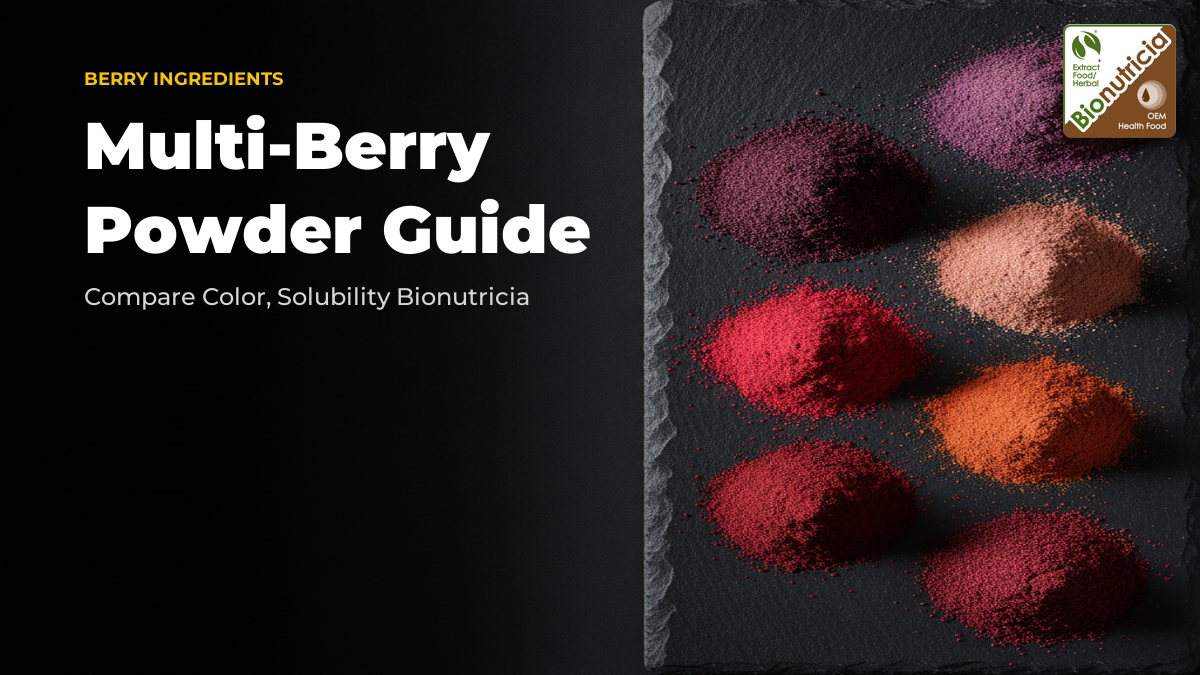
- Colour range: light pink (cranberry) through pink (blackcurrant, strawberry) to purple-red (blueberry) and deep red (roselle)
- pH response: all anthocyanin-bearing berries shift colour with pH — redder in acid, violet/blue as pH rises
- Solubility: water-soluble across all extract grades
- Typical use level: 2–8% of finished formulation for extracts; 2–10% for whole-fruit powders
- COA coverage: identity, marker level, moisture, heavy metals, microbial limits per lot
- Certifications: JAKIM Halal · FSSC 22000 · GMP · HACCP · MeSTI
- Pack sizes: 1 kg · 5 kg · 20 kg
What are berry extract powders?
Berry extract powders are concentrated, spray-dried forms of berry fruit — produced either as standardised extracts at a defined ratio (typically 20:1, meaning twenty kilograms of fruit per kilogram of powder) or as whole-fruit powders that retain the berry’s complete flavour, sugar and fibre profile. The distinction matters for formulation: a 20:1 extract concentrates the marker compounds (anthocyanins, PACs, D-mannose) into a compact, dosable ingredient with a verified marker level on the COA, while a whole-fruit powder delivers authentic taste and colour at higher inclusion rates. Bionutricia produces both classes using its patented enzymatic ultrasonic extraction process (MY-188945-A) for the extract grades, and spray-drying for the whole-fruit grades.
The anthocyanin marker: why it drives specification
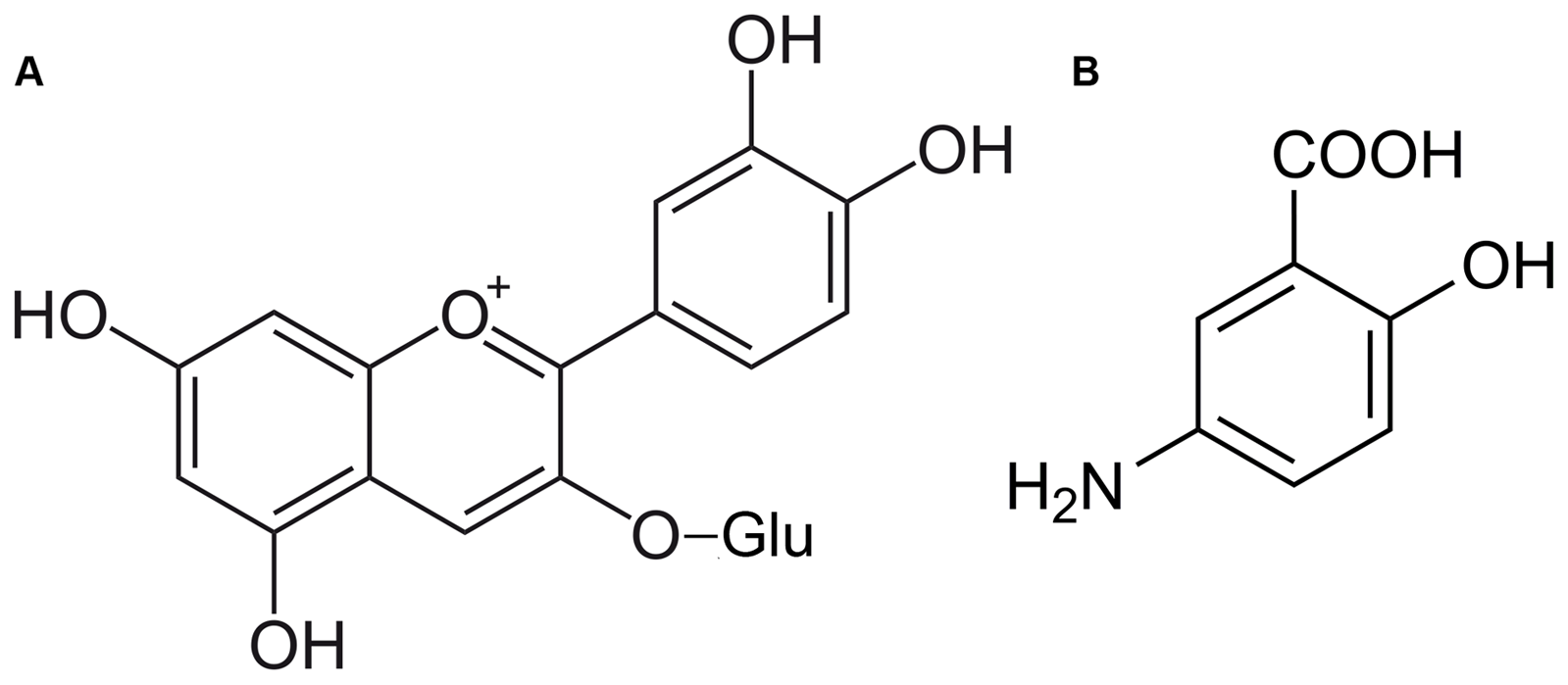
Anthocyanins are the water-soluble pigments that give most berries their red, purple and blue colour. They belong to the flavylium glycoside family — the same cyanidin-3-O-glucoside (chrysanthemin) that appears across blueberry, blackcurrant, cranberry and roselle, alongside berry-specific variants like delphinidin-3-O-rutinoside in blackcurrant and the A-type proanthocyanidins in cranberry. For a formulator, the anthocyanin profile is the single most important specification parameter because it determines three things at once: the colour the powder will produce in the finished product, the pH sensitivity of that colour (anthocyanins shift from red-pink in acidic systems toward violet and blue as pH rises), and the marker level that the COA confirms for quality control and batch-to-batch consistency.
The industry-standard method for quantifying total monomeric anthocyanins is AOAC 2005.02 (pH-differential method), with the individual pigment profile resolved by HPLC-DAD. When a buyer specifies “total anthocyanins by AOAC 2005.02,” every supplier must report against the same method — making the number directly comparable across berries and across suppliers. This is why the comparison table below reports anthocyanin data in the same units and by the same method wherever the ingredient is standardised on anthocyanins.
Berry-by-berry comparison
The table below compares the six berry and berry-adjacent ingredients Bionutricia supplies, on the parameters a formulator checks when selecting for beverage or dairy application. All data is drawn from the published specification on each ingredient’s product page and buyer’s guide.
| Berry powder | Botanical | Ratio | Marker compound | Colour | pH | Solubility | Typical use |
|---|---|---|---|---|---|---|---|
| Blueberry extract | Cyanococcus, fruit | 20:1 | Total anthocyanins 750–760 mg/kg (AOAC 2005.02); malvidin-, delphinidin- & cyanidin-3-O-glucoside | Purple-red | 3–5 | Water-soluble | 2–8% |
| Blackcurrant extract | Ribes nigrum, fruit | 20:1 | 1% total anthocyanins; delphinidin- & cyanidin-3-O-rutinoside (HPLC); native vitamin C | Pink | 3–5 | Water-soluble | 2–8% |
| Cranberry extract | Vaccinium macrocarpon, fruit | 20:1 | 2.5% proanthocyanidins (PACs) & 40% D-mannose | Light pink | 3–5 | Water-soluble | 2–8% |
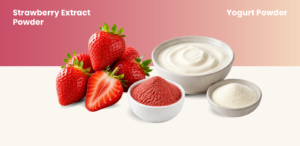
| Strawberry powder | Fragaria × ananassa, fruit | Whole-fruit (spray-dried) | Anthocyanins (pelargonidin-based); natural flavour & colour | Pink-red | 3–5 | Water-soluble | 2–10% |
| Hawthorn powder | Crataegus monogyna, fruit | Extract powder | Flavonoids (vitexin, rutin, hyperoside) | Reddish-brown | 3–5 | Water-soluble | 2–8% |
| Roselle extract | Hibiscus sabdariffa, calyx | Extract powder | Anthocyanins (delphinidin- & cyanidin-3-O-sambubioside | Deep red | 2–4 | Water-soluble | 2–8% |
How to choose the right berry powder for your application
Beverage formulation
For ready-to-drink beverages and powder drink mixes, solubility and colour stability at the product’s pH are the primary selection criteria. All the extract grades in the table above are water-soluble and disperse cleanly into liquid systems. Anthocyanin-rich berries (blueberry, blackcurrant, roselle) deliver vivid colour that shifts with pH — a blueberry extract gives purple-red in an acidic beverage (pH 3–4) but drifts toward blue-grey at neutral pH, which matters for functional waters and near-neutral dairy drinks. Roselle produces a striking deep red that holds well in acidic beverages and cordials. Cranberry, with its lighter pink shade and PAC/D-mannose marker set, is chosen when the formulation story is about those specific compounds rather than intense colour. Strawberry whole-fruit powder brings authentic flavour alongside its pink colour, making it the natural choice for milkshake and smoothie premixes where taste matters as much as appearance.
Dairy formulation
Dairy systems — yoghurt, ice cream, flavoured milk — typically run at pH 4–5 for cultured products and pH 6–7 for milk-based drinks. At these pH values, anthocyanin colour shifts toward violet and can appear dull or greyish in near-neutral milk. For dairy, blueberry and blackcurrant work well in yoghurt and acidic dairy desserts where the pH is low enough to hold the red-pink range. For neutral-pH dairy, consider strawberry (where flavour carries the product and the pink is acceptable) or pair an anthocyanin berry with a stabiliser system that buffers the colour. Cranberry is compatible with dairy but its light pink is subtle; it is more commonly used in supplement drink powders and sachet blends. All berry powders should be tested at the finished product’s pH and process temperature before scale-up, as anthocyanins fade with prolonged heat and light exposure.
Supplement and functional blends
For sachet drink powders, pouch beverages and supplement blends, the marker compound drives selection. Cranberry is specified when the formulation targets PACs and D-mannose. Blueberry and blackcurrant are chosen for their anthocyanin content, with blackcurrant’s delphinidin-3-O-rutinoside profile offering a distinct fingerprint. Hawthorn brings a flavonoid profile (vitexin, rutin, hyperoside) that differentiates it from the anthocyanin-led berries. Roselle offers both anthocyanin colour and a tart, refreshing flavour profile that works in functional beverage formats.
COA requirements for berry powders
A complete Certificate of Analysis for a berry extract powder should cover:
- Identity: botanical name, plant part, extraction ratio
- Marker level: total anthocyanins (AOAC 2005.02), PACs, D-mannose or flavonoids — the lot value, not a “typical” figure
- Physical: appearance, colour, odour, particle size (>95% through 60 mesh), moisture (<10%)
- Heavy metals: arsenic <0.1 ppm, lead <0.2 ppm, mercury <0.05 ppm
- Microbial: APC <10⁴ cfu/g, yeast & mould <10³ cfu/g, coliforms <10² cfu/g, E. coli absent
- Solubility: confirmed water-soluble
- Clean label: vegan, non-GMO, gluten-free (<20 ppm), not irradiated, no listed allergens
- Certifications: JAKIM Halal, FSSC 22000, GMP, HACCP, MeSTI — verifiable, not claimed
Every Bionutricia berry extract ships with a lot-specific COA carrying the release data for that production batch — not a generic specification sheet. For help interpreting marker levels against extraction ratios, see the guide to reading a botanical extract Certificate of Analysis.
Why buy berry powders from Bionutricia?
Bionutricia Extract has manufactured standardised botanical and fruit extracts in Malaysia since 2006, running the patented enzymatic ultrasonic extraction process (MY-188945-A) under a full halal and international food-safety stack — JAKIM Halal, FSSC 22000, GMP, HACCP and MeSTI. The facility is registered with the US FDA and holds NanoVerify validation. Every berry extract lot ships with a Certificate of Analysis, and the powders are produced without added fillers, artificial colours or preservatives. Bulk supply, custom standardisation and OEM packing are available for brand and manufacturer customers building premium berry-based beverages, dairy products and supplement blends. Bionutricia also supplies a mixed berries standardised extract powder for buyers who want a multi-berry profile in a single ingredient.
Frequently asked questions
Which berry powder gives the strongest natural colour? Blueberry and roselle deliver the most intense colour — purple-red and deep red respectively — because of their high anthocyanin content. Blackcurrant gives a vivid pink. Cranberry produces a lighter, subtler pink. All anthocyanin-based colours shift with pH: redder in acidic systems, shifting toward violet as pH rises.
What is the difference between a 20:1 extract and a whole-fruit powder? A 20:1 extract concentrates twenty kilograms of fruit into one kilogram of powder, standardising the marker compounds (anthocyanins, PACs, D-mannose) to a verified level on the COA. A whole-fruit powder (like strawberry) retains the complete flavour, sugar and fibre profile of the berry but at a lower marker concentration, and is dosed at a higher inclusion rate (2–10%).
Are all Bionutricia berry powders water-soluble? Yes — all the extract grades and the strawberry whole-fruit powder are soluble in water, dispersing cleanly into beverage, dairy and powder-blend systems without needing a separate solubiliser.
How do I compare anthocyanin levels across different berries? Specify total monomeric anthocyanins by the AOAC 2005.02 pH-differential method and request the HPLC profile for the individual pigments. This gives you a like-for-like comparison across berries and suppliers. Bionutricia’s blueberry grade carries 750–760 mg/kg total anthocyanins and the blackcurrant grade is standardised to 1% total anthocyanins, both confirmed on the batch COA.
Can I get a mixed berry powder instead of buying each one separately? Yes — Bionutricia supplies a mixed berries standardised extract powder that combines multiple berry profiles in a single ingredient. For custom blends or specific marker targets, request a quotation with your specification.
Request a bulk berry powder quote →