Blueberry Extract Powder (Cyanococcus) — Bulk B2B Supplier
Blueberry extract powder is a water-soluble 20:1 extract of blueberry (Cyanococcus) fruit, standardized to its natural anthocyanins — the purple-red pigments that also serve as its antioxidant marker — in a stable powder for B2B and OEM use across beverages, dairy, desserts, jam and jelly, bakery, confectionery and supplement blends. It is manufactured in bulk by Bionutricia Extract (Bionutricia Manufacturing Sdn Bhd), a JAKIM Halal, FSSC 22000, GMP, HACCP and MeSTI manufacturer in Malaysia, with a Certificate of Analysis on every lot.
Quick facts for formulators
- Botanical / part: Blueberry (Cyanococcus), fruit
- Extraction ratio: 20:1
- Marker compound: anthocyanins — total anthocyanins 750–760 mg/kg (AOAC 2005.02 pH-differential)
- Function: natural purple-red colour & anthocyanin content for F&B and supplement blends
- Form / colour / odour: purple-red fine powder, characteristic odour
- Solubility: soluble in water · Moisture: <10% · pH: 3–5
- Typical use: 2–8% of formulation · Particle: >95% / 60 mesh
- Pack sizes: 1 kg · 5 kg · 20 kg
- Certifications: JAKIM Halal · FSSC 22000 · GMP · HACCP · MeSTI · COA per lot
- Clean label: vegan, non-GMO, gluten-free (<20 ppm), soy-free, not irradiated, not a novel food, no listed allergens
- Shelf life: 24 months sealed, cool & dry · Origin: Malaysia
- Heavy metals: As <0.1 · Pb <0.2 · Hg <0.05 ppm · Microbial: within limits
What is blueberry extract powder?
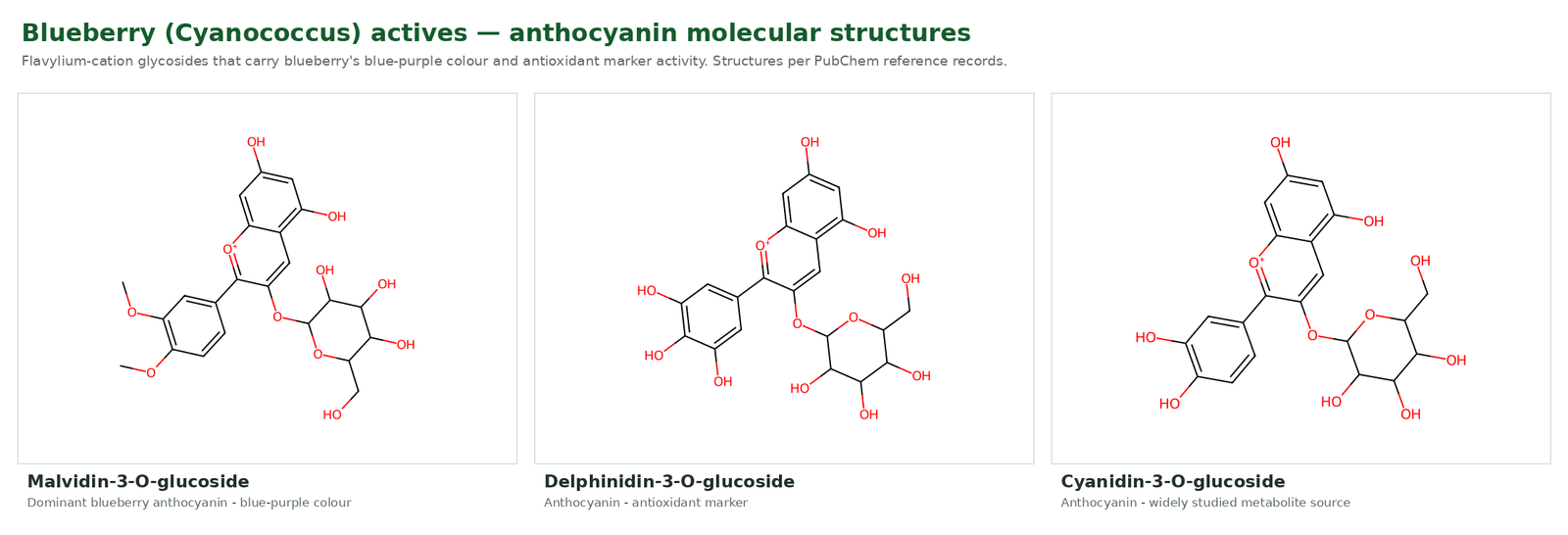
Blueberry (Cyanococcus) is the deep blue-purple fruit of the true blueberry, prized for its sweet berry flavour and its dense load of anthocyanin pigments. Those anthocyanins — water-soluble flavylium glycosides such as malvidin-, delphinidin- and cyanidin-3-glucoside — give the fruit its colour and are the marker used to characterise blueberry ingredients. Bionutricia's blueberry extract powder is a 20:1 extract of the fruit, concentrated and dried into a stable, purple-red, water-soluble powder that carries the natural anthocyanins, giving formulators a consistent, easy-to-handle colour-and-antioxidant raw material in place of variable whole-fruit inputs.
What is it used for in formulation?
It is used as a bulk raw ingredient wherever a natural berry colour, a blueberry note or an anthocyanin content is wanted: beverages and ready-to-drink products; dairy, yoghurt, ice cream and desserts; jam, jelly and fruit fillings; bakery and confectionery; and supplement drink powders and blends. Because it is water-soluble it disperses readily into liquid systems, and it is dosed to the target colour depth and berry intensity — a typical use level is 2–8% of the finished formulation. Bionutricia supplies the bulk ingredient for B2B formulation; brand owners and manufacturers formulate it into their chosen finished format, whether a beverage, a sachet or a dry powder blend.
Typical specification
| Parameter | Value |
|---|---|
| Botanical origin / part | Blueberry (Cyanococcus), fruit |
| Extraction ratio | 20:1 |
| Marker compound | Anthocyanins — total anthocyanins 750–760 mg/kg (AOAC 2005.02) |
| Appearance / colour | Fine powder, purple-red |
| Odour | Characteristic |
| Solubility in water | Soluble |
| Moisture | < 10% |
| pH | 3–5 |
| Particle size / mesh | > 95% through 60 mesh |
| Typical use level | 2–8% of the finished formulation |
| Heavy metals (As, Pb, Hg) | As < 0.1 ppm, Pb < 0.2 ppm, Hg < 0.05 ppm |
| Microbial (APC, Y&M, coliform, E. coli) | APC < 10⁴ cfu/g, Y&M < 10³ cfu/g, coliforms < 10² cfu/g, E. coli absent |
| Certifications | JAKIM Halal, FSSC 22000, GMP, HACCP, MeSTI |
| Shelf life | 24 months sealed, cool & dry |
| Pack sizes | 1 kg, 5 kg, 20 kg |
| Country of origin | Malaysia |
Blueberry's actives and the published clinical research
Blueberry's defining constituents are its anthocyanins — water-soluble flavylium glycosides, led in blueberry by malvidin-, delphinidin- and cyanidin-3-O-glucoside, alongside a contribution of vitamin C. The industry-standard way to specify them is total monomeric anthocyanins by the AOAC 2005.02 pH-differential method, with the individual pigment profile resolved by HPLC-DAD. Bionutricia's house grade carries a total anthocyanin content of 750–760 mg/kg, confirmed on the batch COA. This is the same marker set a formulator uses to specify blueberry in a finished product.
How the actives behave in the body. Published pharmacokinetic work shows that only a small fraction of intact anthocyanins is absorbed directly; the parent glycosides have low bioavailability (Czank et al. 2013, using a 13C-labelled tracer). Most are catabolised by the colonic microbiota into small phenolic-acid metabolites — for example protocatechuic, vanillic and hippuric acids (de Ferrars et al. 2014; Williamson & Clifford 2020). It is these circulating metabolites, rather than the parent pigment, that a controlled trial linked to the measured vascular effects (Rodriguez-Mateos et al. 2019). The metabolites and their conjugates are cleared in urine over roughly the following day.
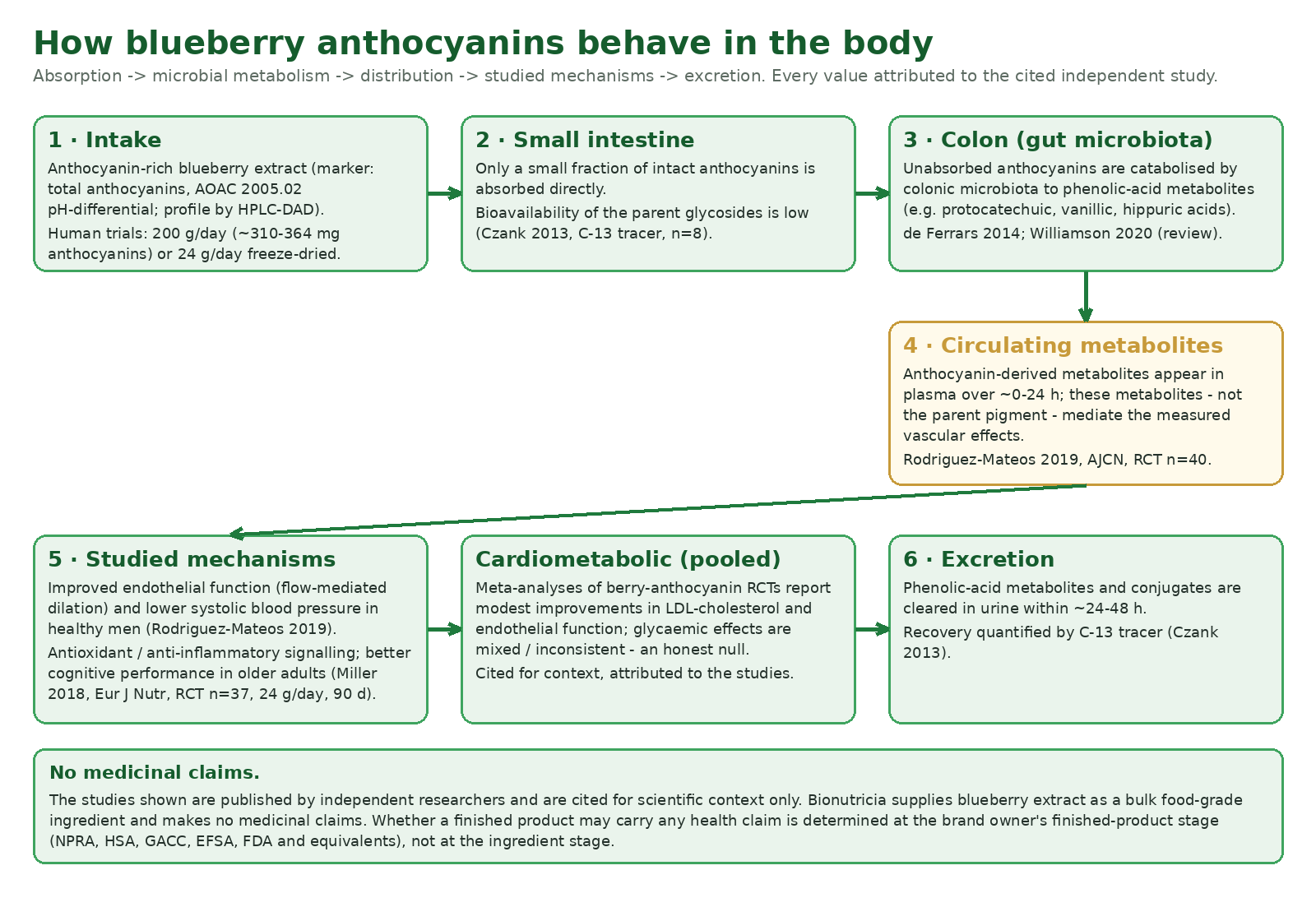
Beyond colour, anthocyanin-rich blueberry has been studied in a body of independent human clinical research:
| Published study | Design / participants | Dose & duration | Reported outcome (per the study) |
|---|---|---|---|
| Rodriguez-Mateos et al. 2019, American Journal of Clinical Nutrition | Double-blind, placebo-controlled RCT; n=40 healthy men | ~200 g/day wild blueberry (≈310–364 mg anthocyanins), 1 month | Improved flow-mediated dilation (endothelial function) and lower 24-hour systolic blood pressure vs control; circulating anthocyanin metabolites mediated the effect. |
| Miller et al. 2018, European Journal of Nutrition | Double-blind, placebo-controlled RCT; n=37 adults aged 60–75 | 24 g/day freeze-dried blueberry (~1 cup fresh), 90 days | Improved cognitive performance (task-switching and memory) vs placebo. |
| Pooled analyses of berry-anthocyanin randomised trials | Meta-analyses of RCTs | Varied anthocyanin doses, ≥4 weeks | Modest improvements in LDL-cholesterol and endothelial function; glycaemic effects were mixed and inconsistent — an honest null. |
Important: the studies above are published by independent researchers and are cited for scientific context only. Bionutricia supplies blueberry as a bulk food-grade ingredient and makes no medicinal claims. Whether a finished product may carry any health claim — and whether it is regulated as a food or as a supplement — is determined at the brand owner's finished-product stage (NPRA in Malaysia, HSA, GACC, EFSA, FDA and equivalents), not at the ingredient stage. Bionutricia can supply blueberry extract to a defined anthocyanin specification and help you navigate that claims interface.
Why buy blueberry extract from Bionutricia?
Bionutricia Extract has manufactured standardized plant and fruit extracts since 2006 under a full halal and international food-safety stack (JAKIM Halal, FSSC 22000, GMP, HACCP, MeSTI), issuing a Certificate of Analysis on every lot. Its patented (MY-188945-A) green-biotechnology process concentrates blueberry's natural anthocyanins into a clean, water-soluble powder without added fillers, flavours, preservatives or artificial colours, and bulk OEM, custom standardisation and packing are available for brand and manufacturer customers building premium colour-and-antioxidant and natural-berry products.
Frequently asked questions
Is it halal certified? Yes — JAKIM Halal (verifiable on the Halal Malaysia portal), plus FSSC 22000, GMP, HACCP, MeSTI; COA per lot.
Standardized to what / is a COA available? 20:1 water-soluble fruit extract standardized to its natural anthocyanins — total anthocyanins 750–760 mg/kg (AOAC 2005.02, profile by HPLC); purple-red fine powder, moisture <10%, pH 3–5; COA per lot.
What colour does it give? A purple-red to blue colour from anthocyanins that shifts with pH, plus a natural berry note (supplied as a compositional colour/antioxidant ingredient; no health claims).
How is it dosed / is it water soluble? Soluble in water; typically used at 2–8% of the finished formulation, or to the target colour depth in food and beverage systems.
Plant & origin? Blueberry (Cyanococcus) fruit, manufactured into extract powder in Malaysia.
Clean-label option? Vegan, non-GMO, gluten-free (<20 ppm), soy-free, not irradiated, not a novel food; no listed allergens; no added fillers, flavours, preservatives or artificial colours.
Applications? Beverages and RTD, dairy and desserts, ice cream, jam and jelly, bakery and confectionery, and supplement drink powders and blends.
Pack sizes, MOQ & lead time / OEM & samples? 1 kg · 5 kg · 20 kg; pre-order packing ~1–2 weeks; bulk MOQ & pricing on quotation; OEM, custom standardisation and paid samples for serious B2B enquiries.
View the blueberry extract product page & request a bulk quote →