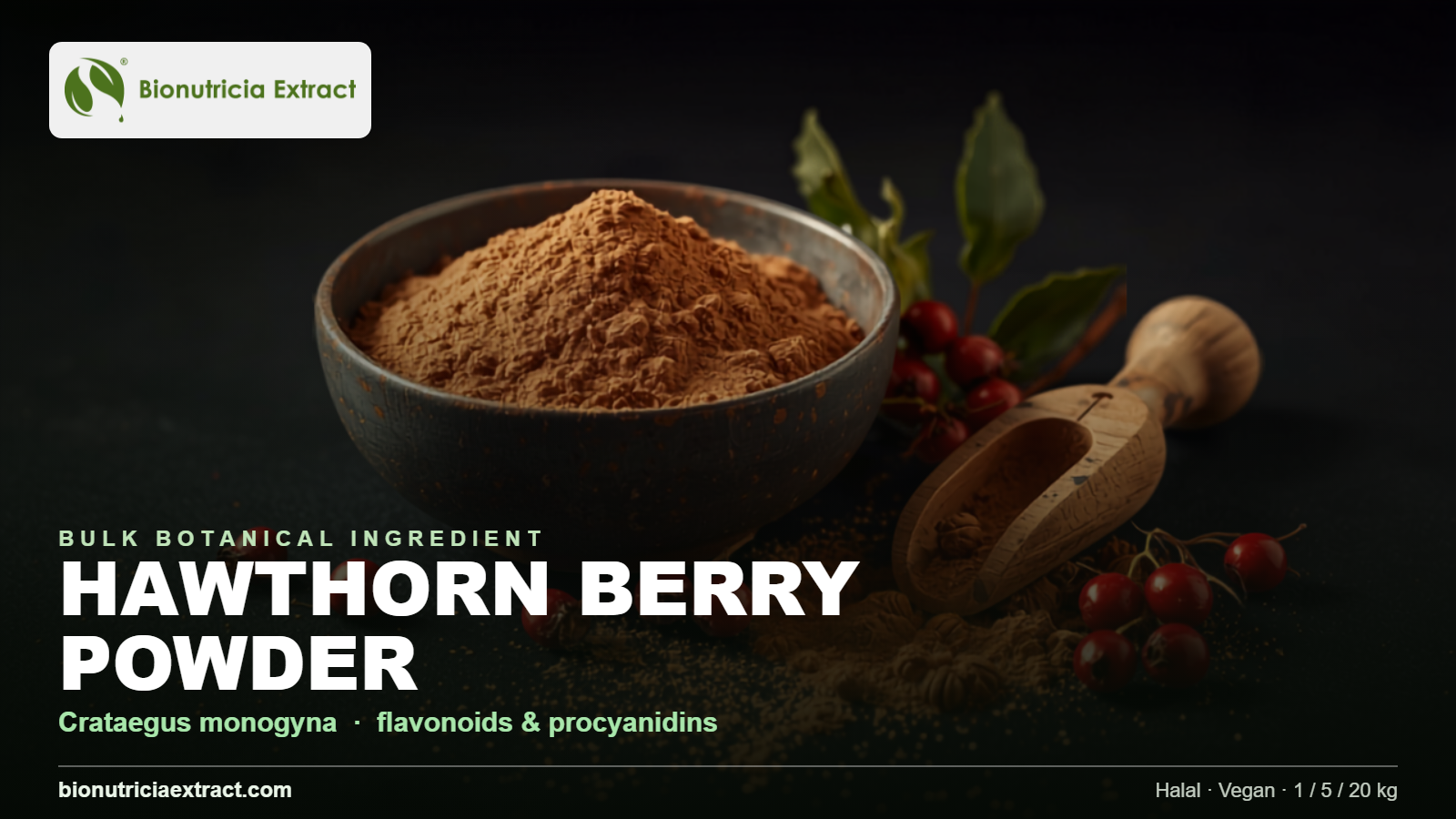
Hawthorn berry powder is a brown, food-grade powder milled from dried hawthorn fruit (Crataegus monogyna), carrying the berry’s native flavonoids, oligomeric procyanidins and chlorogenic acid. Bionutricia Extract supplies it in bulk to brand owners and manufacturers who formulate it into their own finished teas, beverages, capsules, tablets and functional foods.
Fruit (berry) powder
Halal (JAKIM)
Vegan · Non-GMO
1 kg · 5 kg · 20 kg
B2B bulk ingredient
Quick facts
| Botanical / part | Crataegus monogyna — dried fruit (haws) |
| Form | Brown powder, milled from dried hawthorn berry |
| Characteristic constituents | Flavonoids (hyperoside, vitexin, rutin, quercetin), oligomeric procyanidins (OPC), chlorogenic acid, triterpenic acids |
| Standardisation marker | Total flavonoids / oligomeric procyanidins — assayed by UV-spectrophotometry & HPLC (pharmacopoeial approach); marker specification on request |
| Typical dosage | 1–10 g (set by the customer’s finished-product format) |
| Pack sizes | 1 kg, 5 kg, 20 kg |
| MOQ & pricing | On quotation |
| Certifications | FSSC 22000, GMP, HACCP, JAKIM Halal, US FDA registered, MeSTI, plus NanoVerify |
| Origin | Malaysia |
What is hawthorn berry powder?
Hawthorn berry powder is simply the dried fruit of the hawthorn shrub (Crataegus monogyna, family Rosaceae) milled to a fine, brown, free-flowing powder. It is a whole-fruit powder — the berry is dried and ground, so it retains the full native profile of the fruit rather than being reduced to a single isolated compound. Hawthorn, known as shan zha in traditional Chinese food and herbal practice, has a long history of culinary and traditional use in teas, tonics, preserves and confectionery.
As a bulk raw ingredient, it is supplied to manufacturers who blend it into their own finished formats. Bionutricia Extract does not sell finished consumer dosage forms; brand owners and factories formulate the powder into their chosen product — a tea, a beverage, a capsule, a tablet, a gummy or a baked good.
What are the active compounds in hawthorn, and how are they measured?
Hawthorn is one of the more thoroughly characterised food botanicals. Its fruit is rich in polyphenols, and three groups matter most to a formulator:
Flavonoids — more than 60 flavonoids have been identified in hawthorn, including hyperoside, vitexin, rutin and quercetin. In pharmacopoeial monographs (e.g. European Pharmacopoeia hawthorn), flavonoids are one of the two standard markers, typically quantified by UV-spectrophotometry expressed as hyperoside.
Oligomeric procyanidins (OPC) — the reduced, catechin-derived polyphenols. OPC is the second pharmacopoeial marker and the constituent to which the best-studied clinical extracts are standardised (for example, the reference extract WS 1442 is standardised to 18.75% oligomeric procyanidins). OPC is assayed by spectrophotometric and HPLC methods.
Chlorogenic acid and triterpenic acids — chlorogenic acid is the dominant phenolic acid of the fruit; triterpenic acids (e.g. ursolic and oleanolic acids) are characteristic minor constituents.
Honest framing for technical buyers: our product is a whole-berry powder, not a solvent extract standardised to a fixed procyanidin percentage. It carries the fruit’s native marker profile; it is not equivalent to a concentrated, standardised drug extract. Where a customer needs a defined flavonoid or OPC figure, we state the marker specification and provide the batch certificate of analysis, and we can advise on standardisation for the customer’s own finished product.
What does the published clinical research show?
Most human research on hawthorn has used standardised leaf-and-flower extracts (again, WS 1442 is the reference), not whole-berry powder. The evidence below is presented as it appears in the published literature and is attributed to each study — it is not a claim for this ingredient or for any finished product made from it.
| Study | Design & dose | Result (as published) |
|---|---|---|
| SPICE Holubarsch et al., Eur J Heart Fail, 2008 |
Randomised, placebo-controlled trial, n=2,681, NYHA II–III, WS 1442 (18.75% OPC) 900 mg/day for 24 months, added to standard therapy | No statistically significant effect on the composite primary cardiac endpoint — reported openly because an honest negative is more useful to a formulator than an overstated positive |
| Cochrane systematic review Pittler, Guo & Ernst |
Meta-analysis of 10 randomised trials, n=855, hawthorn extract as adjunct in chronic heart failure (NYHA I–III) | Reported improvements in maximal workload and the pressure–heart-rate product versus placebo in the pooled adjunctive data |
| HERB-CHF Zick et al., 2009 |
Small randomised, placebo-controlled trial, standardised hawthorn extract as adjunct | Quality-of-life and functional endpoints examined; small sample size limits conclusions |
The picture is genuinely mixed: a very large 24-month trial did not meet its primary endpoint, while a pooled analysis of smaller trials reported functional benefits. That nuance is exactly what a serious product developer needs when deciding how to position a hawthorn ingredient.
Hawthorn: the human evidence at a glance
Specification
| Parameter | Specification |
|---|---|
| Appearance | Brown powder |
| Odour | Characteristic |
| pH | 3.5 – 4.5 |
| Moisture | < 10% |
| Solubility in water | Soluble with sediments |
| Particle size | ≥ 95% through 60 mesh |
| Arsenic / Lead | < 1 ppm / < 1 ppm |
| Cadmium / Mercury | < 0.5 ppm / < 0.1 ppm |
| Total plate count | ≤ 10,000 CFU/g |
| Yeast & mould | ≤ 1,000 CFU/g |
| E. coli / Salmonella | Absent |
| Coliforms | ≤ 100 CFU/g |
| Clean-label | Vegan, non-GMO, not irradiated, not a novel food, gluten-free (< 20 ppm), no Annex II allergens |
Pack sizes 1 kg, 5 kg and 20 kg. Full specification and the batch certificate of analysis are provided on request. Version 02 (Aug 2024) house specification.
How is it used in finished products?
Hawthorn berry powder is a versatile food-grade ingredient. Because it is water-soluble (with sediments) and pleasantly tart, it is commonly formulated into hawthorn teas and infusions, fruit beverages and syrups, jellies and preserves, confectionery and bakery, and botanical supplement blends in capsule, tablet, sachet or stick-pack format. The customer selects the dose and the finished format; we supply the bulk ingredient and its documentation.
Where does regulatory classification sit for a bulk ingredient?
Bionutricia Extract supplies hawthorn berry powder as a bulk ingredient for B2B formulation. Whether a customer’s finished product is registered as a food, a food supplement or something else is decided at that customer’s finished-product stage, in their market — it is not a property of the bulk powder itself. We support that step with a clear specification and certificate of analysis so the brand owner or manufacturer can complete their own registration and labelling correctly.
Specification, marker detail and batch COA on request — 1 kg, 5 kg and 20 kg.
Frequently asked questions
What is the botanical source of Bionutricia’s hawthorn powder?
It is the dried fruit of Crataegus monogyna (family Rosaceae), milled to a brown powder. The species name follows our current house specification.
Is it an extract or a whole-berry powder?
It is a whole-berry powder — dried hawthorn fruit milled to a fine powder. It is not a solvent extract standardised to a fixed procyanidin percentage. This is stated plainly so buyers can match it to the right application.
What is the standardisation marker?
Flavonoids and oligomeric procyanidins are the pharmacopoeial markers for hawthorn, assayed by UV-spectrophotometry and HPLC. As a whole-fruit powder it carries the native marker profile; the batch marker figure is provided on the certificate of analysis.
Does the clinical research apply to this powder?
The major human trials used standardised leaf-and-flower extracts (such as WS 1442), not whole-berry powder. We cite that research attributed to each study for context; it is not a claim for this ingredient or for finished products made from it.
Is it halal and vegan?
Yes. The ingredient is JAKIM Halal and is suitable for vegetarians and vegans, being free of animal products or derivatives. Bionutricia Extract’s facility also holds FSSC 22000, GMP, HACCP, US FDA registration and MeSTI, plus NanoVerify.
What pack sizes and lead time apply?
Standard bulk packs are 1 kg, 5 kg and 20 kg. As a freshly-milled pre-order item, typical lead time is 1–2 weeks. MOQ and pricing are on quotation.
How should it be stored?
Store in sealed, hygienic containers in a cool, dry place away from pests. Shelf life is 2 years when properly stored.
Can you support our product registration?
Yes. We provide the specification and batch certificate of analysis that a brand owner or manufacturer needs for their own finished-product registration and labelling in their market.