Arabic Gum & Monk Fruit Extract Powder Blend — Bulk B2B Supplier Guide
Direct answer: An arabic gum and monk fruit extract powder blend pairs two functionally different bulk ingredients for one formulation job: arabic gum (Acacia senegal, also called gum acacia) supplies emulsification, bulk and soluble fibre, while monk fruit (Siraitia grosvenorii) extract supplies intense natural sweetness from its mogroside compounds at a very small dose. Formulators combine them because a high-intensity sweetener like monk fruit extract is used at such a low inclusion rate — its main sweetening compound, mogroside V, is naturally far sweeter than sucrose gram-for-gram — that it cannot carry a finished powder blend on its own. It has no bulk, no mouthfeel and no emulsifying capacity. Arabic gum fills exactly that gap: it disperses in water, stabilises fat/water interfaces in beverages, and adds soluble dietary fibre and body to the finished mix. Buyers evaluating a supplier for this blend should ask for the fibre content and mogroside content of each raw material, the emulsifier/carrier identity, halal and food-safety certification, clean-label declarations (vegan, non-GMO, allergen status), and shelf-life and storage data for both components — the same specification questions used for any two-ingredient bulk premix. This guide sets out what each ingredient contributes, how Bionutricia manufactures and supplies both, and what to check before placing a bulk order.
What Is an Arabic Gum & Monk Fruit Extract Powder Blend?
It is a bulk B2B premix concept — not a single finished consumer product — that combines two raw ingredients Bionutricia already supplies individually: Arabic gum (Acacia senegal) powder and monk fruit (Siraitia grosvenorii) extract powder. Brand owners and manufacturers formulate the two together — either as a custom-blended premix or as two components dosed separately into the same batch — to build sugar-reduced beverage powders, bakery fillings, dry-mix beverages and similar applications where a natural sweetener needs a carrier that also improves texture and mouthfeel.
Why These Two Ingredients Are Formulated Together
Arabic gum is a natural gum consisting of the hardened sap of the acacia tree species Senegalia senegal and Vachellia seyal. It is produced by dissolving the raw gum resin in hot water, filtering, and spray-drying it into a powder with no binder or filler added. That process gives it strong emulsifying properties, low-pH stability, and a large particle size that dissolves into a viscous, sediment-free solution. It is also high in soluble dietary fibre — more than 85% total dietary fibre on a dry basis — which is why it is widely used in fibre-enriched formulations as well as an emulsifier.
Monk fruit extract, by contrast, contributes almost no bulk. Its sweetness comes from a small family of triterpene glycosides called mogrosides, present at roughly 1.5–2% in the dried fruit, with mogroside V as the primary sweetening compound. Because the extract is so intensely sweet, an effective formulation dose is tiny relative to the volume of a finished powder blend — leaving a functional gap in texture, dispersibility and mouthfeel that arabic gum is well suited to close. Pairing an intense natural sweetener with a natural emulsifying fibre carrier is a standard approach in sugar-reduction formulation, and it is the reason the two ingredients are frequently requested together by the same B2B buyer.
Where Monk Fruit’s Sweetness Comes From
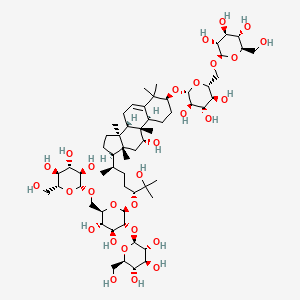
The compound responsible for most of monk fruit extract’s sweetening power is mogroside V, a triterpenoid glycoside. Its structure — a cucurbitane-type triterpene backbone carrying several sugar (glucose) units — is what gives it a sweet taste profile without contributing meaningfully to caloric load, which is why extract manufacturers standardise monk fruit powder to its mogroside content rather than to a generic “extract ratio.”
How Bionutricia Manufactures and Supplies Both Ingredients
Bionutricia Extract supplies both raw materials in bulk powder format for B2B formulation. The arabic gum powder is produced by dissolving, filtering and spray-drying the raw gum resin — no added binder or filler — which is what preserves its emulsifying strength. The monk fruit fraction is produced under Bionutricia’s patented enzymatic ultrasonic extraction (MY-188945-A), a green-biotech-assisted process used across Bionutricia’s standardised botanical fractions to produce a consistent, mogroside-standardised powder for formulators.
For brand owners who want to add a liposomal-delivered active — a phyto-active, vitamin, mineral or amino acid — into the same finished sugar-reduction blend, Bionutricia separately offers Herbosomal® — Bionutricia’s proprietary liposomal encapsulation and sustained-release technology (registered trademark; patent-pending PI2023005773) as an available manufacturing option for that additional component. This is a distinct capability offered alongside the arabic gum and monk fruit blend, not a claim about the arabic gum or monk fruit powders themselves.
Approved OEM output formats for a finished blend include powder sachets, liquid sachets, gel sachets, pouch beverages, chewable tablets and liquid bottles.
Composition Snapshot — What Each Ingredient Brings to the Blend
| Attribute | Arabic Gum (Acacia senegal) Powder | Monk Fruit (Siraitia grosvenorii) Extract Powder |
|---|---|---|
| Functional role | Emulsifier, bulking agent, soluble fibre carrier | High-intensity natural sweetener |
| Key compositional marker | >85% total dietary fibre (dry basis) | Mogroside V ~1.5–2% of dried fruit |
| Solubility | Dissolves in water; forms a viscous, sediment-free solution | Water-soluble extract powder |
| pH behaviour | Stable in low-pH systems | Not applicable — used at very low inclusion levels |
| Clean-label status | Vegan, non-GMO, no fillers, no flavours, no additives, no preservatives, no artificial colours, soy and gluten free | Vegan, non-GMO, no fillers, no flavours, no additives, no preservatives, no artificial colours, soy and gluten free |
| Shelf life | 24 months sealed, below 25°C, RH below 65% | 24 months sealed, below 28°C |
| Typical formulation dose (as supplied individually) | 0.2–6% of total formulation weight | Used at very small inclusion rates due to sweetness intensity |
These figures describe each raw material as supplied individually; a combined blend ratio is set to the buyer’s own target sweetness, texture and label requirements and confirmed on the batch specification and Certificate of Analysis.
Formulation and Application Notes
In beverage systems, arabic gum stabilises the fat/water interface and prevents sedimentation, which is useful when a monk fruit-sweetened drink also carries flavour oils, colour or a cloudy visual profile. In bakery applications, arabic gum is traditionally used in fillings, frostings and glazes to emulsify fat/water interfaces and to give a glossy, tacky finish, while monk fruit extract replaces some or all of the added sugar without contributing the same bulk — meaning the formulator typically needs to replace lost bulk with arabic gum, another fibre, or a bulking agent appropriate to the recipe. For dry-mix sachets and powdered drink premixes, both ingredients are supplied as free-flowing powders that can be dry-blended directly, subject to the buyer’s own compatibility testing with other actives, flavours and colours in the finished formula.
Supplier Qualification Checklist
- Compositional data: total dietary fibre content for the arabic gum lot; mogroside content for the monk fruit extract lot.
- Process disclosure: confirm whether the monk fruit fraction is produced by a standardised extraction process, and request the carrier/processing method for the arabic gum powder.
- Certificates: Certificate of Analysis per lot for both ingredients, plus food-safety and halal certification for the manufacturing facility.
- Clean-label declarations: written confirmation of vegan, non-GMO, allergen and gluten-free status for each raw material.
- Physical specification: particle size, moisture content and solubility behaviour, since both properties affect dry-blend performance and dissolution.
- Storage and shelf-life data: sealed shelf life and recommended storage temperature/humidity for both components.
Why Supply This Blend From Bionutricia
Bionutricia Extract has manufactured specialty nutritional and food ingredients in Malaysia since 2006, in a facility holding FSSC 22000, GMP, HACCP, JAKIM Halal and MeSTI certification, with US FDA registration and a Certificate of Analysis issued on every lot. Both arabic gum powder and monk fruit extract powder are supplied as bulk raw ingredients for B2B formulation, with custom blending and packing available for brand owners and manufacturers building their own finished sugar-reduction products. For a related formulation reference, Bionutricia’s MCT oil powder bulk supplier guide also documents arabic gum’s role as a natural emulsifying carrier in a different application.
Frequently Asked Questions
What is an arabic gum and monk fruit extract powder blend used for in bulk B2B formulation? It combines a natural emulsifying fibre carrier (arabic gum) with an intense natural sweetener (monk fruit extract) to formulate sugar-reduced beverage powders, bakery fillings and dry-mix drink premixes, where the sweetener alone cannot supply bulk, texture or emulsification.
Why is arabic gum used alongside monk fruit extract rather than on its own? Monk fruit extract is used at a very small inclusion rate because of its sweetness intensity, so it contributes almost no bulk, mouthfeel or emulsifying capacity to a finished formulation. Arabic gum supplies exactly those missing functions — dispersibility, emulsification and soluble fibre — which is why the two are commonly requested together.
What is the shelf life and storage requirement for these bulk powders? Both ingredients carry a 24-month shelf life in original sealed packaging when stored cool and dry; arabic gum specifies below 25°C and relative humidity below 65%, while monk fruit extract specifies below 28°C.
Are arabic gum and monk fruit extract powder vegan, non-GMO and allergen-free? Both raw materials are supplied as vegan, non-GMO, with no fillers, flavours, additives, preservatives or artificial colours, and are soy and gluten free, based on Bionutricia’s published product specifications.
What formats can Bionutricia supply this blend in for OEM production? Approved output formats include powder sachets, liquid sachets, gel sachets, pouch beverages, chewable tablets and liquid bottles, with bulk raw-material supply, custom blending and packing available for brand owners and manufacturers.
Related Bulk B2B Supplier Guides
- Arabic Gum (Acacia senegal) Powder — bulk product page
- Monk Fruit Extract Powder — bulk product page
- MCT Oil Powder (Medium Chain Triglyceride) — Bulk B2B Supplier