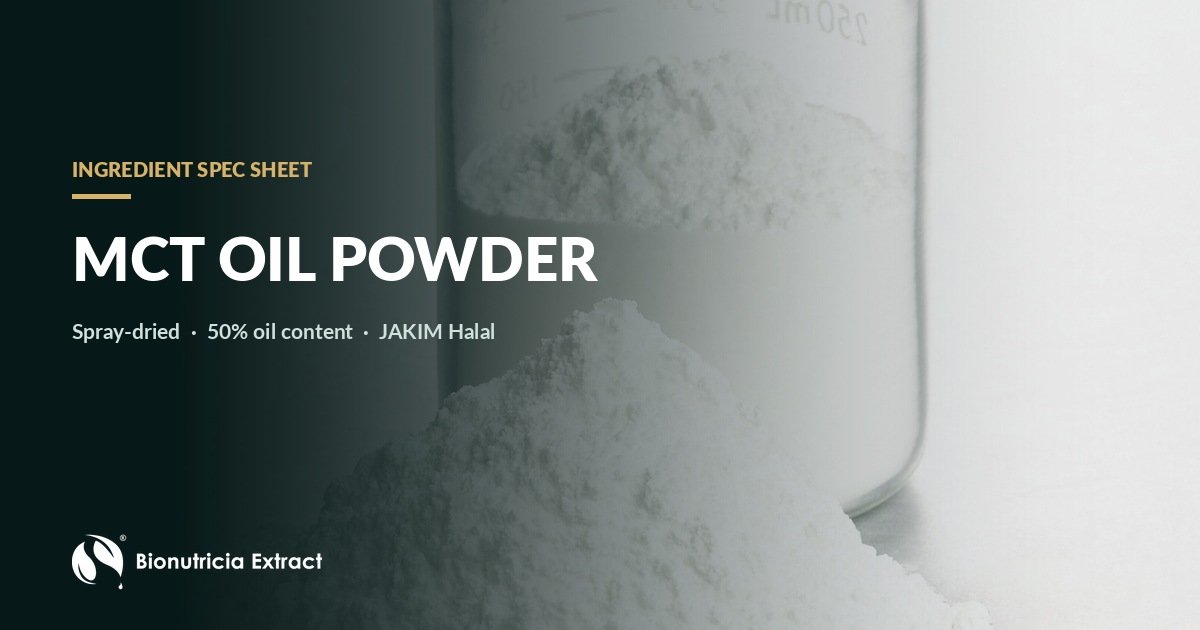
MCT Oil Powder (Medium Chain Triglyceride) — Bulk B2B Supplier
MCT oil powder is spray-dried medium chain triglyceride oil, converted from a liquid into a free-flowing, water-dispersible powder with an oil content of 50 ± 2%. It lets formulators dry-blend MCT into sachets, drink powders, creamers, bakery mixes and supplement blends without handling a liquid oil. It is manufactured in bulk by Bionutricia Extract (Bionutricia Manufacturing Sdn Bhd) in Malaysia — a JAKIM Halal, FSSC 22000, GMP, HACCP and MeSTI facility — with a Certificate of Analysis on every lot.
This page is both the product monograph and a technical buyer’s guide: the house specification, the carrier decision that determines whether a powder is usable in your market, what to request from any MCT powder supplier, dry-mix stability testing, and a supplier qualification checklist. The bulk ingredient itself is listed on the bulk MCT oil powder product page.
Quick facts for formulators
- Ingredient type: spray-dried medium chain triglyceride (MCT) oil powder
- Oil content: 50 ± 2%
- Fatty acid profile: C8:0 caprylic acid 28–33% · C10:0 capric acid 17–22%
- Emulsifier / carrier: arabic gum — not sodium caseinate, so the powder stays dairy-free, vegan and halal-friendly
- Form / colour / odour: non free-flowing powder, creamy white to light yellow, characteristic odour
- Solubility: soluble in water — constant stirring required
- Moisture: <5% · Particle: >95% / 20 mesh
- Typical use level: 2–8% of the finished formulation
- Pack sizes: 1 kg · 5 kg · 10 kg
- Certifications: JAKIM Halal · FSSC 22000 · GMP · HACCP · MeSTI · COA per lot
- Clean label: vegan, non-GMO, gluten-free (<20 ppm), not irradiated, not a novel food (EC 258/97)
- Shelf life: 24 months sealed, cool & dry · Origin: Malaysia
- Heavy metals: As ≤1 · Pb ≤2 · Hg ≤0.05 ppm · Microbial: within limits
What is MCT oil powder?
Medium chain triglycerides are fats whose fatty-acid chains are shorter than those in most dietary oils. In liquid form MCT oil is difficult to work with in a dry product: it cannot be dry-blended, it separates, and it complicates dosing and shipping. MCT oil powder solves that by spray-drying the oil onto a carrier, producing a stable, creamy-white powder with an oil content of 50 ± 2% that disperses in water with stirring. For a formulator it behaves like a powder, not an oil — which is what makes a dry sachet, stick or drink premix possible at all.
Mechanically, the oil is emulsified into a carrier solution and then spray-dried, so that each particle is a microencapsulated droplet of MCT held inside a matrix. The carrier is therefore not an inert filler: it sets the oil loading the powder can carry, how much free surface oil it releases, how it behaves in humidity, and what has to appear on the finished label.
What is it used for in formulation?
MCT oil powder is supplied as a bulk raw ingredient to brand owners and manufacturers, who formulate it into their own finished products: keto and sports drink powders, coffee creamers and instant beverage premixes, ready-to-drink beverages, meal replacements and nutrition powders, bakery and dairy applications, and supplement blends — as well as capsules, tablets or any other finished format the brand chooses to produce. It is typically used at 2–8% of the finished formulation. Because it is a spray-dried oil powder, constant stirring is needed when mixing into water.
Powder or liquid oil? Carrier systems and encapsulation choices
Use free MCT oil where an unencapsulated lipid phase is genuinely required — softgels, spoonable oils, oil-based liquids. Use MCT powder for dry-mix handling, instant beverages, sachets, sticks and powdered supplements, where a liquid oil cannot be blended, dosed or shipped sensibly. Once you choose powder, the carrier system becomes the decision that matters:
- Maltodextrin: neutral in flavour and gives good spray-drying yield, but higher-DE grades are hygroscopic and can cake or release surface oil in humid storage.
- Arabic gum (gum acacia): lower hygroscopicity and better control of free surface oil — useful in tropical and humid markets and in instant beverage systems. This is the carrier Bionutricia uses.
- Modified starches and proteins: improve mouthfeel and re-emulsification on rehydration, but protein carriers (notably sodium caseinate) bring allergen declarations with them.
- Encapsulation route: single-stage spray-drying is the baseline; multilayer systems and complex coacervation reduce free oil and improve oxidation resistance at higher oil loadings, at higher cost.
Emulsified with arabic gum — not sodium caseinate
This is the difference most buyers do not think to ask about, and it decides whether the powder is usable in your market at all. Oil cannot simply be dried into a powder: it has to be emulsified onto a carrier first, and the industry default carrier for MCT powder is sodium caseinate — a milk protein. That single choice makes the powder a dairy ingredient: it must be declared as a milk allergen, it is not vegan, and it complicates halal and dairy-free positioning.
Bionutricia emulsifies its MCT oil powder with arabic gum instead. The powder is therefore dairy-free, carries no milk allergen declaration, is suitable for vegan and plant-based claims, and sits cleanly inside a halal supply chain. For brand owners building vegan keto, plant-based sports or dairy-free creamer lines, that is not a detail — it is the whole reason a caseinate powder cannot be used. We also supply arabic gum as a bulk ingredient in its own right.
The second number worth comparing is the fatty acid split. A powder can be sold as “MCT” while carrying a large fraction of C12 lauric acid from cheap coconut fractions. Our specification commits to C8:0 at 28–33% and C10:0 at 17–22% — ask any competing supplier for those two figures and compare like for like.
Why a Halal-certified Malaysian source matters here
Most of the world’s MCT powder supply is produced in facilities that hold no halal certification, which makes it a recurring sourcing headache for brands selling into Malaysia, Indonesia, the GCC and other halal-sensitive markets. Bionutricia manufactures MCT oil powder in Malaysia in a JAKIM Halal-certified facility that is also FSSC 22000, GMP, HACCP and MeSTI certified, and issues a Certificate of Analysis on every lot. For a brand that needs a halal-credible MCT powder with documented specifications and a verifiable certificate, that combination is genuinely difficult to source elsewhere.
Typical specification
| Parameter | Value |
|---|---|
| Ingredient type | Spray-dried MCT oil powder |
| Oil content | 50 ± 2% |
| Caprylic acid (C8:0) | 28–33% |
| Capric acid (C10:0) | 17–22% |
| Emulsifier / carrier | Arabic gum (no sodium caseinate — dairy-free) |
| Appearance / colour | Non free-flowing powder, creamy white to light yellow |
| Odour | Characteristic |
| Solubility in water | Soluble (constant stirring required) |
| Moisture | < 5% |
| Particle size / mesh | > 95% through 20 mesh |
| Typical use level | 2–8% |
| Heavy metals (As, Pb, Hg) | As ≤ 1 ppm, Pb ≤ 2 ppm, Hg ≤ 0.05 ppm |
| Microbial (APC, Y&M, coliform, E. coli) | APC ≤ 10⁴ cfu/g, Y&M ≤ 10³ cfu/g, coliforms ≤ 10² cfu/g, E. coli absent |
| Certifications | JAKIM Halal, FSSC 22000, GMP, HACCP, MeSTI |
| Shelf life | 24 months sealed, cool & dry |
| Pack sizes | 1 kg, 5 kg, 10 kg |
| Country of origin | Malaysia |
Specifications to request from any MCT powder supplier
- Fatty-acid profile: the C8 and C10 split as a percentage of total FAME — not just the word “MCT”.
- Oil loading: percentage oil by weight. Market powders commonly run 35–70% depending on the carrier; ours is 50 ± 2%.
- Oxidation and quality: peroxide value (PV), p-anisidine value, TBARS and free fatty acids (FFA).
- Physical: residual moisture, bulk density, particle size and free (surface) oil percentage.
- Process and carrier: encapsulation method plus the carrier’s identity and specification — maltodextrin DE, arabic gum, modified starch or protein type.
Stability and formulation checks before commercial release
Run these on pilot batches in the finished matrix, not on the raw powder alone:
- Oil migration / free oil: solvent extraction or centrifugal methods after accelerated storage (40°C / 75% RH) and again on realistic shelf-life samples.
- Oxidation tracking: PV, p-anisidine and TBARS at T0 and at scheduled intervals through shelf life.
- Process resilience: test high-shear mixing, tableting and encapsulation for capsule and tablet formats to confirm the microcapsules survive your process.
- Sensory and reconstitution: solubility, mouthfeel and greasiness in RTD beverages and instant mixes; remember constant stirring is required on rehydration.
- Dose equivalence: derive the powder mass from the supplier’s oil loading — required powder = target oil mass divided by oil-by-weight fraction. At 50% oil content, 1 g of MCT oil equals 2 g of powder.
Supplier qualification pack, related guides and references
The minimum procurement pack you should insist on: a batch Certificate of Analysis (C8/C10, PV, FFA, moisture, microbiology, heavy metals), manufacturing and carrier specifications, an allergen control statement, packaging and barrier specification, food-safety and market certificates (GMP, HACCP, FSSC 22000, halal where relevant) and pilot-trial support from the supplier’s technical team.
- Bulk MCT oil powder — product page and enquiry
- Water-soluble vs oil-soluble botanical extracts
- Virgin Coconut Oil (VCO) powder
- Arabic gum (gum acacia) powder
Selected peer-reviewed reading on the metabolic effects of medium chain triglycerides: PMC6927614 and PMC9579472.
Why source MCT oil powder from Bionutricia?
Bionutricia Extract has manufactured specialty nutritional ingredients in Malaysia since 2006 under a full halal and international food-safety stack (JAKIM Halal, FSSC 22000, GMP, HACCP, MeSTI), issuing a Certificate of Analysis on every lot. Spray-drying an oil into a stable, dispersible powder is a process capability, not a commodity purchase, and it is one Bionutricia runs in-house. Bulk OEM, custom blending and packing are available in 1 kg, 5 kg and 10 kg packs for brand owners and manufacturers.
Frequently asked questions
What is the oil emulsified with — sodium caseinate? No. We use arabic gum as the emulsifier and carrier, not sodium caseinate. The powder is therefore dairy-free with no milk allergen declaration, vegan-suitable and halal-friendly — unlike the caseinate-based MCT powders that dominate the market.
What is the C8 / C10 profile? Caprylic acid (C8:0) 28–33% and capric acid (C10:0) 17–22%, committed on the specification and confirmed per lot.
Is it halal certified? Yes — JAKIM Halal (verifiable on the Halal Malaysia portal), plus FSSC 22000, GMP, HACCP, MeSTI; COA per lot. This is the main reason buyers come to us for MCT powder.
What is the oil content / is a COA available? The house spec commits 50 ± 2% oil content; a COA is issued per lot covering appearance, moisture, fineness, microbiology and heavy metals.
How is MCT powder made? The MCT oil is emulsified into a carrier solution and spray-dried into a free-flowing, microencapsulated powder. The carrier choice — arabic gum, maltodextrin, modified starch or protein — determines oil loading, free surface oil, humidity behaviour and label declarations.
Is it water-soluble? It disperses in water with constant stirring — as with any spray-dried oil powder. Typical use level 2–8%.
Why powder instead of liquid MCT oil? A powder can be dry-blended into sachets, drink powders, creamers and bakery mixes without the separation, dosing and shipping problems of a liquid oil.
How do I calculate the oil-equivalent dose when replacing liquid oil with powder? Divide the target oil mass by the powder’s oil-by-weight fraction from the COA. At our 50% oil content, 1 g of MCT oil equals 2 g of powder; a 45% powder would need 2.22 g.
Which carriers resist oil migration in humid climates? Arabic gum and some modified-starch blends generally hold up better than high-DE maltodextrin alone. Accelerated humidity testing (40°C / 75% RH) is essential before launching into tropical markets.
Does the powder form change MCT absorption? The fatty-acid structure is unchanged. Carriers and encapsulation can slow oil release relative to free oil and may modestly alter absorption kinetics.
What stability tests should I require from a supplier? PV, p-anisidine and FFA on the dispatch COA, plus accelerated stability data (for example 40°C / 75% RH) showing how PV evolves — then repeat the tests on your own finished blend across its shelf life.
How do I verify allergen and clean-label suitability? Confirm the carrier identity in writing and request an allergen control statement together with GMP/HACCP certificates and any export certificates such as halal or organic. If a protein carrier is used, it must be labelled accordingly.
Clean-label option? Vegan, non-GMO, gluten-free (<20 ppm), not irradiated; not a novel food under EC 258/97; no listed allergens.
Applications? Keto and sports drink powders, creamers and instant premixes, RTD beverages, meal replacements, bakery and dairy, supplement blends — and any finished format the brand owner chooses to produce.
Pack sizes & OEM? 1 kg · 5 kg · 10 kg; bulk MOQ and pricing on quotation. Bionutricia supplies the bulk ingredient for B2B formulation; brand owners and manufacturers formulate it into their chosen finished format.
Samples? Paid samples for serious B2B enquiries; bulk supply, custom blending and packing available.