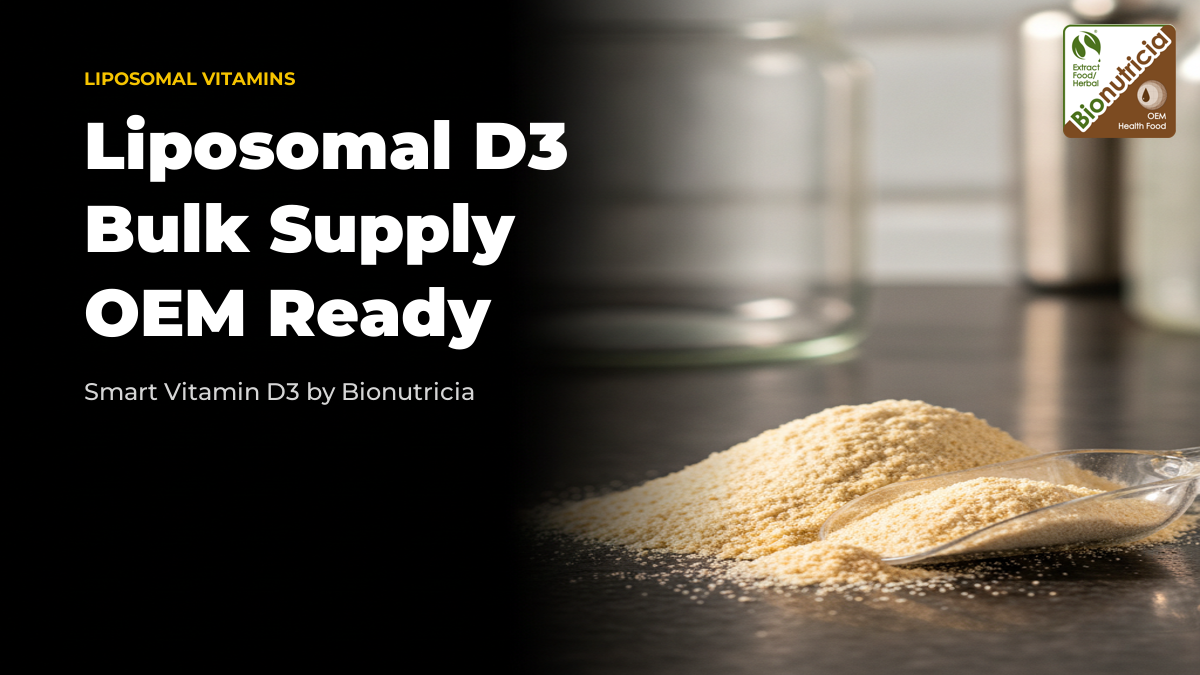
Liposomal D3 (Cholecalciferol) — Bulk B2B Buyer’s Guide for OEM and Functional Ingredient Supply
Direct answer: Liposomal D3 is a vitamin D3 (cholecalciferol) ingredient in which the vitamin is encapsulated in a phospholipid matrix using Herbosomal® — Bionutricia’s proprietary liposomal encapsulation and sustained-release technology (registered trademark; patent-pending PI2023005773). It is supplied as a bulk B2B ingredient for brand owners and manufacturers who formulate vitamin D3 supplements, fortified foods and functional beverages. This guide covers what the ingredient is, how the liposomal delivery system is described, what format it ships in, and the specification questions a buyer should raise before placing a bulk order.
Quick facts for formulators
- Ingredient: Vitamin D3 (cholecalciferol) encapsulated in a phospholipid liposomal matrix
- Technology: Herbosomal® — Bionutricia’s proprietary liposomal encapsulation and sustained-release technology (registered trademark; patent-pending PI2023005773)
- Format supplied: bulk powder for B2B formulation
- Phospholipid supplier: non-GMO sunflower lecithin (soy-free)
- Clean label: vegan where specified, non-GMO, no fillers, no flavours, no additives, no preservatives, no artificial colours, soy and gluten free
- Certifications: JAKIM Halal · FSSC 22000 · GMP · HACCP · MeSTI · US FDA registered · NanoVerify
What is Liposomal D3?
Liposomal D3 is a bulk ingredient in which vitamin D3 (cholecalciferol) is encapsulated within a phospholipid vesicle matrix. The liposomal delivery system is produced using Herbosomal® — Bionutricia’s proprietary liposomal encapsulation and sustained-release technology (registered trademark; patent-pending PI2023005773) — which is a manufacturing capability offered for ingredients where a brand owner or formulator wants a liposomal delivery format for their finished product.
Bionutricia supplies this as a bulk ingredient for B2B formulation; brand owners and manufacturers formulate it into their chosen finished format. Approved OEM output formats include powder sachets, liquid sachets, gel sachets, pouch beverages, chewable tablets and liquid bottles.
How the liposomal delivery system is described
The phospholipid matrix encloses the vitamin D3 payload within lipid vesicles. The phospholipids used are supplied from non-GMO sunflower lecithin, which is soy-free. The encapsulation process is a manufacturing technology — it describes how the ingredient is produced, not a clinical claim about absorption or efficacy. Bionutricia does not make unsupported bioavailability or enhanced-absorption claims about this ingredient.
What vitamin D3 is and why it matters
Vitamin D3 (cholecalciferol) is a fat-soluble vitamin that plays a role in calcium absorption and bone health, and is also recognised for its function in immune system regulation. It is one of the forms of vitamin D used in food fortification and dietary supplementation. The established nutritional role of vitamin D3 in calcium homeostasis and bone health is recognised in food science and regulatory frameworks — this is the general function of the vitamin as a dietary nutrient, not a therapeutic claim about this specific ingredient.
Format, packaging and specification
Liposomal D3 is supplied as a bulk powder for B2B formulation. Buyers should request and agree the following specification parameters before placing a bulk order:
- Vitamin D3 assay per gram — request the certificate of analysis showing the cholecalciferol assay value and analytical method for the specific lot.
- Phospholipid content — confirm the phospholipid identity (sunflower lecithin) and phospholipid percentage on the CoA.
- Particle size and solubility — relevant for dispersion in liquid or powder formulations.
- Moisture and water activity — for shelf stability and packaging selection.
- Microbiology limits — total plate count, yeast and mould, coliforms and pathogen screening per lot.
- Clean-label declarations — vegan, non-GMO, soy-free, gluten-free and allergen status in writing.
- Halal certification — JAKIM Halal certificate on the ingredient, not just the facility.
- Shelf life and storage conditions — confirm recommended storage temperature and shelf life on the CoA or product data sheet.
Why supply Liposomal D3 from Bionutricia
Bionutricia has manufactured botanical and nutritional ingredients in Malaysia since 2006, serving 239+ brand partners from a Sungai Buloh facility holding FSSC 22000, GMP, HACCP, JAKIM Halal, MeSTI and US FDA registration, with NanoVerify certification for nanotechnology work. The liposomal delivery system is produced under Herbosomal® — Bionutricia’s proprietary liposomal encapsulation and sustained-release technology (registered trademark; patent-pending PI2023005773) — which is an available manufacturing option for vitamin D3 and other nutritional ingredients where a brand owner specifies a liposomal format.
Related guides
- Bionutricia’s Liposomal Encapsulation Technology (Herbosomal®): A Technical Overview
- Liposomal Vitamin C — Bulk B2B Supplier Guide
- Liposomal B Complex — Bulk B2B Buyer’s Guide
Frequently asked questions
What is Liposomal D3? It is a bulk B2B ingredient in which vitamin D3 (cholecalciferol) is encapsulated in a phospholipid liposomal matrix using Herbosomal® — Bionutricia’s proprietary liposomal encapsulation and sustained-release technology (registered trademark; patent-pending PI2023005773).
What phospholipid is used, and is it soy-free? The phospholipids are supplied from non-GMO sunflower lecithin, which is soy-free.
What format is it supplied in? It is supplied as a bulk powder for B2B formulation. Approved OEM output formats include powder sachets, liquid sachets, gel sachets, pouch beverages, chewable tablets and liquid bottles.
Is Liposomal D3 halal certified? Yes — the ingredient carries JAKIM Halal certification, and the manufacturing facility holds FSSC 22000, GMP, HACCP, MeSTI and US FDA registration.
What is the role of vitamin D3? Vitamin D3 (cholecalciferol) is a fat-soluble vitamin recognised for its role in calcium absorption and bone health, and in immune system regulation. This is the general nutritional function of the vitamin, not a therapeutic claim about this specific ingredient.