Reviewed by Dr Yong Yi Yi, Operation Manager (PhD Food Science & Technology), Bionutricia
Botanical extracts taste bitter because the compounds buyers want — polyphenols, saponins, alkaloids and terpenes — are the same compounds the plant evolved to deter grazing. Bitterness cannot be removed without removing the actives, so formulation works by covering it, competing with it, or physically separating it from the tongue. This guide sets out which lever to reach for, and how the choice of format and particle size changes the answer.
Quick facts
- Why it happens: the actives are the bitter compounds — the two cannot be separated
- Three strategies: mask it, block it, or physically separate it from the taste receptors
- Cheapest fix: change the format — a capsule or tablet bypasses the palate entirely
- Beverage levers: sweetness, acidity, mouthfeel, temperature and flavour pairing
- Specify early: dose per serving, format and target palate before the first bench trial
Why botanical extracts taste bitter
Bitterness in a plant is a defence mechanism, and the human bitter-taste system is correspondingly sensitive: we carry around twenty-five different bitter receptors, and some of them respond at vanishingly low concentrations. That sensitivity is why a fraction of a percent of a botanical extract can dominate a whole beverage.
The compounds responsible are usually the ones on the specification:
- Polyphenols and tannins — bitter and astringent, and responsible for the drying, puckering mouthfeel in green tea, grape and many fruit extracts.
- Saponins — intensely bitter with a lingering finish, and characteristic of roots such as tongkat ali.
- Alkaloids — among the most potent bitter compounds known, detectable at very low levels.
- Terpenes and sesquiterpene lactones — sharp, sometimes medicinal notes common in leaf and herb extracts.
- Concentration itself — a 100:1 extract concentrates the bitterness by the same factor as the actives.
This is the constraint that shapes everything else: you cannot remove the bitterness without removing what the customer is buying. A standardised extract that no longer tastes of anything has usually lost part of its marker profile with the taste.
Masking, blocking and separating
Three distinct mechanisms, often confused with one another:
- Masking adds competing sensations — sweetness, acidity, salt, a strong flavour — so the bitter signal is crowded out perceptually. It is the most accessible route and the one most formulations rely on.
- Blocking uses compounds that interfere with the bitter receptor response itself. Effective in principle, but ingredient-specific and subject to different regulatory acceptance across markets, so it needs checking market by market.
- Physical separation keeps the bitter compound away from the receptors altogether — a capsule, a coated tablet, an encapsulated or agglomerated particle that does not dissolve in the mouth. This is the most reliable of the three, because it does not rely on perception at all.
Formulation levers for beverages and powders
Sweetness is the first lever and the bluntest. High-intensity natural sweeteners such as monk fruit extract deliver sweetness at low inclusion, though some carry their own lingering profile that has to be balanced. Sugar works well but conflicts with most of the positioning that botanical products are sold on.
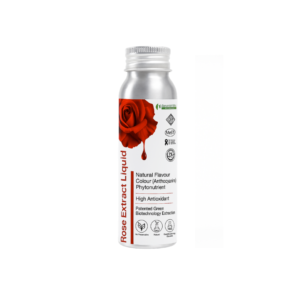
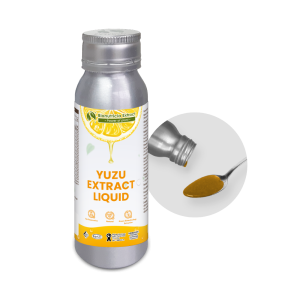
Acidity is underused. A citrus or hibiscus acid note distracts the palate and shortens the bitter finish. Roselle and yuzu are useful here because they contribute acidity plus a recognisable flavour identity, rather than acting purely as correctives.
Mouthfeel and body change how long bitterness lingers. Hydrocolloids and soluble fibres coat the palate and slow the release of bitter compounds onto the tongue. Arabic gum, which we use as the carrier and emulsifier across our oil-powder range, contributes body of this kind while also being a soluble dietary fibre.
Flavour pairing works better than flavour covering. Pairing a bitter herbal note with a flavour the consumer already associates with intensity — ginger, citrus, cocoa, pandan, matcha — reads as intentional. A delicate floral flavour laid over a bitter root reads as a failure to hide something.
Temperature and serving format matter more than most formulators expect. Bitterness is perceived more strongly warm than cold, so a product designed to be served chilled has a real advantage over the same formulation served hot.
Choosing a format around the taste problem
Often the cheapest solution is not a flavour system at all. It is choosing a format where taste never arises:
- Capsules and coated tablets bypass the palate entirely. If the product does not need to be a drink, this removes the problem rather than managing it.
- Stick packs and sachets sit in between: the powder is tasted, but the serving is small and can be flavour-loaded generously without unbalancing a larger volume.
- Beverages are the hardest case, because the extract is diluted across a large volume that the consumer drinks slowly and attentively.
- Gummies and chewables allow high sweetness and strong flavour, but the long residence time in the mouth exposes any bitter finish.
- Bakery, dairy and confectionery matrices carry bitterness well, since fat and sugar both suppress bitter perception.
Because we supply bulk ingredients rather than finished dosage forms, the format decision belongs to the brand owner — but it is worth making before the flavour budget is spent, not after.
Where particle size and solubility come in
How fast a powder dissolves determines how fast the bitter compounds reach the receptors. A very fine, rapidly dissolving powder delivers its full bitter load almost immediately. A coarser or agglomerated particle dissolves more slowly, which flattens the peak of the bitter signal — useful in a sachet, unhelpful in an instant beverage that must dissolve completely and quickly.
Solubility class matters too. Water-soluble extracts present their bitterness directly to the palate; oil-soluble actives carried in an emulsified powder are partially shielded by the fat phase, which is one reason oil powders often taste milder than their water-soluble equivalents at the same active load. Both of these are specification decisions, which is why the taste conversation belongs at the enquiry stage rather than at the bench.
A practical sequence for a bitter extract
Work through it in this order and most projects resolve without an expensive flavour development cycle:
- Confirm the dose per serving. Frequently the efficacious dose is lower than the dose in the first draft formulation, and the taste problem shrinks with it.
- Question the format. If it does not have to be a beverage, this is the decision that saves the most time and money.
- Set the base — sweetness and acidity — before adding flavour. Flavour laid on an unbalanced base cannot rescue it.
- Pair rather than cover. Choose a flavour direction that belongs with the botanical.
- Adjust the physical form last — particle size, agglomeration, or an oil-carried version of the active.
- Test at the real serving temperature, with the real water hardness and the real dilution.
How Bionutricia supports the taste conversation
Bionutricia is a Malaysian botanical-extract manufacturer founded in 2006, with more than 20 years of R&D and 15 years of manufacturing behind a catalogue serving 239+ brand partners. Extraction runs on our patented enzymatic and ultrasonic process, MY-188945-A (“Process for Preparing Nutritional Powder Extract”), inside a system certified to FSSC 22000, with GMP, HACCP, JAKIM Halal, US FDA registration, MeSTI and NanoVerify.
Our catalogue includes flavour-forward botanicals that earn their place in a formulation on taste as well as function — pandan, pandan matcha, roselle, yuzu, monk fruit, durian and cocoa among them — alongside the more challenging roots and leaves. Our Herbosomal® encapsulation technology, a registered trademark and patent-pending (PI2023005773), is applied to compounds such as vitamins, amino acids, minerals and collagen rather than to plain botanicals, so we will tell you plainly when encapsulation is not the right answer for a given extract. Bulk packs are 1 kg, 5 kg and 20 kg with a batch-specific Certificate of Analysis per lot. We supply the bulk ingredient for B2B formulation; brand owners and manufacturers formulate it into their chosen finished format.
Working on a bitter botanical in a beverage or sachet?
Related guides
Frequently asked questions
Why do herbal extracts taste so bitter?
Because the compounds responsible for the bitterness — polyphenols, saponins, alkaloids and terpenes — are largely the same compounds the extract is standardised for. Human bitter receptors are also extremely sensitive, so very low concentrations are detectable.
Can bitterness be removed from a botanical extract?
Not without removing part of what makes the extract active. Formulation therefore focuses on masking the bitterness, blocking the receptor response, or physically separating the compound from the palate through the choice of format.
What is the most reliable way to handle a bitter extract?
Changing the format. A capsule or coated tablet bypasses taste entirely, which is usually faster and cheaper than developing a flavour system for a beverage.
Does particle size affect how bitter a powder tastes?
Yes. Finer, faster-dissolving powders release their bitter compounds immediately, while coarser or agglomerated particles dissolve more slowly and flatten the intensity peak. It is a trade-off against dispersion speed in instant beverages.
Does encapsulation solve bitterness?
It can, where the technology suits the compound. Our Herbosomal® encapsulation is applied to compounds such as vitamins, amino acids, minerals and collagen rather than to plain botanicals, so for a bitter herbal extract the practical routes are usually format choice, flavour pairing and adjusting the physical form of the powder.