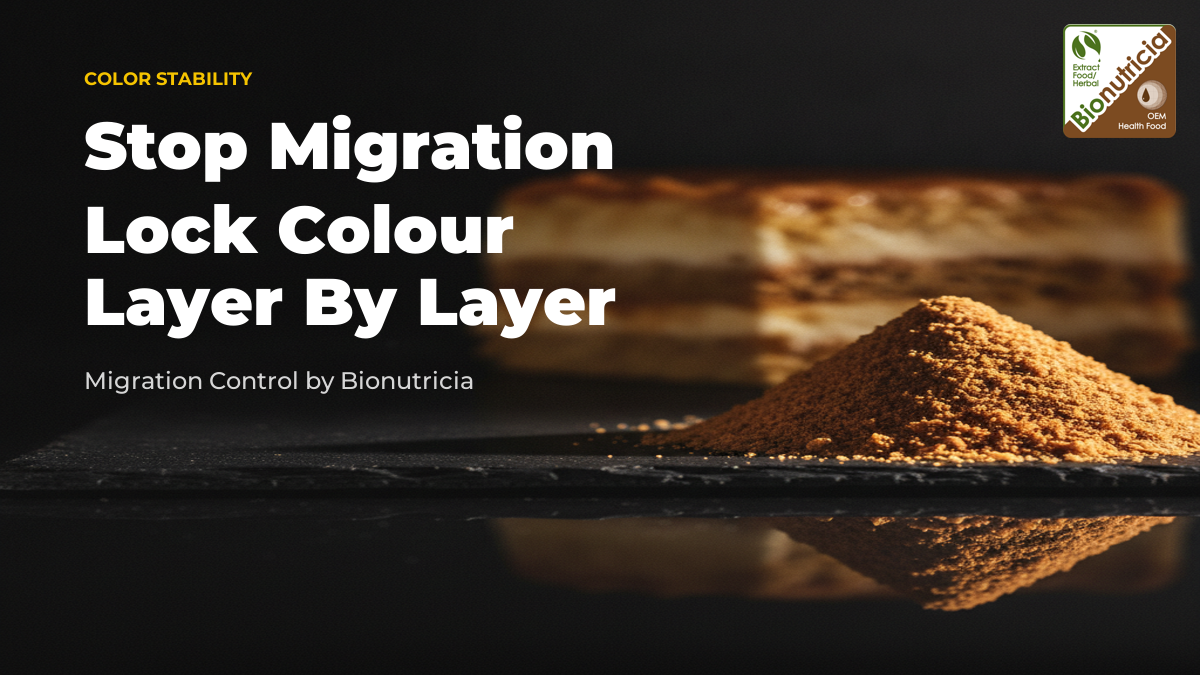
Preventing Caramel Colour Bleeding and Migration in Multi-Layer Bakery and Dairy Systems
Formulator’s summary: Caramel colour bleeding — the unwanted migration of brown pigment from one layer of a multi-component product into an adjacent layer — is a formulation and processing problem, not a quality defect in the caramel itself. It occurs when caramel colour, which is water-soluble, diffuses through the aqueous phase of a bakery or dairy system into a neighbouring layer that has a lower colour concentration. The rate of migration depends on water activity, pH differential between layers, the caramel class (E150a–d), the presence of fat barriers, and the viscosity of the matrix. Preventing it requires selecting the correct caramel class for each layer, managing water activity differentials, incorporating physical or lipid barriers between layers, and validating colour stability under the product’s full shelf-life conditions. Caramel powder disperses in water and is suitable for dry blends, bakery premixes and dairy systems where precise dosing and shelf-stable colour are required.
Quick facts for formulators
- Ingredient: Caramel powder (caramelised sugar, milled to fine powder)
- E150 classes: I (plain), II (caustic sulfite), III (ammonia), IV (sulfite-ammonia)
- Key migration drivers: Water activity differential, pH gradient, matrix viscosity, fat barrier presence
- Key regulatory markers: 4-methylimidazole (4-MEI), 5-hydroxymethylfurfural (HMF)
- Typical applications: Multi-layer bakery, dairy systems, ice-cream and frozen desserts, bakery systems
- Shelf life: 24 months in original sealed packaging below 25 °C, RH below 65%
- Certifications: FSSC 22000, GMP, HACCP, JAKIM Halal, US FDA facility registration, MeSTI
What causes caramel colour bleeding and migration
Caramel colour is a water-soluble food colour produced by the controlled heating of carbohydrates. The colour comes from high-molecular-weight polymers called melanoidins, formed through the Maillard reaction and sugar pyrolysis. Because these pigments are water-soluble, they migrate through the aqueous phase of any food matrix they are incorporated into. In a single-layer product, this is not a problem — the colour distributes uniformly. In a multi-layer product, where a coloured layer sits adjacent to an uncoloured or differently coloured layer, the pigment diffuses across the boundary over time, creating a blurred or muddy interface.
The rate and extent of migration depend on several factors:
- Water activity (aw) differential: Colour migrates from a high-aw layer to a low-aw layer as water carries the dissolved pigment. The larger the differential, the faster the migration.
- pH gradient: Caramel colour stability varies with pH. A large pH difference between adjacent layers can destabilise the pigment at the interface, accelerating colour shift.
- Matrix viscosity: A high-viscosity matrix (e.g., a firm ganache or a dense cake layer) slows diffusion. A low-viscosity matrix (e.g., a thin cream filling or a loose custard) accelerates it.
- Fat barrier presence: A continuous fat layer between two aqueous layers acts as a physical barrier to water-soluble pigments. Without it, there is nothing to slow diffusion.
- Caramel class: The four E150 classes differ in molecular weight distribution and charge. Higher-molecular-weight fractions (more common in Class III and IV) tend to migrate more slowly than lower-molecular-weight fractions.
A review of food colour additive stability noted that processing techniques and matrix composition significantly affect colour retention and migration behaviour in multi-component food systems (Foods, 2025; PMC12469493). A 2014 review of food caramel chemistry and properties documented the relationship between caramel composition and its behaviour in different food matrices (Journal of Food Science and Technology, 2014; PMC4152495).
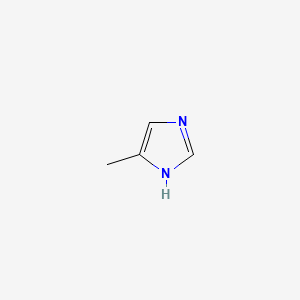
The key regulatory marker: 4-methylimidazole (4-MEI)
4-Methylimidazole (4-MEI) is a byproduct formed during ammonia-process caramelisation (E150 Classes III and IV). It is the key regulatory marker for caramel colour because several jurisdictions — including California under Proposition 65 and the EU under EFSA guidance — set maximum limits for 4-MEI in food and beverage products. When formulating multi-layer systems with Classes III or IV, the 4-MEI level on the certificate of analysis must be checked against the destination market’s regulatory limit.
Selecting the right caramel class for multi-layer systems
The E150 class is the single most important specification decision for preventing colour migration. Each class has different molecular weight distribution, charge behaviour and pH stability, which affect how the pigment moves through a multi-component matrix.
| Class | Migration tendency | Best multi-layer use | Why |
|---|---|---|---|
| E150a (Class I) | Moderate — lower molecular weight fractions | Premium bakery with distinct layers | Cleanest label; heat-only process; moderate colour intensity |
| E150b (Class II) | Moderate | Liqueur-filled confectionery, layered sauces | Alcohol-stable; reddish tone |
| E150c (Class III) | Lower — higher molecular weight fractions resist diffusion | Multi-layer bakery, cream-filled cakes, dairy desserts | Stable in acidic and saline systems; good bakery performance |
| E150d (Class IV) | Lowest — highest molecular weight, highest tinctorial power | Layered dairy drinks, multi-component sauces | Acid-stable; intense colour at low dose; less pigment mass to migrate |
For multi-layer bakery and dairy systems, Class III (E150c) is often the best choice because its higher-molecular-weight melanoidin fractions migrate more slowly through aqueous matrices while delivering a warm reddish-brown tone. Class IV (E150d) offers the highest tinctorial power, meaning less powder is needed to achieve the target colour — and less pigment mass means less material available to migrate.
Formulation strategies to prevent migration
Manage water activity differentials
The most effective single strategy is to minimise the water activity difference between adjacent layers. When two layers have similar aw values, the driving force for water — and the dissolved pigment it carries — is reduced. Formulators can adjust aw by modifying sugar content, adding humectants, or selecting ingredients that bind water. Target an aw differential below 0.05 between adjacent layers where possible.
Use fat barriers between layers
A continuous fat-based layer between two aqueous layers acts as a physical barrier to water-soluble caramel pigments. In a multi-layer bakery product, a thin layer of ganache, chocolate coating or fat-based cream between a caramel-coloured cake layer and an uncoloured cream filling will slow or prevent pigment migration. The fat barrier must be continuous — any gaps or breaks allow water and pigment to pass through.
Increase matrix viscosity
Higher viscosity slows diffusion. Adding a thickener or gelling agent to the coloured layer — such as a starch, pectin or hydrocolloid — increases the resistance to pigment movement. This is particularly effective in dairy systems where a gelled or thickened coloured layer holds its pigment in place against an adjacent uncoloured layer.
Minimise pigment mass
Using a high-tinctorial-power caramel (Class IV) at a low dose delivers the target colour with less total pigment mass. Less pigment mass means less material available to migrate. This is a simple but effective approach: specify the highest tinctorial power grade that achieves the desired colour at the lowest addition rate.
Validate under full shelf-life conditions
Colour migration is a time-dependent process. A product that looks clean at the end of production may show visible bleeding after weeks of storage. Accelerated shelf-life testing at the target storage temperature — with visual inspection and instrumental colour measurement (Delta E) at the layer interface — is the only reliable way to confirm that the formulation strategy works over the product’s full shelf life.
Specification parameters for multi-layer systems
When buying caramel powder for a multi-layer bakery or dairy application, the specification sheet should include the following parameters beyond the standard COA requirements.
| Parameter | Why it matters for multi-layer systems | What to check |
|---|---|---|
| E150 class | Determines molecular weight distribution and migration tendency | Specify the class that matches the application — Class III or IV for multi-layer |
| Tinctorial power | Higher tinctorial power means less pigment mass, reducing migration potential | Request the value and test method; compare across suppliers |
| pH (1% solution) | Affects stability at layer interfaces with pH gradients | Confirm compatibility with the pH of each layer |
| Particle size | Affects dissolution uniformity in dry blends and premixes | Specify mesh size (e.g. 80–100 mesh for fine powder) |
| 4-MEI content | Regulatory marker for Classes III and IV | Confirm ppm level meets destination-market limits |
| Moisture content | Affects flowability and caking in dry-blend handling | Typically below 5% |
Standardised caramel powder vs crude caramel colour
The distinction between a standardised caramel powder and a crude or ungraded caramel colour is a specification and quality-control difference. A standardised caramel powder has a declared E150 class, a measured tinctorial power, a confirmed pH range, and a 4-MEI level reported on the COA — all of which are essential for predicting and controlling migration behaviour in multi-layer systems. Batch-to-batch consistency means the formulator can rely on the same colour intensity and migration characteristics every time.
A crude or ungraded caramel colour, by contrast, may vary in class composition, tinctorial power and pH between batches, making migration behaviour unpredictable. For a multi-layer product where colour bleeding is a known risk, a standardised caramel powder with full COA documentation is the grade to specify.
Supplying caramel powder and related ingredients in bulk
Bionutricia Extract supplies caramel powder from its manufacturing facility in Sungai Buloh, Malaysia, under FSSC 22000, GMP, HACCP, JAKIM Halal, MeSTI and US FDA facility registration. Every batch ships with a certificate of analysis covering identity, E150 class, tinctorial power, pH, moisture, heavy metals, microbial limits and 4-MEI content. Bulk supply, custom specification, spray-dried and powder forms, documentation and export paperwork, and packing options are available on request.
Buyers formulating multi-layer bakery and dairy systems may also need companion ingredients from the published range: vanilla bean extract powder for a complementary flavour layer, or caramel powder for the bulk product page. The caramel powder bulk buyer’s guide covering E150 classes and COA requirements provides the full specification framework.
For specifications, samples, and bulk quotations, contact our team or message us on WhatsApp at +60 16-661 8510.
Order sample quantities or bulk standardised caramel powder from our eStore at https://bionutriciaextract.com/product/caramel-powder/.
Related ingredient guides
- Caramel Powder Bulk Buyer’s Guide: E150 Classes, COA and Procurement Specs
- Caramel Powder — A B2B Buyer’s Guide for Food, Bakery, Beverage and Dairy Manufacturers
- Natural Food Coloring: Sources, Stability and How to Buy in Bulk
Frequently asked questions
What causes caramel colour to bleed between layers in a multi-component product? Caramel colour is water-soluble, so it migrates through the aqueous phase of a food matrix from a high-concentration layer to a low-concentration layer. The rate depends on the water activity differential between layers, the pH gradient, the matrix viscosity, the presence of fat barriers, and the molecular weight distribution of the caramel class used. Higher-molecular-weight fractions (Class III and IV) migrate more slowly than lower-molecular-weight fractions.
Which caramel class is best for preventing colour migration in multi-layer bakery? Class III (E150c, ammonia caramel) is often the best choice for multi-layer bakery because its higher-molecular-weight melanoidin fractions resist diffusion through aqueous matrices while delivering a warm reddish-brown tone. Class IV (E150d) offers the highest tinctorial power, meaning less pigment mass is needed and less material is available to migrate. The choice depends on the specific product’s pH, shelf life and colour target.
How can I prevent caramel colour from migrating into an uncoloured cream layer? Three strategies work in combination: minimise the water activity differential between the coloured and uncoloured layers, insert a continuous fat-based barrier (such as a ganache or chocolate coating) between them, and increase the viscosity of the coloured layer with a thickener or gelling agent. Validate the result with accelerated shelf-life testing and visual inspection at the layer interface.
Does caramel powder behave differently from liquid caramel colour in multi-layer systems? Caramel powder is reconstituted in water before use, so once dissolved it behaves the same as liquid caramel colour of the same class. The powder form offers advantages in dry-blend handling and precise dosing, but the migration behaviour is determined by the E150 class and the formulation matrix, not by whether the caramel was supplied as powder or liquid.
What should I specify on the COA to manage migration risk? Request the E150 class, tinctorial power, pH of a 1% solution, particle size, moisture content, 4-MEI level (for Classes III and IV), and heavy metals. These parameters allow you to predict colour intensity, compatibility with each layer’s pH, and the total pigment mass that could migrate. Confirm each parameter per batch.