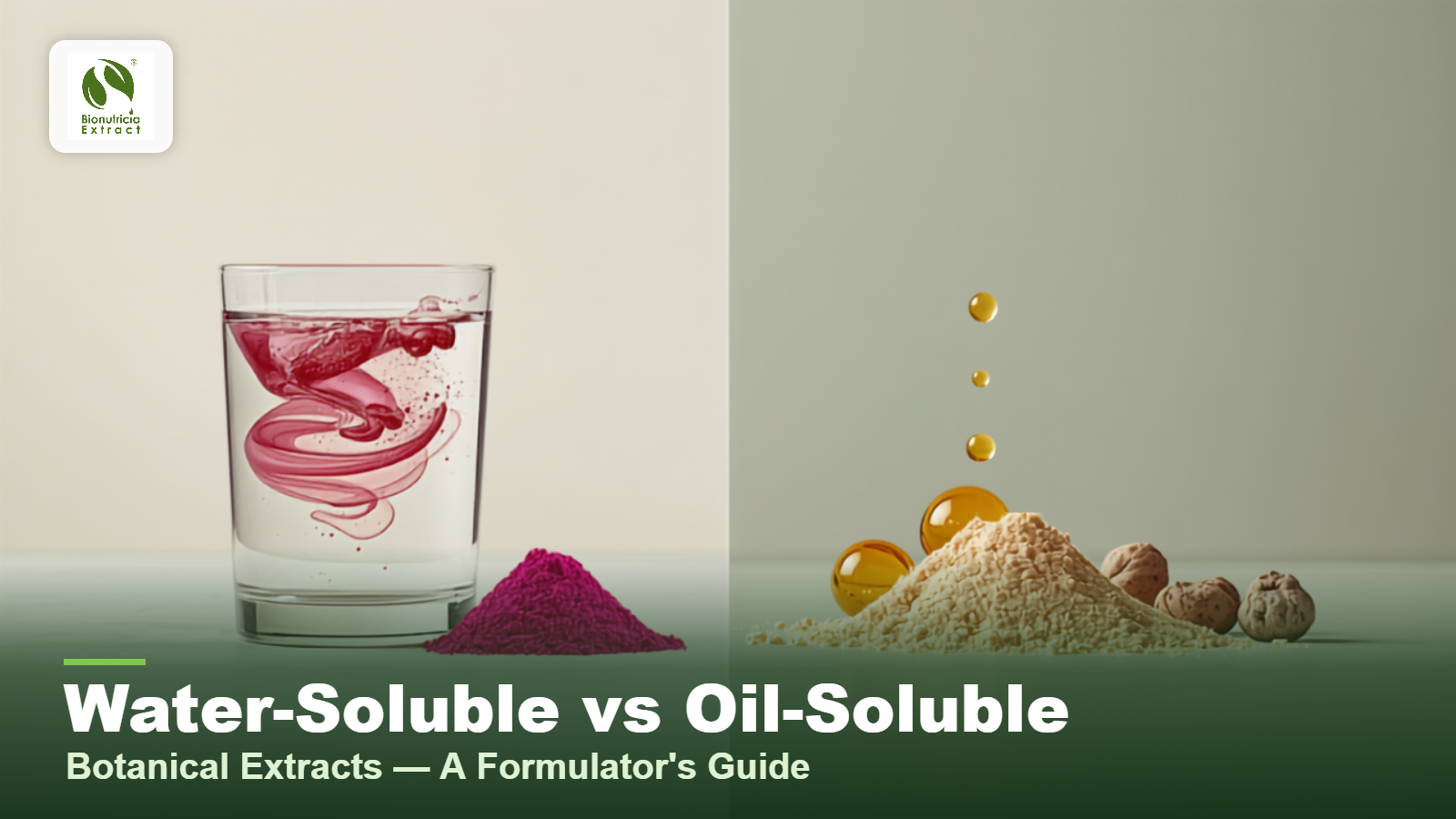
Water-soluble botanical extracts dissolve cleanly into aqueous systems — drinks, sachets, effervescents and syrups — while oil-soluble extracts (carotenoids, tocotrienols, many essential-oil actives) need a lipid phase or an emulsified powder to disperse. The single biggest formulation decision is not the plant; it is whether your active is water- or oil-loving, because that dictates the carrier, the finished format and the label claims you can make.
For brand owners and contract manufacturers sourcing bulk ingredients, matching solubility to your finished format is what separates a stable, on-spec batch from a cloudy drink or a separated gummy. This guide explains how to tell the two apart, which finished formats suit each, and how Bionutricia Extract makes oil-soluble actives behave like water-soluble powders using a food-grade arabic-gum emulsion — with no synthetic emulsifiers.
| Water-soluble extract | Oil-soluble extract | |
|---|---|---|
| Typical actives | Polyphenols, anthocyanins, most flavour & colour extracts, vitamin C, B-vitamins, many botanical glycosides | Carotenoids, tocotrienols/tocopherols, CoQ10, essential-oil actives, vitamin D3, curcuminoids (native) |
| Best finished formats | Beverages, effervescents, sachets/stick-packs, syrups, gummies | Softgel oils, oil-based tablets/capsules — or an emulsified powder for water systems |
| To use in a drink | Disperses directly | Needs emulsification (e.g. arabic-gum spray-dried powder) |
What makes a botanical extract water-soluble or oil-soluble?
Solubility comes down to the chemistry of the active molecule. Compounds with polar groups — hydroxyls, sugars, acids — are attracted to water and dissolve readily in aqueous systems. These “hydrophilic” actives include polyphenols, anthocyanins (the pigments in roselle, butterfly pea and purple yam), organic acids and most water-extracted botanical glycosides.
Compounds built mostly from carbon-hydrogen chains and rings — carotenoids, tocotrienols, sterols, many essential-oil constituents — are “lipophilic” (oil-loving). They resist water and prefer a fat or oil phase. Curcumin from turmeric is the classic example: natively oil-soluble and poorly absorbed in water, which is exactly why liposomal and emulsified delivery systems exist.
A useful rule of thumb: if a plant active is coloured red, blue or purple it is usually water-soluble; if it is yellow-orange, waxy or oily, it is usually oil-soluble. The definitive answer, however, is always on the ingredient’s specification and Certificate of Analysis — ask your supplier for the solubility statement before you formulate.
Water-soluble botanical extracts: formats and handling
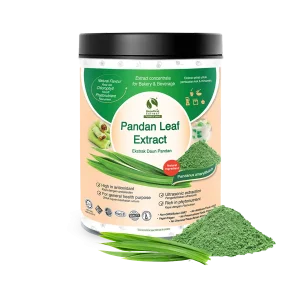
Water-soluble spray-dried extract powders are the workhorse of functional beverages and supplements. They rehydrate quickly, distribute evenly and are simple to standardise by extract ratio or marker content. Typical Bionutricia Extract examples include roselle, pandan, coconut water powder, cranberry and monk-fruit — all designed to dissolve or disperse in water.
Where they shine
Ready-to-mix drink powders, effervescent tablets, stick-pack sachets, syrups and gummies all rely on clean aqueous dispersion. Because the active is already hydrophilic, the formulator’s main tasks are controlling moisture, protecting colour and flavour, and confirming the standardisation marker survives processing. Water-soluble powders also suit liquid concentrates, where the extract is delivered pre-dissolved.
For beverages, watch pH and heat: anthocyanin colours shift with pH, and some polyphenols are heat-sensitive, so pasteurisation and hot-fill steps should be validated against the ingredient’s stability data.
Oil-soluble botanical extracts: the emulsification challenge
Oil-soluble actives deliver some of the most sought-after functional ingredients — carotenoids for skin and eye support, tocotrienols (full-spectrum vitamin E), MCTs and essential-oil actives — but they will not simply stir into water. Left untreated, an oil-soluble active in a drink separates, floats or turns cloudy.
There are two routes. The first is to keep the format oil-based: softgel oils, or oil dispersed onto a tablet. The second, and increasingly the default for modern brands, is to convert the oil into a free-flowing, water-dispersible oil powder by emulsifying it and spray-drying it onto a carrier. This lets an inherently oil-soluble active go into a sachet, a drink or a dry-blend capsule.
Why we emulsify every oil powder on arabic gum — never sodium caseinate
The industry default emulsifier for oil powders is sodium caseinate, which is milk-derived. That single choice carries three problems: it is a declarable allergen, it disqualifies vegan and dairy-free positioning, and it complicates halal review because it is animal-origin.
Every oil powder Bionutricia Extract produces — virgin coconut oil powder, sacha inchi oil powder, carotene oil powder, MCT oil powder, tocotrienol and black-seed oil powders — is emulsified on food-grade arabic gum (acacia gum) instead. Arabic gum is a plant-derived soluble fibre (≥90% total dietary fibre) with no synthetic emulsifier and no maltodextrin needed as the emulsifier. It is the reason our oil powders can legitimately claim vegan, dairy-free and allergen-free, and it makes an otherwise oil-soluble active disperse smoothly into water. It is a genuine differentiator, not a footnote.
A third route: liposomal delivery for absorption-critical actives
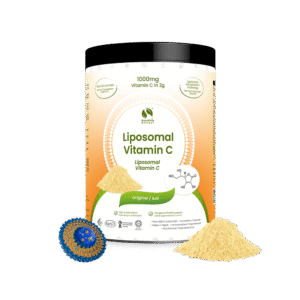
When the goal is not just dispersion but bioavailability — getting more of an oil-soluble or poorly-absorbed active across the gut — a liposomal or encapsulated delivery system is the next step up from a simple emulsion. Encapsulation wraps the active in a phospholipid or lipid-based carrier that protects it through processing and digestion. This is how naturally oil-soluble or poorly-water-soluble actives are engineered into water-friendly, absorption-optimised powders. If you are weighing an emulsified oil powder against an encapsulated version, our explainer on Herbosomal® encapsulation walks through when the extra step is worth it.
How to choose: a formulator’s decision guide
Work backwards from the finished format your brand owner wants:
- Functional drink, effervescent or sachet → choose a water-soluble powder, or an arabic-gum emulsified oil powder if the active is oil-soluble.
- Gummy or syrup → water-soluble powders and liquid concentrates disperse best; oil-soluble actives need emulsification first.
- Softgel → keep the active oil-based; a native oil or oleoresin is the natural fit.
- Dry-blend tablet or capsule → either works, but an emulsified oil powder flows and blends far more predictably than raw oil.
The mistake to avoid is choosing the plant first and worrying about solubility later. A beautiful standardised extract is worthless if it clouds your drink or separates in your gummy. Fixing the finished format up front lets you specify the right solubility state, carrier and particle size from the first sample, which shortens development and protects your batch consistency at scale.
Bionutricia Extract supplies the bulk ingredient for B2B formulation; brand owners and manufacturers formulate it into their chosen finished format — capsules, tablets, gummies, softgels, sachets, beverages, bakery, dairy or confectionery. Our role is to deliver the active in the solubility state your process needs.
What to specify when you order
To avoid surprises, put the following on your purchase specification: the solubility statement (water-dispersible / oil-soluble), the carrier and emulsifier system, the standardisation basis (extract ratio or marker %), particle size / mesh, moisture, and the heavy-metal and microbial limits. Every Bionutricia Extract ingredient ships against our own house specification and our own Certificate of Analysis, in 1 kg, 5 kg and 20 kg bulk packs. Botanical extraction is backed by our granted enzymatic + ultrasonic process patent (MY-188945-A) for higher active yield with a greener, faster process.
Frequently asked questions
Can an oil-soluble botanical extract be used in a water-based drink?
Yes — but only after it is emulsified. Bionutricia Extract converts oil-soluble actives into water-dispersible oil powders by emulsifying them on food-grade arabic gum and spray-drying, so they disperse cleanly into beverages, effervescents and sachets without separating.
How do I know if an extract is water- or oil-soluble?
Check the ingredient’s specification sheet and Certificate of Analysis, which state the solubility. As a guide, red/blue/purple pigment actives (polyphenols, anthocyanins) are usually water-soluble, while yellow-orange, waxy or oily actives (carotenoids, tocotrienols) are usually oil-soluble.
Why does Bionutricia Extract use arabic gum instead of sodium caseinate?
Sodium caseinate is milk-derived, making it a declarable allergen that blocks vegan and dairy-free claims and complicates halal review. Arabic gum is plant-derived soluble fibre, so our oil powders stay vegan, dairy-free and allergen-free while still dispersing in water.
Are water-soluble extract powders more stable than oil powders?
Both are stable when stored correctly — cool, dry and sealed — with a typical two-year shelf life. Water-soluble powders can be colour- and pH-sensitive in drinks, while emulsified oil powders resist oxidation better than raw oils thanks to the encapsulating carrier.
What bulk pack sizes and documentation are available?
Ingredients ship in 1 kg, 5 kg and 20 kg bulk packs, each with our own specification and Certificate of Analysis. Our facility holds JAKIM Halal, FSSC 22000, GMP, HACCP, US FDA registration and MeSTI, plus NanoVerify.
Bionutricia Extract manufactures standardised botanical extract powders, liquids and arabic-gum oil powders for B2B formulation across Malaysia and export markets. Request a specification, sample or quotation →