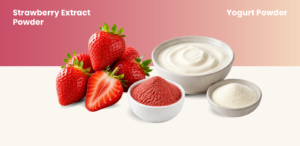
Yogurt Powder: Bulk B2B Buyer’s Guide
Formulator’s summary: Yogurt powder is a spray-dried or freeze-dried dairy ingredient produced by fermenting milk with lactic acid cultures — typically Lactobacillus bulgaricus and Streptococcus thermophilus — and then dehydrating the resulting yogurt into a shelf-stable powder. It retains the characteristic tangy flavour, creamy mouthfeel and dairy protein content of fresh yogurt while offering the handling, storage and formulation advantages of a dry ingredient. For B2B buyers in food, beverage and nutraceutical manufacturing, the key procurement considerations are protein content (typically 11–35% depending on grade), fat level (full-fat, low-fat or non-fat), moisture (under 4–5% for spray-dried grades), titratable acidity, live culture status (inactive for standard spray-dried grades), carrier type (maltodextrin or lactose), particle size for solubility, packaging format, and the supplier’s documentation package including certificate of analysis, halal certification and food-safety compliance. The primary marker compound is lactic acid (2-hydroxypropanoic acid, C₃H₆O₃), the defining acid of fermented dairy. The powder disperses readily in warm water and is suitable for dry powder blends, bakery systems, beverage premixes and ice-cream and frozen dessert applications.
GMP
HACCP
JAKIM Halal
US FDA facility registration
MeSTI
NanoVerify
Quick Facts for Formulators
- Ingredient: Spray-dried yogurt powder (fermented dairy powder)
- Primary active compound: Lactic acid (2-hydroxypropanoic acid, C₃H₆O₃)
- Fermentation cultures: Lactobacillus bulgaricus, Streptococcus thermophilus
- Typical protein: 11–35% (grade-dependent)
- Typical fat: Full-fat, low-fat or non-fat grades available
- Moisture: ≤ 4–5% (spray-dried)
- Particle size: 80–200 mesh (grade-dependent)
- Shelf life: 12–24 months from manufacture when stored correctly
- Storage: Cool, dry conditions; away from direct sunlight; sealed packaging
- Applications: Dry powder blends, bakery systems, beverage premixes, ice-cream and frozen desserts, seasoning blends, dairy systems
- Manufacturing technology: Patented enzymatic ultrasonic extraction (MY-188945-A)
What Is Yogurt Powder?
Yogurt powder is a dehydrated form of yogurt produced by fermenting milk with lactic acid bacteria and then drying the fermented product into a fine powder. The two principal drying methods are spray drying — the most common industrial method — and freeze drying, which preserves more of the original flavour and protein structure but at higher cost. The result is a shelf-stable, easy-to-handle ingredient that delivers the characteristic tangy, creamy profile of yogurt without the refrigeration, short shelf life and handling difficulties of fresh yogurt.
The fermentation step is what distinguishes yogurt powder from ordinary milk powder. During fermentation, Lactobacillus bulgaricus and Streptococcus thermophilus convert lactose into lactic acid, lowering the pH and creating the distinctive sour flavour and altered protein profile. The primary compound responsible for this acidity is lactic acid (2-hydroxypropanoic acid, C₃H₆O₃), a three-carbon organic acid that is the defining marker of fermented dairy. Bionutricia’s manufacturing process employs patented enzymatic ultrasonic extraction (MY-188945-A) to process the fermented dairy base, ensuring consistent quality and reproducible specifications across production lots.
How yogurt powder is produced
The production sequence for spray-dried yogurt powder typically follows these stages:
| Stage | Process | Key Output |
|---|---|---|
| 1. Milk preparation | Standardisation of fat and protein content; pasteurisation | Standardised milk base |
| 2. Fermentation | Inoculation with L. bulgaricus and S. thermophilus; incubation at 42–45 °C until target pH | Fermented yogurt base |
| 3. Neutralisation (optional) | pH adjustment for specific applications where tartness must be controlled | Adjusted yogurt base |
| 4. Drying | Spray drying or freeze drying; carrier addition (maltodextrin or lactose) where required | Yogurt powder |
| 5. Milling and sieving | Particle size reduction and classification to target mesh | Finished powder |
| 6. Packaging | Sealed moisture-barrier packaging under controlled conditions | Packed product ready for dispatch |
Key Specifications Buyers Should Set
When procuring yogurt powder in bulk, the specification sheet is the single most important document. Buyers should define each of the following parameters with their supplier to ensure the powder matches the intended application:
| Parameter | Typical Range | Why It Matters |
|---|---|---|
| Protein content | 11–35% | Determines nutritional labelling and functional performance in formulations |
| Fat content | 0–28% (non-fat to full-fat) | Affects flavour richness, mouthfeel and caloric profile |
| Moisture | ≤ 4–5% | Critical for shelf stability and microbial safety; higher moisture shortens shelf life |
| Titratable acidity | 0.5–2.0% as lactic acid | Controls the tangy flavour intensity; can be adjusted for different applications |
| pH | 4.0–4.6 (acidic grades); 6.0–7.0 (neutralised grades) | Determines compatibility with other ingredients and formulation stability |
| Particle size | 80–200 mesh | Affects solubility, dispersibility and mouthfeel in finished products |
| Carrier type | Maltodextrin, lactose or none | Impacts labelling, allergen declarations and dissolution behaviour |
| Live culture status | Inactive (spray-dried) or active (freeze-dried select grades) | Determines whether the powder carries viable cultures; most spray-dried grades are inactive |
| Microbiological limits | Per specification (TPC, coliforms, yeast, mould, pathogens) | Food safety compliance; must meet buyer and regulatory thresholds |
Supplier qualification checklist:
- Certificate of analysis (COA) provided for every production lot
- FSSC 22000 or equivalent food-safety certification current and verifiable
- Halal certification (JAKIM or equivalent) covering the ingredient and manufacturing site
- Allergen declaration (milk, lactose) clearly stated
- Country of origin and manufacturing site disclosed
- Shelf life and recommended storage conditions documented
- Batch traceability system in place
- Export documentation and customs paperwork available
Applications in Food, Beverage and Nutraceutical Manufacturing
Yogurt powder’s versatility makes it valuable across multiple manufacturing categories. Its tangy flavour, creamy dairy notes and protein contribution make it a functional ingredient in formulations where fresh yogurt would be impractical due to shelf life, refrigeration or handling constraints.
Flavouring and seasoning
Yogurt powder is widely used as a flavouring agent in dry seasoning blends for snacks and savoury coatings. The acidic tang complements herbs, spices and cheese flavours, and the powder form allows even distribution across dry surfaces. Buyers specifying yogurt powder for seasoning applications should focus on particle size (finer for better adhesion), acidity level (higher for more pronounced tang) and carrier type (maltodextrin-based grades disperse more evenly in dry blends).
Bakery and confectionery
In bakery applications, yogurt powder contributes moisture retention, flavour and browning characteristics. It can be incorporated into cake mixes, cookie doughs, frostings and fillings. For confectionery, yogurt-flavoured coatings and fillings use the powder for its distinctive dairy-acidic profile. Buyers should specify fat content and protein level to match the desired texture and mouthfeel.
Beverages and dry mixes
Instant beverage mixes — including smoothie bases, protein shakes and meal-replacement powders — use yogurt powder for flavour, protein enrichment and creamy mouthfeel. Solubility and dispersibility are critical specifications for beverage applications; buyers should request solubility data and test the powder in their actual beverage matrix. A companion ingredient such as coconut water powder can be paired with yogurt powder in beverage formulations to build tropical flavour profiles.
Nutritional formulations
Yogurt powder appears in nutritional powders, meal replacements and functional food formulations where its protein content and dairy flavour profile add value. Buyers in this category should verify protein assay, amino acid profile if required, and microbiological specifications against their finished-product regulatory requirements.
Quality, Safety and Certification Requirements
Bulk yogurt powder is a dairy-based food ingredient, and its procurement demands rigorous attention to food-safety certification, allergen management and halal compliance. Bionutricia’s yogurt powder is manufactured in a facility holding FSSC 22000, GMP, HACCP, JAKIM Halal, US FDA facility registration and MeSTI certifications, with NanoVerify available for verified particle-size grades. Every production lot ships with a certificate of analysis covering microbiological, physicochemical and sensory parameters.
Because yogurt powder contains milk proteins and lactose, allergen labelling is mandatory in most markets. Buyers should confirm that the supplier’s allergen control programme prevents cross-contamination and that the COA includes allergen declarations. For halal-certified supply, the JAKIM Halal certification must cover both the ingredient and the manufacturing facility — Bionutricia’s JAKIM Halal certification meets this requirement.
Bionutricia’s in-house authority team — comprising a registered pharmacist, a nutritionist, a dietitian and a PhD biomedical scientist — oversees specification development and quality assurance for every ingredient the company supplies. Founded in 2006, Bionutricia brings nearly two decades of extraction and ingredient manufacturing experience to bulk yogurt powder supply.
Packaging, Storage and Shelf Life
Proper packaging and storage are essential to preserve yogurt powder’s quality throughout its shelf life. The powder is hygroscopic — it absorbs moisture from the air — so moisture-barrier packaging and controlled storage conditions are non-negotiable.
| Factor | Recommendation |
|---|---|
| Packaging | Sealed multi-wall paper bags with inner polyethylene liner, or vacuum-sealed foil pouches for smaller quantities |
| Storage temperature | Cool conditions (≤ 25 °C); refrigeration not required for spray-dried grades |
| Humidity | Dry environment (relative humidity ≤ 60%) |
| Light exposure | Store away from direct sunlight |
| Shelf life | 12–24 months from manufacture when stored as recommended |
| After opening | Reseal immediately; use within the period stated on the packaging |
Buyers should also confirm that the supplier’s packaging is suitable for export shipping — including moisture resistance, stack strength and labelling compliance for the destination market. Bionutricia provides export documentation and customs paperwork for international shipments.
Supplying Yogurt Powder and Related Ingredients in Bulk
Bionutricia supplies bulk yogurt powder manufactured under its patented enzymatic ultrasonic extraction (MY-188945-A) process, with custom specification and extract ratio options available to match buyer requirements. The powder is supplied in spray-dried form with COA per lot, full documentation and export paperwork, and a range of packing options to suit both domestic and international orders. Buyers can request samples for formulation testing before committing to bulk quantities.
Beyond yogurt powder, Bionutricia’s published ingredient range includes companion products that a yogurt powder buyer may also need. Coconut water powder offers a complementary tropical flavour partner for beverage formulations. Virgin coconut oil (VCO) powder provides a plant-based fat option for dairy-free or hybrid formulations. Both are supplied with the same certification package — FSSC 22000, GMP, HACCP, JAKIM Halal, US FDA facility registration and MeSTI — and are available for bulk order through their respective product pages.
For buyers requiring a custom specification, Bionutricia’s in-house authority team can develop a tailored parameter set covering protein content, fat level, acidity, particle size and carrier type.
For specifications, samples, and bulk quotations, contact our team or message us on WhatsApp at +60 16-661 8510.
Order sample quantities or bulk yogurt powder from our eStore at https://bionutriciaextract.com/product/yogurt-powder/.
Related ingredient guides
- Yogurt Powder: The Complete B2B Buyer’s Guide for Food Manufacturers
- Yogurt Powder: Specification, Processing & Bulk Supply Guide
- Coconut Water Powder — Supplier & Formulation Guide for Beverage & Functional Food OEMs
Frequently Asked Questions
What is the difference between yogurt powder and milk powder?
Yogurt powder is produced from milk that has been fermented with lactic acid bacteria (Lactobacillus bulgaricus and Streptococcus thermophilus) before drying, while milk powder is dried directly from unfermented milk. The fermentation step gives yogurt powder its characteristic tangy flavour, lower pH and altered protein profile. Milk powder has a neutral, sweet dairy flavour and higher pH. The two ingredients serve different formulation purposes and are not interchangeable in most applications.
Is yogurt powder soluble in water?
Yogurt powder is dispersible in water but not fully soluble — it forms a suspension rather than a clear solution, because it contains dairy proteins and fats that do not dissolve completely. Dispersibility depends on particle size, carrier type and formulation. Finer grades (100–200 mesh) with maltodextrin carriers typically disperse more readily. Buyers should request solubility and dispersibility data from the supplier and test the powder in their actual application matrix.
Does spray-dried yogurt powder contain live cultures?
Standard spray-dried yogurt powder does not contain viable live cultures. The high temperatures used in spray drying kill the lactic acid bacteria. Freeze-dried select grades may retain viable cultures, but these are less common and more expensive. Buyers requiring live culture status should specify this explicitly and confirm it on the COA. Most commercial yogurt powder is supplied as an inactive ingredient for flavour, protein and functional purposes.
What certifications should I look for when buying yogurt powder in bulk?
At minimum, verify FSSC 22000 or equivalent food-safety certification, GMP, HACCP, and JAKIM Halal certification if halal supply is required. US FDA facility registration and MeSTI notification are relevant for export to and from Malaysia respectively. The supplier should provide a COA for every lot, allergen declarations (milk, lactose), and batch traceability.
How should yogurt powder be stored and what is its shelf life?
Store yogurt powder in a cool, dry place at ≤ 25 °C with relative humidity ≤ 60%, away from direct sunlight, in sealed moisture-barrier packaging. Under these conditions, spray-dried yogurt powder typically has a shelf life of 12–24 months from manufacture. Once opened, reseal the packaging immediately and use within the period stated on the label. Proper storage is critical because the powder is hygroscopic and will absorb moisture, leading to caking, reduced quality and potential microbial growth.