Standardised Black Ginger Extract: Methoxyflavone Marker Compounds, Assay Methods and Batch Consistency
Formulator’s summary: Black ginger (Kaempferia parviflora) is a Zingiberaceae rhizome whose characteristic phytochemistry is a profile of polymethoxyflavones — flavone compounds carrying multiple methoxy groups — with 5,7-dimethoxyflavone as the primary marker. A standardised black ginger extract specifies the methoxyflavone content on the certificate of analysis, confirmed by HPLC assay, so that every batch delivers the same marker profile. This is the specification difference that matters: a standardised extract with a declared assay marker and batch-to-batch consistency, versus a crude ground-rhizome powder with no marker quantification and unpredictable composition. The extract is water-soluble and disperses readily, making it suitable for functional beverage premixes, sachet drink mixes and dry powder blends where a consistent methoxyflavone dose per serving is a formulation requirement. The standardised active marker is 5,7-dimethoxyflavone, quantified by HPLC on every batch.
Quick facts for formulators
- Botanical: Kaempferia parviflora, rhizome
- Primary marker compound: 5,7-dimethoxyflavone (polymethoxyflavone)
- Assay method: HPLC (high-performance liquid chromatography)
- Extraction method: Patented enzymatic ultrasonic extraction (MY-188945-A)
- Concentration grades: 20:1 and 100:1
- Solubility: Water-soluble
- Form: Free-flowing brown powder
- Certifications: FSSC 22000, JAKIM Halal, GMP, HACCP, MeSTI, US FDA facility registration
What makes black ginger chemically distinct
Black ginger (Kaempferia parviflora), also known in Thai as Krachaidum, is a member of the Zingiberaceae family. Unlike common ginger (Zingiber officinale), black ginger’s rhizome has a deep purple-black flesh and a phytochemical profile dominated not by gingerols but by polymethoxyflavones — flavone molecules with multiple methoxy (–OCH3) substituents on the flavone backbone. A review of Kaempferia parviflora and its methoxyflavones documented the compound profile and the range of methoxyflavone derivatives present in the rhizome (Evidence-Based Complementary and Alternative Medicine, 2018; PMC6311295).
The methoxyflavone profile includes 5,7-dimethoxyflavone as the primary marker, alongside other polymethoxyflavones such as 3,5,7,4′-tetramethoxyflavone and 5,7,4′-trimethoxyflavone. These compounds are structurally related — all are flavone derivatives with varying numbers and positions of methoxy groups — and they co-occur in the rhizome extract. For standardisation purposes, 5,7-dimethoxyflavone is the compound most commonly used as the assay marker because it is abundant, well-characterised and detectable by HPLC.
The primary marker: 5,7-dimethoxyflavone
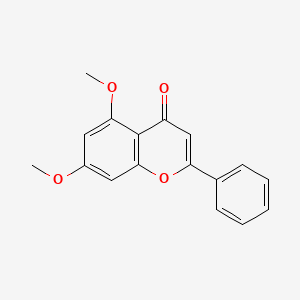
5,7-Dimethoxyflavone is a polymethoxyflavone with two methoxy groups at the 5- and 7-positions of the flavone A-ring. It is the compound that a specification sheet should name when declaring the standardisation marker for a black ginger extract.
A perspective review of Kaempferia parviflora applications noted the methoxyflavone constituents as the defining chemical feature of the plant and the basis for its standardisation in extract form (Natural Product Communications, 2024; DOI 10.1177/1934578X241281615). For procurement, the marker compound name and its assay percentage on the COA are the two pieces of information that confirm a supplier is selling a standardised extract rather than a crude powder.
Assay methods: how methoxyflavone content is confirmed
The standard analytical method for quantifying methoxyflavones in a black ginger extract is high-performance liquid chromatography (HPLC). HPLC separates the individual methoxyflavone compounds in the extract and quantifies each one against a reference standard. The result is a chromatogram with peaks for each compound, and the assay value for 5,7-dimethoxyflavone is calculated from the peak area against the standard calibration.
What a buyer should look for on the COA:
- Marker compound named: 5,7-dimethoxyflavone (or the full polymethoxyflavone complex)
- Assay method stated: HPLC (with the specific method reference where available)
- Assay value reported: the percentage of 5,7-dimethoxyflavone in the batch (e.g. ≤ 2% per COA for a 100:1 extract)
- Batch identification: lot number linking the COA to the specific batch
- Additional markers: where the supplier reports the full polymethoxyflavone profile, the individual compound percentages should be listed
A systematic review and meta-analysis of studies on Kaempferia parviflora extract synthesised evidence across multiple outcomes, noting the range of study designs and the importance of standardised extract composition for reproducible results (Nutrition Research, 2024; PMID 38194854). A clinical-effects review of Krachaidum examined the human study evidence for Kaempferia parviflora extract, noting the range of clinical effects investigated in human subjects (Journal of Evidence-Based Complementary and Alternative Medicine, 2017; PMC5871153). These are context references for the ingredient’s evidence base; the article makes no efficacy claim about any commercial product.
Standardised extract vs crude rhizome powder
The difference between a standardised black ginger extract and a crude ground-rhizome powder is a specification and quality-control difference, not a health claim. A standardised extract has been processed to concentrate the methoxyflavone compounds, with 5,7-dimethoxyflavone as the declared marker, and the assay value is confirmed by HPLC on every batch. The concentration ratio (e.g. 20:1 or 100:1) tells the formulator how much raw rhizome was processed to produce one unit of extract, and the marker percentage confirms the active content.
A crude ground-rhizome powder is simply dried rhizome milled to a fine particle size. It contains whatever methoxyflavones were present in the raw material, with no concentration step, no marker assay and no batch consistency guarantee. The methoxyflavone content of raw rhizome varies with growing conditions, harvest time and drying method, so a crude powder’s composition shifts from lot to lot. For a formulation where a consistent methoxyflavone dose per serving is a requirement, a standardised extract with HPLC-verified marker content is the grade to specify.
| Parameter | Standardised extract | Crude ground-rhizome powder |
|---|---|---|
| Marker compound | 5,7-dimethoxyflavone, declared and assayed | Not declared; varies with raw material |
| Assay method | HPLC, reported on COA | Not reported |
| Concentration ratio | Declared (e.g. 20:1, 100:1) | 1:1 (no concentration) |
| Batch consistency | Verified per lot by COA | Unverified; varies with harvest and drying |
| Formulation dosing | Predictable — marker content known per gram | Unpredictable — marker content unknown |
Extraction method and its role in standardisation
Bionutricia’s black ginger extract is produced using patented enzymatic ultrasonic extraction (MY-188945-A). The process combines enzymatic pre-treatment — which breaks down the structural polysaccharides in the rhizome cell wall — with ultrasonic cavitation, which ruptures the cell walls mechanically and releases the intracellular methoxyflavone compounds into the extraction solvent. The combined process operates at controlled low temperature, which preserves the methoxyflavone compounds that might degrade under prolonged heating. The extract is then dried to a free-flowing powder with a declared concentration ratio and HPLC-verified marker content.
Solubility and formulation considerations
The extract is water-soluble, dispersing readily in aqueous systems. This makes it suitable for functional beverage premixes, sachet drink mixes and dry powder blends where the methoxyflavone content must be uniform across servings. In a dry-blend application, the powder should be pre-dispersed in a small volume of liquid or dry-blended with a carrier to ensure uniform distribution before adding to the main batch. The brown powder colour contributes a mild earthy tone to clear beverages, which is a formulation consideration for products where visual clarity matters.
Supplying black ginger extract and related ingredients in bulk
Bionutricia Extract supplies standardised black ginger extract powder in 20:1 and 100:1 grades, produced under patented enzymatic ultrasonic extraction (MY-188945-A) in a facility holding FSSC 22000, GMP, HACCP, JAKIM Halal, MeSTI and US FDA facility registration. Every batch ships with a certificate of analysis confirming the methoxyflavone content by HPLC. Bulk supply, custom specification and extract ratio, spray-dried and powder forms, documentation and export paperwork, and packing options are available on request.
Buyers formulating with black ginger may also need companion ingredients from the published range: black ginger liquid concentrate for ready-to-drink applications, or black turmeric extract powder as a related rhizome extract. The black ginger extract powder bulk buyer’s guide covers the full specification and application data.
For specifications, samples, and bulk quotations, contact our team or message us on WhatsApp at +60 16-661 8510.
Order sample quantities or bulk standardised black ginger extract from our eStore at https://bionutriciaextract.com/product/black-ginger-kaempferia-parviflora-extract-powder/.
Related ingredient guides
- Black Ginger Extract Powder – Bulk B2B Buyer’s Guide
- Black Ginger (Kaempferia parviflora) Extract: B2B Buyer’s Guide for Sports & Men’s Health
- Standardised Botanical Extract COA Requirements: Marker Compounds, Assay Methods and Acceptance Criteria
Frequently asked questions
What methoxyflavone marker compounds should a standardised black ginger extract specify? The primary marker is 5,7-dimethoxyflavone, a polymethoxyflavone that is abundant in Kaempferia parviflora rhizome and detectable by HPLC. A standardised extract should name 5,7-dimethoxyflavone on the specification sheet and report its assay percentage on the COA. Other co-occurring polymethoxyflavones — such as 3,5,7,4′-tetramethoxyflavone and 5,7,4′-trimethoxyflavone — may also be reported as part of the full methoxyflavone profile.
What assay method confirms batch consistency for black ginger extract? High-performance liquid chromatography (HPLC) is the standard method for quantifying methoxyflavones in a black ginger extract. HPLC separates the individual compounds and quantifies each against a reference standard. The COA should state the HPLC method used, the marker compound assayed, and the assay value for the specific batch.
What is the difference between a 20:1 and a 100:1 black ginger extract? The ratio indicates the concentration: 20:1 means 20 kg of raw rhizome yields 1 kg of extract; 100:1 means 100 kg yields 1 kg. A higher ratio produces a more concentrated extract with a higher methoxyflavone content per gram, meaning a smaller dose is needed to deliver the same marker amount. The choice depends on the target dose per serving and the formulation’s space constraints.
Is black ginger extract water-soluble, and what applications does that suit? Yes, the extract is water-soluble and disperses readily in aqueous systems. This makes it suitable for functional beverage premixes, sachet drink mixes and dry powder blends where a consistent methoxyflavone dose per serving is required. The brown powder colour contributes a mild earthy tone to clear beverages.
How does the extraction method affect methoxyflavone recovery? Low-temperature ultrasonic extraction uses acoustic cavitation to rupture rhizome cell walls mechanically, releasing methoxyflavone compounds without the sustained heating that can degrade them. An enzymatic pre-treatment step breaks down structural polysaccharides, making the cell contents more accessible. The combined process preserves the methoxyflavone profile that a high-temperature extraction might lose.