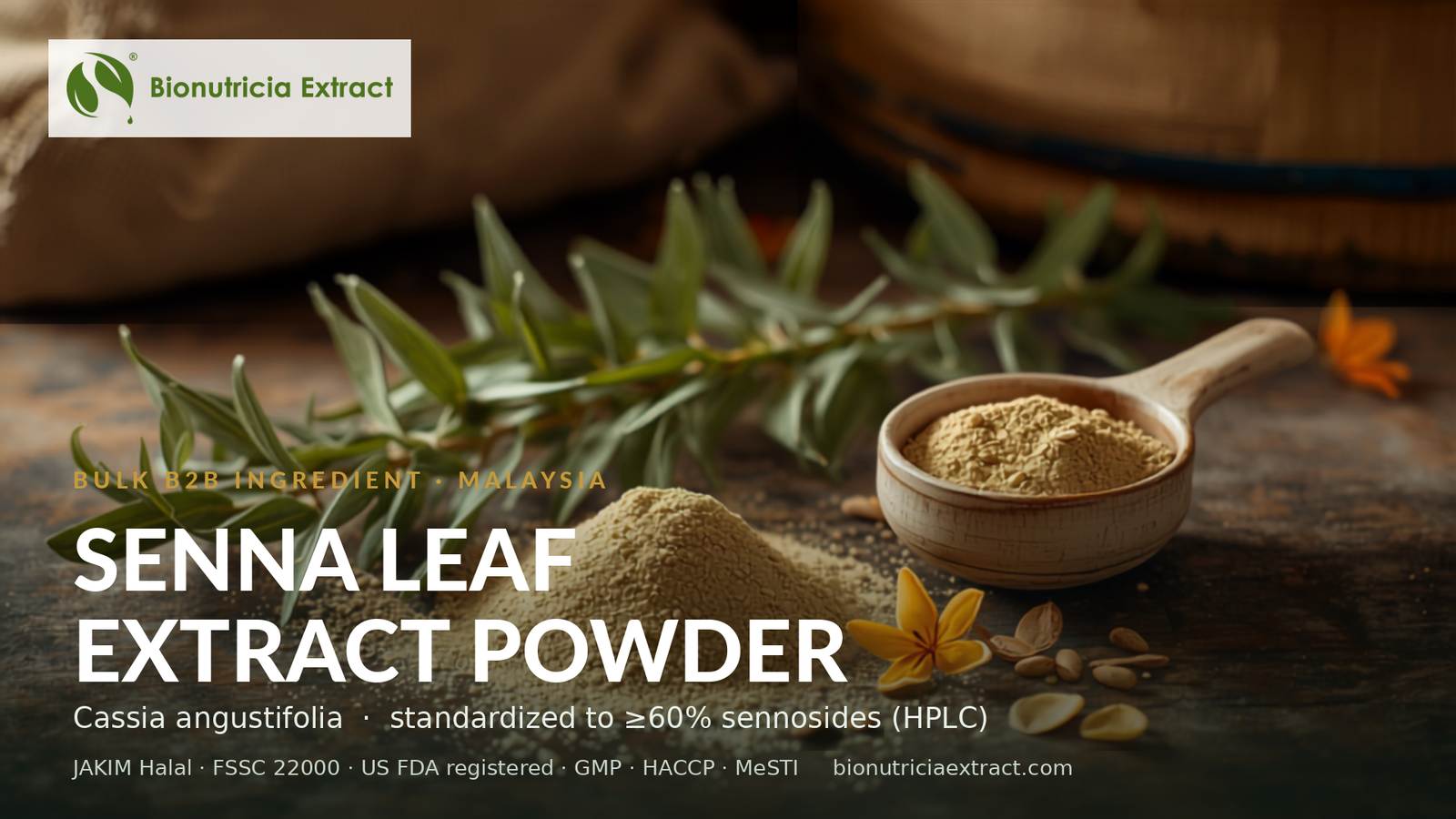
Senna leaf extract powder is an extract of Cassia angustifolia (senna) leaf, standardized to not less than 60% sennosides (the marker actives, measured by HPLC). Bionutricia Extract supplies it in bulk to B2B and OEM formulators from a JAKIM Halal, FSSC 22000, US FDA-registered, GMP, HACCP and MeSTI facility in Malaysia, with a Certificate of Analysis on every lot.
Quick facts for formulators
- Botanical / part: Cassia angustifolia (senna, syn. Senna alexandrina), leaf
- Standardisation marker: sennosides not less than 60% (HPLC)
- Form / colour / odour: non-free-flowing light greenish-brown powder, characteristic
- Moisture: 2–8% · Solubility: soluble in water · pH (10%): 6–9
- Dosage: 200–800 mg
- Pack sizes: 1 kg · 5 kg · 20 kg
- Certifications: JAKIM Halal · FSSC 22000 · US FDA registered · GMP · HACCP · MeSTI · COA per lot
- Clean label: vegan, non-GMO, gluten-free (<20 ppm), not irradiated, no Annex II allergens
- Shelf life: 24 months sealed, cool & dry · Origin: Malaysia
What is senna leaf extract powder?
Senna (Cassia angustifolia, syn. Senna alexandrina) is a small desert shrub of the legume family with pinnate leaves of paired, lance-shaped leaflets and bright yellow flowers, cultivated mainly in India and North Africa. Its dried leaflets are one of the most widely used botanicals in the world and appear in traditional systems from Ayurveda to Middle Eastern herbal practice, where senna tea has been drunk for centuries to support bowel regularity. Bionutricia's extract concentrates the leaf's characteristic actives — the sennosides — into a stable, water-soluble powder with a defined ≥60% marker level, converting a variable agricultural raw material into a documented, easy-to-dose B2B ingredient.
Active compound & standardisation
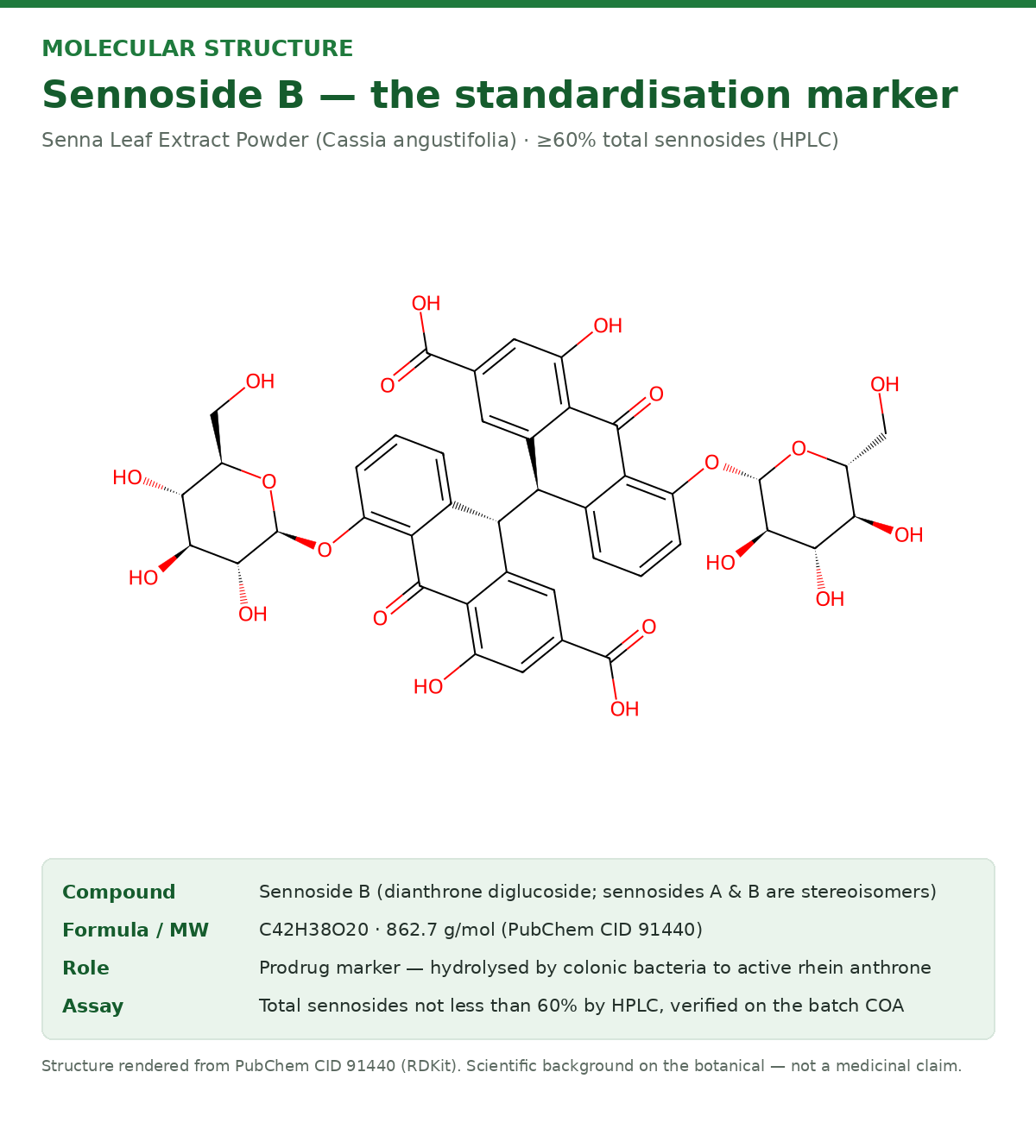
The marker actives of senna are the sennosides — dianthrone diglucosides, of which sennosides A and B (stereoisomers, C₄₂H₃₈O₂₀) dominate. They belong to the hydroxyanthracene glycoside family, and pharmacopoeial assays conventionally express total sennoside content calculated with reference to sennoside B. Bionutricia standardises to not less than 60% sennosides by HPLC — an unusually concentrated grade — so a formulator can dose a defined sennoside quantity per serving and document batch-to-batch consistency on the COA, rather than working from crude leaf powder whose sennoside content naturally varies.
How sennosides work in the body (mechanism)
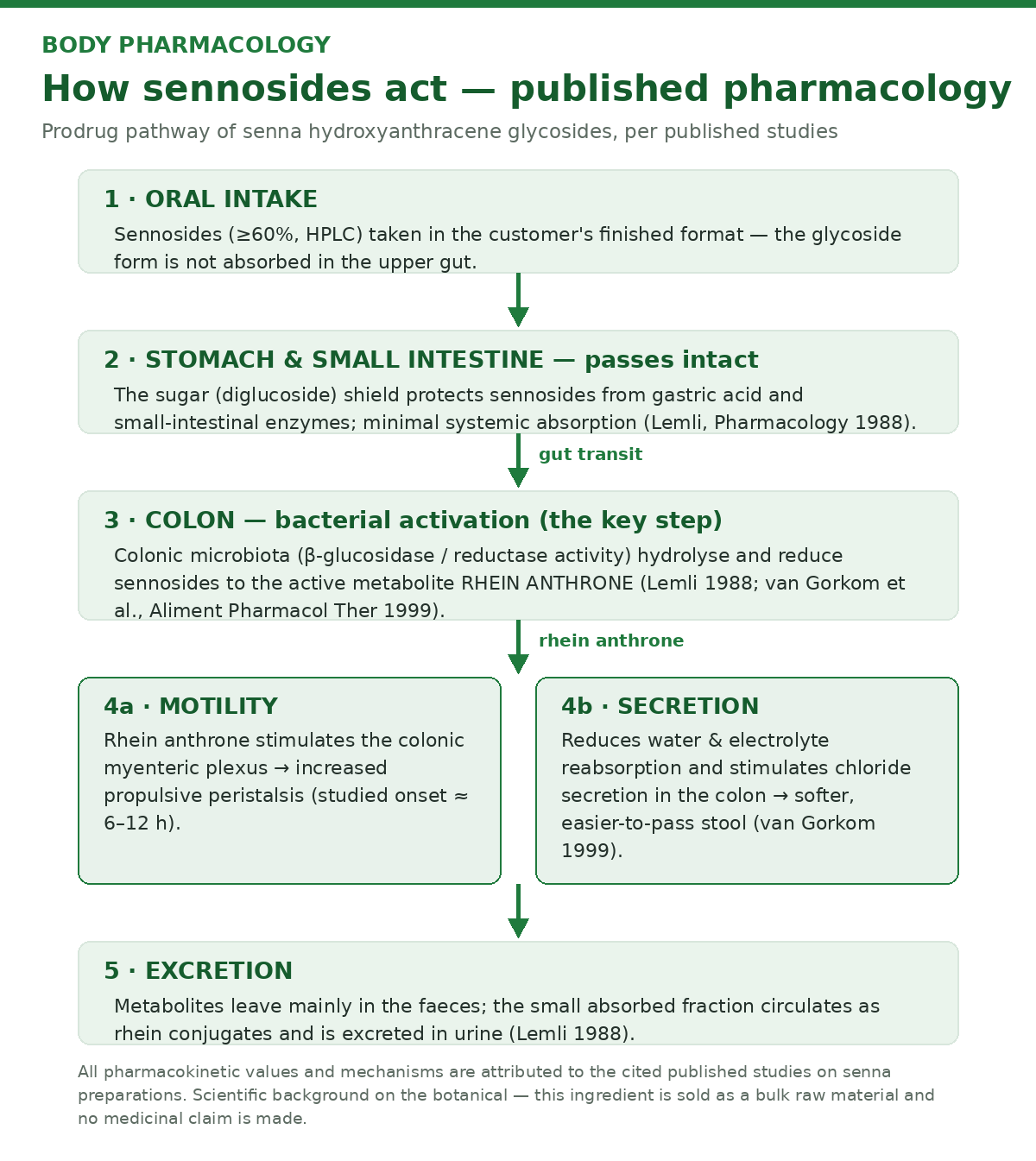
Sennosides are classic prodrugs. Taken orally, the sugar-bound glycosides are neither absorbed nor activated in the stomach or small intestine; they travel intact to the colon, where the resident microbiota (β-glucosidase and reductase activity) hydrolyse and reduce them to the active metabolite rhein anthrone (Lemli, Pharmacology 1988). Rhein anthrone then acts locally on the large bowel in two published ways: it stimulates the myenteric nerve plexus, increasing propulsive peristalsis, and it shifts colonic water and electrolyte handling — reducing reabsorption and stimulating chloride secretion — so stools become softer and easier to pass, with a studied onset of roughly 6–12 hours (van Gorkom et al., Alimentary Pharmacology & Therapeutics 1999). Systemic absorption is minimal; metabolites leave mainly in the faeces, with the small absorbed fraction excreted in urine as rhein conjugates. Mechanism is provided as scientific background on the botanical, attributed to the cited studies; it is not a claim that this ingredient treats, cures or prevents any condition.
Clinical evidence on senna
Senna is among the most studied laxative botanicals, with decades of comparative trials and formal recognition in both the US OTC monograph system and the European Union herbal monograph framework. The evidence below was generated on senna preparations by independent researchers and regulators; it is attributed to those sources and provided as scientific context for technical buyers — not as performance claims for this ingredient.
| Area studied | Best available human evidence | Result (attributed to the study) |
|---|---|---|
| Chronic constipation, long-stay elderly | Double-blind crossover RCT, n=77, senna-fibre combination (10 ml/day, 14 days) vs lactulose (15 ml twice daily) (Passmore et al., Pharmacology 1993;47 Suppl 1:249–252) | Mean daily bowel frequency, stool consistency and ease of evacuation all significantly greater with the senna-fibre arm; the recommended dose was exceeded more often on lactulose (χ² = 8.38, p < 0.01); adverse effects no different between arms |
| Constipation in terminal cancer care (opioid-treated patients) | Randomised comparison, n=91, senna vs lactulose over 27 days (Agra et al., Journal of Pain and Symptom Management 1998) | No significant difference in defecation-free intervals or overall efficacy between senna and lactulose; senna was the more economical option |
| Regulatory recognition | US FDA OTC monograph system; EMA herbal monograph on Senna alexandrina leaf (well-established use) | Senna preparations are long-recognised OTC stimulant-laxative actives in the US; the EMA monograph accepts well-established use for short-term occasional constipation at 15–30 mg hydroxyanthracene glycosides (calculated as sennoside B) once daily, for a maximum of 1–2 weeks |
| Safety caution (cited honestly) | EFSA Panel opinion on hydroxyanthracene derivatives (2018); Commission Regulation (EU) 2021/468 | EFSA raised genotoxicity concerns for the hydroxyanthracene class from in-vitro data; the EU subsequently restricted certain hydroxyanthracene preparations in ordinary foods and placed senna-derived preparations under formal scrutiny — buyers formulating for the EU should route senna through the appropriate regulated product category, not conventional food |
Trial populations, doses and preparations vary, and senna's effect is dose-limited and intended for short-term use in the cited frameworks; results describe the botanical in research and regulatory settings and are not extrapolated to any Bionutricia finished product.
Typical specification
| Parameter | Value |
|---|---|
| Botanical source / part | Cassia angustifolia, leaf |
| Appearance / colour | Non-free-flowing powder, light greenish brown |
| Odour | Characteristic |
| Standardisation marker | Sennosides, not less than 60% (HPLC) |
| Moisture | 2–8% |
| Solubility | Soluble in water |
| pH (10%) | 6–9 |
| Residue on ignition | Not more than 12% |
| Loss on drying | Not more than 5% |
| Dosage | 200–800 mg |
| Heavy metals (As, Pb, Cd, Hg) | As < 1 ppm, Pb < 1 ppm, Cd < 1 ppm, Hg < 0.5 ppm |
| Microbial (APC, Y&M, coliform, E. coli) | APC < 10³ cfu/g, Y&M < 10² cfu/g, coliforms < 10 cfu/g, E. coli absent (1 g) |
| Certifications | JAKIM Halal, FSSC 22000, US FDA registered, GMP, HACCP, MeSTI |
| Shelf life | 24 months sealed, cool & dry |
| Pack sizes | 1 kg, 5 kg, 20 kg |
| Country of origin | Malaysia |
Full specification and a batch Certificate of Analysis are provided on request. Figures are typical values; confirm the current lot COA for release data.
Applications
As a water-soluble concentrate dosed at 200–800 mg, senna leaf extract powder is formulated by customers into the finished categories appropriate to their market — capsules, tablets, sachet and stick-pack blends, herbal teas and beverage premixes. Bionutricia supplies the bulk ingredient for B2B formulation; brand owners and manufacturers formulate it into their chosen finished format and register it under the product category applicable in their country. Because senna is a recognised laxative active in most regulatory systems, experienced buyers treat category selection as the first formulation decision — and Bionutricia's specification, COA and certification stack are built to support that registration work.
Why source senna extract from Bionutricia?
Bionutricia Extract has manufactured standardized Malaysian botanical extracts since 2006 under a full halal and international food-safety stack (JAKIM Halal, FSSC 22000, US FDA registration, GMP, HACCP, MeSTI), issuing a Certificate of Analysis on every lot. Its enzymatic-and-ultrasonic process is patented (MY-188945-A, "Process for Preparing Nutritional Powder Extract"), concentrating senna's marker sennosides to an unusually high ≥60% grade with no added colourants, fillers or preservatives. Bulk OEM, custom standardisation and packing are available. See the live senna leaf extract product page for ordering.
Formulators building a digestive or fibre range alongside senna also source our ginger extract powder, dandelion extract powder and barley β-glucan powder from the same certified catalogue — one audit pack, one shipment.
Frequently asked questions
Standardized to what / is a COA available? An extract of Cassia angustifolia leaf standardized to not less than 60% sennosides by HPLC, moisture 2–8%; batch COA per lot.
Is it halal? Yes — JAKIM Halal certified; the facility is also FSSC 22000, US FDA-registered, GMP, HACCP and MeSTI. Halal documentation issued with each shipment.
Is it water-soluble? Yes — soluble in water; a non-free-flowing light greenish-brown powder dosed at 200–800 mg for powder premixes and liquid systems.
What does the 60% sennosides figure mean? Sennosides are senna's marker actives; a defined ≥60% level lets a brand dose a documented sennoside quantity per serving with batch-to-batch consistency.
What formats do customers make? We supply the bulk ingredient; customers formulate capsules, tablets, sachets, teas and beverage blends registered under their market's applicable category.
How is senna regulated in finished products? At the customer's finished-product stage, and it differs by market — US OTC monograph and EMA herbal monograph recognise senna as a laxative active, while the EU restricts hydroxyanthracene derivatives in ordinary foods. We supply the documentation for your chosen route.
MOQ & lead time? Pack sizes 1 kg, 5 kg, 20 kg; pre-order packing ~1–2 weeks. MOQ & pricing on quotation.
Storage & shelf life? Sealed, cool & dry, away from pests; 24 months when properly stored.