Saffron Extract Powder (Crocus sativus) — Bulk B2B Supplier
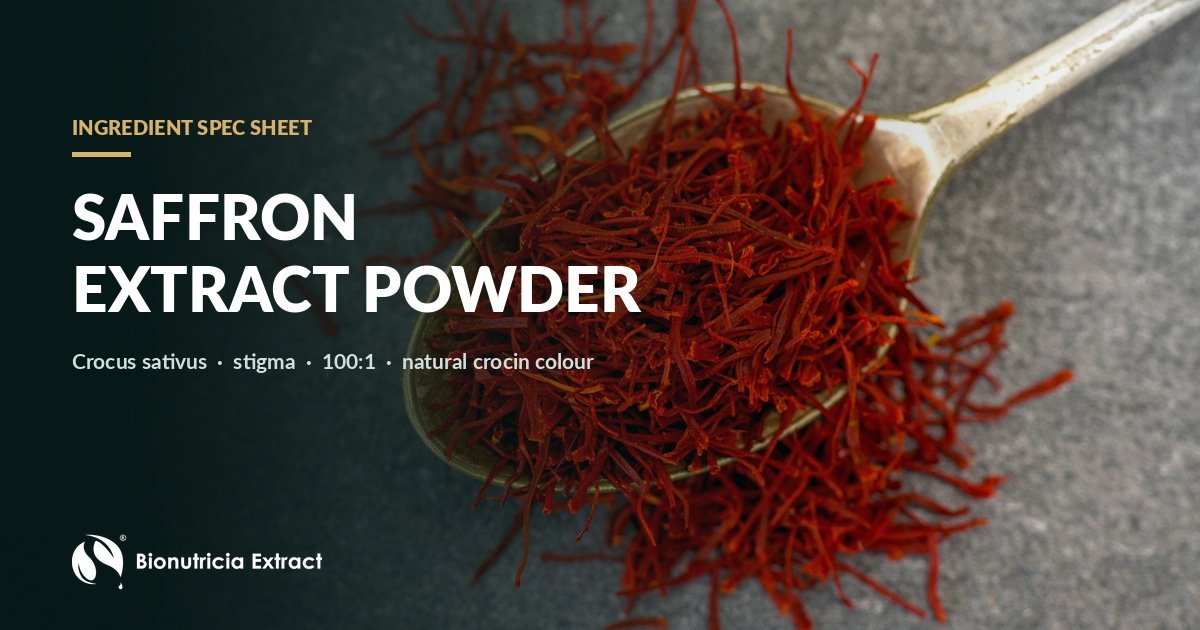
Saffron extract powder is a water-soluble 100:1 extract of Crocus sativus stigma — the source of the saffron spice — carrying the natural crocin colour compounds that give a luminous yellow-orange colour, along with saffron’s characteristic aroma and flavour, in a stable yellow powder for B2B and OEM use across beverages, rice dishes, dairy, bakery, confectionery and supplement blends. It is manufactured in bulk by Bionutricia Extract (Bionutricia Manufacturing Sdn Bhd), a JAKIM Halal, FSSC 22000, GMP, HACCP and MeSTI manufacturer in Malaysia, with a Certificate of Analysis on every lot. This guide is written for procurement, R&D and formulation teams: it covers the full specification, how to evaluate crocin / crocetin / safranal standardisation, how to authenticate incoming lots, and how to design a stable finished product that meets the rules of your target market.
Quick facts for formulators
- Botanical / part: Crocus sativus (saffron), stigma
- Extraction ratio: 100:1
- Marker compounds: crocins (colour, water-soluble), crocetin, safranal (volatile aroma), picrocrocin (taste)
- Forms available: water / hydroalcoholic extracts and spray-dried powders; CO2 or oil-based fractions where aroma delivery is the priority
- Function: natural yellow-orange colour & characteristic saffron flavour for F&B and supplement blends
- Form / colour / odour: yellow non-free-flowing powder, characteristic odour
- Solubility: soluble in water · Moisture: 2–8% · pH: 4–6
- Typical serving / use: 250–750 mg · Particle: >95% / 60 mesh
- Pack sizes: 1 kg · 5 kg · 20 kg
- Certifications: JAKIM Halal · FSSC 22000 · GMP · HACCP · MeSTI · COA per lot
- Clean label: vegan, non-GMO, gluten-free (<20 ppm), not irradiated, porcine DNA absent, no listed allergens
- Shelf life: 24 months sealed, cool & dry — always validate retention in your own finished matrix
- Heavy metals: As <0.1 · Pb <0.2 · Cd <0.5 · Hg <0.1 · Sb <0.1 ppm · Microbial: within limits
- Supplier documentation: lot COAs, annotated chromatograms, adulteration screening and food-safety credentials — the paperwork that removes development and regulatory risk
- Origin: Malaysia
What is saffron extract powder?
Saffron (Crocus sativus) is the dried stigma of the saffron crocus, hand-harvested and prized for centuries as the world’s most valuable spice for the luminous yellow-orange colour and unmistakable aroma it lends to food. Its colour comes from a group of water-soluble carotenoid glycosides called crocins, while its characteristic aroma and flavour come from compounds such as safranal and picrocrocin. Bionutricia’s saffron extract powder is a 100:1 extract of the stigma, concentrated and dried into a stable, yellow, water-soluble powder that carries the natural crocins, giving formulators a consistent, easy-to-handle colour-and-flavour raw material in place of variable whole-thread inputs.
What is it used for in formulation?
It is used as a bulk raw colour-and-flavour ingredient wherever the signature saffron hue and note are wanted: rice dishes such as biryani, paella, risotto and jewelled rice; beverages and ready-to-drink products; dairy, ice cream and desserts; bakery and confectionery; seasoning and spice blends; and supplement drink powders. Because it is water-soluble it disperses readily into liquid systems, and it is dosed to the target colour depth and flavour intensity — for supplement and beverage formats a typical serving is 250–750 mg. Saffron is often paired with complementary spices or natural colours to build a full sensory profile.
Product page and ordering details for the material described here: Saffron Yellow (Crocus sativus) Standardized Extract Powder — bulk. For related guidance on delivery formats and colour use-levels see our delivery systems guide and natural food colouring article.
Standardisation & authentication — crocin and safranal
Ask any supplier to declare which marker(s) they standardise to, and to provide the method behind the number. The practical requirements for B2B procurement are:
- Quantitative assay: HPLC for crocin / crocetin (reported as mg/g or % w/w), and GC-MS for safranal if aroma is part of your selling proposition.
- Chromatograms: an annotated lot-level HPLC chromatogram showing retention times and peak areas, plus UV-Vis colouring-strength data where requested.
- Adulteration screening: targeted tests for safflower, turmeric and synthetic dyes, and DNA barcoding for raw botanical identity where available.
- Reporting format: a COA that states method, limits and units — without those three, supplier-to-supplier comparison is meaningless.
Useful peer-reviewed references: a review of saffron constituents and analytics (PMC4599112), an updated narrative review of saffron bioactives (PMC10400758), and an analytical study covering crocin, crocetin and safranal (PubMed 33356506).
Formulation, stability & packaging guidance
- Match form to function: use crocin-rich water extracts or water-dispersible powders for colour in aqueous products; use CO2 or oil-based fractions for aroma delivery.
- Microencapsulation: protects volatile safranal from loss during processing and storage, and aids incorporation into dry mixes.
- Thermal and oxidative sensitivity: safranal is heat- and oxidation-sensitive; validate aroma retention in pilot runs and include antioxidants or protective carriers where permitted.
- Packing: opaque, airtight containers with nitrogen flush or oxygen-scavenging liners preserve both pigment and aroma; carry clear storage instructions (cool, dry, dark) onto the finished pack.
- Stability testing: accelerated and real-time stability in the finished matrix are mandatory before you assign a shelf life or make a label statement.
Regulatory considerations & supplier qualification checklist
Regulatory classification varies by country and by intended use (colouring, flavouring, or supplement ingredient). Brands must confirm allowable use levels and labelling rules for each market before launch. Use this checklist when qualifying lots:
- Lot COA with crocin / crocetin assay (mg/g or %), annotated chromatogram and the method used.
- Adulteration and authenticity screening report.
- Heavy metals, pesticide residues, mycotoxin and microbial testing.
- Traceability documents: batch trace, country of origin and supplier contact.
- The certifications your markets require (e.g. Halal, GMP, FSSC 22000).
- Stability data, or a commitment to co-develop stability testing in your own SKU.
Typical specification
| Parameter | Value |
|---|---|
| Botanical source / part | Crocus sativus (saffron), stigma |
| Extraction ratio | 100:1 |
| Marker compound | Crocins (natural colour compounds), present |
| Crocin / crocetin assay | Reported as mg/g or % w/w on the lot COA (HPLC) |
| Safranal | Reported by GC-MS where aroma is specified |
| Appearance / colour | Non-free-flowing powder, yellow |
| Odour | Characteristic |
| Solubility in water | Soluble |
| Moisture | 2–8% |
| pH | 4–6 |
| Particle size / mesh | > 95% through 60 mesh |
| Typical serving / use | 250–750 mg |
| Porcine DNA | Absent |
| Heavy metals (As, Pb, Cd, Hg, Sb) | As < 0.1 ppm, Pb < 0.2 ppm, Cd < 0.5 ppm, Hg < 0.1 ppm, Sb < 0.1 ppm |
| Microbial (APC, Y&M, coliform, E. coli) | APC < 10⁴ cfu/g, Y&M < 10³ cfu/g, coliforms < 10² cfu/g, E. coli absent |
| Certifications | JAKIM Halal, FSSC 22000, GMP, HACCP, MeSTI |
| Shelf life | 24 months sealed, cool & dry |
| Pack sizes | 1 kg, 5 kg, 20 kg (OEM bulk on request) |
| Country of origin | Malaysia |
Saffron’s actives and the published clinical research
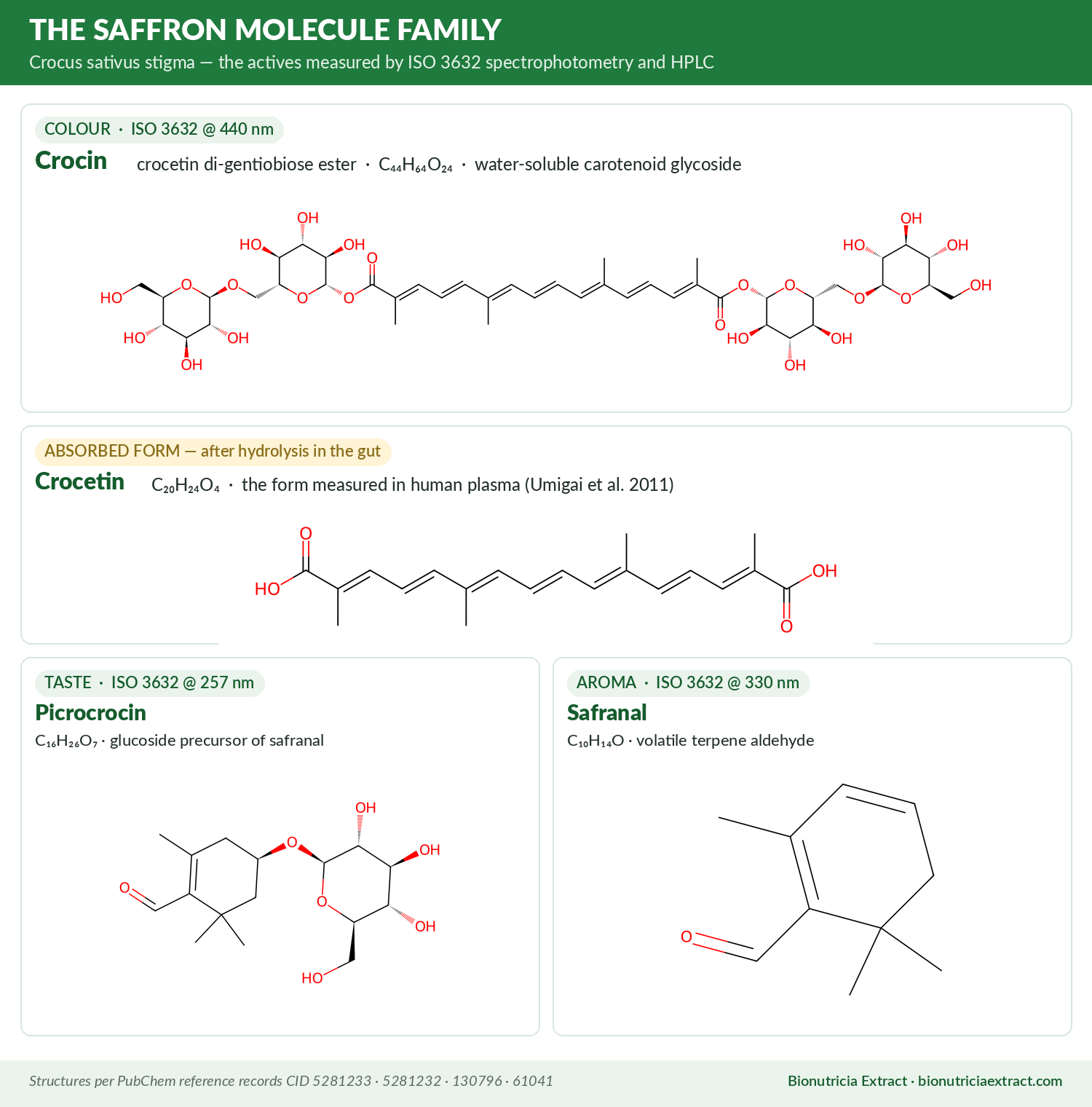
Three well-characterised constituents define saffron and are all measurable by internationally recognised methods. Crocins — water-soluble carotenoid glycosides — carry the colour; picrocrocin carries the taste; and safranal carries the aroma. The ISO 3632 method grades saffron spectrophotometrically on these three markers — colouring strength at ~440 nm (crocins), bittering power at ~257 nm (picrocrocin) and odour strength at ~330 nm (safranal) — while individual crocins and safranal are further resolved by HPLC. This is the same marker set formulators use to specify saffron in a finished product.
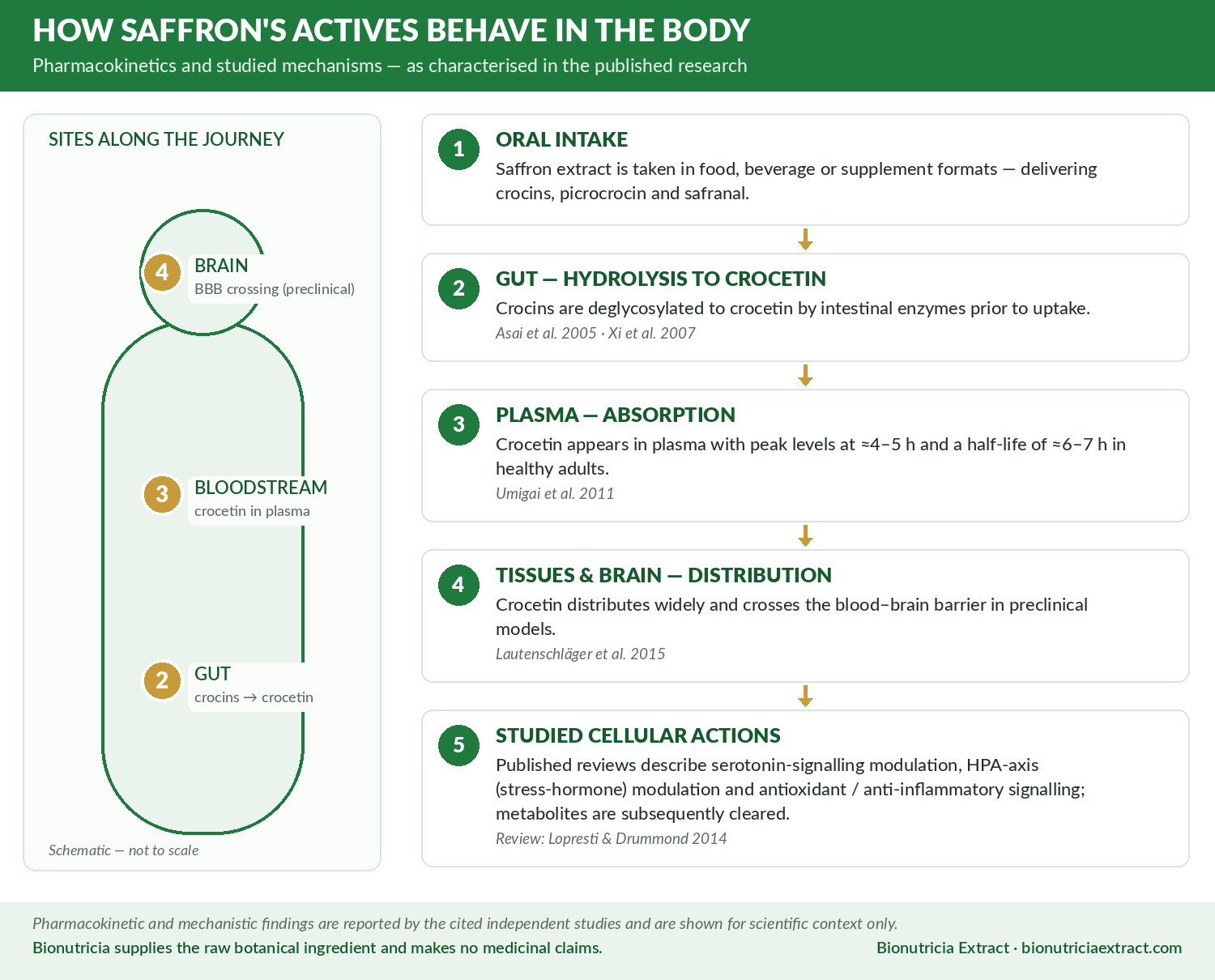
How the actives behave in the body. Published pharmacokinetic work shows that dietary crocins are deglycosylated to crocetin by intestinal enzymes before uptake (Asai et al. 2005; Xi et al. 2007). In healthy adults, crocetin appears in plasma with peak levels at roughly 4–5 hours and a half-life of about 6–7 hours (Umigai et al. 2011). Preclinical models report that crocetin distributes widely and crosses the blood–brain barrier (Lautenschläger et al. 2015). Mechanistic reviews of the clinical literature describe serotonin-signalling modulation, HPA-axis (stress-hormone) modulation and antioxidant / anti-inflammatory signalling as the actions under study (Lopresti & Drummond 2014).
Beyond colour and flavour, standardised saffron stigma extracts — typically characterised by their combined safranal and crocin content and dosed at around 28–30 mg/day — have been studied in a substantial body of independent human clinical research:
| Published study | Design / participants | Dose & duration | Reported outcome (per the study) |
|---|---|---|---|
| Kell et al. 2017, Complementary Therapies in Medicine — standardised saffron stigma extract | Double-blind, placebo-controlled RCT; n=128 healthy adults | 28 mg/day, 4 weeks | Improved mood and reduced stress vs placebo; a 22 mg/day arm did not separate from placebo — an honest dose threshold. |
| Agha-Hosseini et al. 2008, BJOG — saffron stigma | Double-blind, placebo-controlled RCT; n=50 women with PMS | 30 mg/day, 2 menstrual cycles | 76% of the saffron group achieved ≥50% symptom reduction vs 8% on placebo. |
| Meta-analysis of randomised trials in major depressive disorder | Pooled RCTs | ~30 mg/day, ≥6 weeks | Efficacy comparable to standard antidepressants, with favourable tolerability. |
| Decentralised RCT in adults with moderate insomnia (2025) | Double-blind, placebo-controlled RCT | Standardised saffron extract, daily | Improved self-reported sleep quality vs placebo. |
Important: the studies above are published by independent researchers and are cited for scientific context only. Bionutricia supplies saffron as a bulk food-grade colour-and-flavour ingredient and makes no medicinal claims. Whether a finished product may carry any health claim — and whether it is regulated as a food or as a supplement — is determined at the brand owner’s finished-product stage (NPRA in Malaysia, HSA, GACC, EFSA, FDA and equivalents), not at the ingredient stage. Bionutricia can supply saffron extract to a defined crocin / safranal specification and help you navigate that claims interface.
Why source saffron extract from Bionutricia?
Bionutricia Extract has manufactured standardized plant and spice extracts since 2006 under a full halal and international food-safety stack (JAKIM Halal, FSSC 22000, GMP, HACCP, MeSTI), issuing a Certificate of Analysis on every lot with porcine DNA confirmed absent. Its patented (MY-188945-A) green-biotechnology process concentrates saffron’s natural crocins into a clean, water-soluble powder without added fillers, flavours, preservatives or artificial colours, and bulk OEM, custom standardisation and packing are available for brand and manufacturer customers building premium colour-and-flavour and natural-spice products.
Frequently asked questions
Is it halal certified? Yes — JAKIM Halal (verifiable on the Halal Malaysia portal), plus FSSC 22000, GMP, HACCP, MeSTI; porcine DNA absent; COA per lot.
Standardized to what / is a COA available? 100:1 water-soluble stigma extract carrying the natural crocin colour compounds; yellow non-free-flowing powder, moisture 2–8%, pH 4–6; COA per lot.
What should I request to confirm crocin potency? Request the lot COA listing crocin / crocetin values (mg/g or %), the HPLC method, and an annotated chromatogram. Units and method details are essential to compare suppliers.
Is saffron extract suitable as a natural food colour? Yes — crocins give a yellow-orange colour in aqueous systems. Confirm the local regulatory status and maximum use levels for each market before declaring it as a colouring agent.
How can I preserve saffron aroma during processing? Use microencapsulation or protective carriers and avoid excessive heat and oxygen exposure. Validate aroma retention in pilot processing, and choose CO2 or oil-soluble fractions if aroma delivery is critical.
When is third-party testing recommended? For high-value SKUs, export into strict regulatory markets, or wherever adulteration risk is a concern, request third-party HPLC / GC-MS verification and contaminant testing.
What colour & flavour does it give? A luminous yellow-orange colour from crocins, plus saffron’s characteristic aroma and flavour from compounds such as safranal and picrocrocin (supplied as a compositional colour/flavour ingredient; no health claims).
How is it dosed / is it water soluble? Soluble in water; typically used at 250–750 mg per serving in supplement and beverage formats, or to the target colour and flavour intensity in food.
Botanical source & origin? Crocus sativus stigma (the saffron spice), manufactured into extract powder in Malaysia.
Clean-label option? Vegan, non-GMO, gluten-free (<20 ppm), not irradiated; no listed allergens; no added fillers, flavours, preservatives or artificial colours.
Applications? Rice dishes (biryani, paella, risotto), beverages and RTD, dairy and desserts, bakery and confectionery, seasoning blends, and supplement drink powders.
Pack sizes, MOQ & lead time / OEM & samples? 1 kg · 5 kg · 20 kg; pre-order packing ~1–2 weeks; bulk MOQ & pricing on quotation; OEM, custom standardisation and paid samples for serious B2B enquiries.