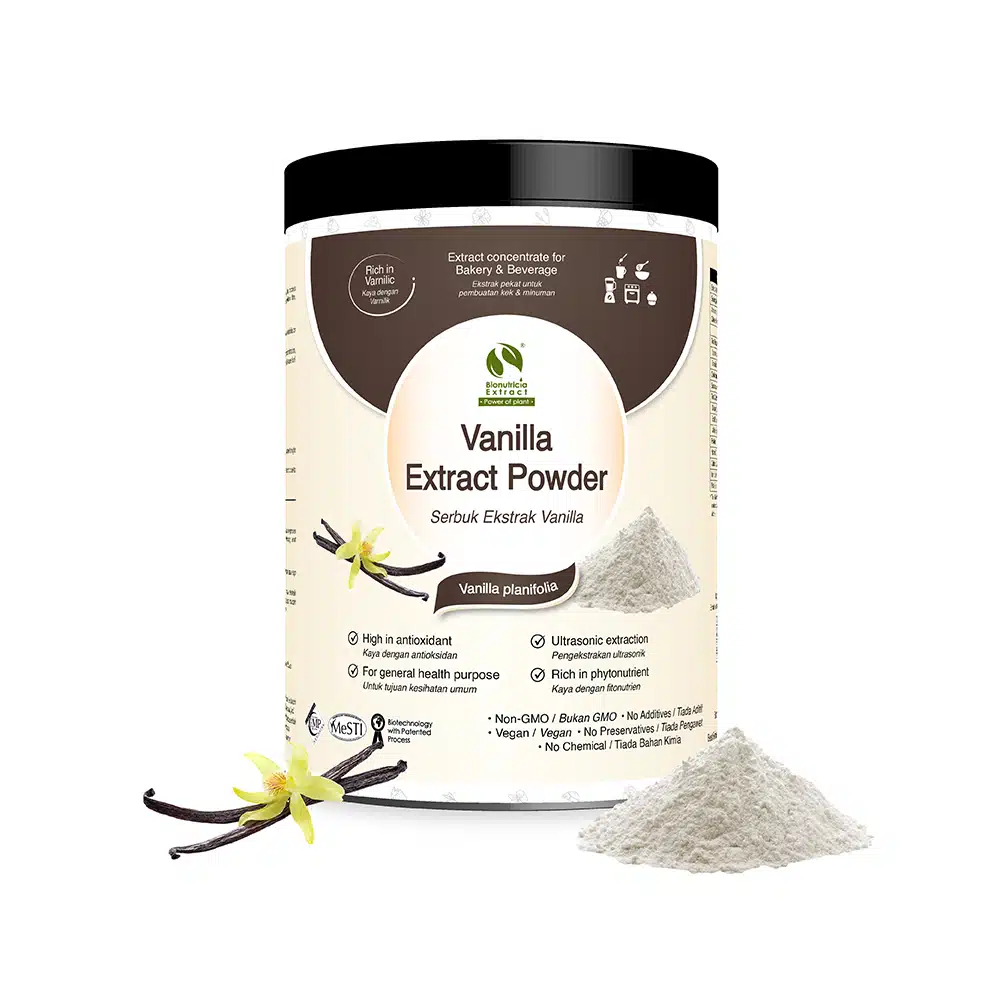
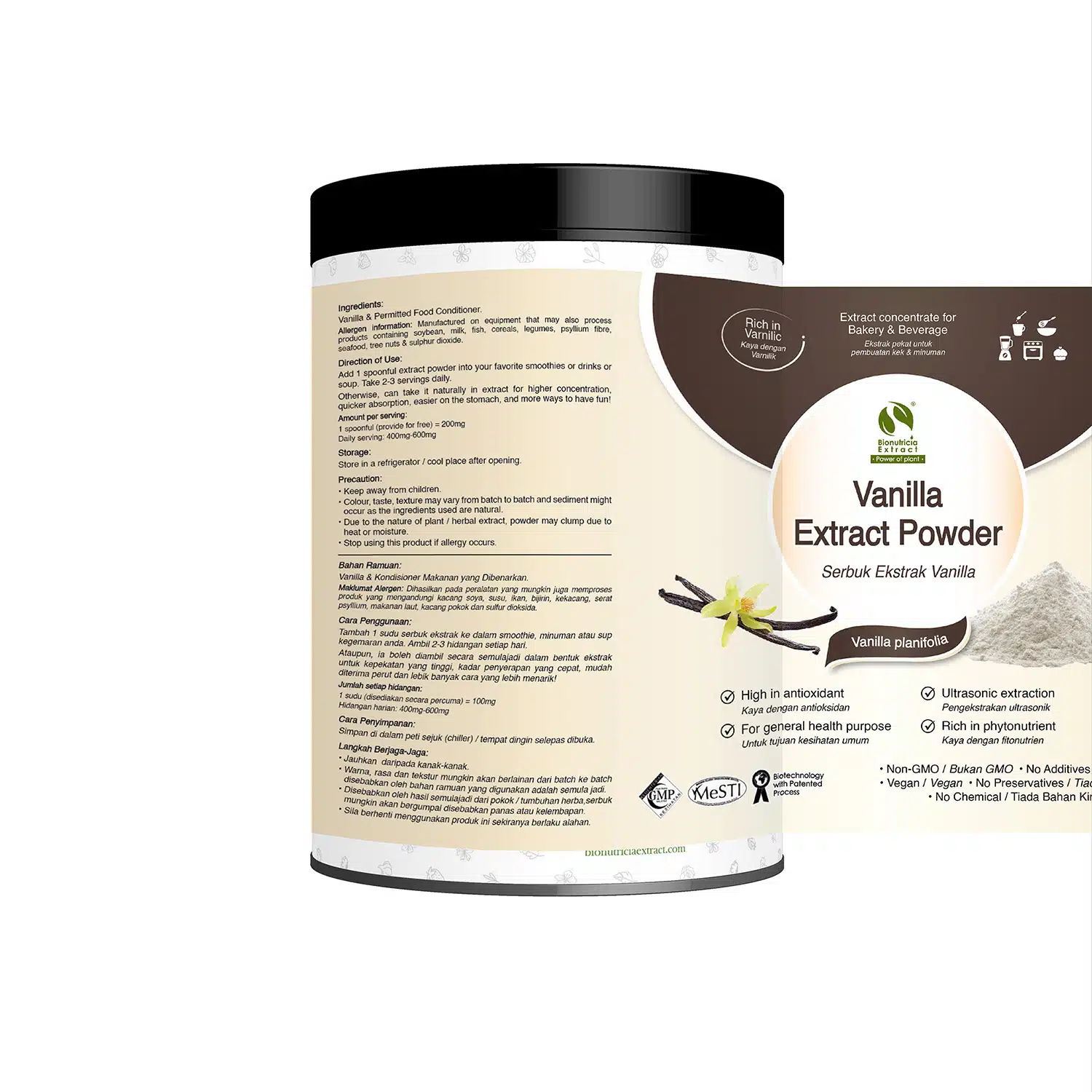
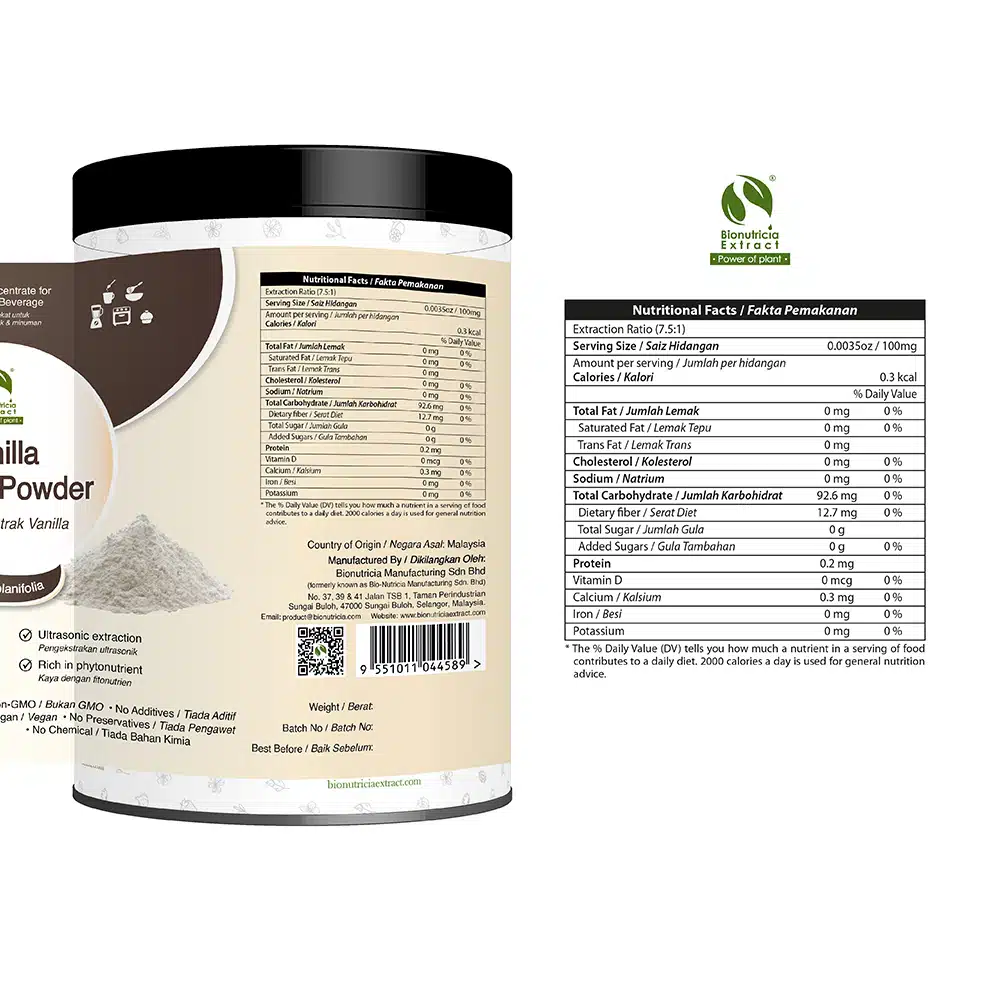


Description
Vanilla plants belong to the tropical climbing orchid family, and Vanilla planifolia Andrews which is cultivated in many countries such as Madagascar, Indonesia, Tahiti and Tonga is favoured by the food and beverage industries. Natural vanilla is a complex mixture of flavour components extracted from the ground black bean pods using alcohol. The fruity, floral fragrance of cured vanilla pods, combined with a deep, aromatic body, makes it a widely accepted flavouring agent, especially in sweet foods and drinks.
The main chemical constituent of vanilla is vanillin (4-hydroxy-3-metoxy benzaldehyde). Artificial vanilla flavour only contains this component. Vanillin can be synthesized from readily available materials such as guaiacol or eugenol derived from clove oil. Natural vanilla extract contains other polar aromatic flavour compounds such as 4-hydroxybenzaldehyde, 4- hydroxybenzoic acid, 4-hydroxybenzyl alcohol, and vanillic acid that can be identified by HPLC. Therefore, the ratio of 4-hydroxybenzoic acid, 4-hydroxybenzaldehyde and vanillic acid to vanillin in natural vanilla extracts was used to confirm the authenticity of vanilla extracts and as a useful index for detecting the origin of vanilla extracts. Amongst the variety of natural flavours in use today, vanilla occupies a prominent marketplace and has been in use for the preparation of ice creams, chocolates, cakes, soft drinks, pharmaceuticals, liquors, perfumery and nutraceuticals.
The flavour profile of Standardized vanilla extract contains more than 200 components, of which only 26 occur in concentrations greater than 1 mg/kg. Vanillin is the main constituent vanillin, which occurs in a concentration of 2.0% w/w in cured vanilla pods. True vanilla pods possess a pure delicate spicy flavour that cannot be duplicated exactly by synthetic products. For this reason, and because of limited supply, natural vanilla can command a premium price, leading to numerous efforts of its blending and adulteration. Also, the flavour quality of vanilla extracts varies considerably, depending upon the origin, curing technique used, storage conditions, extraction methods, and age of the vanilla extract itself.
Format, Packaging and Storage
25 kg vacuum-sealed kraft bags with inner liners, or lined drums for palletised container loads. R&D sample quantities available for specification testing. Packaging options include vacuum-sealed kraft bags, lined drums, or customer-specified primary packaging for private-label projects. Palletised and shrink-wrapped for export. Store in original sealed packaging below 25°C, relative humidity below 65%, in odour-free conditions away from direct sunlight. Shelf life is 24 months from manufacture date in original sealed packaging under specified storage conditions.
No harm/chemicals/preservatives, just harmony, manufactured naturally
- Vegan
- Non-GMO
- No Fillers
- No Flavors
- No Additives
- No Preservatives
- No Artificial Colours
- Soy and Gluten Free
Storage
- Keep in a cool & dry place. Avoid sunlight. Fridge would be best.
- Keep away from children.
- Has a shelf life of 24 months, in the original sealed packaging below 25°C, relative humidity below 65% and odour-free conditions.
- Packages should not be in direct contact with walls or floors.
Precaution
- Powder texture may vary. Some powder is fine, while some powder is coarser. Please consider this when ordering.
- Due to the nature of plant / herbal extract, powder may clump due to heat or moisture.
- Food supplements should not be used as a substitute for a varied and balanced diet.
- If you are pregnant, lactating or taking medications, please consult a physician before taking any nutritional products.
- Colour, taste, and texture may vary from batch to batch.
- Stop using this product if an allergy occurs.
Click here for more product information
What is Vanilla Bean Extract Powder?
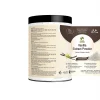
Vanilla bean extract powder is a standardized extract produced from cured vanilla beans (Vanilla planifolia), spray-dried into a fine powder. Vanillin is the primary flavour compound, but the full flavour profile includes over 200 aromatic components naturally present in the cured bean. The powder is used as a natural flavouring ingredient in food and beverage formulations, providing the characteristic sweet, creamy and floral vanilla aroma without the need for artificial flavourings. Our vanilla bean extract powder is supplied as a dry bulk ingredient with full specification and batch documentation for B2B customers.
Applications for food, beverage and supplement manufacturers
– Natural flavouring in beverages, dairy products, ice cream and confectionery
– Flavour ingredient in bakery, sauces and ready-to-eat products
– Standardised extract for consistent vanillin content and flavour profile
– Ingredient in functional beverage and supplement formulations
– Technical datasheets with recommended inclusion ranges available on request
Bulk buying checklist (documents and analytical checks)
– Certificate of Analysis (COA) for identity and batch purity
– Heavy metals report (lead, cadmium, arsenic, mercury)
– Microbial limits (total plate count, yeast & mould, E. coli, Salmonella)
– Moisture, ash, particle size and vanillin content specification
– Allergen declaration and processing aids list
– Packing list and commercial invoice for customs clearance
Supplier & packaging details (B2B terms)
– MOQ and pack sizes: R&D samples to 25 kg vacuum-sealed bags, drums with liners and palletised container loads — contact sales for current MOQ and lead times
– Pack formats: Vacuum-sealed kraft bags, lined drums, or customer-specified primary packaging for private-label projects
– OEM & private-label: Bulk supply, private-label packing and co-packing available; formulation support and finished-product OEM can be arranged through our partner services
– Documentation: COA, specification sheet, packing list and export documentation provided with shipments; halal and other certificates available where applicable
Certifications and quality systems
– Facility-level JAKIM Halal certification where applicable
– GMP and HACCP food-safety management systems in place at manufacturing sites
– FSSC 22000 implemented at primary processing facilities
– Batch COA and analytical reports provided with shipments
B2B FAQ
Q: Can you provide a COA and specification sheet before purchase?
A: Yes. We provide a recent COA and full specification sheet to support regulatory checks and in-house testing.
Q: Are samples available for specification testing?
A: Yes. Production samples and small evaluation packs are available. Contact sales with your intended application so we can match the right product grade.
Q: What are typical lead times?
A: Lead times vary with order size, current stock and destination. Provide required quantity, packaging and delivery address for an accurate estimate.
Q: Do you provide private-label packaging and OEM services?
A: Yes. Private-label and OEM services are available; contact sales to discuss formulation, packaging and regulatory labelling requirements.
Supplier & packaging details
Bionutricia Manufacturing supplies vanilla bean extract powder as a bulk ingredient for food and beverage manufacturers. We provide COA and full specification sheets for every lot, MOQ-friendly pack sizes and private-label/OEM services. Export documentation and halal certificates are available for international shipments.
- COA availability: COA and full specification sheets are provided for every shipped lot on request.
- Specifications: Vanilla planifolia origin, particle size, moisture, ash, and vanillin content are supplied on the specification sheet.
- MOQ & pack sizes: R&D samples, 25 kg vacuum-sealed bags, drums with liners, and palletised container loads — contact sales for current MOQ.
- Packing options: Vacuum-sealed kraft bags, drums with inner liners, or customer-specified primary packaging for private-label projects.
- OEM & private label: Private-label blending and finished-product OEM services are available via our formulation partners and in-house R&D team.
- Samples: Evaluation samples and R&D packs are available for specification testing.
Application — for food and beverage manufacturers
Vanilla bean extract powder is used as a natural flavouring ingredient across food, beverage and supplement formulations. Typical applications include beverages and dairy products, ice cream and confectionery, bakery and sauces, and supplement premix sachets. Technical datasheets describing recommended inclusion ranges for formulation stability testing are available on request.
Certifications
- JAKIM Halal certification (facility-level)
- GMP and HACCP food-safety systems
- FSSC 22000 at the manufacturing facility
- COA and batch analytical reports provided with shipments
Frequently asked questions (B2B)
What is the MOQ for vanilla bean extract powder?
MOQ depends on the product format and current stock. We supply single-bag R&D quantities up to full drum, pallet and container loads. Contact sales with your target volume and packaging to receive an MOQ and quotation.
Can you provide a COA and specification sheet before purchase?
Yes. We provide a recent COA for the suggested lot and a full specification sheet to support regulatory checks and in-house testing.
Are samples available for specification testing?
Yes. Production samples and small evaluation packs are available for testing. Contact sales to request a sample and advise the intended application so we can match the right product.
What lead times should I expect?
Lead times vary with order size, stock and destination. Provide required quantity, packaging and delivery address for an accurate delivery estimate.
Read the vanilla bean extract bulk buyer’s guide — specifications, MOQ, certifications and OEM details.
OEM / contract manufacturing: Bionutricia Extract supplies this as a bulk ingredient. For finished-product OEM & contract formulation, please visit our sister company bionutricia.com.
Chemistry of Vanilla Bean — Vanillin and Aromatic Compounds
The principal flavour compound in vanilla is vanillin (4-hydroxy-3-methoxybenzaldehyde, PubChem CID 1183), a phenolic aldehyde that accounts for the characteristic sweet, creamy aroma of cured vanilla pods. In cured Vanilla planifolia beans, vanillin occurs at approximately 2.0% w/w, though this concentration varies with origin, curing method, and bean maturity. Vanillin can also be synthesised from guaiacol or eugenol (clove oil derivative), which is why HPLC authentication of natural vanilla extract is critical for buyers distinguishing natural from synthetic material.
Natural vanilla extract contains over 200 identified aromatic components, of which only 26 occur at concentrations above 1 mg/kg. Beyond vanillin, the key HPLC authentication markers are 4-hydroxybenzaldehyde, 4-hydroxybenzoic acid, 4-hydroxybenzyl alcohol, and vanillic acid. The ratio of these marker compounds to vanillin is the established industry index for confirming authenticity and detecting the botanical origin of vanilla extracts. A synthetic vanillin product lacks these co-occurring markers entirely, which is why the marker profile is the primary specification parameter for natural vanilla extract powder.
For formulators, vanillin content (%) is the primary specification parameter because it directly determines flavour intensity and cost-in-use. However, the full flavour profile — the complex interplay of all 200+ components — is what distinguishes natural vanilla extract from synthetic vanillin in finished products. Buyers should confirm both the vanillin content and the HPLC marker profile on the COA to verify that the material is natural and standardised to the declared specification.
Typical Specification Parameters
| Parameter | Why It Matters to a Buyer |
|---|---|
| Vanillin content (%) | The primary flavour specification. Determines flavour intensity, inclusion rate, and cost-in-use. Must be verified on every COA for batch consistency. Natural vanilla typically contains 1–2% vanillin in cured pods; standardised extracts are concentrated to higher levels. |
| Moisture | Excess moisture promotes caking, microbial growth, and flavour degradation during storage. Typical spray-dried powder should be below 5%. |
| Particle size | Affects dispersibility, dissolution rate, and mouthfeel. Finer particles dissolve faster but may generate dust during handling. |
| Mesh size | Defines the screen specification (e.g. 80 mesh, 100 mesh). Consistency in mesh size ensures uniform behaviour across batches in automated dosing and encapsulation systems. |
| Bulk density | Determines volume-to-weight ratios for packaging, silo storage, and dosing equipment calibration. Low bulk density increases packaging volume per kilogram. |
| Ash content | Indicates mineral residue after incineration. High ash suggests contamination or incomplete purification. Typical specification is below 5%. |
| Heavy metals (Pb, Cd, As, Hg) | Regulatory compliance for food safety. Limits must meet destination-market standards (e.g. EU, US FDA, Codex Alimentarius). Verified on the COA for every lot. |
| Microbial limits | Total plate count, yeast & mould, E. coli, and Salmonella must be within specification. Spray drying reduces bioburden, but post-processing handling must maintain limits through to delivery. |
Quick Facts for Formulators
- Botanical name: Vanilla planifolia Andrews
- Key compound: Vanillin (4-hydroxy-3-methoxybenzaldehyde, PubChem CID 1183)
- Aromatic profile: Over 200 identified components; 26 above 1 mg/kg
- HPLC authentication markers: 4-hydroxybenzaldehyde, 4-hydroxybenzoic acid, 4-hydroxybenzyl alcohol, vanillic acid
- Vanillin concentration in cured pods: approximately 2.0% w/w
- Extraction method: Alcohol extraction from ground cured bean pods, spray-dried into powder
- Appearance: Dark brown to black fine powder
- Flavour profile: Sweet, creamy, floral vanilla aroma with deep aromatic body
- Shelf life: 24 months in original sealed packaging below 25°C
- Documentation: COA and specification sheet provided with every shipped lot
- Certifications: JAKIM Halal, GMP, HACCP, FSSC 22000, MeSTI
How to Qualify a Vanilla Bean Powder Supplier
- Request a recent COA with vanillin content (%), moisture, ash, heavy metals, and microbial results for the offered lot
- Verify the specification sheet lists particle size, mesh size, bulk density, and vanillin content values
- Confirm the supplier provides HPLC authentication data showing the natural marker compound profile (4-hydroxybenzaldehyde, 4-hydroxybenzoic acid, vanillic acid)
- Check that vanillin content is consistent batch-to-batch, as flavour intensity directly affects finished-product quality
- Validate heavy metals meet destination-market regulatory limits (EU, US FDA, Codex Alimentarius)
- Confirm microbial limits include total plate count, yeast & mould, E. coli, and Salmonella
- Request an allergen declaration and list of processing aids used during extraction and spray-drying
- Ask for evaluation samples to test flavour intensity and solubility in your specific formulation matrix
- Confirm halal, GMP, HACCP, and FSSC 22000 certifications are current and facility-level
- Verify export documentation, packing lists, and lead-time commitments for your order volume, and confirm private-label packaging and OEM services if required
FSSC 22000
GMP
HACCP
JAKIM Halal
US FDA
MeSTI
NanoVerify