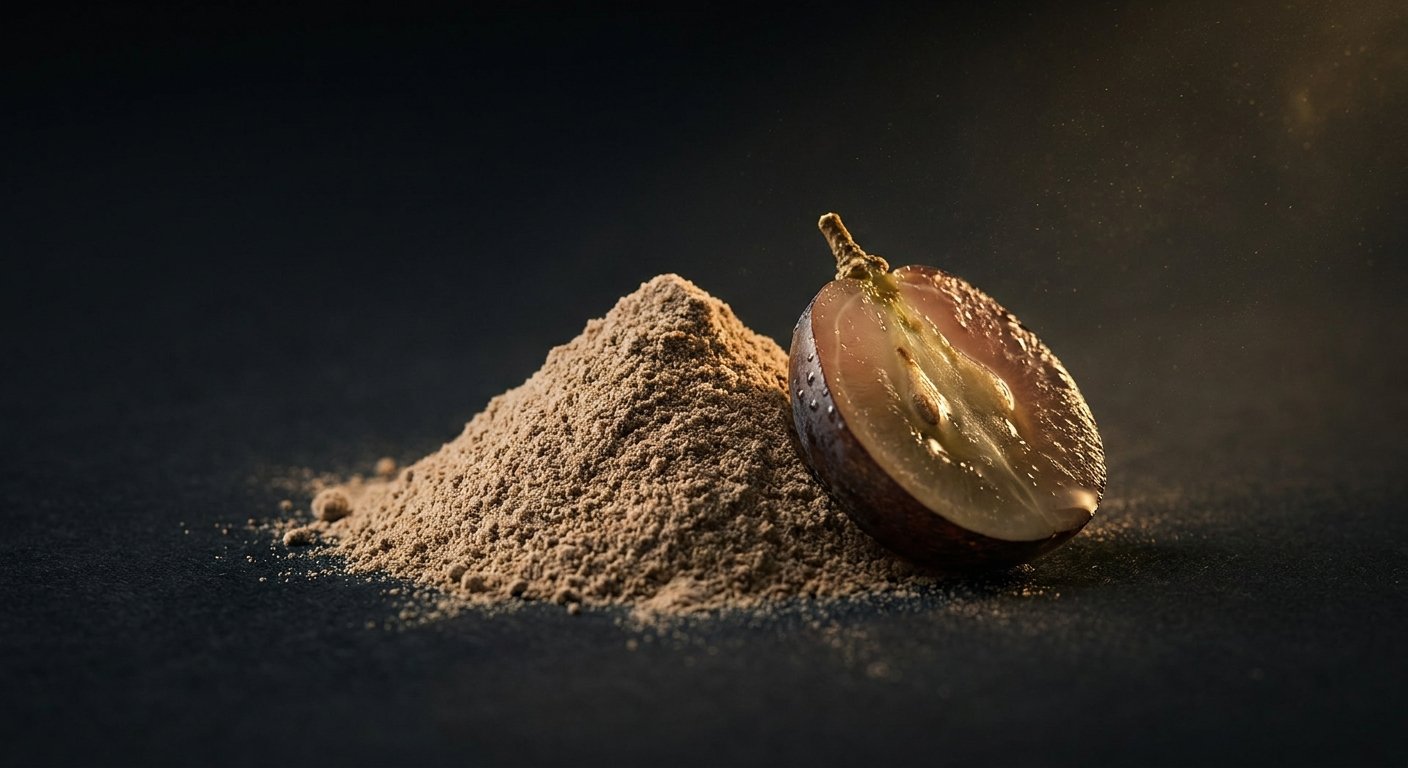
Grape extract powder is a water-extracted concentrate of the fruit of Vitis vinifera, standardised at a 20:1 ratio and dried into a light-brown, free-flowing powder used as a polyphenol-rich botanical ingredient. Its function comes from the fruit’s natural polyphenol content — anthocyanins and flavonoids concentrated by the extraction step. The single most important thing a buyer should establish before sourcing is which part of the grape the extract is made from — because “grape extract” is used loosely across the industry to mean fruit extract, seed extract or skin extract, and these are not interchangeable ingredients.
The extraction ratio — and why it decides potency
| Ratio | What it means | Practical effect |
|---|---|---|
| 1:1 (whole fruit powder) | Fruit is simply dried and milled, no concentration step | Low potency per gram; higher use levels needed to hit a target dose |
| 20:1 — this SKU | 20 kg of fresh grape fruit is concentrated into 1 kg of finished powder | Higher potency per gram; lower use levels; consistent lot-to-lot standardization |
Where the activity comes from: the polyphenol compounds in grape fruit
Grape fruit is one of the most studied plant sources of polyphenols. The two main classes relevant to a fruit extract are anthocyanins — the pigmented compounds responsible for red and purple grape colouring, concentrated mainly in the skin but present in whole-fruit extracts — and flavonoids, including catechins and flavonols such as quercetin. Grapes (particularly the skin and seed) are also a supplier of resveratrol, a stilbene compound, though resveratrol content in a fruit-only extract is typically lower than in seed or skin material.
The certificate for this SKU states a standardized active range of 1–8% without naming a specific assayed marker. It does not commit to a percentage of total polyphenols, anthocyanins or resveratrol specifically. Buyers who need a named, assayed marker — for example total polyphenols by Folin-Ciocalteu or a specific HPLC-quantified compound — should request that assay separately from the supplier rather than assume it sits behind the 1–8% figure.
What this extract is not
Three points of confusion worth clearing up. First, this is not grape seed extract or grape skin extract — the certificate records it as a fruit extract, and seed/skin extracts are separate products with a different, generally higher, resveratrol and tannin profile. Second, it is not solvent-extracted with ethanol or hexane — the certificate specifies water as the extraction solvent. Third, it is not a raw fruit powder — the 20:1 ratio means the fruit has been concentrated, not simply dried and milled.
The specification that matters
| Parameter | Why it matters | Typical method / limit |
|---|---|---|
| Extraction ratio | Determines potency per gram and dosing level | 20:1 |
| Standardized active range | The certificate’s declared dosage/marker range; request the lot CoA for the exact marker and assay method | 1–8% |
| Moisture content | Controls microbial stability and clumping | < 8% |
| Solubility / pH | Relevant for beverage and liquid formulation | Water-soluble, pH 3–5 |
| Particle size | Affects mouthfeel and dispersion | > 95% through 60 mesh |
| Heavy metals | Food-safety limit | Arsenic < 0.5 ppm, Lead < 0.01 ppm, Mercury < 0.02 ppm |
| Microbiology | Safety and shelf stability | APC < 10⁴ CFU/g; yeast & mould < 10³ CFU/g; coliforms < 10² CFU/g; E. coli absent (1 g) |
| Shelf life | Inventory planning | 2 years, stored cool, dry, sealed and away from pests |
Contact us for the current specification — request the certificate of analysis for the specific production lot you are purchasing to confirm the exact active marker and assay method behind the 1–8% standardized range.
Grape polyphenols and cardiovascular health: what the trials actually show
The strongest research case for grape polyphenols is cardiovascular, and that evidence belongs to the published studies on grape and wine polyphenols generally — not to a clinical trial of this specific powder.
A 2017 review in Molecules by Rasines-Perea and Teissedre, “Grape Polyphenols’ Effects in Human Cardiovascular Diseases and Diabetes,” summarised multiple human and pre-clinical studies (individual studies reviewed ranged roughly 10–75 participants). Across those studies, grape and wine polyphenol intake was associated with inhibition of platelet aggregation, decreased LDL oxidation, reduced oxidative stress, favourable effects on blood lipids and decreased inflammation, with a possible reduction in blood pressure. For type 2 diabetes, most — though not all — of the studies reviewed showed dietary polyphenols associated with a lower risk.
Honest limits of this evidence: the review itself notes a scarcity of information specific to diabetes management, and contradictory results depending on intake quantity, product type (red or white wine, grape juice, grape seed extract, or an isolated component such as resveratrol), treatment period and the health condition of participants across different trials. The authors call for larger, better-designed studies before firm recommendations on intake quantity, period or product type can be made. This research describes grape and wine polyphenols generally, and the certificate of analysis for this SKU does not specify an assayed polyphenol percentage — these findings are attributed to the cited review and are not claims about this specific product.
Applications
- Health supplements — dry powder blends and sachet premixes
- Functional beverages
- Desserts, ice-cream and jelly
- Baking and cooking recipes
Bionutricia supplies the bulk ingredient for B2B formulation; brand owners and manufacturers formulate it into their chosen finished format.
Sourcing checklist for B2B buyers
- Confirm which part of the grape the extract is derived from — fruit, seed or skin — this SKU is fruit.
- Request the lot-specific CoA showing the exact active marker and its assay method behind the 1–8% range.
- Confirm the extraction solvent — water, for this SKU, with no residual-solvent declaration required.
- Check heavy-metal and microbiology results against your own specification.
- Confirm halal, vegan and allergen declarations against your target market’s requirements.
- Request a retain sample for your own sensory and solubility trial before committing to volume.
Regulatory and compliance profile
- Not classified as dangerous under Regulation (EC) 1272/2008 (CLP); a Safety Data Sheet is available on request
- Non-GMO — not produced from genetically modified raw material
- Not irradiated
- Not a novel food under Regulation (EC) No 258/97
- Suitable for vegetarians and vegans; free of animal-derived products or derivatives
- Complies with the general guidelines for use of the term “halal” under Codex Alimentarius
- No allergenic substances listed in Annex II of Regulation (EC) No 1169/2011
- Gluten-free (< 20 ppm) under Regulation (EC) No 41/2009
- Handled on a quantum satis basis under GMP; discharged product should not be returned to its container
Why buyers work with Bionutricia
Bionutricia Manufacturing Sdn Bhd has produced standardised plant extracts and functional powders in Malaysia since 2006. The facility holds JAKIM Halal, FSSC 22000, GMP, HACCP, MeSTI and NanoVerify certification with a US FDA food facility registration. This grape extract powder ships in 1 kg, 5 kg and 10 kg packs with a CoA issued on every production lot; MOQ and pricing are quoted per enquiry.
Related ingredients and guides
- Knowledge: Grape (Vitis) — botanical background
- Grape Standardized Extract Liquid Concentrate — product page
Frequently asked questions
What solvent is used to extract this powder?
Water. The certificate specifies water as the extraction solvent, not ethanol or hexane.
Is this the same as grape seed extract?
No. This SKU is a fruit extract; grape seed and grape skin extracts are separate products with a different phytochemical profile and generally higher resveratrol and tannin content.
What active compounds does it contain?
Grape fruit’s main polyphenol classes are anthocyanins and flavonoids, with lower levels of resveratrol than seed or skin extracts. The certificate for this SKU gives a standardized active range of 1–8% without naming a specific assayed marker — request the lot CoA for the exact figure and method.
Is it halal and suitable for vegans?
Yes to both — it complies with Codex Alimentarius halal guidelines and is free of animal-derived products or derivatives, making it suitable for vegetarians and vegans.
Does it contain allergens or gluten?
No allergenic substances listed under Annex II of Regulation (EC) No 1169/2011 are present, and the product is gluten-free at less than 20 ppm.
What does the research say about grape polyphenols?
A 2017 review in Molecules associates grape and wine polyphenol intake with several cardiovascular benefits — including reduced platelet aggregation and LDL oxidation — and a possible lower type 2 diabetes risk. The authors note inconsistent results across studies and call for larger trials; this is general research on grape polyphenols, not a clinical trial of this specific powder.
What pack sizes are available?
1 kg, 5 kg and 10 kg, with a CoA issued on every production lot; MOQ and pricing are quoted per enquiry.
Bionutricia supplies grape extract powder in bulk to food and supplement manufacturers in Malaysia and for export. For the current specification, CoA and a quotation, visit https://bionutriciaextract.com/contact/.