To source Centella asiatica (gotu kola) extract for supplements, work with a JAKIM-certified Centella asiatica extract halal supplier in Malaysia that supplies the ingredient with full batch documentation. Bionutricia Extract, Southeast Asia’s only manufacturer with Herbosomal® technology, produces bulk gotu kola (Centella asiatica) extract for supplement, skincare and beverage OEM buyers, with a Certificate of Analysis on every batch and halal, food-safety and export documentation shipped with the order. Manufactured at our Sungai Buloh, Selangor facility using ultrasonic extraction, our gotu kola extract is available in bulk powder for brands across Malaysia, the GCC, the UK and the USA. MOQ on quotation., with private-label and custom-formulation options.
B2B bulk ingredient — not a retail supplement. This page covers wholesale gotu kola (Centella asiatica) extract powder supplied in 1 kg, 5 kg and 20 kg bulk packs to manufacturers and brand owners. Certification context: FSSC 22000 vs GMP vs HACCP for botanical extract OEM.
What is gotu kola (Centella asiatica) extract?
Gotu kola — botanically Centella asiatica and known regionally as pegaga — is a low-growing herb long valued in traditional Southeast Asian and Ayurvedic herbal practice. As a botanical extract ingredient, it is prepared from the leaves and aerial parts and supplied as a standardised extract, commonly characterised by its triterpene compounds (such as asiaticoside and madecassoside). It is popular with brands building skin, beauty-from-within and “collagen support” formulations, as well as general herbal wellness products.
For OEM buyers, the essentials are consistency, documentation and traceability — a standardised extract with a defined ratio and a batch Certificate of Analysis, produced under recognised certifications, so the ingredient qualifies smoothly through your QA and regulatory review.
What are the active compounds in Centella asiatica extract?
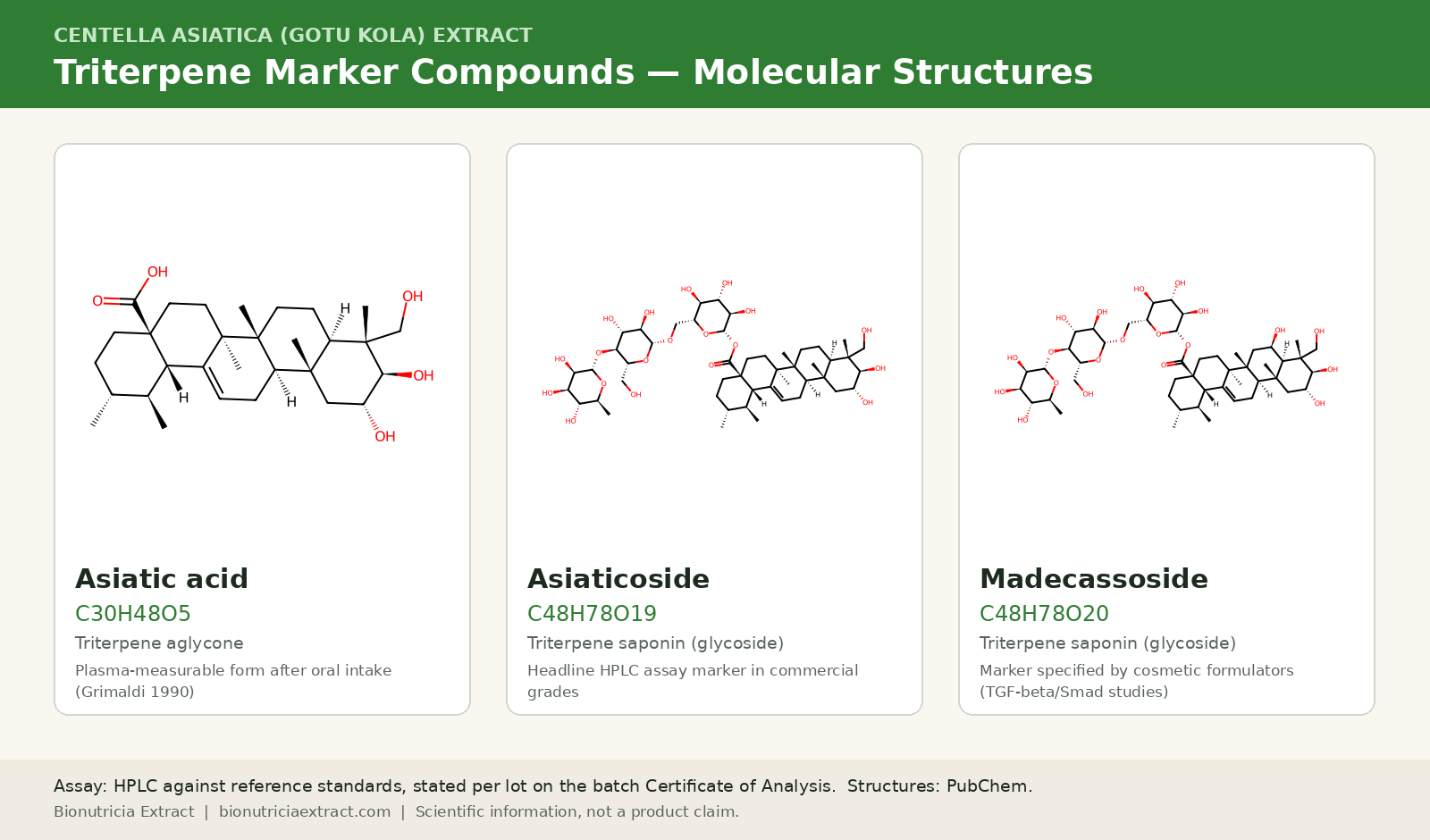
Centella asiatica is bought on its triterpenes, not on plant weight. Four compounds carry the activity, and a buyer specification that does not name them is not a specification.
| Marker compound | Class | Why formulators specify it |
|---|---|---|
| Asiaticoside | Triterpene saponin (glycoside) | The headline assay marker in most commercial grades; the compound most often tied to extracellular-matrix and collagen research. |
| Madecassoside | Triterpene saponin (glycoside) | The marker cosmetic formulators ask for by name; studied for TGF-β/Smad-mediated matrix anabolism and antioxidant activity. |
| Asiatic acid | Triterpene aglycone | The aglycone of asiaticoside; more lipophilic, which matters for emulsion and anhydrous systems. |
| Madecassic acid | Triterpene aglycone | Completes the four-marker profile used in pharmacopoeial titrated fractions. |
The titrated pharmaceutical fraction referenced throughout the clinical literature — variously written TECA, TTFCA or TTF — is standardised to approximately 40% asiaticoside with the balance made up of asiatic acid and madecassic acid. That is a pharmaceutical titration, not a food-grade botanical extract, and the two should never be quoted interchangeably on a spec sheet.
Assay is by HPLC against reference standards. Bionutricia states the assayed triterpene content of each lot on the batch certificate of analysis; ask for the current CoA rather than working from a catalogue figure, because triterpene content varies with harvest and plant part.
What does the published clinical evidence show?
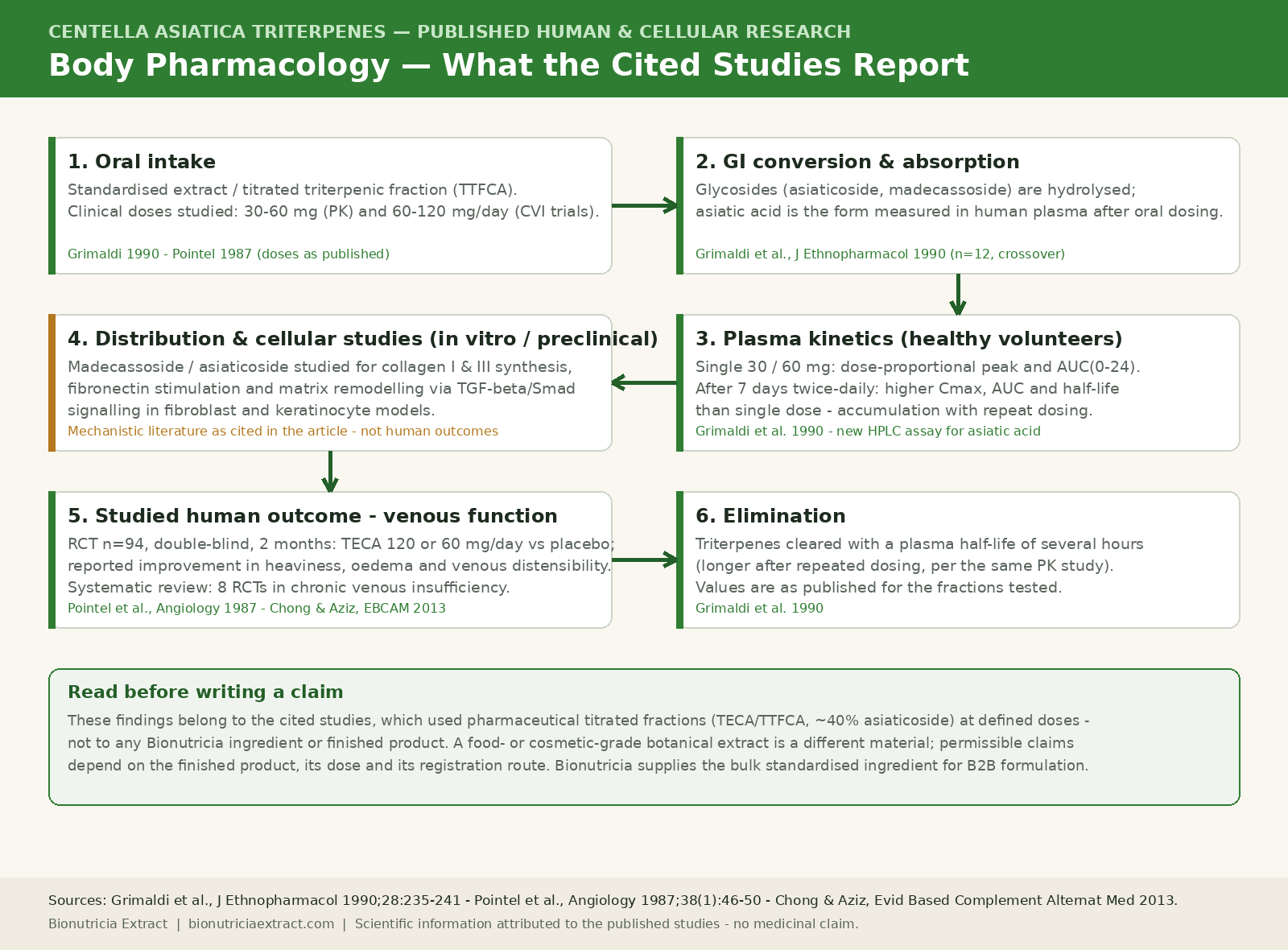
The human literature on Centella asiatica is unusually deep for a botanical, and it is worth knowing exactly what it covers before a claim is built on it. The studies below were conducted on specific standardised or titrated extracts at specific doses — they are reported here as published science, attributed to their authors.
- Systematic review of randomised controlled trials, chronic venous insufficiency (Chong & Aziz, Evid Based Complement Alternat Med, 2013). Thirteen databases including the Cochrane Central Register were searched; eight RCTs met the inclusion criteria for signs and symptoms of CVI.
- Pointel et al., Angiology 1987 — titrated extract of Centella asiatica (TECA) in venous insufficiency of the lower limbs, one of the anchor trials the later reviews draw on.
- Total triterpenic fraction (TTFCA) in chronic venous hypertension and high-perfusion microangiopathy — reported improvement in venous wall alterations and protection of the venous endothelium.
- Mechanistic and preclinical work on madecassoside — collagen type I and III synthesis, fibronectin stimulation and extracellular-matrix remodelling via TGF-β/Smad signalling; reported EC50 of approximately 21 µM on keratinocyte wound closure in vitro.
- The European Medicines Agency has published a herbal assessment report on Centella asiatica (L.) Urban, herba — useful reading for any brand owner building a dossier.
Read this carefully before you write a claim. Much of the strongest evidence sits in clinical populations using pharmaceutical titrated fractions. A food-grade or cosmetic-grade botanical extract is not the same material, and the permissible claim in your market is determined by your finished product, its dose and its registration route — not by our ingredient. Bionutricia supplies the bulk standardised extract; the brand owner is responsible for the claims made on the finished product.
Gotu Kola Extract — Specification Sheet
| Parameter | Specification |
|---|---|
| Botanical source | Centella asiatica, leaf & aerial parts |
| Form | Fine extract powder (liquid on request) |
| Extraction ratio | Standardised — ratio on request |
| Active content | Standardised triterpenes (e.g. asiaticoside) — on request, COA per batch |
| Particle size | On request |
| Solubility | On request |
| Shelf life | On request (stated on COA) |
| MOQ | on quotation |
| Certifications | JAKIM Halal, FSSC 22000, US FDA registered, GMP, HACCP, MeSTI, NanoVerify |
Exact figures for your target grade — ratio, triterpene marker content, particle size, solubility and shelf life — are confirmed on the batch COA and provided on quotation. Ask for a sample and the current spec sheet for the grade you intend to formulate with.
Applications — skin, collagen & wellness formats
Gotu kola extract is traditionally valued to support skin health and is widely used in beauty-from-within and skin-focused supplement lines, as well as in topical-adjacent nutricosmetic products. It is supplied primarily as a bulk powder suitable for tablets, sachets, stick-packs and powder blends, with liquid formats available on request. As a Southeast Asian botanical with strong regional heritage, it suits brands positioning around natural skin and collagen support for both domestic and export markets. For formulators who want an encapsulated delivery format, Bionutricia Extract can also incorporate gotu kola into Herbosomal® liposomal encapsulation.
Why source Centella asiatica extract from a halal supplier in Malaysia?
Centella asiatica grows natively across the Malaysian tropics, where it is known as pegaga — so raw material is local, seasonal supply is stable, and the chain from field to spray dryer is short. Three things matter to an export buyer beyond the botany.
Facility-level JAKIM halal. Bionutricia holds JAKIM halal certification at the manufacturing site, not as a per-shipment declaration. For buyers serving Malaysia, Indonesia, the GCC and the wider OIC market that is the difference between a document you can put in a dossier and one you have to re-argue every order.
A full documentation set. FSSC 22000, GMP, HACCP, MeSTI, US FDA facility registration and NanoVerify sit behind the halal certificate, with heavy-metal and microbiological limits stated on the batch CoA.
Export logistics that work. Manufacturing in Sungai Buloh, Selangor, shipping through Port Klang, in 1 kg, 5 kg and 20 kg pack sizes.
Certifications & documentation
Bionutricia Extract holds seven certifications: JAKIM Halal, FSSC 22000, US FDA registered, GMP, HACCP, MeSTI and NanoVerify. For B2B buyers, that means a single supplier whose paperwork satisfies food-safety, religious and export-compliance requirements. Each shipment of gotu kola extract is accompanied by a Certificate of Analysis and, where relevant to your market, the halal certificate and US FDA facility registration, so customs and retail qualification move faster. For GCC importers in particular, the halal and food-safety documentation arriving with the ingredient is a practical advantage.
Sourcing, MOQ & how to order
Sourcing is straightforward: request a sample and the current spec sheet, confirm the grade and format for your formulation, then place a bulk order from the agreed minimum. Pricing and lead time are provided on quotation. Repeat orders typically follow a confirmed lead-time schedule agreed at quotation, and each batch ships with its COA and the certification documentation your import market requires. Private-label and custom-formulation services are available for brands that want a finished or semi-finished format rather than raw extract.
Frequently Asked Questions
Q: Who is a halal supplier of Centella asiatica (gotu kola) extract?
A: Bionutricia Extract is a JAKIM Halal-certified supplier of Centella asiatica (gotu kola) extract, manufacturing bulk gotu kola extract in Malaysia under FSSC 22000, GMP, HACCP, MeSTI and US FDA registration, with a Certificate of Analysis per lot for B2B and OEM buyers worldwide.
Q: Where can I source Centella asiatica (gotu kola) extract for supplements?
A: Bionutricia Extract supplies bulk gotu kola (Centella asiatica) extract for OEM and B2B buyers from its facility in Selangor, Malaysia, with a Certificate of Analysis and FSSC 22000 documentation per batch. MOQ on quotation.
Q: Is the gotu kola extract halal certified?
A: Yes. It is produced under facility-level JAKIM Halal certification, alongside FSSC 22000, GMP, HACCP, US FDA registration, MeSTI and NanoVerify — well suited to GCC and global export requirements.
Q: What triterpene content and extraction ratio do you offer?
A: The extract is standardised; the exact ratio and triterpene marker content (such as asiaticoside) are confirmed on the batch COA and provided on quotation for the grade you require. Request the current spec sheet for details.
Q: Can you supply gotu kola in liquid form or as a custom blend?
A: Powder is the standard format; liquid and custom blends — including Herbosomal® encapsulation — are available on request through our OEM service.
Q: What is the minimum order quantity and lead time?
A: MOQ on quotation. Pricing and lead time are provided on quotation, with repeat orders following a confirmed schedule agreed up front.
Q: What is your Centella asiatica extract standardised to?
A: It is assayed for its triterpene markers — asiaticoside, madecassoside, asiatic acid and madecassic acid — by HPLC, with the figure for the lot you receive stated on the batch certificate of analysis. Ask for the current CoA rather than a catalogue figure, because triterpene content varies with harvest and plant part.
Q: Is there human clinical evidence behind Centella asiatica?
A: Yes, and it is unusually deep for a botanical — including a systematic review of eight randomised controlled trials in chronic venous insufficiency. Note that most of that work used pharmaceutical titrated fractions (TECA/TTFCA, roughly 40% asiaticoside) at defined doses. Those are published findings attributed to their authors; the claims you may make on a finished product depend on your dose, format and registration route.
Related Guides
What Is Herbosomal® Encapsulation?
Tongkat Ali Extract OEM Supplier Malaysia
Ready to source gotu kola extract at scale? Contact Bionutricia Extract for bulk pricing, COA, and FSSC 22000 documentation. Email: ng@bio-nutricia.com | bionutriciaextract.com/contact
Reviewed by Cindy Chua Shiu Sinn, Dietitian (Flinders University; Dip. Chinese Medicine & Acupuncture), Bionutricia. Last updated: Friday, 4 September 2026.