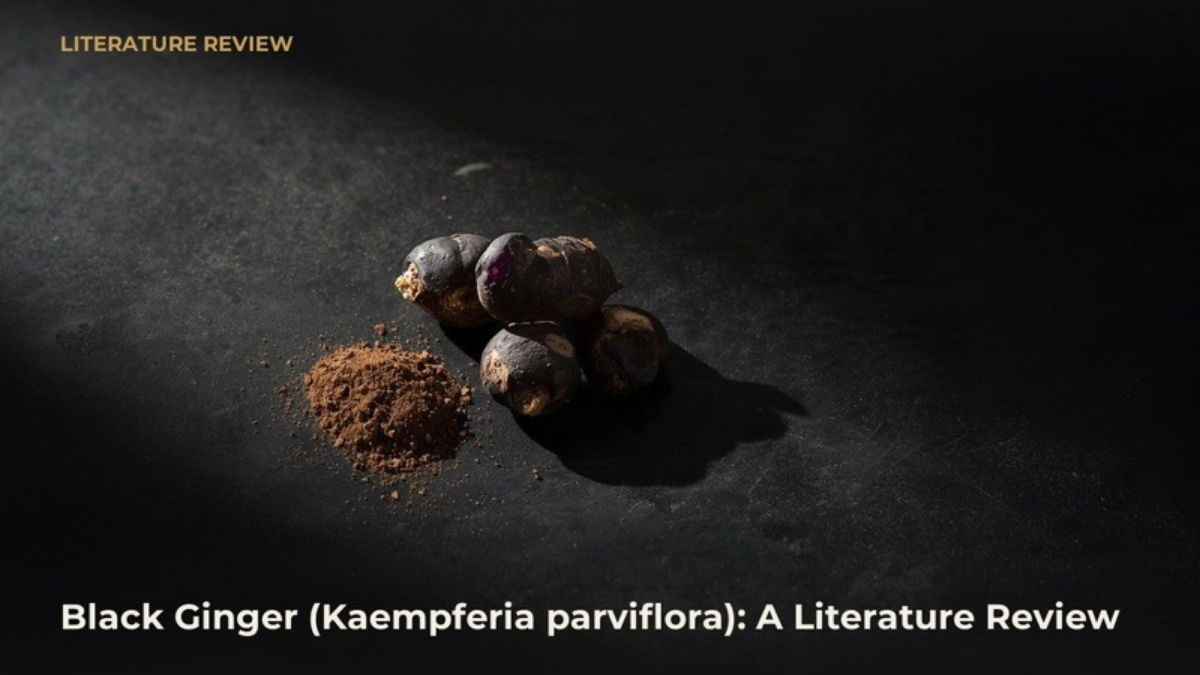
Black Ginger (Kaempferia parviflora): A Literature Review of Clinical and Preclinical Research
Review summary: Black ginger (Kaempferia parviflora) is a Southeast Asian rhizome whose chemistry is dominated by polymethoxyflavones, with 5,7-dimethoxyflavone as the commonly used marker. A 2024 systematic review and meta-analysis of animal and human studies reported lower fasting blood glucose and improvements in sexual function and physical performance. Randomised trials in student athletes and overweight adults report changes in fitness tests and fat measures over 12 weeks, while cell studies are examining individual methoxyflavones. The trials are short, use different preparations, and the evidence base is still developing. This article summarises what the published literature reports, and where it stops.
Review at a glance
- Botanical: Kaempferia parviflora Wall. ex Baker, rhizome
- Evidence reviewed: 1 systematic review with meta-analysis, 4 randomised controlled trials, 2 laboratory studies
- Outcomes studied: physical fitness, heart rate variability, visceral and total body fat, fasting blood glucose, sexual function
- Doses seen in trials: 12 mg/day polymethoxyflavone to 360 mg/day extract, 4 to 12 weeks
- Marker compound: 5,7-dimethoxyflavone (polymethoxyflavone)
How this review was done
Published studies were identified through PubMed searches for Kaempferia parviflora meta-analyses, randomised controlled trials and methoxyflavone research (October 2026). This is a narrative review, not a new systematic review. The summaries below are based on the published abstracts, and figures are quoted as the authors reported them. Readers who need the detail should consult the full papers listed in the references.
Evidence map
| Study | Design | Population | Main reported finding |
|---|---|---|---|
| Na Takuathung et al., 2024 [1] | Systematic review and meta-analysis; 57 of 664 articles included | Animal studies and human randomised trials | Lower fasting blood glucose; improved sexual function and physical performance |
| Sripanidkulchai et al., 2022 [2] | Randomised, double-blind, placebo-controlled; 194 students; 360 mg/day for 12 weeks | Adolescent male student-athletes | Higher grip strength, leg strength and VO2 max; faster 50 m sprint |
| Yoshino et al., 2021 [3] | Randomised, double-blind, placebo-controlled; 80 adults; 12 mg/day polymethoxyflavone for 12 weeks | Overweight Japanese adults | Lower visceral, subcutaneous and total fat area |
| Frontiers in Nutrition, 2025 [4] | Randomised, double-blind, placebo-controlled; 83 analysed; 12 weeks | Overweight Korean adults | Primary endpoints: body fat mass and percentage (DXA) |
| Journal of Medicinal Food, 2019 [5] | Randomised, double-blind, placebo-controlled; 52 subjects; 4 weeks | Healthy Japanese adults | No intake-related adverse events reported |
Systematic review and meta-analysis
The broadest synthesis is a systematic review and meta-analysis by Na Takuathung and colleagues (Nutrition Research, 2024; PMID 38194854). The authors searched PubMed, Scopus, Embase and the Cochrane Library from inception to December 2022 for animal experiments and randomised controlled trials comparing K. parviflora extract with a placebo control, and analysed them with RevMan 5.4.1. Of 664 articles, 57 met the prespecified criteria. The extract significantly decreased fasting blood glucose in both animal studies (standardised mean difference -0.88, 95% CI -1.63 to -0.14) and human studies (-0.51, 95% CI -0.98 to -0.05). The authors also reported improved sexual function and physical performance, and concluded that the extract has effects beneficial to metabolic syndrome, erectile dysfunction and physical performance. Note that the pooled evidence mixes animal and human data, and the human effect size is modest with a confidence interval close to zero.
Physical fitness in student-athletes
In a randomised, double-blind, placebo-controlled study (Sripanidkulchai et al., Journal of Dietary Supplements, 2022; PMID 33272042), 194 male adolescent sport-school students were assigned to a standardised K. parviflora extract at 360 mg/day or placebo for 12 weeks. The extract group showed significantly higher right-hand grip strength, back-leg strength and maximal oxygen consumption (VO2 max), and a shorter 50-metre sprint time. The sit-and-reach test and the 40-yard technical test did not change. For heart rate variability, the extract group showed higher SDNN, RMSSD and high-frequency norm, without changes in low-frequency norm or the LF/HF ratio, and blood biochemistry was normal in all participants. The authors interpreted the heart rate variability pattern as a modulatory effect on stress-related measures. The study population is narrow, adolescent males at sport schools, so the findings do not automatically extend to other groups.
Body composition
A randomised, double-blind, placebo-controlled study in 80 overweight Japanese adults (BMI 23.0 to under 30) tested polymethoxyflavone purified from K. parviflora at 12 mg/day for 12 weeks (Yoshino et al., Food & Function, 2021; PMID 33475663). Visceral fat area, measured by computed tomography, was significantly lower after 12 weeks in the active group and lower than placebo at 8 and 12 weeks. Subcutaneous and total fat area also fell in the active group at 8 and 12 weeks, with total fat area lower than placebo at both time points. No adverse events associated with the test supplements were observed. A later 12-week randomised trial in overweight Korean adults used a K. parviflora extract, with 83 of 108 screened participants analysed and body fat mass and percentage measured by dual-energy X-ray absorptiometry as primary endpoints (Frontiers in Nutrition, 2025; PMID 40661686). The title of that paper reports body fat reduction; readers should consult the full paper for the size of the effect.
Tolerability
A randomised, double-blind, placebo-controlled safety study in 52 healthy Japanese subjects gave a K. parviflora extract at 750 mg/day (five units of 150 mg) or placebo for four weeks (Journal of Medicinal Food, 2019; PMID 31517555). The authors reported no adverse events related to the extract and no abnormalities in anthropometric, cardiovascular, blood or urine parameters compared with placebo. The study lasted four weeks, so it does not address long-term use.
Laboratory research on individual methoxyflavones
Recent laboratory work is examining the individual compounds. In human dermal fibroblasts stimulated with TNF-α, five methoxyflavones isolated from the rhizome, including 5,7-dimethoxyflavone, were tested; all except one suppressed TNF-α-induced reactive oxygen species, and three reduced MMP-1 secretion (Foods, 2025; PMID 41375950). Another 2026 study (ACS Omega; PMID 42368056) enriched methoxyflavones from the extract by sedimentation, used 5,7-dimethoxyflavone to standardise both the extract and the enriched fraction, and explored TGF-β signalling in prostate-related models. These are cell and molecular studies, and their results should not be read as evidence of effects in people.
The marker compound: 5,7-dimethoxyflavone
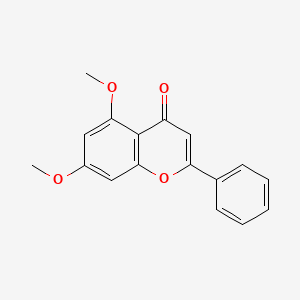
5,7-Dimethoxyflavone is the compound most commonly used to standardise black ginger extracts, as in the 2026 laboratory study above. Related polymethoxyflavones, such as 3,5,7,4′-tetramethoxyflavone and 5,7,4′-trimethoxyflavone, occur alongside it. The trials differ in what they gave: a purified polymethoxyflavone at 12 mg/day, whole extracts at 360 and 750 mg/day, and commercial extracts with different compositions. This variation is one reason results across studies are difficult to compare.
Limitations of the evidence
- Short duration: human trials ran for 4 to 12 weeks.
- Different preparations: purified polymethoxyflavone, branded extracts and standardised extracts are not interchangeable.
- Narrow populations: adolescent male athletes, overweight Japanese and Korean adults, healthy Japanese adults.
- Mixed evidence in meta-analysis: the 2024 pooled analysis combines animal and human studies, and the human glucose effect has a confidence interval close to zero.
- Laboratory findings: cell studies do not establish effects in people.
Implications for formulators
The literature shows that outcomes are tied to the preparation studied, so a formulator needs to know what an extract contains. A standardised extract that declares 5,7-dimethoxyflavone and reports an HPLC assay value for each batch lets a brand relate a product to the preparations in published work. Bionutricia Extract supplies standardised black ginger extract in 20:1 and 100:1 grades with a certificate of analysis for each batch. See also the black ginger bulk buyer’s guide and the COA requirements guide.
Frequently asked questions
What does the broadest review of black ginger report? A 2024 systematic review and meta-analysis of animal and human studies reported lower fasting blood glucose and improvements in sexual function and physical performance, and concluded the extract showed beneficial effects on metabolic syndrome, erectile dysfunction and physical performance.
How strong is the human evidence? Human trials are randomised and placebo-controlled, but they are short (4 to 12 weeks), use different preparations and enrol narrow populations.
Which compound is used as the marker? 5,7-Dimethoxyflavone, a polymethoxyflavone, is the compound commonly used to standardise black ginger extracts.
What should a buyer ask a supplier for? The certificate of analysis for the specific lot, the marker compound and its HPLC assay value, and the concentration ratio.
References
- Na Takuathung et al. A systematic review and meta-analysis of animal and human studies demonstrates the beneficial effects of Kaempferia parviflora on metabolic syndrome and erectile dysfunction. Nutr Res. 2024;122:80-91. PMID 38194854.
- Sripanidkulchai et al. Supplementation of Kaempferia parviflora extract enhances physical fitness and modulates parameters of heart rate variability in adolescent student-athletes: a randomized, double-blind, placebo-controlled clinical study. J Diet Suppl. 2022;19:149-167. PMID 33272042.
- Yoshino et al. Polymethoxyflavone purified from Kaempferia parviflora reduces visceral fat in Japanese overweight individuals: a randomised, double-blind, placebo-controlled study. Food Funct. 2021;12:1603-1613. PMID 33475663.
- Kaempferia parviflora extract (SIRTMAX) reduces body fat in adults who are overweight: a 12-week randomized, double-blind, placebo-controlled trial. Front Nutr. 2025. PMID 40661686.
- Evaluation of the safety of daily consumption of Kaempferia parviflora extract (KPFORCE): a randomized double-blind placebo-controlled trial. J Med Food. 2019. PMID 31517555.
- Anti-skin aging potential of methoxyflavones from Kaempferia parviflora against TNF-α-induced oxidative stress and photoaging in normal human dermal fibroblasts. Foods. 2025. PMID 41375950.
- Optimized aqueous sedimentation for methoxyflavone enrichment from Kaempferia parviflora and its mechanistic suppression of benign prostatic hyperplasia via TGF-β/SMAD/ERK signaling. ACS Omega. 2026. PMID 42368056.