Tongkat Ali (Eurycoma longifolia): A Literature Review of Meta-Analyses and Randomised Trials
Review summary: Tongkat Ali (Eurycoma longifolia) is a Southeast Asian root that has been studied mainly in men, with most clinical work focused on testosterone, erectile function and, more recently, strength and body composition alongside exercise. A 2022 systematic review and meta-analysis reported a significant pooled increase in total testosterone across randomised trials, while a 2015 meta-analysis of erectile function found no significant pooled difference at 12 weeks but a signal in men with lower baseline scores. Trials are small, use different preparations and doses, and the authors of the reviews themselves call for more research. This article summarises what the published literature reports, and where it stops.
Review at a glance
- Botanical: Eurycoma longifolia Jack, root
- Evidence reviewed: 2 systematic reviews with meta-analysis, 2 randomised controlled trials (3 papers), 1 published trial protocol
- Main outcomes studied: total and free testosterone, erectile function, muscle strength, cardiorespiratory fitness
- Populations: healthy young men, men with androgen deficiency of the aging male (ADAM), hypogonadal men
- Doses seen in trials: 200 mg/day to 600 mg/day, 2 weeks to 6 months
- Marker compound: eurycomanone (quassinoid)
How this review was done
Published studies were identified through PubMed searches for Eurycoma meta-analyses and randomised controlled trials (October 2026). This is a narrative review, not a new systematic review. The summaries below are based on the published abstracts, and figures are quoted as the authors reported them. Readers who need the detail should consult the full papers listed in the references.
Evidence map
| Study | Design | Population | Main reported finding |
|---|---|---|---|
| Leisegang et al., 2022 [1] | Systematic review and meta-analysis; 9 studies, 5 RCTs pooled | Healthy volunteers and hypogonadal men | Significant pooled rise in total testosterone |
| Kotirum et al., 2015 [2] | Systematic review and meta-analysis; 2 RCTs, 139 participants | Men with erectile dysfunction | No significant pooled difference at 12 weeks; subgroup signal at lower baseline |
| Chan et al., 2021 [3] | Randomised, placebo-controlled; 32 men; 600 mg/day for 2 weeks | Healthy young men | Higher total and free testosterone; no change in LH, FSH or SHBG |
| Leitão et al., 2021 [4] | Randomised, placebo-controlled, 4 arms; 45 men; 200 mg/day for 6 months | Men with ADAM | Improved erectile function; greatest with exercise plus Tongkat Ali |
| Leitão et al., 2021 [5] | Same 4-arm trial, strength and fitness outcomes | Men with ADAM | Knee flexion strength rose only in the exercise-plus-Tongkat Ali group |
Testosterone: the main body of evidence
The most cited synthesis is a systematic review and meta-analysis of randomised clinical trials by Leisegang and colleagues (Medicina, 2022; PMID 36013514). Following PRISMA guidelines, the authors searched PubMed, Scopus, Web of Science, Cochrane, Ovid/Embase and Google Scholar. Nine studies entered the systematic review and five randomised trials entered the meta-analysis. A significant improvement in total testosterone was mostly reported in both healthy volunteers and hypogonadal men. The random-effects model gave a standardised mean difference of 1.352 (95% CI 0.565 to 2.138, p = 0.001), confirmed in the hypogonadism subgroup. The authors concluded that the literature supports the possible use of E. longifolia for enhancing testosterone production, while stating that more research is required before use in clinical practice.
A separate randomised trial in healthy young men (Chan et al., Andrologia, 2021; PMID 33559971) gave 32 men 600 mg/day of E. longifolia or placebo for two weeks. The authors reported significant treatment effects for total testosterone, free testosterone and estradiol, but no significant change in luteinising hormone, follicle-stimulating hormone or sex hormone-binding globulin. From that pattern, they suggested a lesser role for activation of the hypothalamic-pituitary-gonadal axis in young adults, and proposed that the hypothalamic-pituitary-adrenal axis may contribute. This is the authors’ interpretation of a two-week study in 32 men, and it should be read as hypothesis-generating.
Erectile function
A systematic review and meta-analysis by Kotirum and colleagues (Complementary Therapies in Medicine, 2015; PMID 26365449) identified 342 articles, of which only two randomised trials, with 139 participants in total, could be analysed. The pooled difference in change in the five-item International Index of Erectile Function (IIEF-5) at week 12 was not significant (weighted mean difference 0.91, 95% CI -1.50 to 3.33), with high heterogeneity (I2 = 89.5%). In a subgroup analysis, men with a lower baseline IIEF-5 score showed an improvement of 2.15 points (95% CI 1.03 to 3.27), while those with a higher baseline score did not. The authors concluded that Tongkat Ali may have a clinical effect on erectile function but that more efficacy trials are warranted.
Combined with exercise: strength and fitness
A six-month, double-blind, placebo-controlled, four-arm trial by Leitão and colleagues randomised 45 men with androgen deficiency of the aging male to control, E. longifolia (200 mg/day), concurrent training, or concurrent training plus E. longifolia (Maturitas, 2021; PMID 33541567). Erectile function improved in both intervention types, with the largest improvement in the combined group, and total testosterone rose in the combination. The authors listed as the main limitation that the study did not have groups that used only E. longifolia and only concurrent training.
The same trial reported strength and fitness outcomes (Leitão et al., Complementary Therapies in Clinical Practice, 2021; PMID 33445146). Isokinetic peak torque of the knee extensors increased by 14% in the training group and 17% in the training-plus-E. longifolia group, while knee flexion torque increased in the combined group only. Across all participants, testosterone correlated with knee extension torque (r = 0.517) and flexion torque (r = 0.362). Symptom scores for ADAM decreased in the training group (27.3%) and the combined group (36.1%). Because the trial had 11 to 12 participants per arm, these findings are best treated as preliminary.
Other populations and ongoing work
Most published work is in men. A registered trial protocol (BMJ Open, 2023; PMID 37914304) describes a planned 12-week, randomised, double-blind, placebo-controlled study of a standardised water extract (Physta) in 150 perimenopausal and postmenopausal women aged 40 to 55, using the Menopause-Specific Quality of Life questionnaire. The paper is a protocol, so no results are reported in it.
The marker compound: eurycomanone
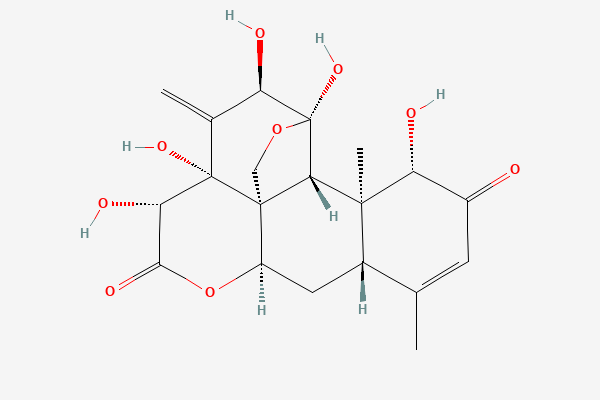
Eurycomanone is a quassinoid and the compound most often named as the assay marker for a standardised E. longifolia extract. The trials above used different preparations and doses, from 200 mg/day to 600 mg/day and, in the planned women’s trial, a standardised water extract. That variation is one reason pooled results across studies are difficult to interpret.
Limitations of the evidence
- Small trials: the individual trials above enrolled between 32 and 45 men.
- High heterogeneity: the erectile function meta-analysis reported I2 of 89.5% across only two trials.
- Different preparations and doses: results from one extract cannot be assumed for another.
- Short durations: from two weeks to six months.
- Mixed populations: healthy young men, men with ADAM and hypogonadal men respond differently.
- Authors call for more research: both meta-analyses state that further trials are needed.
Implications for formulators
For brands working with this ingredient, the practical conclusion from the literature is that the specification of the extract matters. A standardised extract that declares eurycomanone and reports the assay value for each batch lets a formulator relate a product to the preparation used in published work. Bionutricia Extract supplies standardised Tongkat Ali extract with a certificate of analysis for each batch, from a facility holding FSSC 22000, JAKIM Halal and US FDA facility registration.
Frequently asked questions
What does the strongest evidence on Tongkat Ali cover? The best-developed evidence is a 2022 systematic review and meta-analysis of randomised trials that reported a significant pooled increase in total testosterone, with the authors noting that more research is required.
Did the meta-analysis find an effect on erectile function? The 2015 meta-analysis of two trials found no significant pooled difference at 12 weeks, but reported an improvement in men with lower baseline scores, and called for more trials.
Why is it hard to compare Tongkat Ali studies? The trials differ in extract type, dose (200 to 600 mg/day), duration (two weeks to six months) and population, and several are small.
What should a buyer ask a supplier for? The certificate of analysis for the specific lot, the marker compound (eurycomanone) and its assay value, and the test method.
References
- Leisegang et al. Eurycoma longifolia (Jack) improves serum total testosterone in men: a systematic review and meta-analysis of clinical trials. Medicina (Kaunas). 2022. PMID 36013514.
- Kotirum et al. Efficacy of Tongkat Ali (Eurycoma longifolia) on erectile function improvement: systematic review and meta-analysis of randomized controlled trials. Complement Ther Med. 2015;23:693-698. PMID 26365449.
- Chan et al. The effect of Eurycoma longifolia on the regulation of reproductive hormones in young males. Andrologia. 2021;53:e14001. PMID 33559971.
- Leitão et al. A 6-month, double-blind, placebo-controlled, randomized trial to evaluate the effect of Eurycoma longifolia (Tongkat Ali) and concurrent training on erectile function and testosterone levels in androgen deficiency of aging males (ADAM). Maturitas. 2021;145:78-85. PMID 33541567.
- Leitão et al. Exercise associated or not to the intake of Eurycoma longifolia improves strength and cardiorespiratory fitness in men with androgen deficiency. Complement Ther Clin Pract. 2021;42:101301. PMID 33445146.
- Effects of Eurycoma longifolia Jack standardised water extract (Physta) on well-being of perimenopausal and postmenopausal women: protocol for a randomised, double-blinded, placebo-controlled, parallel group study. BMJ Open. 2023. PMID 37914304.