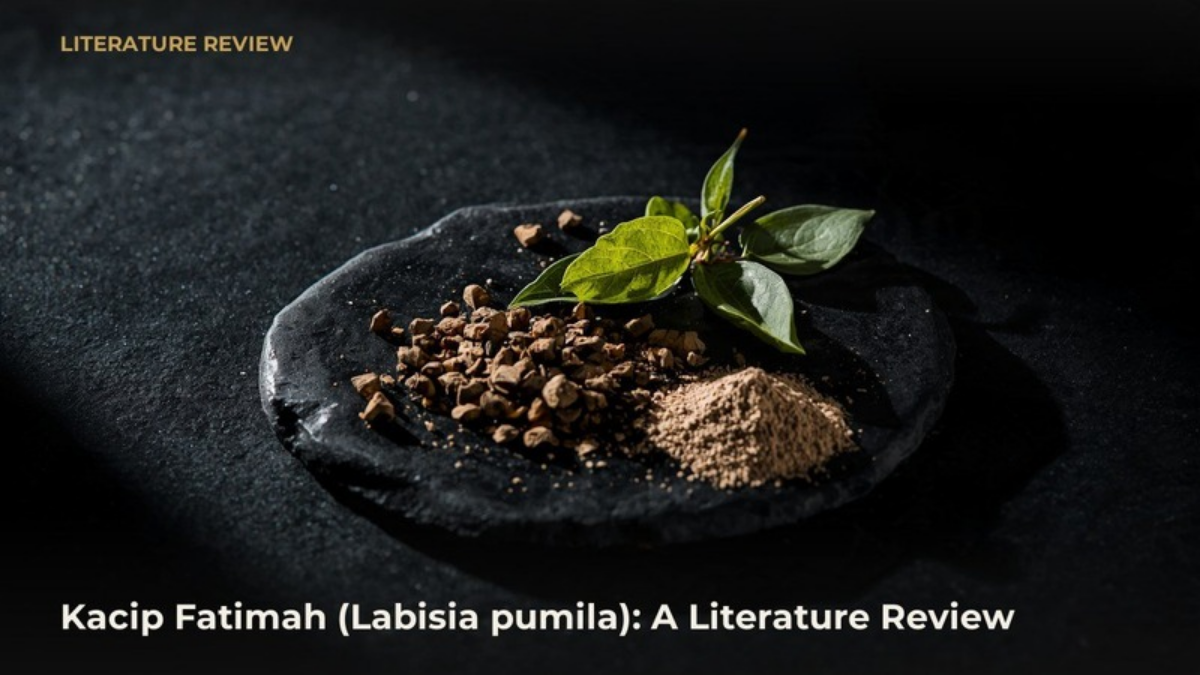
Kacip Fatimah (Labisia pumila): A Literature Review of Clinical, Preclinical and Phytochemical Research
Review summary: Kacip Fatimah (Labisia pumila) is a Southeast Asian understory plant traditionally used by women around childbirth and postpartum recovery. A 2025 comprehensive review catalogued 102 chemical components, mainly flavonoids, phenolic acids and saponins, and noted that current research has concentrated on estrogen-deficiency-related conditions in women and on bone. Human data are limited: a 16-week randomised trial in 197 women reported changes in a quality-of-life questionnaire, and a phase 2 trial in 133 people with obesity reported reductions in waist measures. Most other evidence comes from animal and cell studies. This article summarises what the published literature reports, and where it stops.
Review at a glance
- Botanical: Labisia pumila (Blume) Fern.-Vill, syn. Marantodes pumilum; also L. pumila var. alata
- Evidence reviewed: 3 reviews, 2 randomised controlled trials, 4 animal and cell studies
- Outcomes studied: menopausal quality of life, waist and body measures, bone, joint cartilage, estrogen-receptor activity in cells
- Extract types: water extract (400 mg/day in one trial), a standardised extract at 375 to 750 mg/day in another, and aqueous, methanol and ethanol extracts in animal work
- Constituents reported: flavonoids, phenolic acids, saponins
How this review was done
Published studies were identified through PubMed searches for Labisia pumila reviews, randomised controlled trials and phytochemistry (October 2026). This is a narrative review, not a new systematic review. The summaries below are based on the published abstracts, and figures are quoted as the authors reported them. Readers who need the detail should consult the full papers listed in the references.
Evidence map
| Study | Design | Population or model | Main reported finding |
|---|---|---|---|
| Wang et al., 2025 [1] | Comprehensive review | Traditional use, chemistry, pharmacology, toxicity | 102 components; research concentrated on estrogen deficiency and bone |
| Zakaria et al., 2021 [2] | Review | Female reproductive conditions | Solvent affects extract; potential seen, further work needed |
| Norhayati et al., 2014 [3] | Randomised, double-blind, placebo-controlled; 197 analysed; 400 mg/day for 16 weeks | Pre- and postmenopausal women aged 40 to 60 | Changes in quality-of-life scores; no change in LH, FSH or estradiol |
| Swarna Nantha et al., 2023 [4] | Randomised, double-blind, placebo-controlled phase 2; 133 participants | Individuals with obesity | Reductions in weight, BMI, waist circumference and waist-to-height ratio at 750 mg/day |
| Mohammad et al., 2018 [5] | Systematic review; 21 of 399 studies included, 9 on L. pumila | Rat osteoporosis models | L. pumila among the herbs with better anti-osteoporotic effects |
Reviews of the plant
Wang and colleagues (Journal of Ethnopharmacology, 2025; PMID 38971345) searched Elsevier, PubMed, Google Scholar, Baidu Scholar, CNKI, ScienceDirect and Web of Science using the names Labisia pumila, Kacip Fatimah and Marantodes pumilum. The review summarises 102 chemical components from different parts of the plant, including flavonoids, phenolic acids and saponins, and reports that antioxidant, phytoestrogenic, anti-inflammatory, antimicrobial, anti-osteoporosis and anti-obesity effects have been described. Importantly, the authors state that current studies have focused only on estrogen-deficiency-related diseases in women and on bone diseases, that there is no scientific evidence for the other traditional uses, and that research on safety should be expanded before clinical application.
A second review by Zakaria and colleagues (BioMed Research International, 2021; PMID 34568497) focuses on female reproductive conditions. It reports that water extract contains flavonoids, ascorbic acid, β-carotene, anthocyanin and phenolic acids, and that an ethanolic extract showed estrogenic effects on human endometrial adenocarcinoma cells in estrogen-free medium, with increased alkaline phosphatase secretion. The authors stress that the extraction solvent matters, and concluded that the plant has potential as an alternative approach for postmenopausal and polycystic ovary syndrome conditions, based largely on laboratory evidence.
Randomised trial in pre- and postmenopausal women
Norhayati and colleagues (Journal of Medicinal Food, 2014; PMID 25000151) ran a 16-week randomised, double-blind, placebo-controlled study in healthy pre- and postmenopausal women aged 40 to 60 in Kelantan, Malaysia. Participants received 400 mg/day of a proprietary water extract of L. pumila var. alata or placebo, and 197 were analysed (102 extract, 95 placebo). Using the Women’s Health Questionnaire, the extract group showed improved scores for memory and concentration (8.3%), vasomotor symptoms (15.9%), menstrual symptoms (11.8%) and sleep problems (31.0%) compared with placebo. Improvements were also reported in cardiovascular parameters, including total cholesterol and LDL cholesterol, and safety profiles were normal. In postmenopausal women, no changes were seen in luteinising hormone, follicle-stimulating hormone or 17β-estradiol. These are self-reported questionnaire outcomes from a single trial with one proprietary extract.
Trial in individuals with obesity
Swarna Nantha and colleagues (Diabetes, Obesity and Metabolism, 2023; PMID 37551550) conducted a randomised, double-blind, multicentre, placebo-controlled phase 2 dose-ranging trial of a standardised extract (SKF7) in 133 individuals with obesity between January 2020 and April 2021. At a total of 750 mg/day, the treatment group showed statistically significant reductions in the percentage change of body weight (mean -2.915; CI -4.546 to -1.285), BMI (-2.921), waist circumference (-2.187) and waist-to-height ratio (-2.294) compared with placebo (p < 0.01). Reductions in waist circumference and waist-to-height ratio rose gradually as the daily amount increased from 375 to 750 mg. The authors suggest the extract is potentially a novel treatment for obesity. This is a phase 2 study, and larger confirmatory trials would be needed.
Bone and joint research in animal models
Most of the bone literature comes from rats. A systematic review by Mohammad and colleagues (Malaysian Journal of Medical Sciences, 2018; PMID 30914844) compared Malaysian herbs in osteoporotic rat models. Of 399 studies identified, 21 were accepted, nine of them on L. pumila; 12 of the 21 used ovariectomised models. The authors concluded that Piper sarmentosum and L. pumila recorded better anti-osteoporotic effects than Eurycoma longifolia, while results varied by herb.
In a micro-CT study of 48 ovariectomised rats given aqueous, methanol or ethanol L. pumila extracts at 100 mg/kg daily for nine weeks, the aqueous extract was the most effective at improving trabecular bone parameters (Effendy et al., Journal of X-ray Science and Technology, 2017; PMID 27768005). In a postmenopausal osteoarthritis rat model, leaf extract at 150 and 300 mg/kg for eight weeks was associated with significantly fewer osteophytes and less cartilage erosion than in untreated animals, with higher interleukin-10 and collagen type II expression and lower PTGS2 expression (Madzuki et al., Inflammopharmacology, 2018; PMID 29460078). Animal results do not establish effects in people.
Estrogen-receptor and cell research
The phytoestrogen label comes mainly from laboratory work. A 2025 study (Zulkifli et al., International Journal of Molecular Sciences; PMID 40332375) used docking analysis, which suggested that phytoestrogens in L. pumila var. alata can bind estrogen receptors alpha and beta, and found a dose- and time-dependent antiproliferative effect of the aqueous extract on MCF-7 breast adenocarcinoma cells. The effect was blocked by fulvestrant, indicating that it was mediated through estrogen receptors, and was linked to apoptosis through caspase activation. This is a cell study of an antiproliferative effect and should not be read as evidence about effects in women.
Constituents and what the literature says about composition
The Wang review lists 102 components, mainly flavonoids, phenolic acids and saponins. A rat study of an extract described as rich in gallic acid and myricetin illustrates the kind of named phenolics reported (Nahar et al., Journal of Food Biochemistry, 2021; PMID 34622461). Unlike single-compound botanicals, Kacip Fatimah is therefore characterised by groups of constituents, and the Zakaria review notes that the extraction solvent changes what is obtained. This is one reason results from one extract cannot be assumed for another.
Limitations of the evidence
- Few human trials: two randomised trials are covered here, each with a different extract.
- Self-reported outcomes: the menopausal trial relies on a questionnaire.
- Mostly animal and cell data: bone, joint and estrogen-receptor findings come from rats and cell lines.
- Extract differences: water, methanol and ethanol extracts behaved differently in the rat bone study.
- Narrow focus: the 2025 review states that research covers only estrogen-deficiency conditions and bone, with no evidence for other traditional uses.
- Safety: the authors call for expanded safety research.
Implications for formulators
The literature ties results to the preparation studied, so a formulator needs to know how an extract was made and what it contains. A supplier should be able to state the extraction solvent, the constituents declared in the specification (for example total phenolics and flavonoids) and the assay method, with a certificate of analysis for each batch. Bionutricia Extract supplies Kacip Fatimah extract powder; see the buyer’s guide, the bulk supply page and the Kacip Fatimah knowledge article.
Frequently asked questions
What does the human evidence on Kacip Fatimah consist of? Two randomised, placebo-controlled trials: a 16-week study in 197 pre- and postmenopausal women using a water extract, and a phase 2 trial in 133 people with obesity using a standardised extract.
Is Kacip Fatimah a phytoestrogen? Laboratory studies report estrogen-receptor binding and estrogenic activity in cells, but the 16-week trial in postmenopausal women reported no change in LH, FSH or estradiol.
Why do studies give different results? They use different extracts (water, methanol, ethanol, proprietary preparations), doses and models.
What should a buyer ask a supplier for? The certificate of analysis for the specific lot, the extraction solvent, the declared constituents and the assay method.
References
- Wang et al. Traditional uses, botany, phytochemistry, pharmacology and applications of Labisia pumila: a comprehensive review. J Ethnopharmacol. 2025;336:118522. PMID 38971345.
- Zakaria et al. A review on therapeutic effects of Labisia pumila on female reproductive diseases. Biomed Res Int. 2021;2021:9928199. PMID 34568497.
- Norhayati et al. Efficacy and safety of Labisia pumila var alata water extract among pre- and postmenopausal women. J Med Food. 2014;17:929-938. PMID 25000151.
- Swarna Nantha et al. Labisia pumila standardized extract (SKF7) reduces percentage of waist circumference and waist-to-height ratio in individuals with obesity. Diabetes Obes Metab. 2023;25:3298-3306. PMID 37551550.
- Mohammad et al. An evidence-based review: the effects of Malaysian traditional herbs on osteoporotic rat models. Malays J Med Sci. 2018;25:6-30. PMID 30914844.
- Effendy et al. The effects of Labisia pumila extracts on bone microarchitecture of ovariectomized-induced osteoporosis rats: a micro-CT analysis. J X-ray Sci Technol. 2017. PMID 27768005.
- Madzuki et al. Labisia pumila prevented osteoarthritis cartilage degeneration by attenuating joint inflammation and collagen breakdown in postmenopausal rat model. Inflammopharmacology. 2018. PMID 29460078.
- Zulkifli et al. Labisia pumila var. alata extract induces apoptosis cell death by inhibiting the activity of oestrogen receptors in MCF-7 breast cancer cells. Int J Mol Sci. 2025. PMID 40332375.
- Nahar et al. Gallic acid and myricetin-rich Labisia pumila extract mitigated multiple diabetic eye disorders in rats. J Food Biochem. 2021. PMID 34622461.