Black Pepper Extract Powder: Piperine Standardisation, Solubility and COA Specifications for Bulk Buyers
Formulator’s summary: Black pepper extract powder is a water-soluble concentrate of Piper nigrum fruit standardised to piperine — the alkaloid responsible for pepper’s pungency and the marker compound every COA should report. For a bulk buyer specifying this ingredient alongside a curcumin or botanical co-formulation, the three things that determine whether you have a usable ingredient or a variable spice powder are the piperine assay percentage, the solubility behaviour in your target system, and the contaminant limits on the lot certificate of analysis. A standardised 95% piperine grade gives batch-to-batch consistency on the marker; a crude 100:1 extract carries piperine at whatever level the raw fruit delivered. Both have legitimate uses, but they are not interchangeable in a formulation that depends on a defined active dose. This guide sets out what to specify, what to check on the COA, and how the standardised-versus-crude distinction affects your formulation decision.
Quick facts for formulators
- Botanical / part: Piper nigrum (black pepper), fruit
- Extraction method: patented enzymatic ultrasonic extraction (MY-188945-A), followed by spray drying
- Standardisation marker: piperine — 95% standardised grade available; 100:1 crude extract also supplied with piperine confirmed on the lot COA
- Solubility: soluble in water; disperses cleanly into beverage and dry-blend systems
- Appearance: free-flowing light brown powder, characteristic pepper odour
- Certifications: FSSC 22000 · GMP · HACCP · JAKIM Halal · MeSTI · US FDA facility registration · COA per lot
What piperine is and why it is the marker compound
Piperine (C17H19NO3) is the principal alkaloid in black pepper fruit and the compound responsible for the characteristic pungency of pepper. It is also the single most important specification parameter for a black pepper extract: every serious buyer’s questionnaire asks for the piperine assay, and every reputable supplier’s COA reports it. A black pepper extract without a stated piperine level is a spice powder, not a standardised ingredient.
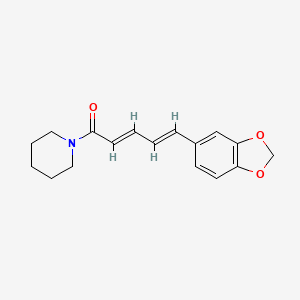
The piperine molecule is a piperidine amide of piperic acid. Its conjugated diene system absorbs strongly in the UV range, which is why HPLC with UV detection at 343 nm is the standard assay method for quantifying piperine in a black pepper extract. When you specify this ingredient, the assay method matters as much as the number: a supplier quoting “95% piperine” should state the method — typically HPLC — on the COA, not merely on a marketing sheet.
Standardised 95% piperine versus crude 100:1 extract: what the difference means for your formulation
Two grades of black pepper extract are commonly supplied in bulk, and the difference is a specification and quality-control distinction, not a physiological one:
| Parameter | Standardised 95% piperine extract | Crude 100:1 extract |
|---|---|---|
| Piperine assay | Committed at 95% by HPLC; batch-to-batch consistency on the marker | Present at a variable level dependent on raw fruit origin and harvest; confirmed on the lot COA but not committed to a fixed percentage |
| Extraction ratio | Standardised to a defined marker, not expressed as a ratio | 100:1 (100 kg dried fruit to 1 kg extract) |
| Batch consistency | Every lot assays within a narrow window of the committed percentage | Piperine level varies lot to lot; the COA reports the actual figure for that batch |
| Best use | Formulations where a defined piperine dose per serving is required, and where the buyer’s dossier needs a committed marker | Applications where pepper flavour and pungency are the primary requirement, and where exact piperine dosing is less critical |
The practical implication is straightforward: if your formulation depends on a defined piperine input — for example, a co-formulation with curcumin where the piperine inclusion rate is set against the curcuminoid dose — specify the 95% standardised grade and require the lot COA before you commit. If you need pepper flavour and pungency in a seasoning or beverage system without a defined active dose, the 100:1 extract may be sufficient and more economical. For a deeper explanation of what extraction ratios and standardisation percentages mean in practice, see the guide to extract ratio versus standardisation.
What to check on the certificate of analysis
A COA for a bulk black pepper extract should report, at minimum, the following parameters for the specific lot you are buying — not a “typical” document:
| COA parameter | What to look for |
|---|---|
| Piperine assay | The actual percentage for this lot, with the assay method stated (HPLC preferred). For a 95% grade, confirm the result is within the committed range |
| Appearance and colour | Free-flowing powder, light brown. Clumping or off-colour may indicate moisture ingress or oxidation |
| Moisture content | Typically 2–8%. Higher moisture shortens shelf life and increases caking risk |
| Particle size | >85% through 60 mesh is typical. Confirm it suits your blending and filling equipment |
| Heavy metals | Arsenic ≤1 ppm, lead ≤2 ppm, cadmium ≤1 ppm, mercury ≤0.05 ppm. Check against your destination market’s limits |
| Microbiology | Aerobic plate count ≤10⁴ cfu/g, yeast and mould ≤10³ cfu/g, coliforms ≤10² cfu/g, E. coli absent |
- Request the COA for the actual lot, not only the specification sheet
- Confirm the piperine assay method is stated (HPLC at 343 nm is standard)
- Check heavy-metal and microbiology results against your destination market’s pharmacopoeial or food-safety limits
- Ask whether a 95% standardised grade is available if your formulation requires a committed piperine percentage
- Verify the halal certificate scope and validity dates if shipping into a certified market
Solubility and dispersion behaviour
Black pepper extract powder is soluble in water, which distinguishes it from many other botanical extracts that are oil-soluble or require a carrier to disperse. This solubility is what makes it practical in beverage and dry-blend systems: it dissolves into a water-based ready-to-drink beverage without a separate oil phase, and it blends uniformly into a sachet drink mix or dry powder blend without segregation. In a curcumin co-formulation, the piperine extract’s water solubility means it can be added to the same water-based system as a water-dispersible curcumin ingredient — though a standard 95% curcuminoid extract is poorly soluble in water and may require a liposomal or other carrier format. For a guide to how different botanical extracts behave in water, see water-soluble versus oil-soluble botanical extracts.
Co-formulation with curcumin: what the published literature covers
The pairing of piperine with curcumin is one of the most widely researched co-formulations in the botanical extract literature. A human pharmacokinetic study (Shoba et al., Planta Medica, 1998; PMID 9619120) investigated the influence of piperine on the pharmacokinetics of curcumin in animals and human volunteers. A more recent randomised crossover study (Thanawala et al., Alternative Therapies in Health and Medicine, 2024; PMID 38702159) compared the pharmacokinetics of curcuminoids from a water-dispersible turmeric extract against a curcuminoids-piperine combination. These studies describe the ingredient combination and its pharmacokinetic behaviour; they do not constitute claims about any specific commercial product, and any claim on a finished formulation must rest on the regulatory framework of the target market and, ideally, on work done with the specific formulation.
Applications and formulation considerations
Black pepper extract powder is used in:
- Functional beverages and cordials where a pepper note or piperine inclusion is wanted without particulates
- Sachet drink mixes and dry powder blends where water solubility is essential
- Functional coffee and instant beverage premixes
- Seasoning and savoury blend systems
The low inclusion rate — typically 200–800 mg per serving depending on the format — means the extract contributes minimal flavour impact relative to the primary botanical. In a curcumin co-formulation, the piperine extract is dosed at a fraction of the curcuminoid weight, and its water solubility ensures even distribution through the blend.
Regulatory and compliance position
Bionutricia’s black pepper extract is manufactured in a JAKIM-certified halal facility in Sungai Buloh, Selangor, Malaysia, under FSSC 22000, GMP, HACCP and MeSTI, with US FDA facility registration. The ingredient is classified as a food ingredient and supplied with documentation including the COA per lot, halal certificate, and export paperwork. For buyers shipping into Indonesia or the Middle East, JAKIM Halal certification is the relevant compliance anchor. The material is vegan, non-GMO, gluten-free (below 20 ppm), not irradiated, and free of listed allergens.
Supplying black pepper extract and related ingredients in bulk
Bionutricia supplies black pepper extract powder in both a 95% piperine standardised grade and a 100:1 crude extract, with a COA on every lot. Buyers specifying a curcumin co-formulation will also find the turmeric extract powder and ginger extract powder bulk supplier pages on this site, both of which are commonly paired with black pepper extract in the same formulation. For a detailed guide to what a botanical extract COA should report — including marker compounds, assay methods and acceptance criteria — see the standardised botanical extract COA requirements guide. Bulk supply is available in 1 kg, 5 kg and 20 kg packs, with custom specification and extract ratio available on request. Documentation includes the COA per lot, halal certificate, and export paperwork. Sample requests can be made through the contact page.
Order sample quantities or bulk standardised black pepper extract from our eStore at https://bionutriciaextract.com/product/black-pepper-piper-nigrum-extract-powder/.
Frequently asked questions
What piperine percentage should I specify when buying black pepper extract for a curcumin co-formulation? If your formulation depends on a defined piperine dose per serving, specify a 95% piperine standardised grade and require the lot COA confirming the assay by HPLC. If you need pepper flavour and pungency without a committed active dose, a 100:1 crude extract may be sufficient. The two grades are not interchangeable when a defined marker is required.
Is black pepper extract powder water-soluble? Yes. It is a soluble powder that disperses into water-based systems, which makes it practical in ready-to-drink beverages, sachet drink mixes and dry powder blends. This is a key advantage over oil-soluble botanical extracts that require a carrier or separate oil phase.
What should the COA report for a bulk black pepper extract? At minimum: piperine assay with the method stated (HPLC at 343 nm is standard), appearance, moisture, particle size, heavy metals (arsenic, lead, cadmium, mercury) and microbiology (aerobic plate count, yeast and mould, coliforms, E. coli). The COA should be for the specific lot, not a typical document.
What is the difference between a 95% piperine extract and a 100:1 crude extract? A 95% standardised extract commits to a defined piperine percentage with batch-to-batch consistency on the marker. A 100:1 crude extract carries piperine at a variable level dependent on the raw fruit, confirmed on the lot COA but not committed to a fixed percentage. The difference is a specification and quality-control distinction.
Is the extract halal-certified? It is manufactured in Bionutricia’s JAKIM-certified halal facility under a full halal quality system, alongside FSSC 22000, GMP, HACCP and MeSTI. Halal documentation is provided with the shipment.
Related ingredient guides
- Turmeric Extract Powder (Curcuma longa) — Bulk B2B Supplier
- Ginger Extract Powder (Zingiber officinale) — Bulk B2B Supplier
- Extract Ratio vs Standardisation: What 10:1, 20:1 and 95% Actually Mean