Spray-Dried Kombucha Powder: Preserving Organic Acids and Metabolites Through Low-Temperature Drying
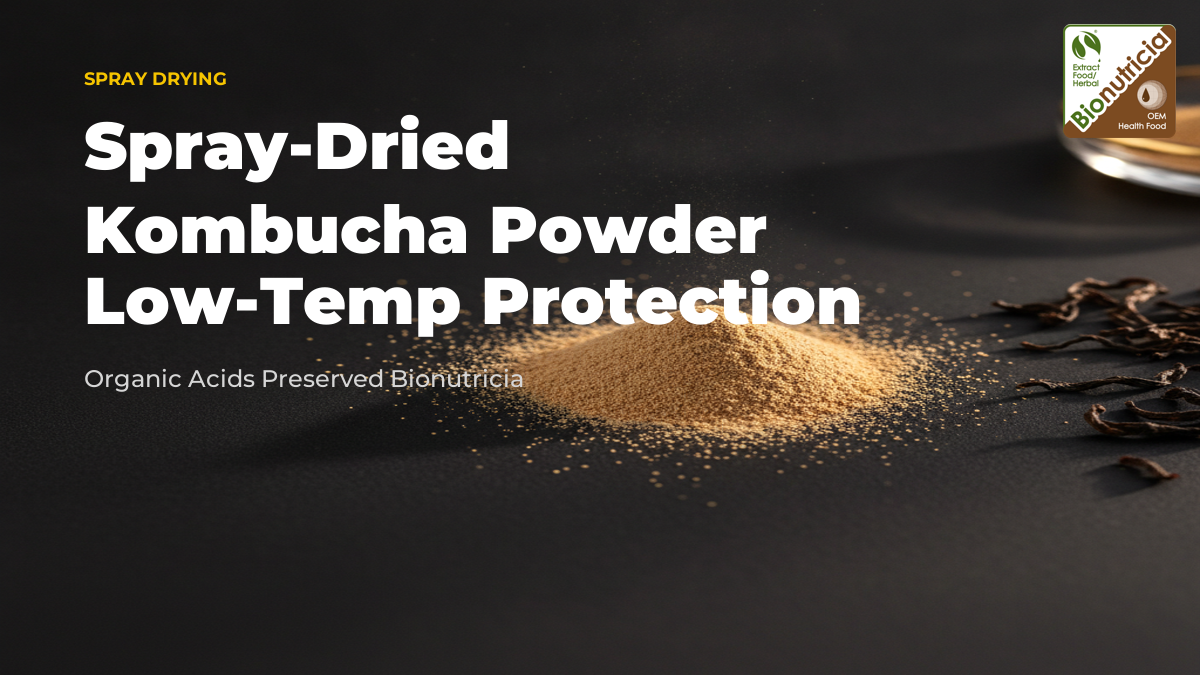
Formulator’s summary: Spray-dried kombucha powder is a water-soluble ingredient produced by fermenting sweetened black tea with a defined starter culture — Lactobacillus plantarum carrying out the fermentation, supported by an inactivated yeast (both ex Chr. Hansen) that feeds the bacteria with amino acids and vitamins rather than fermenting the sugar itself — then drying the fermented liquid into a stable powder that retains the lactic acid and tea-polyphenol profile generated during fermentation. For a formulator, the central question is not whether this fermented tea can be dried (it can) but how the drying process affects the metabolite profile that gives the ingredient its functional and sensory identity. Low-temperature spray drying, with inlet temperatures controlled to minimise thermal degradation, is the method that preserves the highest proportion of the lactic acid and tea polyphenols. The resulting powder is soluble in water, has a low water activity that prevents microbial growth in storage, and can be formulated into ready-to-drink beverages, sachet drink mixes, and dry powder blends where a fermented-tea character is wanted without the logistics of a live liquid.
Quick facts for formulators
- Botanical source: fermented black tea (Camellia sinensis) with a defined starter culture — Lactobacillus plantarum and an inactivated yeast nutrient source (both ex Chr. Hansen)
- Drying method: low-temperature spray drying
- Key metabolites: lactic acid (the primary organic acid from the fermentation) and tea polyphenols
- Solubility: soluble in water
- Appearance: fine powder, characteristic sour tea odour
- Certifications: FSSC 22000 · GMP · HACCP · JAKIM Halal · MeSTI · US FDA facility registration · COA per lot
How this kombucha is fermented
Bionutricia’s kombucha is fermented using a defined starter culture rather than a traditional SCOBY (symbiotic culture of bacteria and yeast). Lactobacillus plantarum, a lactic acid bacterium, carries out the fermentation; an inactivated yeast is added alongside it, but because it is not metabolically active it does not ferment sugar into ethanol or carbon dioxide — its role is to supply the bacteria with amino acids and vitamins. The result is a lactic acid fermentation: L. plantarum converts the sugars in the sweetened tea into lactic acid as the primary organic acid, alongside the tea’s own polyphenols and minor amounts of other fermentation by-products. The fermented liquid is tangy and acidic, without the carbonation associated with a yeast-driven alcoholic fermentation.
Lactic acid is what gives this ingredient its characteristic tang and its functional identity. It also has a preservative effect — the drop in pH as lactic acid accumulates inhibits the growth of spoilage and pathogenic bacteria in the fermented liquid. When the liquid is dried into a powder, preserving the lactic acid content is the primary processing challenge.
Where the lactic acid comes from
Lactobacillus plantarum converts the sugars in the sweetened tea into lactic acid through fermentation — the same pathway used in other lactic-fermented foods. Lactic acid is the primary organic acid in this ingredient and a useful marker for assessing whether the fermentation reached the desired endpoint. The inactivated yeast plays no part in acid production; its role is solely to supply the bacteria with amino acids and vitamins during fermentation.
Why spray drying and why low temperature
Spray drying is the standard industrial method for converting a liquid fermentation product into a shelf-stable powder. The fermented liquid is atomised into a hot air stream, where the water evaporates rapidly and the dissolved solids — lactic acid, tea polyphenols, residual fermentation nutrients — are captured as a dry powder. The critical variable is the inlet air temperature: higher temperatures dry faster and increase throughput, but they also risk thermally degrading heat-sensitive tea polyphenols and can affect flavour and colour through browning reactions at the sugar levels present in the fermentation liquid.
Low-temperature spray drying — with inlet temperatures kept as low as the drying kinetics allow — minimises this degradation. The trade-off is throughput: lower inlet temperatures mean slower drying and lower production rates per hour. For a buyer specifying a kombucha powder ingredient, the relevant question is whether the supplier can document the lactic acid content of the finished powder, not merely the composition of the incoming fermentation liquid. A COA that reports the lactic acid content of the powder confirms that the drying process preserved it rather than degrading it.
Standardised powder versus liquid kombucha: what the difference means
| Parameter | Spray-dried kombucha powder | Liquid kombucha |
|---|---|---|
| Water activity | Low (typically below 0.3) — prevents microbial growth and gas generation in storage | High — requires refrigeration and has a short shelf life |
| Lactic acid profile | Retained through low-temperature drying; confirm on the lot COA | Full profile present in the fresh liquid; changes over time as fermentation continues |
| Shelf life | 24 months sealed, cool and dry | Days to weeks refrigerated; continues fermenting |
| Logistics | Dry powder — no cold chain, no gas pressure, no breakage | Liquid — requires cold chain, vented packaging for CO2, heavy and bulky |
| Formulation flexibility | Weighable, blendable into dry mixes and beverage bases | Liquid only; limited to ready-to-drink applications |
The distinction is a processing and logistics one, not a claim about what the ingredient does in the body. A spray-dried powder is a stable, weighable, transportable form of the fermented tea’s metabolite profile; a liquid kombucha is the fresh fermentation product with its full microbial activity but a short shelf life and demanding logistics.
What to check on the certificate of analysis
| COA parameter | What to look for |
|---|---|
| Appearance | Fine powder, consistent colour. Clumping may indicate moisture ingress |
| Moisture content | Low — typically below 5%. Higher moisture shortens shelf life and risks caking |
| Water activity | Below 0.3 is typical for a spray-dried powder. This is what prevents microbial growth in storage |
| pH | Acidic, reflecting the lactic acid generated during fermentation; the exact range is confirmed per lot on the COA |
| Heavy metals | Arsenic, lead, cadmium, mercury within food-safety limits. Check against your destination market’s requirements |
| Microbiology | Aerobic plate count, yeast and mould, coliforms, E. coli — within limits for a dried food ingredient |
- Request the COA for the actual lot, not only the specification sheet
- Ask whether the lactic acid content of the finished powder is reported, not merely the composition of the fermentation liquid
- Confirm the water activity is low enough to prevent microbial growth and gas generation in storage
- Check heavy-metal and microbiology results against your destination market’s limits
- Verify the halal certificate scope and validity dates if shipping into a certified market
- Run a solubility trial in your own beverage base before scale-up
Solubility and dispersion in formulation
Kombucha powder is soluble in water, which makes it practical across beverage and dry-blend applications. In a ready-to-drink beverage, it dissolves to reconstitute the fermented tea character — the lactic tang, the tea polyphenol backbone and the characteristic flavour — without the carbonation or live microbial activity of fresh liquid kombucha. In a sachet drink mix or dry powder blend, it blends uniformly with other dry ingredients and reconstitutes on addition of water. The low water activity of the powder means it can be stored and handled without the risk of microbial contamination that would occur with a live liquid. For applications where a carrier or wall material is needed to protect the lactic acid during drying, arabic gum is a natural encapsulation wall material commonly used in spray-dried botanical extracts.
Applications
Spray-dried kombucha powder is used in:
- Ready-to-drink beverages and cordials where a fermented-tea character is wanted without live fermentation logistics
- Sachet drink mixes and dry powder blends
- Functional beverage bases where the lactic acid contributes flavour acidity
- Ice-cream and frozen desserts where a sour-tea flavour note is desired
- Bakery systems where the acidic character can interact with leavening
Regulatory and compliance position
Bionutricia’s kombucha powder is manufactured in a JAKIM-certified halal facility in Sungai Buloh, Selangor, Malaysia, under FSSC 22000, GMP, HACCP and MeSTI, with US FDA facility registration. The ingredient is supplied with documentation including the COA per lot, halal certificate, and export paperwork. The material is vegan, non-GMO, and free of artificial colours, flavours and preservatives. For buyers shipping into Indonesia or the Middle East, JAKIM Halal certification is the relevant compliance anchor. A product specification and material safety data sheet are available on request.
Supplying kombucha powder and related ingredients in bulk
Bionutricia supplies spray-dried kombucha powder with a COA on every lot, manufactured in a GMP-certified facility using low-temperature drying to preserve the lactic acid and metabolite profile. Buyers formulating fermented-tea beverages may also find the arabic gum powder bulk supplier page useful — arabic gum is a natural carrier and wall material for spray-dried ingredients. The coconut water powder formulation guide covers another beverage-grade powder ingredient commonly used in functional drink systems, and the yogurt powder guide covers a related fermented-food powder. Bulk supply is available with custom specification on request. Documentation includes the COA per lot, halal certificate, and export paperwork. Sample requests can be made through the contact page.
Order sample quantities or bulk spray-dried kombucha powder from our eStore at https://bionutriciaextract.com/product/kombucha-powder/.
Frequently asked questions
How is kombucha’s lactic acid preserved when spray-drying the powder? Low-temperature spray drying minimises thermal degradation. The inlet air temperature is kept as low as the drying kinetics allow, so that the lactic acid produced by Lactobacillus plantarum fermentation is captured in the powder rather than degrading under heat. The COA for the finished powder should confirm the lactic acid content was retained.
Is kombucha powder soluble in water? Yes. It is a soluble powder that reconstitutes in water, making it practical for ready-to-drink beverages, sachet drink mixes and dry powder blends. The solubility means the fermented-tea character can be reconstituted without the logistics of a live liquid.
What is the shelf life of spray-dried kombucha powder? 24 months when stored sealed in a cool, dry place below 25°C with relative humidity below 65%. The low water activity of the powder — typically below 0.3 — is what prevents microbial growth and gas generation during storage.
Does the powder contain live probiotic bacteria? The spray-drying process reduces the water activity to a level that prevents microbial growth, which means the powder is a stable ingredient rather than a live fermentation product. The lactic acid and metabolite profile is retained; the microbial viability is not. Confirm the specification with the supplier if your formulation requires a defined microbial count.
What culture is used to ferment this kombucha? A defined starter culture — Lactobacillus plantarum, which carries out the fermentation, supported by an inactivated yeast that supplies nutrients to the bacteria. This is not a traditional SCOBY (symbiotic culture of bacteria and yeast); it is a controlled lactic acid fermentation, which gives more consistent batch-to-batch results than an open SCOBY culture.
Is the kombucha powder halal-certified? It is manufactured in Bionutricia’s JAKIM-certified halal facility under a full halal quality system, alongside FSSC 22000, GMP, HACCP and MeSTI. Halal documentation is provided with the shipment.
Related ingredient guides
- Arabic Gum as a Natural Encapsulation Wall Material for Spray-Dried Botanical Extracts
- Coconut Water Powder — Supplier & Formulation Guide for Beverage & Functional Food OEMs
- Knowledge: Kombucha