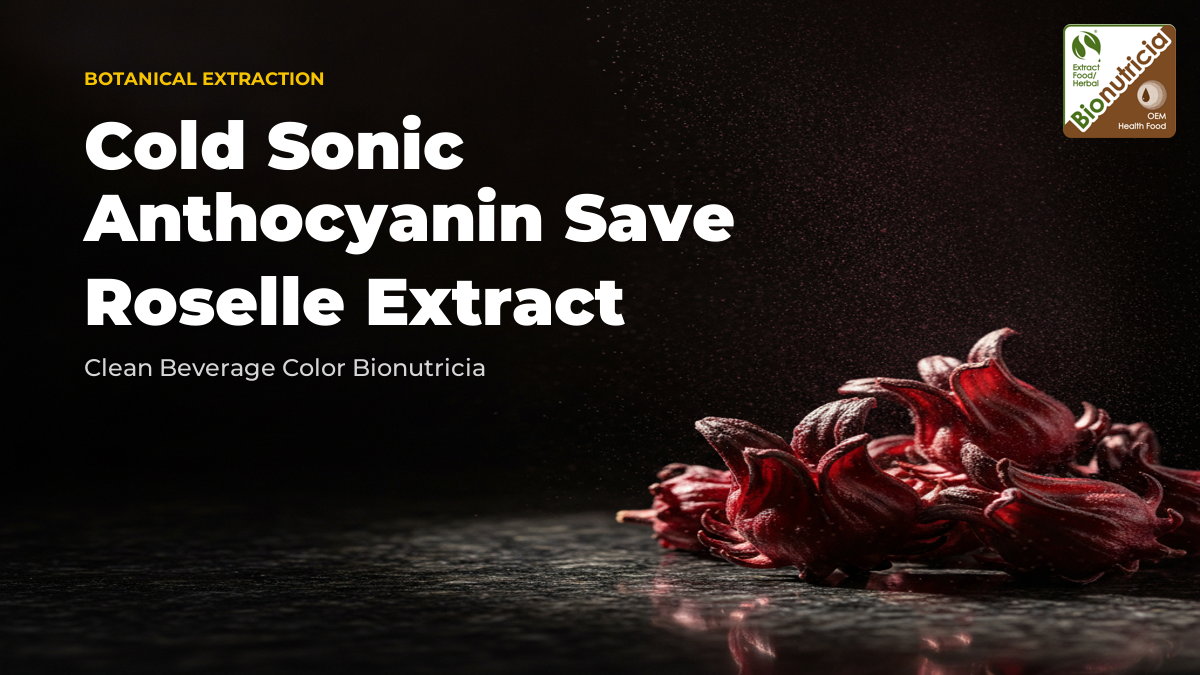
Why Low-Temperature Ultrasonic Extraction Preserves Anthocyanins in Standardised Roselle Extract for Beverage Applications
Formulator’s summary: Roselle (Hibiscus sabdariffa) calyx extract is valued in beverage formulation for its intense ruby-red colour and tart-sweet flavour profile, both of which come from anthocyanin pigments — principally delphinidin-3-sambubioside — concentrated in the dried calyx. Anthocyanins are thermally labile: prolonged exposure to the high temperatures used in conventional maceration and hot-water extraction degrades them, producing an extract with weaker colour and a narrower polyphenol profile. Low-temperature ultrasonic extraction uses acoustic cavitation to rupture plant cell walls mechanically rather than thermally, releasing anthocyanins into the solvent without sustained heating. The resulting standardised extract is water-dispersible and available as both a liquid concentrate and a spray-dried powder, making it suitable for ready-to-drink beverages, cordials, sachet drink mixes and dry powder blends where colour intensity and anthocyanin retention are the primary specification criteria. A certificate of analysis that names the anthocyanin assay and confirms the extraction method is what separates a genuine low-temperature extract from a commodity powder produced by conventional hot-water processing.
Quick facts for formulators
- Botanical: Hibiscus sabdariffa, dried calyx
- Primary colour marker: Delphinidin-3-sambubioside (anthocyanin)
- Extraction method: Patented enzymatic ultrasonic extraction (MY-188945-A)
- Key processing advantage: Low-temperature cavitation preserves anthocyanin pigments and polyphenols
- Solubility: Water-dispersible; available as both extract powder and liquid concentrate
- Sensory contribution: Deep ruby-red colour, tart-sweet flavour
- Best applications: Ready-to-drink beverages, cordials, sachet drink mixes, dry powder blends
- Certifications: FSSC 22000, JAKIM Halal, GMP, HACCP, MeSTI, US FDA facility registration
Why anthocyanins are heat-sensitive
The deep red colour that makes roselle extract valuable in beverage formulation comes from anthocyanins — a class of water-soluble plant pigments concentrated in the dried calyx. The principal anthocyanin in roselle is delphinidin-3-sambubioside, a glycoside of the anthocyanidin delphinidin. A phytochemical analysis of Hibiscus sabdariffa calyces confirmed delphinidin-3-sambubioside as a characteristic anthocyanin pigment present in the calyx material (Anthocyanins of Hibiscus sabdariffa Calyces from Sudan, Natural Product Communications, 2015; https://journals.sagepub.com/doi/pdf/10.1177/1934578X1501000120). This is an in vitro phytochemical characterisation study, not a human clinical trial.
Anthocyanins are structurally unstable at elevated temperatures. The flavylium cation core that gives anthocyanins their red colour degrades through hydrolysis, oxidation and polymerisation when exposed to sustained heat. Conventional extraction methods — hot-water maceration, decoction, prolonged reflux — subject the calyx material to temperatures of 60–100 °C for hours, during which a significant fraction of the anthocyanin content is lost to thermal degradation. The result is an extract with weaker colour intensity, a shifted hue toward brown, and a reduced polyphenol profile compared to what the calyx actually contains.
The key colour compound: delphinidin-3-sambubioside
Delphinidin-3-sambubioside is the glycosylated form of delphinidin found in roselle calyx. Delphinidin itself is an anthocyanidin — the aglycone backbone — with three hydroxyl groups on the B-ring that contribute to its red-to-blue colour range depending on pH. In the plant, the sugar moiety (sambubioside) stabilises the pigment somewhat, but thermal sensitivity remains a fundamental property of the molecule.
For procurement purposes, delphinidin-3-sambubioside is the marker compound that distinguishes a genuine anthocyanin-preserving roselle extract from a crude calyx powder. A supplier that has invested in low-temperature extraction should be able to discuss the anthocyanin assay on the specification sheet; a supplier that cannot name the compound is likely selling a commodity powder with no colour guarantee.
Conventional extraction vs ultrasonic extraction
The extraction method determines how much anthocyanin content survives into the finished extract. The table below compares the two principal approaches.
| Parameter | Conventional maceration / hot-water extraction | Ultrasonic extraction (low-temperature) |
|---|---|---|
| Temperature | Typically 60–100 °C; sustained heating | Controlled low temperature; cavitation does the work |
| Mechanism | Thermal diffusion across cell walls | Acoustic cavitation ruptures cell walls mechanically |
| Anthocyanin retention | Low — anthocyanins degrade at sustained high temperature | Higher — low processing temperature preserves heat-sensitive pigments |
| Extraction time | Hours to days for maceration | Shorter — cavitation accelerates mass transfer |
| Solvent exposure | Prolonged contact with heated solvent | Brief contact at controlled temperature |
| Finished extract colour | Weaker, shifted toward brown | Intense ruby-red, closer to the natural calyx colour |
What low-temperature ultrasonic processing preserves
Ultrasonic extraction works through acoustic cavitation: high-frequency sound waves create microscopic bubbles in the extraction liquid, which collapse violently against plant cell walls, rupturing them and releasing intracellular contents — including anthocyanin pigments and polyphenols — into the solvent. Because the energy is delivered mechanically rather than thermally, the bulk liquid temperature stays low, and heat-sensitive compounds like delphinidin-3-sambubioside are not subjected to the sustained heating that destroys them in conventional processes.
Bionutricia’s roselle extract is produced using patented enzymatic ultrasonic extraction (MY-188945-A), which combines enzymatic pre-treatment with ultrasonic cavitation. The enzymatic step breaks down structural polysaccharides in the calyx cell wall, making the cell contents more accessible to the ultrasonic extraction that follows. The combined process operates at controlled low temperature, preserving the anthocyanin profile and polyphenol content that conventional hot-water extraction would lose.
Solubility and dispersion in beverage systems
Roselle extract is supplied in two physical forms, each suited to different beverage applications:
- Extract powder: A fine, free-flowing powder that disperses in water with gentle stirring. Suitable for sachet drink mixes, dry powder blends and functional beverage premixes where a dry-format ingredient is required. Bloom in a small volume of warm water before adding to the main batch to ensure uniform dispersion.
- Liquid concentrate: A standardised liquid that disperses readily in cold water without blooming. Preferred for ready-to-drink beverages and cordials where a liquid ingredient doses more precisely and integrates without a hydration step.
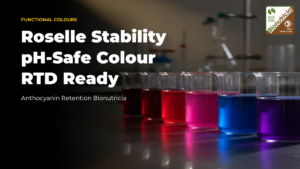
In a clear ready-to-drink beverage, roselle extract contributes an intense ruby-red colour from anthocyanins. The colour is pH-dependent — shifting toward pink in acidic conditions and toward purple-blue as pH rises — which is a formulation consideration for beverages targeting a specific pH range. For a detailed treatment of anthocyanin colour stability and pH sensitivity in roselle extract, see our companion guide on anthocyanin stability and colour retention in RTD and cordial applications.
Standardised extract vs crude calyx powder
The distinction between a standardised roselle extract and a crude ground-calyx powder is a specification and quality-control difference, not a health claim. A standardised extract has been processed to concentrate the anthocyanin pigments — with delphinidin-3-sambubioside as the marker — and the extraction method, concentration ratio and anthocyanin assay are documented on the certificate of analysis. Batch-to-batch consistency is verifiable: the COA confirms that each lot meets the same colour and polyphenol specification.
A crude ground-calyx powder is simply dried roselle calyx milled to a fine particle size. It contains whatever anthocyanins survived the drying process, with no concentration step, no marker assay and no batch consistency guarantee. It is cheaper, weaker and less predictable — a formulator using it will find that colour intensity varies between lots and fades faster in storage. For a beverage product where roselle colour is a selling point, a standardised extract produced by low-temperature ultrasonic processing is the grade to specify.
Supplying roselle extract and related ingredients in bulk
Bionutricia Extract supplies standardised roselle (Hibiscus sabdariffa) calyx extract in both powder and liquid concentrate forms, produced under patented enzymatic ultrasonic extraction (MY-188945-A) in a facility holding FSSC 22000, GMP, HACCP, JAKIM Halal, MeSTI and US FDA facility registration. Every batch ships with a certificate of analysis. Bulk supply, custom specification and extract ratio, spray-dried and powder forms, documentation and export paperwork, and packing options are available on request.
Buyers formulating roselle into beverage systems may also need companion ingredients from the published range: pandan leaf liquid concentrate for a complementary sweet-floral aroma profile, or coconut water powder + roselle hydration sachet for a pre-blended electrolyte-and-colour system. The natural food colouring guide covers stability and specification considerations across multiple plant-based colour ingredients.
For specifications, samples, and bulk quotations, contact our team or message us on WhatsApp at +60 16-661 8510.
Order sample quantities or bulk standardised roselle extract from our eStore at https://bionutriciaextract.com/product/roselle-hibiscus-sabdariffa-standardized-extract-powder/.
Related ingredient guides
- Ultrasonic Extraction of Pandan Leaf: Why Low-Temperature Processing Preserves Aroma Compounds for Beverage Applications
- Coconut Water Powder + Roselle Extract Hydration Powder Sachet: A Bulk B2B Buyer’s Guide
- Natural Food Coloring: Sources, Stability and How to Buy in Bulk
Frequently asked questions
Why does low-temperature ultrasonic extraction preserve more anthocyanins in standardised roselle extract than conventional maceration? Ultrasonic extraction uses acoustic cavitation to rupture plant cell walls mechanically, releasing anthocyanin pigments into the solvent without sustained high-temperature heating. Because delphinidin-3-sambubioside — roselle’s principal anthocyanin — is thermally labile, the low processing temperature prevents it from degrading during extraction. Conventional hot-water maceration exposes anthocyanins to prolonged heat, which causes hydrolysis, oxidation and colour loss before the pigment reaches the finished extract.
What is delphinidin-3-sambubioside and why is it the marker compound for roselle extract? Delphinidin-3-sambubioside is the glycosylated anthocyanin pigment most strongly associated with roselle’s characteristic ruby-red colour. A phytochemical analysis of Hibiscus sabdariffa calyces confirmed it as a characteristic pigment in the calyx material. Because it is the dominant anthocyanin, it is the natural marker for confirming that an extract has preserved the calyx’s true colour profile. A specification that names the anthocyanin assay and confirms low-temperature processing is what separates an anthocyanin-preserving extract from a commodity powder.
Should I specify roselle extract powder or liquid concentrate for a ready-to-drink beverage? For ready-to-drink beverages, a liquid concentrate is typically preferred because it disperses in cold water without a hydration step and doses precisely by volume. Extract powder is better suited to sachet drink mixes and dry powder blends where a dry-format ingredient is required. Both forms carry the same standardised anthocyanin profile; the choice is a formulation and handling decision.
How does the extraction method affect the colour intensity of the finished extract? Conventional hot-water extraction degrades anthocyanins through sustained heating, producing an extract with weaker colour and a shifted hue toward brown. Low-temperature ultrasonic extraction preserves the anthocyanin content by using mechanical cavitation instead of thermal diffusion, resulting in an extract with colour intensity closer to the natural calyx. The difference is visible on the certificate of analysis as a higher anthocyanin assay.
What should I look for on the COA when buying roselle extract for beverage formulation? Request botanical identity (Hibiscus sabdariffa, calyx), extraction method (ultrasonic, low-temperature), concentration ratio, anthocyanin or polyphenol assay, solubility data, microbial limits, heavy metals, and colour specification. The COA should confirm batch-to-batch consistency against the same specification every time.