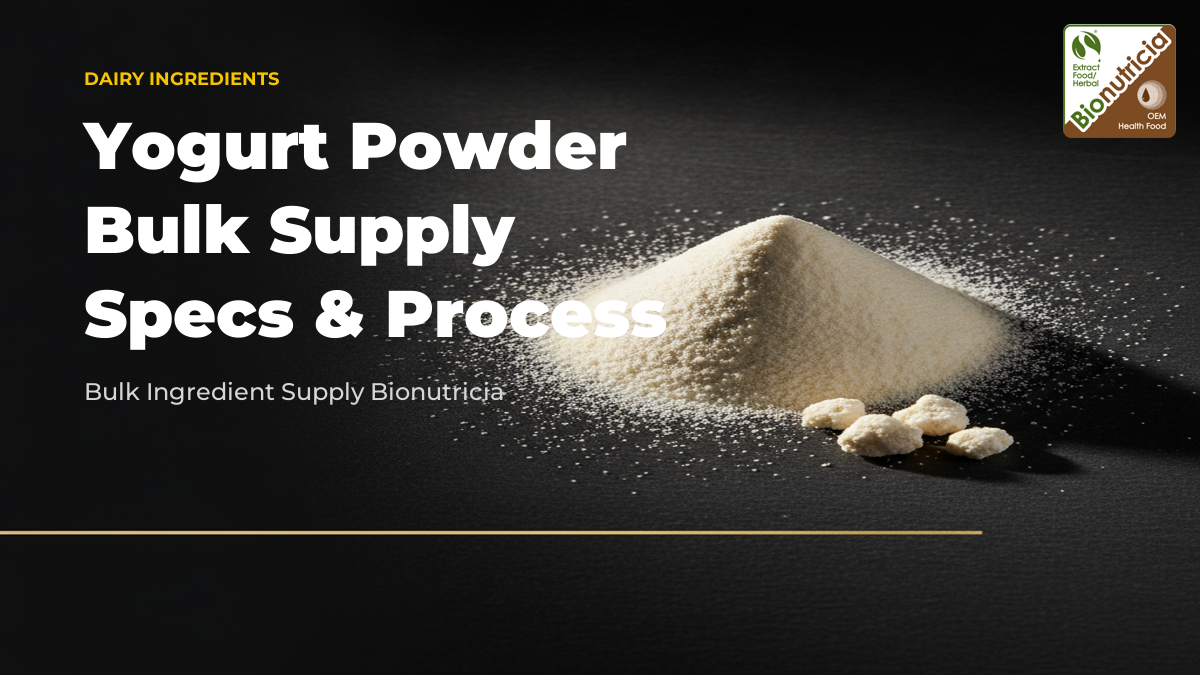
Yogurt Powder: Specification, Processing & Bulk Supply Guide
Direct answer: Yogurt powder is plain, unsweetened Greek yogurt that has been spray-dried using a starch hydrolysate carrier under a relatively low heating temperature, producing a shelf-stable, sour-tasting powder that behaves like a dry ingredient rather than a refrigerated dairy product. Bulk buyers specify it primarily on four points: the probiotic count and strain mix stated on the specification (Bionutricia’s current sheet lists more than 2 billion CFU comprising Lactobacillus, Streptococcus and Bifidobacterium), the absence of fillers, added flavours, artificial colours or preservatives, its allergen status (soy- and gluten-free), and its inclusion rate in the target formulation — typically 0.2% to 6% of total finished-product weight. Because it is dried rather than fresh, it does not carry the short open-pack window of liquid yogurt, does not need refrigeration for storage, and carries a 24-month shelf life when kept sealed below 25°C and 65% relative humidity. This guide covers how the powder is made, what a specification sheet should show, how to plan an inclusion rate, and the certification and packaging questions worth raising with any supplier before committing to a bulk order.
GMP
HACCP
JAKIM Halal
US FDA
MeSTI
NanoVerify
Quick facts for formulators
- Base material: plain, fresh, unsweetened Greek yogurt, spray-dried to a powder
- Carrier / drying aid: starch hydrolysate, processed under a relatively low heating temperature
- Probiotic count (specification): more than 2 billion CFU, comprising Lactobacillus, Streptococcus and Bifidobacterium
- Format: free-flowing powder — no refrigeration required for storage
- Allergen status: soy- and gluten-free
- Composition: non-GMO, no fillers, no added flavours, no additives, no preservatives, no artificial colours
- Typical inclusion rate: 0.2%–6% of total formulation weight
- Shelf life: 24 months, sealed, below 25°C and 65% relative humidity
How yogurt powder is made
Bionutricia’s yogurt powder starts from plain, fresh, unsweetened Greek yogurt — no sugar and no flavouring added at the base. That liquid Greek yogurt is spray-dried using a starch hydrolysate carrier, and the drying step runs at a relatively low heating temperature specifically to protect the viability of the bacterial culture through the drying process rather than driving off moisture as fast as possible. The result is a fine, sour-tasting powder rather than a granulated or agglomerated one.
Spray-drying is what converts yogurt from a refrigerated, short-shelf-life dairy product into a stable dry ingredient. The powder does not require refrigeration for storage, and — unlike an opened tub of fresh yogurt, which is typically used up within about two weeks — the dried format does not carry that same use-by pressure once the original sealed pack is opened and resealed correctly.
Where the tang and texture come from
Yogurt’s characteristic sourness is a fermentation outcome, not an additive. Starter cultures — species drawn from Lactobacillus, Streptococcus and Bifidobacterium — convert the lactose in milk into lactic acid. That drop in pH is also what causes milk proteins to curdle, which is why fermented yogurt has a thicker texture than the milk it was made from, and why fermentation has historically been used as a way to keep milk from spoiling as quickly as it otherwise would.
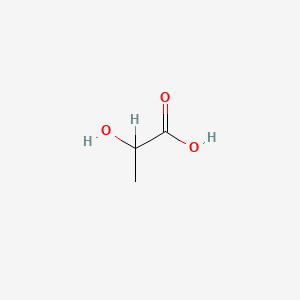
Because this chemistry happens before drying, the spray-dried powder carries the same sour flavour profile as the liquid yogurt it came from — buyers using it as a flavour or texture input should expect that tang to come through in the finished formulation, and should trial their own inclusion rate rather than assume a fresh-yogurt equivalence.
Specification: what to check on the sheet
| Parameter | What the specification states | Why a buyer checks it |
|---|---|---|
| Base material | Plain, fresh, unsweetened Greek yogurt | Confirms no added sugar or flavouring in the base before drying |
| Drying method | Spray-dried using a starch hydrolysate carrier, low heating temperature | The low-heat step is what the specification credits with protecting probiotic viability during drying |
| Probiotic count | More than 2 billion CFU per the current specification | The headline potency figure formulators use to compare lots and suppliers |
| Probiotic strains | Lactobacillus, Streptococcus, Bifidobacterium | Confirms which genera contribute to the stated CFU count |
| Composition | Non-GMO; no fillers, added flavours, additives, preservatives or artificial colours | Relevant to clean-label and “free-from” positioning on a finished pack |
| Allergens | Soy- and gluten-free | Needed for allergen declarations on the finished product label |
| Appearance / taste | Sour-tasting powder | Sets buyer expectation for flavour carry-through in the finished formulation |
| Shelf life | 24 months in original sealed packaging, below 25°C, relative humidity below 65%, odour-free storage | Governs inventory planning and warehouse conditions |
Request the current specification sheet and a lot-specific certificate of analysis before committing to a bulk order — the CFU figure and probiotic strain mix should be confirmed on the CoA for the lot being shipped, not assumed from the general specification alone.
Formulation and inclusion rate
Bionutricia’s specification gives a working inclusion range of roughly 0.2% to 6% of total formulation weight, equivalent to about one-eighth of a teaspoon up to six tablespoons per typical recipe batch, adjusted to the finished product and to personal or brand flavour targets. In practice, the right rate is a trial-and-error decision driven by the tang and colour you want to carry through, not a fixed dose.
- Smoothie, beverage and pouch-drink powder bases
- Ice cream and frozen dessert formulations
- Baked goods — cakes, biscuits and traditional kuih-muih
- Jams, jellies and puddings where a yogurt tang is wanted without fresh dairy
- Snack seasoning and dessert toppings, sprinkled for flavour
- Salad dressings, as a dry substitute for sour cream in a formulation
- Dry-blend formats such as powder sachets, pouch beverages and chewable tablets
Packaging, storage and handling
Keep the powder in a cool, dry place away from direct sunlight; refrigerated storage is not required, though it is acceptable if warehouse space allows it. In the original sealed packaging, the specification carries a 24-month shelf life provided storage stays below 25°C and below 65% relative humidity in odour-free conditions — dairy powders readily pick up ambient odours, so store away from strongly scented goods. Keep packs off direct contact with walls or floors. Because it is a spray-dried powder, texture can vary lot to lot — some lots run finer, some coarser — and the powder can clump if exposed to heat or moisture, so buyers should factor that into their own handling and blending steps. Colour and taste may also vary slightly batch to batch, which is normal for a dairy-derived powder rather than a sign of an off-spec lot; always confirm against the certificate of analysis for the shipped lot.
- Request the current specification sheet and the lot-specific certificate of analysis, not a generic datasheet.
- Confirm the stated probiotic CFU count and strain mix are tested per production lot.
- Confirm the drying method (spray-dried, starch hydrolysate carrier) and the base material (plain, unsweetened Greek yogurt).
- Verify allergen status (soy- and gluten-free) matches your labelling requirements.
- Confirm halal certification scope and validity dates if shipping into a certified market.
- Run your own sensory and colour trial at your intended inclusion rate before scaling to a full production batch.
- Check storage conditions specified for the lot against your own warehouse capability.
Why buyers work with Bionutricia
Bionutricia Manufacturing Sdn Bhd has supplied standardised botanical extracts and functional food powders out of Malaysia since 2006, working with 239+ brand partners. The facility holds JAKIM Halal, FSSC 22000, GMP, HACCP, MeSTI and NanoVerify certification alongside a US FDA food facility registration. For a dairy-derived powder like this one, the value for a bulk buyer is consistent lot-to-lot documentation — a specification sheet and a certificate of analysis issued per production lot — plus a supplier that can also support the same ingredient across multiple finished formats, including powder sachets, pouch beverages and chewable tablets.
See the Yogurt Powder bulk product page for the current listing, or read on for related bulk powder ingredients formulators often specify alongside it: the Hydrolyzed Vegetable Protein (HVP) Buyer’s Guide for another fermentation-derived, spray-dried functional powder; the Coconut Water Powder Supplier & Formulation Guide for beverage-format spray-dried powders; and the MCT Powder Technical & Supplier Guide for another widely blended functional powder ingredient.
Clinical literature for buyer review
The references below are provided for procurement due diligence and evidence review only. They summarise published research on fermented dairy foods and probiotic genera in general — they are not a description, test, or proof of effect for Bionutricia’s yogurt powder, its stated probiotic count, or any specific production lot. Nothing in this section is a claim that this article, this product, or its probiotic content produces, treats, relieves or prevents any health condition.
| Reference | PubMed link | What the study investigated |
|---|---|---|
| Kiessling et al., European Journal of Clinical Nutrition, 2002. “Long-term consumption of fermented dairy products over 6 months increases HDL cholesterol.” | https://pubmed.ncbi.nlm.nih.gov/12209372/ | A controlled clinical trial that measured blood cholesterol markers in human volunteers consuming fermented dairy products over a six-month period. |
| Xiao et al., Journal of Dairy Science, 2003. “Effects of milk products fermented by Bifidobacterium longum on blood lipids in rats and healthy adult male volunteers.” | https://pubmed.ncbi.nlm.nih.gov/12906063/ | A randomised trial that measured blood lipid parameters in rats and, separately, in a group of healthy adult male human volunteers who consumed milk fermented with Bifidobacterium longum. |
| Matsumoto et al., Microbiology and Immunology, 2009. “Dynamics of fecal microbiota in hospitalized elderly fed probiotic LKM512 yogurt.” | https://pubmed.ncbi.nlm.nih.gov/19659926/ | A clinical trial that tracked fecal microbiota composition in hospitalized elderly patients fed a Bifidobacterium-strain probiotic yogurt. |
These studies describe research on fermented dairy foods and probiotic genera in the published literature generally. Buyers evaluating strain-specific or CFU-specific claims should request Bionutricia’s current specification sheet and lot-specific certificate of analysis rather than treating this literature as a substitute for product-specific testing.
Is yogurt powder the same as freeze-dried yogurt?
Not necessarily. Bionutricia’s yogurt powder is produced by spray-drying plain, unsweetened Greek yogurt with a starch hydrolysate carrier under a relatively low heating temperature. Freeze-drying is a different process; buyers should confirm the drying method on the specification sheet rather than assume one from the product name alone.
Does yogurt powder need to be refrigerated?
No. Because it is a dried powder rather than a liquid dairy product, it does not require refrigeration for storage. The specification instead calls for a cool, dry place below 25°C and below 65% relative humidity, away from direct sunlight, to reach its stated 24-month shelf life.
What probiotic count does the specification guarantee?
The current Bionutricia specification lists more than 2 billion CFU, made up of Lactobacillus, Streptococcus and Bifidobacterium. Request the lot-specific certificate of analysis to confirm the tested figure for the batch being shipped.
What inclusion rate should we plan for in a new formulation?
The specification’s working range is roughly 0.2% to 6% of total formulation weight. Because the powder carries a genuine sour flavour, the right rate for your product is a sensory decision best confirmed with a small trial batch before scaling up.
Is Bionutricia’s yogurt powder allergen-free?
The specification states it is soy- and gluten-free, with no added fillers, flavours, additives, preservatives or artificial colours. Always confirm current allergen status against the certificate of analysis for your specific order, since specifications can be updated.
Request the current specification and a certificate of analysis.