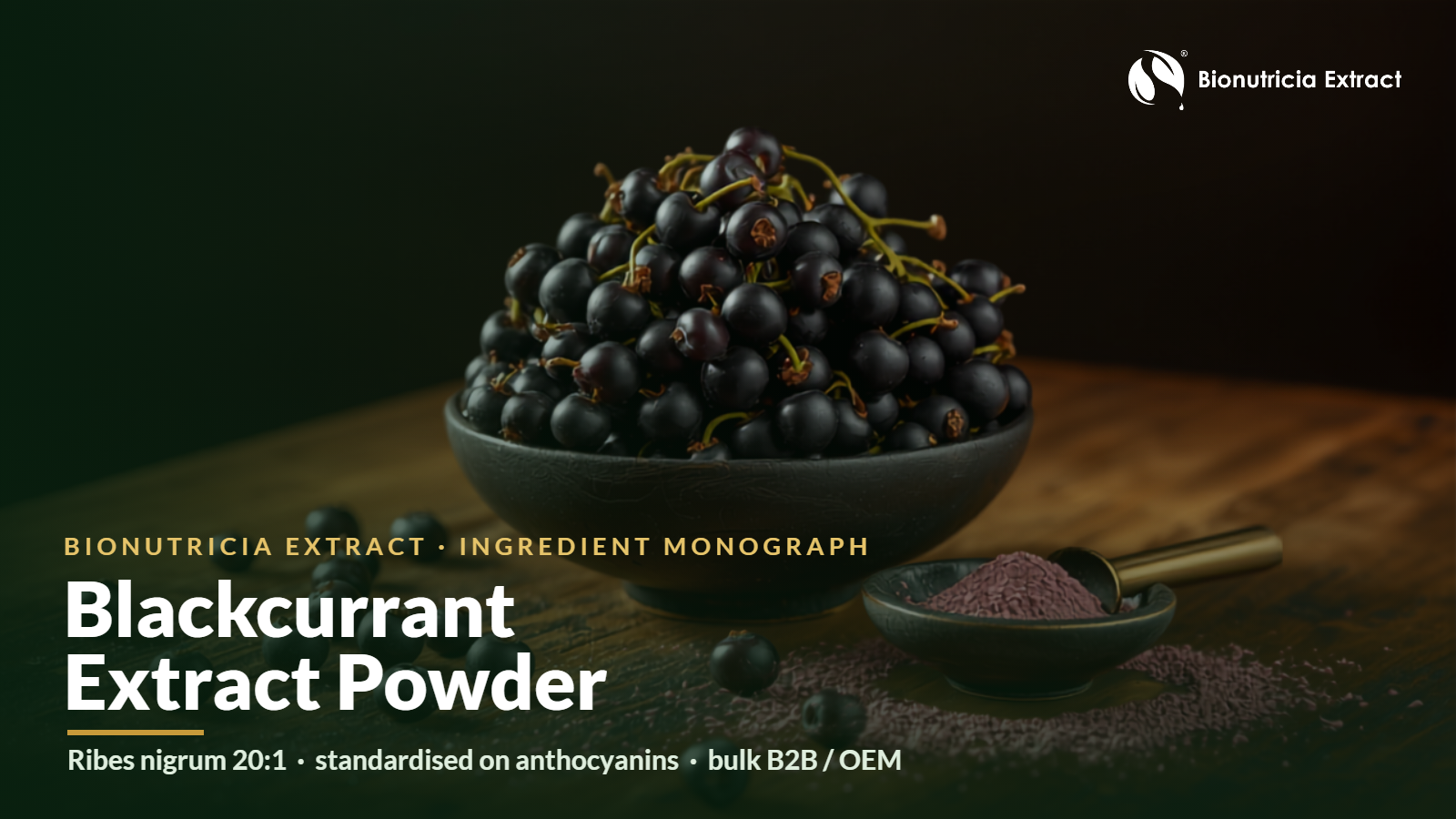
Blackcurrant extract powder is a 20:1 fruit extract of Ribes nigrum, characterised on its anthocyanins — chiefly delphinidin-3-O-rutinoside and cyanidin-3-O-rutinoside — alongside the berry’s native vitamin C. Bionutricia Extract supplies it in bulk to B2B and OEM formulators from a JAKIM Halal, FSSC 22000, US FDA-registered, GMP, HACCP and MeSTI facility in Malaysia, with a Certificate of Analysis on every lot.
Quick facts for formulators
- Botanical / part: Ribes nigrum, fruit
- Type: standardized extract powder, extraction ratio 20:1
- Marker compounds: anthocyanins — delphinidin-3-O-rutinoside and cyanidin-3-O-rutinoside (HPLC profile); native vitamin C
- Standardised total anthocyanins: 1% (house specification; confirmed on the batch Certificate of Analysis)
- Form / colour / odour: free-flowing pink powder, characteristic odour
- Solubility: water-soluble · pH: 3–5 · Moisture: <10%
- Particle size: >95% through 60 mesh
- Dosage: typically 2–8% of the finished formulation
- Pack sizes: 1 kg · 5 kg · 20 kg
- Clean label: vegan, non-GMO, gluten-free (<20 ppm), not irradiated, no Annex II allergens, not a novel food
- Shelf life: 2 years sealed, cool & dry · Origin: Malaysia
What is blackcurrant extract powder?
Blackcurrant (Ribes nigrum) is a small, deeply pigmented berry cultivated across Europe, Central Asia and New Zealand, long used in cordials, confectionery and traditional European food culture — the site’s blackcurrant knowledge page covers the fruit itself. Bionutricia’s ingredient is a 20:1 concentrated extract of the fruit, produced with the patented enzymatic + ultrasonic extraction process (MY-188945-A, “Process for Preparing Nutritional Powder Extract”) and spray-dried into a water-soluble pink powder. One kilogram of extract therefore represents about twenty kilograms of fresh fruit input, concentrating the berry’s colour, flavour and marker anthocyanins into a single dosable ingredient — see the live blackcurrant extract powder product page.
Active compound & standardisation
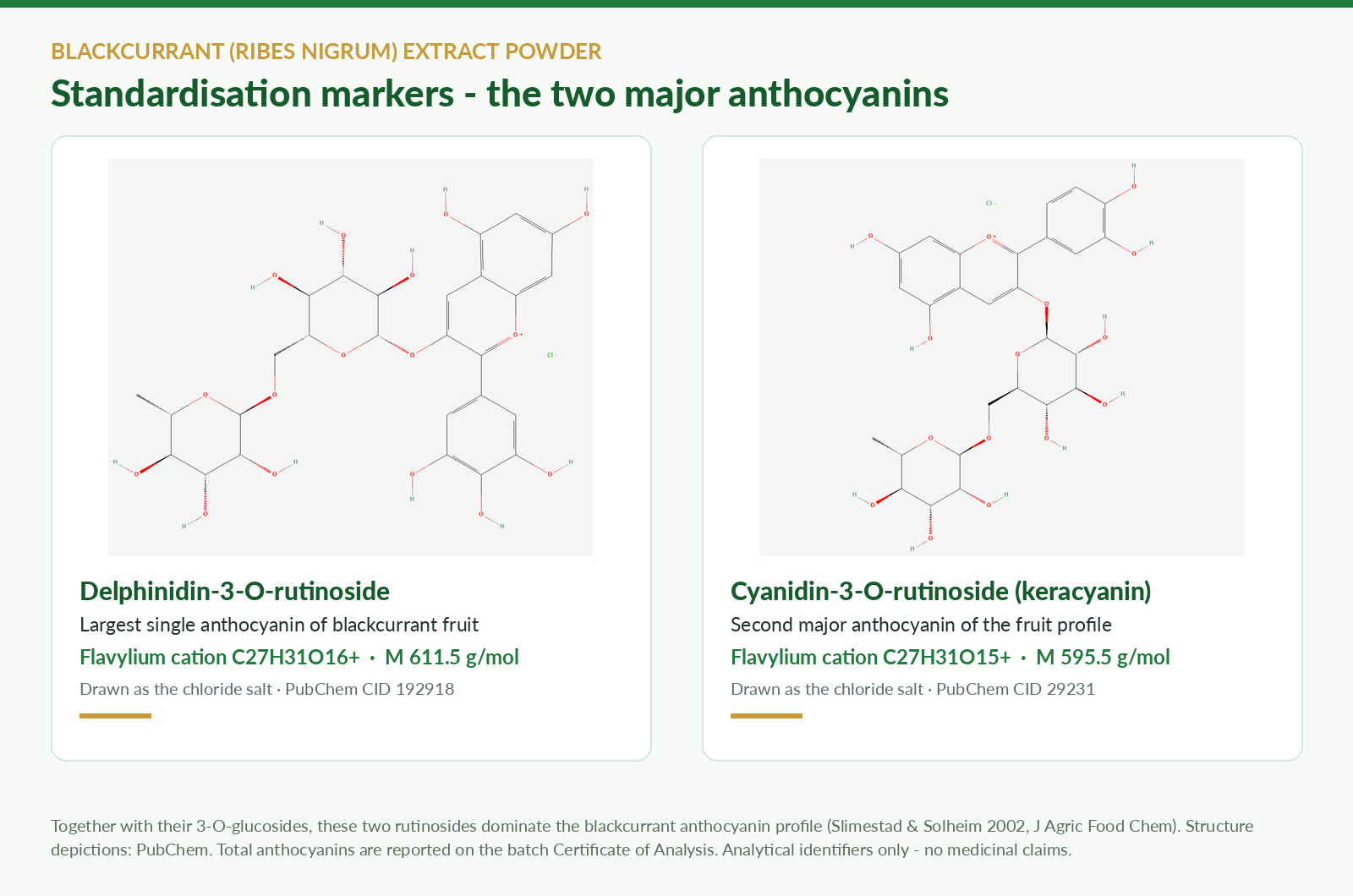
Blackcurrant owes its near-black skin to anthocyanins. The profile is dominated by four pigments — the 3-O-rutinosides and 3-O-glucosides of delphinidin and cyanidin — with delphinidin-3-O-rutinoside the single largest component, a fingerprint that distinguishes genuine blackcurrant from other berry extracts (Slimestad & Solheim 2002, J Agric Food Chem). The anthocyanin profile is read by HPLC, and our house specification standardises the extract to a total anthocyanin content of 1%, confirmed on each batch Certificate of Analysis; the berry’s native vitamin C is retained as a co-constituent. Anthocyanins are also pH-responsive natural colours — vivid pink-red in acidic systems, shifting violet as pH rises — so the same ingredient contributes label-friendly colour, berry flavour and the studied marker compounds at once.
How blackcurrant anthocyanins work in the body (mechanism)
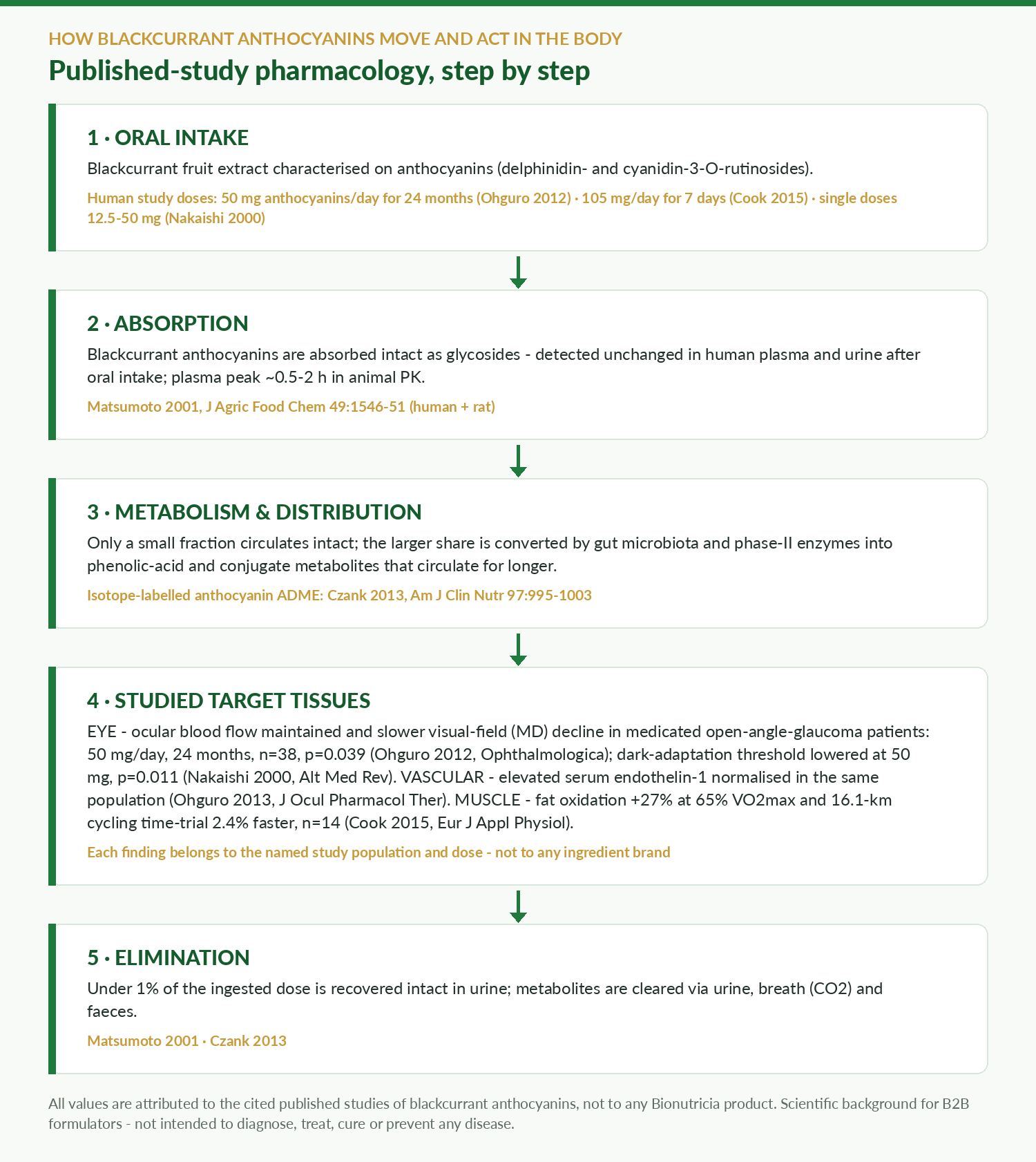
Blackcurrant’s rutinoside anthocyanins are among the few shown to be absorbed intact as glycosides — Matsumoto et al. (2001, J Agric Food Chem) detected delphinidin-3-rutinoside and cyanidin-3-rutinoside unchanged in human plasma and urine after oral intake. Only a small fraction circulates intact; the larger share is transformed by gut microbiota and phase-II enzymes into phenolic-acid metabolites that persist longer than the parent pigments (isotope-labelled anthocyanin ADME, Czank et al. 2013, Am J Clin Nutr). The mechanisms studied in humans centre on microcirculation and vascular tone: in medicated glaucoma patients, blackcurrant anthocyanins maintained ocular blood flow measured by laser-speckle flowgraphy (Ohguro 2012) and normalised elevated serum endothelin-1, a vasoconstrictor peptide (Ohguro 2013, J Ocul Pharmacol Ther); in trained cyclists they increased whole-body fat oxidation during submaximal exercise (Cook 2015). Mechanism is provided as scientific background on the berry’s anthocyanins, attributed to the cited studies; it is not a claim that this ingredient treats, cures or prevents any condition.
Clinical evidence on blackcurrant anthocyanins
The findings below belong to the cited studies and populations, at the stated doses — they are scientific context for formulators, not performance claims for this ingredient.
| Study | Design | Result (attributed to the study) |
|---|---|---|
| Ohguro et al. 2012, Ophthalmologica | 2-year randomized, placebo-controlled, double-masked; n=38 medicated open-angle-glaucoma patients; 50 mg anthocyanins/day | Smaller visual-field mean-deviation decline vs placebo at 24 months (p=0.039); ocular blood flow maintained |
| Nakaishi et al. 2000, Alt Med Rev | Placebo-controlled crossover, healthy adults; single doses 12.5 / 20 / 50 mg | Dose-dependent lowering of the dark-adaptation threshold (50 mg, p=0.011, n=12); VDT-work transient refractive shift prevented (n=21) |
| Cook et al. 2015, Eur J Appl Physiol | Double-blind crossover, n=14 trained cyclists; 300 mg/day New Zealand blackcurrant extract (105 mg anthocyanins) for 7 days | 16.1-km time-trial 2.4% faster; fat oxidation +27% at 65% VO2max |
| Systematic review & meta-analysis 2020 (NZ blackcurrant & sport performance) | Pooled controlled exercise trials | Small overall performance benefit across studies, with between-trial variability |
| Morton et al. 2025, Eur J Sport Sci | RCT, trained cyclists; acute and 7-day dosing | No effect on cycling performance or physiological responses — an honest null result |
Evidence appraisal: the ocular trials are small and from a single research group, and the sports literature is mixed — the 2025 trial found no effect. Anthocyanin content on the batch COA is the objective quality metric; the trials above describe blackcurrant anthocyanins, not a Bionutricia finished product.
Typical specification
| Parameter | Value |
|---|---|
| Botanical source / part | Ribes nigrum, fruit |
| Type / ratio | Standardized extract powder, 20:1 |
| Appearance / colour | Free-flowing powder, pink |
| Marker compounds | Anthocyanins (delphinidin- & cyanidin-3-O-rutinosides, HPLC); native vitamin C |
| Standardised total anthocyanins | 1% (house specification; confirmed on the batch COA) |
| Solubility | Soluble in water |
| pH | 3–5 |
| Moisture | < 10% |
| Particle size / mesh | > 95% through 60 mesh |
| Dosage | 2–8% of the finished formulation |
| Heavy metals | As < 0.1 ppm · Pb < 0.2 ppm · Hg < 0.05 ppm |
| Microbiology | APC < 10⁴ cfu/g · Y&M < 10³ cfu/g · coliforms < 10² cfu/g · E. coli absent |
| Clean label | Vegan · non-GMO · gluten-free (<20 ppm) · not irradiated · no Annex II allergens · not a novel food |
| Certifications | JAKIM Halal, FSSC 22000, US FDA registered, GMP, HACCP, MeSTI |
| Shelf life | 2 years sealed, cool & dry |
| Pack sizes | 1 kg, 5 kg, 20 kg |
| Country of origin | Malaysia |
Figures are typical specification values; the batch Certificate of Analysis carries the release data — including the anthocyanin figure — for each production lot. Full specification on request.
Applications
Bionutricia supplies the bulk ingredient for B2B formulation; brand owners and manufacturers formulate it into their chosen finished format — beverages and cordials, ice-cream and frozen desserts, bakery systems, and sachet drink mixes. Because the anthocyanins double as a pH-responsive natural pink-to-violet colour with genuine berry flavour, one ingredient can carry a product’s colour, taste and marker-compound story simultaneously.
Why source blackcurrant extract from Bionutricia?
Bionutricia Extract has manufactured botanical extracts in Malaysia since 2006, running the patented enzymatic + ultrasonic extraction process (MY-188945-A) under a full halal and international food-safety stack — JAKIM Halal, FSSC 22000, US FDA registration, GMP, HACCP and MeSTI — and issuing a Certificate of Analysis with every lot. The blackcurrant extract is freshly made to order; pre-order packing takes about 1–2 weeks. MOQ and pricing are provided on quotation via the product page.
Frequently asked questions
What is it standardised on, and is a COA available? It is a 20:1 Ribes nigrum fruit extract characterised on anthocyanins — delphinidin- and cyanidin-3-O-rutinosides by HPLC — standardised to a total anthocyanin content of 1% per the house specification and confirmed on the batch Certificate of Analysis issued per lot.
Is this a juice powder or a true extract? A true concentrated extract at a 20:1 ratio — about twenty kilograms of fruit per kilogram of powder — not a spray-dried juice.
Is the blackcurrant extract halal? Yes — it is JAKIM Halal certified, produced in a facility that also holds FSSC 22000, US FDA registration, GMP, HACCP and MeSTI; documentation accompanies each shipment.
What finished formats can a brand owner make? Bionutricia supplies the bulk ingredient; customers formulate it into beverages, ice-cream, bakery and sachet applications in their own facilities.
What colour does it give a formulation? A natural anthocyanin colour — pink-red in acidic systems such as beverages and cordials, shifting toward violet as pH rises; it is water-soluble for easy dosing.
What is the typical dosage? Typically 2–8% of the finished formulation, dosed on a quantum satis basis.
What are the pack sizes, MOQ and lead time? 1 kg, 5 kg and 20 kg packs; freshly made pre-order packing takes about 1–2 weeks; MOQ and tiered pricing on quotation.
How should it be stored? Sealed in hygienic containers, cool and dry, away from light and pest infestation; shelf life is 2 years when properly stored.
Request a bulk blackcurrant extract quote →