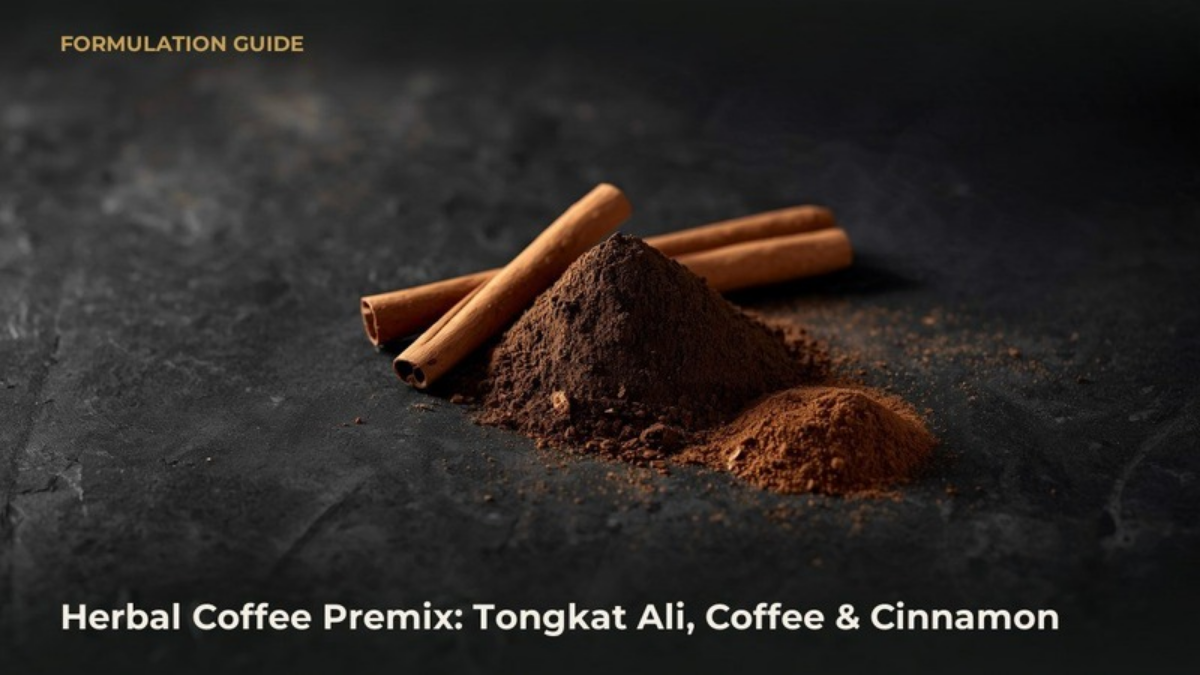
Herbal Coffee Premix for Powder Blends: Tongkat Ali, Coffee and Cinnamon Matrix
Formulator’s summary: A dry herbal coffee premix can be screened with instant coffee at 20–45% w/w, standardised Tongkat Ali Root (Eurycoma longifolia) extract powder at 1–4%, and cinnamon powder at 0.2–2%. The botanical powder is not necessarily soluble; validate dispersion. Coffee-led blends suit functional coffee, instant beverage premixes and sachet drink mixes.
Quick facts for formulators
- Physical form: dry powder matrix
- Ingredient form: Tongkat Ali root extract powder, Coffee extract powder and ground Cinnamon powder
- Standardisation marker: Eurycomanone; the Tongkat Ali product page identifies a 1–3% range
- Typical screening ranges: instant coffee 20–45%, Tongkat Ali extract 1–4%, cinnamon powder 0.2–2% w/w of blend; development ranges, not product specifications
- Dispersion: ingredient-dependent; coffee extract is described as dissolving without sediment, while cinnamon powder is not fully dissolved and the Tongkat Ali page does not establish finished-matrix behaviour
- Certifications: FSSC 22000, JAKIM Halal, GMP, HACCP, MESTI, and US FDA facility registration
What is the Tongkat Ali, coffee and cinnamon matrix?
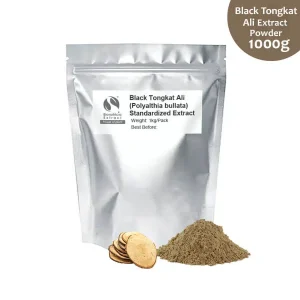
This is a formulation concept for a dry coffee powder blend containing a standardised herbal extract, coffee extract and ground cinnamon. The three ingredients remain distinct materials: standardised Tongkat Ali Root (Longjack) Standardized Extract Powder 1–3% Eurycomanone, Coffee (Coffea) Standardized Extract Powder, and Cinnamon (Cinnamomum verum) Powder. They should not be treated as interchangeable grades or as one already-validated finished matrix.
For this combination, the formulation brief should establish the intended coffee intensity, cinnamon character, botanical assay target, sweetness or creamer system, particle-size compatibility, liquid preparation conditions and packaging. A typical range is a starting point for bench screening only: the finished proportions are determined by the product brief, sensory acceptance and process validation.
What are the components and their formulation roles?
| Component | Role in the proposed matrix | Published form or behaviour |
|---|---|---|
| Tongkat Ali root extract | Standardised botanical component; set an assay-based incoming specification and blend target | Powder; product title identifies Eurycomanone standardisation at 1–3% |
| Coffee extract | Coffee body, aroma and principal beverage character | Spray-dried powder; product page describes water dissolution without sediment |
| Cinnamon | Spice aroma and warm flavour note | Fine ground powder; product page says it is not fully dissolved in water |
| Optional carrier or sweetener system | Adjusts bulk, sweetness and handling according to the target brief | Select and qualify against the intended formula; no specific carrier grade is stipulated here |
The coffee product page gives a broad 2–6% use direction for its stated range of applications, and the cinnamon page gives 0.2–6%. These are catalogue directions for the individual products, not a combined-matrix specification; the broader screening ranges below are development starting points, not supplier guarantees.
What typical inclusion ranges can guide initial bench work?
For an initial dry-blend screen, broad industry formulation ranges can help organise trials when no matrix-specific inclusion data are published. The ranges below describe a generic development window for a coffee-based herbal powder blend, not a Bionutricia specification, validated finished formula or recommended intake. Select a set of trial levels within the ranges and assess the complete formula.
| Component | Typical screening range (% w/w) | Use in development |
|---|---|---|
| Instant coffee or coffee powder | 20–45% | Vary to establish the target coffee intensity and balance against the other dry components. |
| Standardised Tongkat Ali extract powder | 1–4% | Set using the ingredient assay and product brief; retain the assay basis in the formula record. |
| Ground cinnamon powder | 0.2–2% | Screen for spice character, visible particulate and sediment in the prepared beverage. |
| Other dry ingredients and carriers | Balance to 100% | Use only the ingredients specified for the intended formulation and label declaration. |
A useful trial design changes one component at a time while holding the preparation procedure constant. Record the actual powder mass, liquid volume, mixing method and observation time for each sample. Because these are generic starting ranges, the formulator must confirm that the chosen use and ingredient category are appropriate for the target market and product classification.
How should dispersion and sensory performance be evaluated?
The three powders behave differently in liquid. Coffee extract is described on its product page as dissolving in water without sediment. Ground cinnamon is explicitly described as not fully dissolving; suspended spice particles can therefore remain visible or settle. The Tongkat Ali product page identifies an extract powder but does not establish the finished premix’s dispersibility. Do not infer complete solubility from the fact that one matrix component dissolves.
For each trial, compare dry blend uniformity, wetting, lump formation, visible particles and sediment at the intended preparation temperature and liquid volume. Take observations immediately after mixing and after a practical standing interval, such as 5–30 minutes. That interval is a test-planning window, not a stability result. Evaluate aroma, bitterness, coffee intensity, cinnamon impact, colour and mouthfeel with a consistent sensory protocol; the combined profile is a property of the selected formula, not an established attribute of the three separate product descriptions.
For a clear ready-to-drink system, the insoluble cinnamon fraction may be unsuitable unless the process or ingredient form is changed and validated. In an opaque beverage or a dry powder blend intended for preparation immediately before consumption, visible suspension may be acceptable depending on the brief. The selection should be confirmed in the final matrix rather than inferred from the component list.
What blending sequence is suitable for a first trial?
A generic low-dose powder-blending approach is to first premix the Tongkat Ali extract with a portion of the coffee powder, then combine that premix with the remaining coffee and cinnamon. This geometric dilution approach is commonly used in dry blending to distribute a lower-inclusion component through a larger mass. It is a starting process concept, not a validated Bionutricia manufacturing instruction for this matrix.
- Review each ingredient’s identity, lot documentation, appearance and physical handling requirements.
- Break up soft agglomerates and sieve only as appropriate to the required particle-size compatibility.
- Premix the low-inclusion Tongkat Ali powder with a small portion of coffee powder, increasing the blend mass in stages.
- Add the remaining coffee and cinnamon, then blend until the pre-defined uniformity sampling plan is met.
- Protect the blend from unnecessary humidity exposure during handling and pack after the process checks are complete.
In a first development pass, broad mixing windows of approximately 5–15 minutes for a small bench blend may be tested, with sampling at more than one point to check uniformity. This is a generic trial range only; blender geometry, batch size, fill level, particle density and equipment type can change the required time. Establish a suitable endpoint from blend-uniformity results rather than applying a fixed time to every scale.
How should standardisation and lot documentation be compared?
A standardised botanical extract has a named assay marker and a specified percentage range that can be checked against lot documentation. The Tongkat Ali product page identifies Eurycomanone and a 1–3% standardisation range. A crude herbal powder without a defined marker percentage cannot be checked against the same marker-based acceptance criterion. This is a distinction in specification and quality control, not a claim about physiological performance.
For purchasing and incoming quality control, set the botanical identity, plant part, marker assay method, acceptance range, physical form and lot documentation requirements. Review the certificate of analysis (COA) for the actual lot and confirm that its marker result uses the agreed assay basis. Batch-to-batch consistency is assessed against the stated specification and the COA per lot; an extraction ratio alone is not a substitute for an assay percentage.
Bionutricia describes its botanical extraction capability as patented enzymatic ultrasonic extraction (MY-188945-A). This is a manufacturing capability description and does not establish a clinical result or a validated blending process for this proposed coffee matrix.
Which specification checks matter for the finished blend?
| Check | What to define for the project | How to assess |
|---|---|---|
| Component identity | Botanical name and plant part for the extract; identity and grade for coffee and cinnamon | Match incoming product documents and lot labels to the purchase specification. |
| Marker assay | Eurycomanone marker basis and acceptance range for the Tongkat Ali input | Review the ingredient COA and retain the assay basis in the technical file. |
| Dry blend uniformity | Sampling plan and acceptable variation for the low-inclusion component | Test representative locations or samples using a validated method appropriate to the formula. |
| Dispersion profile | Preparation mass, liquid volume, temperature, agitation and evaluation time | Record wetting, clumping, visible sediment and sensory observations in the target beverage. |
| Moisture and handling | Incoming acceptance criteria and handling controls | Use the product specification and lot COA; qualify packaging and process separately. |
| Finished-product stability | Study protocol, packaging system and acceptance attributes | Evaluate representative finished samples; component information does not establish blend shelf life. |
Component certificates do not replace finished-matrix qualification. The final blend’s uniformity, sensory profile, dispersion and shelf life depend on the selected formula, process and packaging. Set the acceptance plan before scale-up and keep the records linked to the ingredient lots used.
What should a buyer request before selecting the matrix ingredients?
Buyer review checklist
- For Tongkat Ali, request the botanical identity, plant part, Eurycomanone assay basis and lot-specific COA.
- For coffee extract, define the required coffee profile and confirm the product form and individual powder specification.
- For cinnamon, record the botanical identity and account for its non-dissolving powder behaviour in the application brief.
- Agree the intended application, target sensory profile, dispersion criteria and blend-uniformity test before pilot work.
- Confirm relevant certification and destination-market documentation for each ingredient.
Individual material documents establish the specifications of their respective lots. They do not by themselves verify the composition, uniformity or storage performance of a combined premix. Keep the intended ingredient list and batch records linked, and assess the completed blend against the project’s written criteria.
Supplying Tongkat Ali, coffee and cinnamon ingredients for powder blends
The catalogue lists Tongkat Ali Root (Longjack) Standardized Extract Powder 1–3% Eurycomanone, Coffee (Coffea) Standardized Extract Powder and Cinnamon (Cinnamomum verum) Powder as individual ingredients.
Published supply information covers bulk supply, custom specification and extract ratio, powder forms, COA per lot, documentation and export paperwork, and packing options. Quality credentials published for the ingredient business include FSSC 22000, JAKIM Halal, GMP, HACCP, MESTI and US FDA facility registration. Each material should be specified and reviewed on its own documentation; the blend’s final performance must be established for the intended application.
Frequently asked questions
What typical inclusion range can be screened for Tongkat Ali in herbal coffee powder? A broad development window is 1–4% w/w of the dry blend. It is a generic screening range rather than a supplier specification; final selection should use the ingredient’s marker assay and the product brief.
Does the Tongkat Ali, coffee and cinnamon blend dissolve completely? Not necessarily. Coffee extract is described as dissolving without sediment, while the cinnamon powder is not fully dissolved, and the Tongkat Ali ingredient description does not establish combined-blend dispersion.
What is a practical first blending approach? A formulator can first dilute the low-inclusion extract into a portion of coffee powder, then blend in the remaining components. Establish the blending endpoint through representative uniformity checks rather than relying on a fixed time alone.
How is the Tongkat Ali extract distinguished from crude root powder? The product page specifies Eurycomanone at 1–3%, which provides a marker-based criterion for lot review. Crude powder without a declared marker percentage does not provide that same assay specification.
Can this matrix be used in ready-to-drink beverages? A ready-to-drink application requires assessment of cinnamon particulate, sedimentation, sensory profile and process compatibility in the intended beverage. The individual ingredient descriptions do not establish finished-matrix suitability.
Request the certificates of analysis, specification sheets and samples of Tongkat Ali Root (Longjack) Standardized Extract Powder, Coffee (Coffea) Standardized Extract Powder and Cinnamon (Cinnamomum verum) Powder.