Export Regulatory Status of Botanical Extracts: EU Novel Food, US GRAS & Registration
Before a botanical extract can be sold in a given market, it has to clear that market’s rules on what may enter the food and supplement supply — chiefly the EU Novel Food framework, the US GRAS and dietary-supplement pathways, and the registration or notification steps required in each destination. This guide explains, at a buyer’s level, what those pathways are and what documentation makes market entry smoother — so importers and brand owners can plan sourcing with regulatory status in mind from the start.
Why regulatory status belongs in your sourcing decision
Two extracts can look identical on a spec sheet yet face very different routes to market. A botanical with a long history of food use in one region may be treated as “novel” in another, requiring an authorisation before it can be sold. Discovering that after a purchase order is placed is costly. Building regulatory status into the sourcing conversation — alongside price, specification and lead time — avoids stranded inventory and failed launches.
The EU: the Novel Food framework
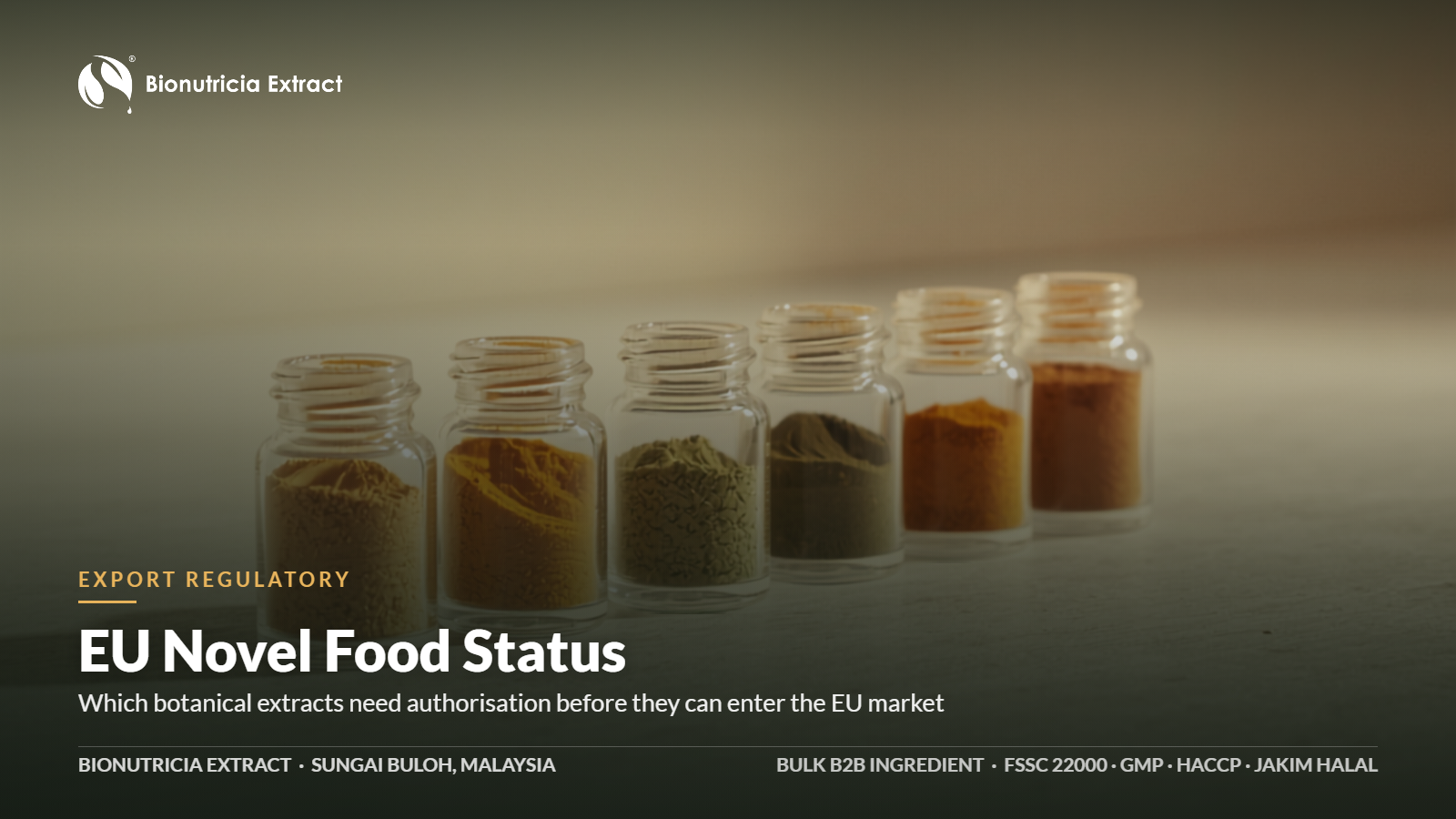
In the European Union, a “novel food” is broadly a food or ingredient that was not consumed to a significant degree in the EU before 15 May 1997. If an extract falls in that category, it generally needs authorisation under the Novel Food Regulation before it can be placed on the EU market; if it has a documented significant history of consumption in the EU before that date, it typically falls outside the Novel Food requirement.
For a buyer, the practical questions are: does this botanical (in this form and use) have a pre-1997 EU food history, is it already authorised, and can the supplier’s specification support that position? A supplier specification that states a product “is not a novel food according to European Regulation (EC) No 258/97” is a useful starting reference, but the final determination depends on the exact ingredient, form and intended use in the destination market.
The United States: GRAS and dietary-supplement routes
In the US, food ingredients generally reach the market either as approved additives or via the GRAS (“generally recognized as safe”) route, where safety for the intended use is established by scientific consensus. Some botanicals have well-documented GRAS status for defined food uses. Separately, botanicals used in dietary supplements follow the DSHEA framework: depending on history of use, a New Dietary Ingredient (NDI) notification to the FDA may be required, and products must be made under dietary-supplement cGMPs.
The buyer’s checklist here is whether the intended use is food or supplement, whether a GRAS basis or an NDI history exists for that use, and whether the manufacturer operates to the appropriate GMP standard.
Registration, notification and import documentation
Beyond the EU and US, most markets require some combination of product notification or registration, import permits, and supporting documentation. While the details differ by country, the documents buyers are most often asked to supply are broadly consistent:
| Document | What it supports |
|---|---|
| Product specification | Defines identity, extraction ratio, characteristic markers and limits. |
| Certificate of Analysis (per lot) | Shows the actual lot conforms to specification. |
| Halal / food-safety certificates | JAKIM Halal, FSSC 22000, GMP, HACCP, MeSTI — required or preferred in many markets. |
| Safety data sheet (SDS) | Handling, transport and storage information. |
| Allergen, GMO, irradiation & origin statements | Common data points in import and retailer questionnaires. |
| Manufacturer registration (e.g. US FDA facility registration) | Demonstrates the producing facility is registered where required. |
How Bionutricia supports export-ready sourcing
Bionutricia Extract manufactures standardized botanical extracts in Malaysia under an audited halal and international food-safety stack — JAKIM Halal, FSSC 22000, GMP, HACCP and MeSTI, with US FDA facility registration — and issues a Certificate of Analysis on every lot. Each product carries a defined specification with its scientific name, extraction ratio, characteristic markers and clean-label statements (including GMO, irradiation, allergen and, where applicable, novel-food positioning). This documentation package gives importers and brand owners a clear, consistent basis for their own regulatory submissions and market-entry planning in the EU, US, GCC and Asian markets. Final registration or notification in a destination market remains the importer’s responsibility, and we support it with the manufacturer-side documentation it requires.
Frequently asked questions
What makes an ingredient a “novel food” in the EU? Broadly, a lack of significant food consumption in the EU before 15 May 1997. Such ingredients generally need authorisation before sale; those with a documented pre-1997 history usually do not.
Does GRAS status apply to supplements? GRAS relates to food uses. Dietary supplements follow the DSHEA framework, where a New Dietary Ingredient notification may be required depending on the ingredient’s history of use.
Who is responsible for registering the product in the destination country? Typically the importer or brand owner. The manufacturer supports the process with specifications, COAs and certificates, but market registration is completed locally.
Does a halal or FSSC 22000 certificate help with export? Yes — these audited certifications are required or strongly preferred in many markets and streamline retailer and regulator due diligence, though they do not replace product-specific market authorisation.
Can Bionutricia confirm the regulatory status of a specific extract for my market? We provide the manufacturer-side documentation and the specification’s stated positions; the definitive status for your product, form and use should be confirmed with a regulatory professional in your destination market.
Request export documentation for your market →