Reviewed by Vitthia Rama Murti, Lab Pharmacist, Bionutricia
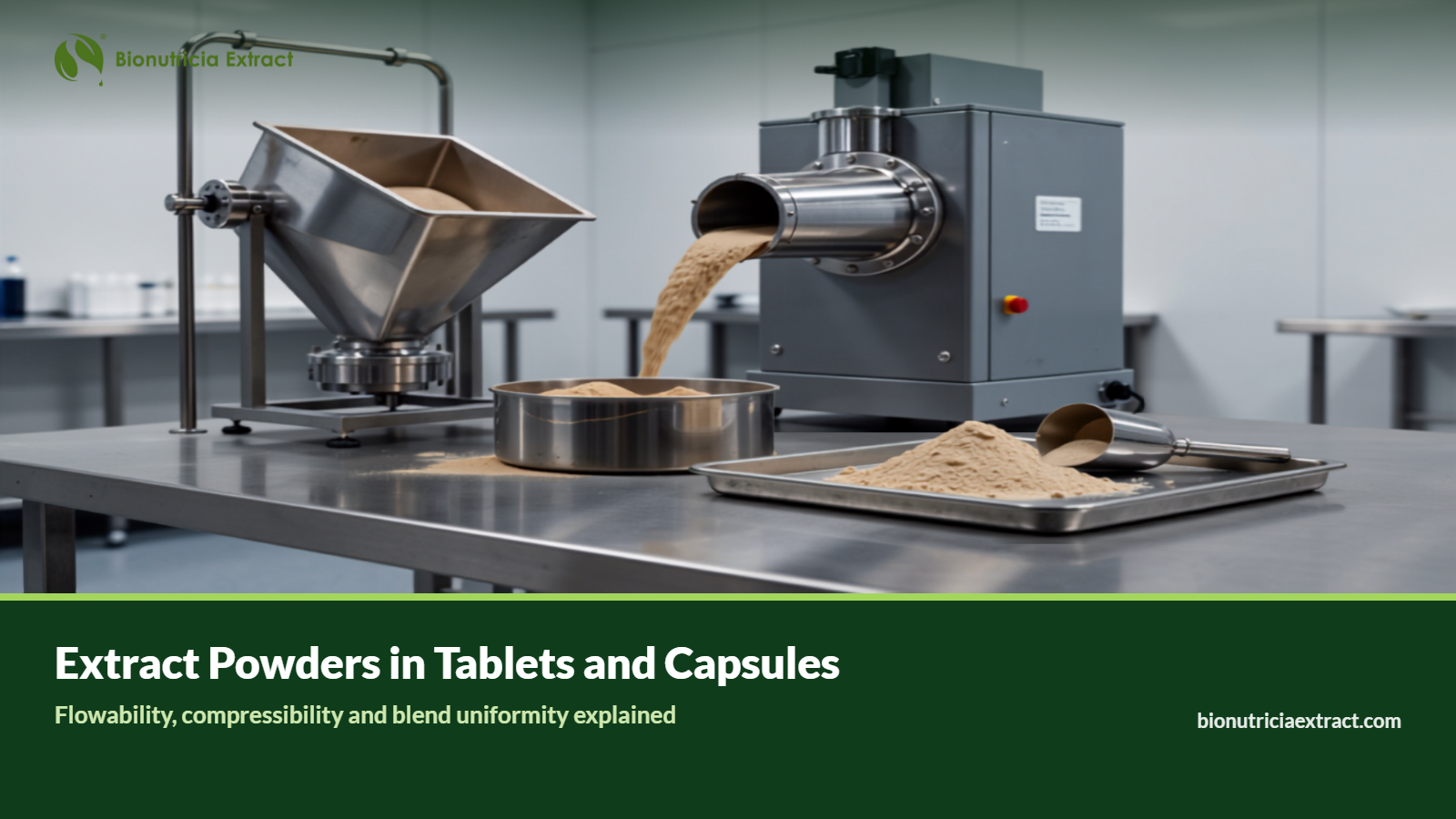
Whether a botanical extract powder tablets cleanly comes down to three properties: how well it flows into the die, how well it consolidates under pressure, and how uniformly it stays mixed with everything else in the blend. Particle size, moisture and the carrier system drive all three — and all three are visible on the ingredient specification before you ever run a trial. This guide explains what to look for, and how to brief a supplier so the powder behaves in your press.
Quick facts
- Flowability governs die filling and therefore tablet weight consistency
- Compressibility governs hardness, friability and whether the tablet caps or laminates
- Blend uniformity governs content uniformity — the regulatory make-or-break
- Biggest levers: particle size distribution, bulk and tapped density, moisture, carrier system
- Ask for: mesh/particle size, bulk & tapped density, moisture, and loss on drying on the spec
Will a botanical extract powder tablet cleanly?
Sometimes, and rarely on its own. A standardised botanical extract is a functional ingredient, not a tabletting excipient, and it is usually present at a small fraction of the tablet weight. What matters is how it behaves inside your blend — whether it drags the flow down, whether it interferes with consolidation, and whether it segregates from the diluents around it.
Spray-dried extract powders tend to be fine, low-density and somewhat cohesive. Those characteristics are excellent for dissolution and for beverage applications, but they are the opposite of what a rotary press wants. That is not a fault in the ingredient; it is a formulation problem with well-understood solutions. The mistake is discovering it during a scale-up trial rather than reading it off the specification at the sampling stage.
Flowability: what actually determines it
Flow is the ability of the powder to move freely from the hopper, through the feed frame, and into each die cavity in the fraction of a second available at production speed. Poor flow shows up as weight variation, and weight variation shows up as content variation.
Four properties on the specification predict it:
- Particle size distribution. Very fine powders are dominated by inter-particle cohesion and van der Waals forces, so they bridge and rathole rather than flow. Coarser, more uniform particles flow better. A mesh specification tells you which you are getting — see our particle size and mesh guide below.
- Bulk and tapped density. The relationship between the two gives you the Carr index and Hausner ratio, the standard shorthand for flow character. A large gap between bulk and tapped density signals a cohesive, poorly flowing powder.
- Moisture content. Water at the particle surface creates liquid bridges that make powders sticky. Extract powders are frequently hygroscopic, so ambient humidity in the press room matters as much as the moisture figure on the CoA.
- Particle shape and surface. Spray-dried particles are broadly spherical, which helps; agglomerated or irregular material interlocks and resists flow.
The usual formulation responses are granulation, blending with a free-flowing diluent, and a glidant at a low inclusion level. None of these are exotic — but they all consume tablet weight, so knowing early lets you budget the space.
Compressibility: hardness, capping and lamination
Compressibility is the powder’s ability to deform and bond under pressure into a coherent tablet. Some materials deform plastically and bond well; others fracture, and others simply spring back when the punch releases. Elastic recovery is what produces capping, where the tablet crown separates, and lamination, where it splits horizontally.
Botanical extracts vary widely here, and the carrier system usually matters more than the botanical. A maltodextrin-carried extract behaves differently under pressure from one carried on arabic gum, and an oil powder behaves differently again because the oil load itself acts as a lubricant within the compact. High oil content can reduce bonding, which is why oil powders are often better suited to capsules, sachets or a wet-granulated route than to direct compression at high inclusion levels.
Practical levers are the choice of filler-binder in the blend, granulation to build a more compressible granule, adjusting compression force and dwell time, and pre-compression on a rotary press. If the ingredient is a small percentage of the tablet, the excipient system will normally carry it without difficulty.
Blend uniformity and segregation
Content uniformity is where regulators look, and blend uniformity is what determines it. Segregation happens when particles of different size or density separate during handling — in the blender discharge, in the hopper, or during transfer. A fine, low-density extract mixed with a coarse, dense diluent is a textbook segregation risk, and the problem often appears only after the blend has travelled to the press.
Three habits keep it under control:
- Match particle size across the blend. The closer the extract is in size and density to the bulk of the formulation, the less it will separate. This is the single most effective control, and it starts with specifying the mesh you want.
- Use geometric dilution for low-dose actives. Pre-blending the extract with a portion of diluent before adding the rest distributes a small quantity far more reliably than a single-shot addition.
- Sample the blend properly. Stratified sampling across the blender and, where appropriate, at the point of compression, rather than a single grab from the top.
For coloured extracts — butterfly pea, purple yam, roselle — segregation is at least visible. For a pale extract it is not, which is exactly why the analytical work matters.
Capsules, sachets and the alternatives
Tablets are not always the right answer. Capsule filling is more forgiving of cohesive powders than compression is, because the powder is dosed volumetrically rather than compacted, although flow still governs fill-weight consistency. Sachets and stick packs are more forgiving again and suit high-dose or hygroscopic material. Beverage and instant formats sidestep the mechanics entirely, but bring solubility and taste into play instead.
Because we supply the bulk ingredient rather than the finished dose, this is a decision our customers make with their own equipment in mind. What we can do is align the ingredient to that decision — a coarser mesh for a direct-compression blend, a finer one for rapid dispersion in a beverage.
Moisture, hygroscopicity and the press room
Many botanical extract powders pick up moisture from the air. In a humid press room a powder that flowed acceptably at intake can gain enough surface moisture within hours to cause sticking, picking on the punch faces, and weight drift. Controls are practical rather than complicated: keep the compression area at controlled relative humidity, keep containers closed until the moment of use, dispense what you need rather than the whole drum, and check loss on drying at the point of manufacture rather than relying on the intake figure. Sealed inner liners on bulk packs exist for exactly this reason and should not be opened early.
What to ask for on the specification
Before you commit to a formulation trial, ask your supplier for particle size or mesh specification, bulk density and tapped density, moisture content and loss on drying, the carrier and emulsifier system with its origin, and a retained sample large enough for a real compression trial rather than a visual check. Those five items will tell an experienced formulator most of what they need to know before any powder reaches the press.
How Bionutricia supports formulators
Bionutricia is a Malaysian botanical-extract manufacturer founded in 2006, with more than 20 years of R&D and 15 years of manufacturing behind a catalogue serving 239+ brand partners. Extraction runs on our patented enzymatic and ultrasonic process, MY-188945-A (“Process for Preparing Nutritional Powder Extract”), inside a system certified to FSSC 22000, with GMP, HACCP, JAKIM Halal, US FDA registration, MeSTI and NanoVerify.
Every oil powder we manufacture is emulsified on arabic gum rather than sodium caseinate, which keeps the ingredient dairy-free and vegan-suitable and avoids adding an allergen to your blend. Bulk packs are 1 kg, 5 kg and 20 kg, each shipped with a batch-specific Certificate of Analysis. We supply the bulk ingredient for B2B formulation; brand owners and manufacturers formulate it into their chosen finished format, whether that is tablets, capsules, sachets, gummies, beverages or bakery. Where a physical property such as mesh matters to your process, tell us at the enquiry stage and we will confirm what is achievable for that ingredient.
Planning a tablet or capsule formulation around a botanical extract?
Related guides
Frequently asked questions
Can botanical extract powders be directly compressed?
At typical inclusion levels, yes — the excipient system carries the tablet and the extract rides along. Direct compression becomes difficult when the extract is a large fraction of the tablet, is very fine and cohesive, or carries a high oil load, in which case granulation or a capsule format is usually the better route.
Why does my extract powder cause tablet weight variation?
Almost always poor flow into the die. Fine, cohesive or moisture-laden powders bridge in the hopper and fill inconsistently. Check particle size distribution, the bulk-to-tapped density relationship and moisture, and control press-room humidity.
What causes capping and lamination with herbal extracts?
Elastic recovery when the punch releases, often compounded by entrapped air or excessive compression force. Adjusting force and dwell time, using pre-compression, granulating, or changing the filler-binder are the standard remedies.
What particle size should I specify for tabletting?
There is no universal figure — it depends on your blend. The principle is to match the extract to the particle size and density of the rest of the formulation so it neither segregates nor drags the flow down. Tell your supplier the target at enquiry stage rather than after the trial.
Does the carrier affect how a powder compresses?
Yes, often more than the botanical does. Different carrier and emulsifier systems deform and bond differently under pressure, and a high oil load reduces bonding within the compact. Always confirm the carrier system on the specification before designing the blend.