Liposomal B complex powder is a water-soluble yellow powder carrying all eight dietary B vitamins in a phospholipid matrix. Unlike most ingredients in this range, the commercial question here is not solubility — B vitamins are water-soluble to begin with. The real buyer question is what is actually in the drum: a B complex is eight separate assays, and a supplier who quotes you only a single “45–55% B complex” figure has told you almost nothing you can build a label from. This guide sets out the per-vitamin assay from Bionutricia’s specification, so you can calculate your own inclusion rate against the reference intakes in your market rather than working backwards from a blended percentage.
How a B complex reaches a formulation: three routes compared
| Route | How it works | What it means for your formulation |
|---|---|---|
| Individual synthetic B vitamins, blended in-house | You buy thiamine HCl, riboflavin, niacinamide and so on separately and blend to your own ratio | Total control over the ratio and the cheapest raw cost, but you carry eight sets of assays, eight lots to qualify, and the blending uniformity risk sits with you |
| Standard pre-blended B complex powder | A supplier blends the eight vitamins to a fixed ratio | One lot, one certificate. Riboflavin’s strong yellow colour and the characteristic B-vitamin odour carry straight through into a drink |
| Liposomal B complex powder (this ingredient) | The B complex is carried in a phospholipid matrix and dried to a powder | Bionutricia’s specification states 45–55% total B complex, with each of the eight vitamins separately assayed. Presented in a matrix intended to moderate the taste and odour issues of a raw B blend in a drinkable format |
Where the activity comes from
The eight B vitamins are not chemically related to each other — they are grouped by function, not structure. What they share is a role as coenzymes or coenzyme precursors in energy metabolism: thiamine (B1) as thiamine pyrophosphate in carbohydrate metabolism, riboflavin (B2) as FAD and FMN, niacin (B3) as NAD and NADP, pantothenic acid (B5) as coenzyme A, pyridoxine (B6) in amino-acid metabolism, biotin (B7) as a carboxylase cofactor, folate (B9) in one-carbon metabolism, and cobalamin (B12) in methylation and methylmalonyl-CoA conversion.
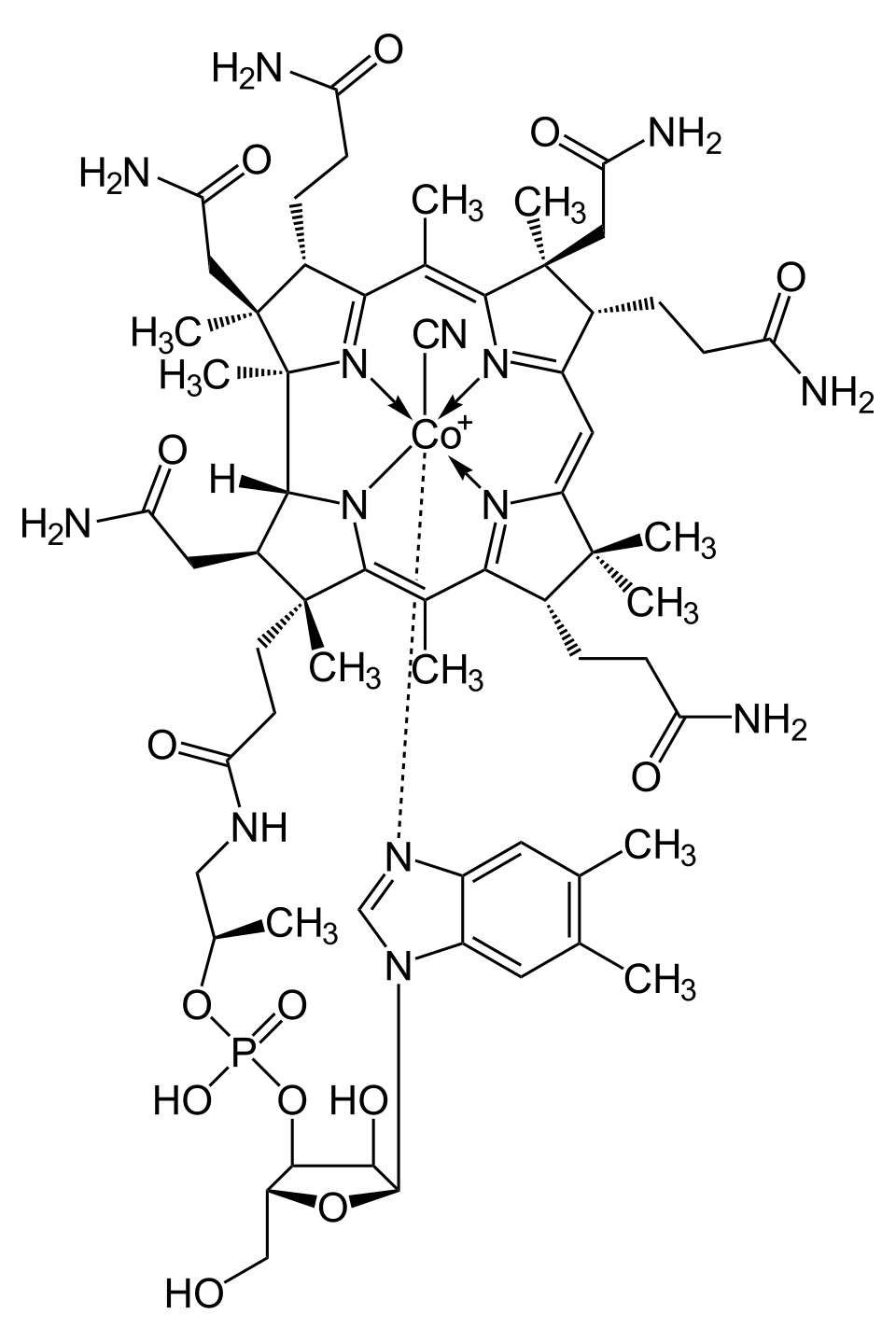
Cobalamin is the structurally remarkable one, and the reason the group is worth illustrating. It is the largest and most complex of the vitamins — a corrin ring built around a central cobalt atom, which is the only place a metal ion sits at the catalytic centre of a human vitamin. That cobalt is also why B12 is the most fragile member of the set in a finished product, being sensitive to light, to reducing agents such as ascorbic acid, and to extremes of pH.
Bionutricia’s specification assays total vitamin B complex at 45–55% and, importantly, gives a separate figure for each of the eight vitamins. Those are the numbers to formulate against.
What this ingredient is not
- It is not a solubility fix. B vitamins are water-soluble as supplied. The carrier system here is about the sensory and handling profile in a finished drink, not about making an insoluble compound dissolve.
- It is not standardised to a single active. There is no one marker compound. Eight assays define this material, and your dossier should quote all eight.
- It is not free-flowing. The specification describes it as a non-free-flowing powder, which matters for automated blending and sachet filling.
Per-vitamin assay from the specification
| Vitamin | Assay per 100 mg of powder | Coenzyme role |
|---|---|---|
| B1 (thiamine) | 0.6–0.7 mg | Thiamine pyrophosphate — carbohydrate metabolism |
| B2 (riboflavin) | 0.5–0.7 mg | FAD and FMN — redox reactions; also the source of the yellow colour |
| B3 (niacin) | 8–9 mg | NAD and NADP — the largest contributor by weight in this blend |
| B5 (pantothenic acid) | 2.5–3 mg | Coenzyme A — fatty-acid metabolism |
| B6 (pyridoxine) | 0.8–0.9 mg | Amino-acid metabolism and transamination |
| B7 (biotin) | 15–18 mcg | Carboxylase cofactor |
| B9 (folate) | 200–225 mcg | One-carbon metabolism |
| B12 (cobalamin) | 1.2–1.3 mcg | Methylation and methylmalonyl-CoA metabolism |
Specification: what to check and why it matters
| Parameter | Bionutricia specification | Why a buyer checks it |
|---|---|---|
| Total vitamin B complex | 45–55% | The headline figure, but only meaningful alongside the eight individual assays above |
| Appearance and colour | Yellow, non-free-flowing powder, characteristic odour | Riboflavin colour and B-vitamin odour carry into a finished drink; plan sensory masking accordingly |
| Solubility | Soluble in water; can be consumed directly or mixed into water with constant stirring | Note the specification’s own wording — constant stirring is expected, not instant dispersion |
| Moisture | <10% | Caking risk and vitamin stability over shelf life |
| pH | 6–7 | Near-neutral. Relevant to B12 stability, which degrades at pH extremes |
| Particle size | >95% through 20 mesh | Coarser than a fine blended vitamin premix — affects blend uniformity and mouthfeel |
| Heavy metals | Arsenic <0.1 ppm; lead <0.2 ppm; mercury <0.05 ppm; cadmium <0.5 ppm; antimony <0.5 ppm | A full five-metal panel. Request lot-specific results, not the specification sheet alone |
| Microbiology | Aerobic plate count <10⁴ CFU/g; yeast & mould <10³ CFU/g; coliforms <10² CFU/g; E. coli absent in 1 g; Staphylococcus aureus absent in 1 g | Includes a S. aureus test, which many vitamin premix specifications omit |
| Recommended dosage | 500–1000 mg | A formulation starting range. Check the resulting per-vitamin amounts against your market’s maximums |
| Shelf life and storage | 2 years properly stored; sealed hygienic containers, cool and dry, away from pest infestation | B12 and folate are the members most likely to drift on shelf — build your own stability data |
| Pack sizes | 500 g, 1 kg, 5 kg | The 500 g pack suits sensory and stability screening before bulk commitment |
Figures above are taken from Bionutricia’s product specification for liposomal B complex, Version 03, February 2026. These are specification limits and ranges; reconcile against the certificate of analysis for the lot you are buying.
Regulatory and compliance position
The specification states:
- Non-GMO — not produced from genetically modified raw materials
- Not irradiated
- Not a novel food under Regulation (EC) No 258/97
- Suitable for vegetarians and vegans; free of animal products and derivatives
- Halal, per the Codex Alimentarius guidelines on use of the term
- No allergens listed in Annex II of Regulation (EC) No 1169/2011
- Gluten-free at <20 ppm, per Regulation (EC) No 41/2009
- Not classified as dangerous under Regulation (EC) 1272/2008; safety data sheet available on request
- Country of origin: Malaysia
What the clinical literature actually shows
The most directly relevant human trial on a B complex, rather than a single B vitamin, is a double-blind, randomised, placebo-controlled study of 60 participants who took a high-dose B-complex preparation for 90 days. Compared with placebo, the B-complex group reported significantly lower personal strain at twelve weeks, along with reductions in confusion and in depressed or dejected mood.
Source: Stough C, et al. The effect of 90 day administration of a high dose vitamin B-complex on work stress. Human Psychopharmacology: Clinical and Experimental, 2011. PubMed 21905094 (randomised, double-blind, placebo-controlled; n = 60; 90 days).
Where buyers use this material
- Daily multivitamin and energy-positioned sachet drinks
- Effervescent and stick-pack powders where a B blend is the functional core
- Chewables and gummies needing a full B panel in one raw material
- Sports and recovery formulas built around energy metabolism
- Vegan formulations where the B12 contribution is the selling point
Sourcing checklist before you commit to a lot
- Request the certificate of analysis for the actual lot, with all eight vitamins assayed individually — not just the total B-complex percentage.
- Ask for the chemical form of each vitamin, particularly folate and B12.
- Calculate your serving’s per-vitamin amounts against your destination market’s maximum permitted amounts, especially folate and niacin.
- Request the encapsulation method and phospholipid source in writing.
- Run your own stability study on the finished format, tracking B12 and folate specifically.
- Trial the sensory profile in your own base — riboflavin colour and B-vitamin odour both carry through.
- Confirm halal certificate scope and validity dates if shipping into a certified market.
Why buyers work with Bionutricia
Bionutricia Manufacturing Sdn Bhd has produced botanical extracts and finished supplement formats in Malaysia since 2006 and now supports more than 239 brand partners. The plant operates under JAKIM Halal certification, FSSC 22000, GMP, HACCP, MeSTI and NanoVerify, and holds patent MY-188945-A for its encapsulation work. For a multi-vitamin material where stability is the commercial risk, the practical advantage is that encapsulation and finished-format manufacturing sit in the same facility, so a stability trial can be run on the same lot that will supply production.
Frequently asked questions
Per 100 mg of powder, the specification states B1 0.6–0.7 mg, B2 0.5–0.7 mg, B3 8–9 mg, B5 2.5–3 mg, B6 0.8–0.9 mg, B7 15–18 mcg, B9 200–225 mcg and B12 1.2–1.3 mcg, with total B complex at 45–55%.
The specification does not state them — it does not say whether folate is folic acid or a methylated form, or whether B12 is cyanocobalamin or methylcobalamin. Request this in writing before finalising label copy.
The specification states it is soluble in water and can be consumed directly or mixed into water with constant stirring. Note that wording — expect to stir, not to have it disperse instantly.
Very likely. The powder is yellow with a characteristic odour, both normal for a B complex and driven largely by riboflavin. Plan sensory work early.
The specification gives 500–1000 mg. At that range the folate and niacin contributions are high relative to most markets’ reference intakes, so check your destination market’s maximum permitted amounts before setting a serving size.
Arsenic below 0.1 ppm, lead below 0.2 ppm, mercury below 0.05 ppm, cadmium below 0.5 ppm and antimony below 0.5 ppm, with E. coli and Staphylococcus aureus absent in 1 g.
Two years when stored properly — sealed, cool, dry and away from pest infestation. B12 and folate are the members most worth tracking in your own stability work.
The specification states it is suitable for vegetarians and vegans, free of animal products and derivatives, halal per Codex Alimentarius, non-GMO, not irradiated, allergen-free and gluten-free below 20 ppm.
Related ingredient guides
- Liposomal glutathione powder — B2B buyer’s guide
- Liposomal quercetin powder — B2B buyer’s guide
- Liposomal turmeric powder — B2B buyer’s guide
- Liposomal vitamin D3 ingredient — bulk supplier guide
Ready to specify it? See the Liposomal B Complex Powder bulk product page for the specification snapshot, pack sizes and a quotation request.
Tell us your format and target market and we will send the full eight-vitamin assay and documentation your dossier needs. Contact the Bionutricia ingredient team.