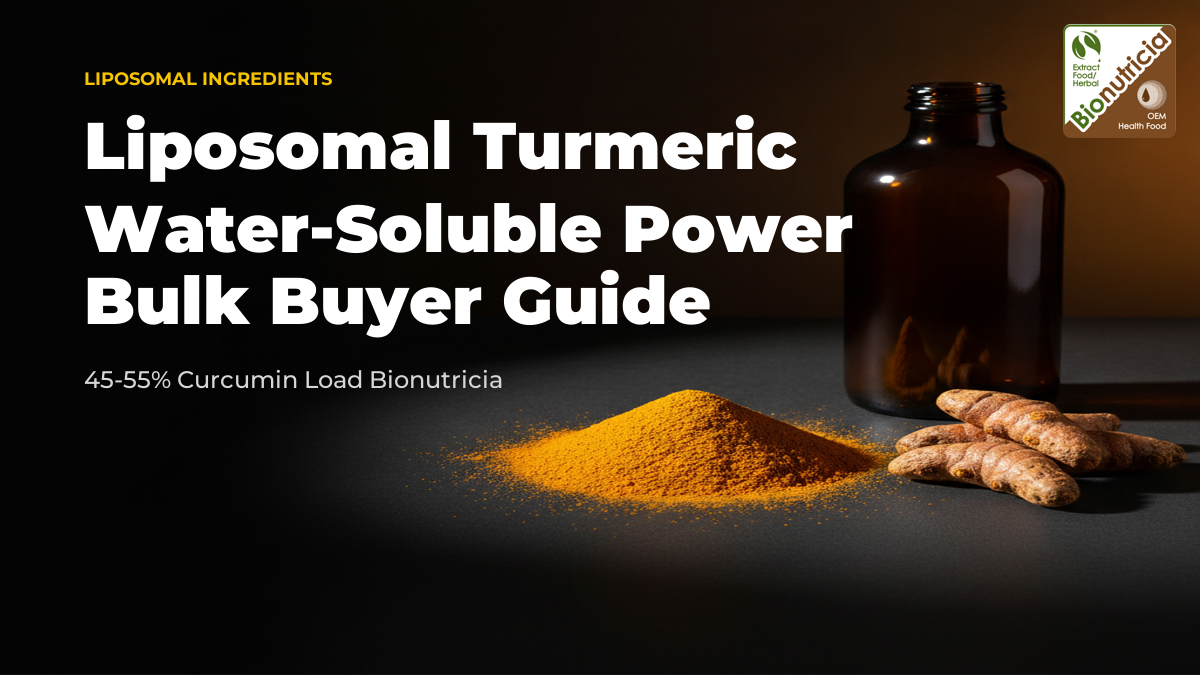
Liposomal turmeric powder is a water-dispersible Curcuma longa ingredient in which turmeric extract is carried in a phospholipid matrix and spray-dried into a free-flowing-to-caking powder. For a formulator, the point of the format is not novelty — it is getting a stubbornly water-insoluble material into a clear beverage, a sachet drink or a chewable without a solvent, an oil phase or a gritty mouthfeel. The commercial risk is equally plain: the phrase “liposomal” is used loosely across the supplement supply chain, and the only things a buyer can actually hold a supplier to are the assayed active load, the solubility behaviour and the contaminant limits on the certificate of analysis.
How turmeric reaches a water-based formulation: three routes compared
| Route | How it works | What it means for your formulation |
|---|---|---|
| Standard turmeric extract (95% curcuminoids) | Solvent extraction of dried rhizome, concentrated to a high curcuminoid assay | Highest active per gram and the cheapest per unit of curcuminoid, but practically insoluble in water. Suits capsules, tablets and oil-phase systems; it will disperse poorly and settle in a clear drink |
| Turmeric powder (ground rhizome) | Dried rhizome milled to a culinary or food-grade powder | Lowest active load, strong colour and flavour carry-over. Suits culinary and colour applications rather than a defined active dose |
| Liposomal turmeric powder (this ingredient) | Turmeric extract carried in a phospholipid matrix, then dried to a powder | Lower assay per gram than a 95% extract (Bionutricia’s specification states 45–55% turmeric extract), but it is water-soluble, which is what makes clear beverages, sachet drinks and rapid-dispersion formats possible |
Where the activity comes from
The characterised actives in Curcuma longa are the curcuminoids — principally curcumin, together with demethoxycurcumin and bisdemethoxycurcumin. Curcumin is a diarylheptanoid (C21H20O6) with two phenolic rings joined by an unsaturated seven-carbon chain carrying a keto–enol system. That structure explains both its behaviour and its problems: the conjugated system gives turmeric its intense yellow colour and its antioxidant chemistry, while the largely non-polar backbone is why the molecule is so poorly soluble in water and why carrier systems exist at all.

Bionutricia’s specification for this material assays turmeric extract at 45–55% and describes the finished powder as soluble in water. Note precisely what that figure is and is not: it is a declared turmeric-extract content, not a curcuminoid percentage. If your label or dossier needs a curcuminoid number, request the curcuminoid assay for the specific lot in writing before you commit.
What this ingredient is not
- It is not a 95% curcuminoid extract in disguise. The specification states 45–55% turmeric extract. Any supplier quoting you a liposomal powder at a 90%-plus active load should be asked to show the assay method.
- It is not a bioavailability claim. Solubility in water is a measured physical property on the specification. Enhanced absorption in humans is a separate question that requires a trial on the finished material, and this specification does not make that claim.
- It is not a free-flowing powder. The specification explicitly describes it as non-free-flowing. Plan your blending, sieving and filling equipment around that, not around a typical granulated extract.
Specification: what to check and why it matters
| Parameter | Bionutricia specification | Why a buyer checks it |
|---|---|---|
| Turmeric extract content | 45–55% | Sets your inclusion rate and cost per unit of active. Confirm whether your dossier needs curcuminoids specifically |
| Appearance | Light yellow powder, non-free-flowing | Drives handling, blending and filling equipment choices, and colour carry-over into a finished product |
| Solubility | Soluble in water | The whole commercial reason for the format. Verify on your own water and at your own temperature before scale-up |
| Moisture | <10% | Governs caking, microbial stability and shelf life in your pack format |
| pH | 6–7 | Near-neutral, so it is unlikely to shift the pH of a beverage base materially |
| Particle size | >95% through 20 mesh | Coarser than a typical 60-mesh extract — relevant to mouthfeel, dissolution rate and sachet filling |
| Heavy metals | Arsenic <0.1 ppm; lead <0.2 ppm; mercury <0.05 ppm | Tight limits, well inside common pharmacopoeial ceilings. Ask for lot-specific results, not the specification sheet alone |
| Microbiology | Aerobic plate count <10⁴ CFU/g; yeast & mould <10³ CFU/g; coliforms <10² CFU/g; E. coli negative in 1 g | Standard food-ingredient hygiene envelope for a dried botanical preparation |
| Recommended dosage | 480–960 mg | A starting range from the specification, not a clinically established dose. Your own substantiation still applies |
| Pack sizes | 150 g, 1 kg, 5 kg | Useful for pilot batches before committing to bulk |
Figures above are taken from Bionutricia’s product specification for liposomal turmeric powder, Version 02, January 2024. Values are specification limits; always reconcile against the certificate of analysis for the lot you are buying.
Regulatory and compliance position
The specification for this material states the following, which is what most buyer questionnaires ask for:
- Non-GMO
- Not irradiated
- Not a novel food
- Suitable for vegetarians and vegans
- Halal
- Free of the declarable allergens
- Gluten-free at <20 ppm
- Country of origin: Malaysia
- Safety data sheet available on request
What the clinical literature actually shows
The strongest recent human evidence for turmeric actives sits in joint comfort. In a randomised, double-blind, placebo-controlled trial published in Nutrients, Lopresti and colleagues gave adults with knee osteoarthritis a curcumin extract or placebo for eight weeks. Of 101 participants enrolled, 96 completed. The curcumin group improved more on the KOOS knee-pain score than placebo (mean improvement 11.98 versus 5.52 points; p = 0.009), improved more on physical-function measures including the six-minute walk test, and 37% reduced their pain medication compared with 13% on placebo. The material was well tolerated, with no serious adverse events.
Source: Lopresti AL, Smith SJ, Jackson-Michel S, Fairchild TJ. An Investigation into the Effects of a Curcumin Extract (Curcugen®) on Osteoarthritis Pain of the Knee: A Randomised, Double-Blind, Placebo-Controlled Study. Nutrients. 2021;14(1):41.
Where buyers use this material
- Clear and cloudy functional beverages where a standard extract would settle out
- Stick-pack and sachet drink powders, including effervescent bases
- Chewable tablets and gummies where an oily curcumin phase is unwelcome
- Joint-comfort and everyday-wellness supplement blends
- Beauty-from-within drinks where turmeric is used for both colour and positioning
Sourcing checklist before you commit to a lot
- Ask for the certificate of analysis for the actual lot, not only the specification sheet.
- Confirm whether the assay you are being quoted is turmeric extract content or curcuminoid content — they are not interchangeable.
- Request the encapsulation method and phospholipid source in writing if your dossier needs them.
- Run your own solubility trial in your own beverage base, at your own fill temperature.
- Check heavy-metal and microbiology results against your destination market’s limits, not just the specification.
- Order a pilot pack (150 g or 1 kg) and test handling on your real filling line before bulk commitment.
- Confirm the halal certificate scope and validity dates if you are shipping into a certified market.
Why buyers work with Bionutricia
Bionutricia Manufacturing Sdn Bhd has produced botanical extracts and finished supplement formats in Malaysia since 2006, and now supports more than 239 brand partners. The plant operates under JAKIM Halal certification, FSSC 22000, GMP, HACCP, MeSTI and NanoVerify, and holds patent MY-188945-A for its encapsulation work. For buyers, the practical value is that the extraction, the encapsulation and the finished-format manufacturing sit under one roof, so a pilot beverage or sachet can be built from the same lot of powder that will supply the production run.
Frequently asked questions
No. Bionutricia’s specification for this material states 45–55% turmeric extract, and describes the powder as water-soluble. A 95% curcuminoid extract carries far more active per gram but is practically insoluble in water.
Turmeric extract at 45–55%. That is a turmeric-extract figure, not a curcuminoid percentage. If you need a curcuminoid number for a label or dossier, request the lot-specific assay.
The specification states the powder is soluble in water. Turmeric is strongly coloured, so a “clear” drink will still take on colour. Always trial in your own base and at your own fill temperature before scale-up.
Arsenic below 0.1 ppm, lead below 0.2 ppm and mercury below 0.05 ppm on the specification. Ask for the certificate of analysis for your lot to see actual results.
The specification gives a recommended range of 480–960 mg. Treat that as a formulation starting point rather than a clinically established dose; your own claim substantiation and your market’s rules still govern what you may say.
The specification states the material is halal, suitable for vegetarians and vegans, non-GMO, not irradiated, allergen-free and gluten-free at below 20 ppm. Request the current halal certificate if you need it for your own certification file.
150 g, 1 kg and 5 kg. The 150 g pack is usually enough to run handling, solubility and sensory trials before a bulk order.
Not directly. Published trials, including the eight-week knee-osteoarthritis study cited above, were run on other curcumin materials. They describe the ingredient class. Claims on your finished product must comply with your market’s rules and are best supported by work on your own formulation.
Ready to specify it? See the Liposomal Turmeric Powder bulk product page for the specification snapshot, pack sizes and a quotation request.
Tell us your format — beverage, sachet, chewable or blend — and we will send the lot documentation your dossier needs. Contact the Bionutricia ingredient team.