Can Purple Sweet Potato, Butterfly Pea and Red Dragon Fruit Form a Clean-Label Colour Premix for Beverages and Bakery?
Formulator’s summary: Catalogue powders of purple sweet potato, butterfly pea and red dragon fruit serve beverage and bakery colour work. Butterfly pea shifts from blue to violet to pink as acidity rises. Catalogue usage for butterfly pea is 2–6% of total weight; powder may clump with heat or moisture. Verify permitted colour use in each market.
Quick facts for formulators
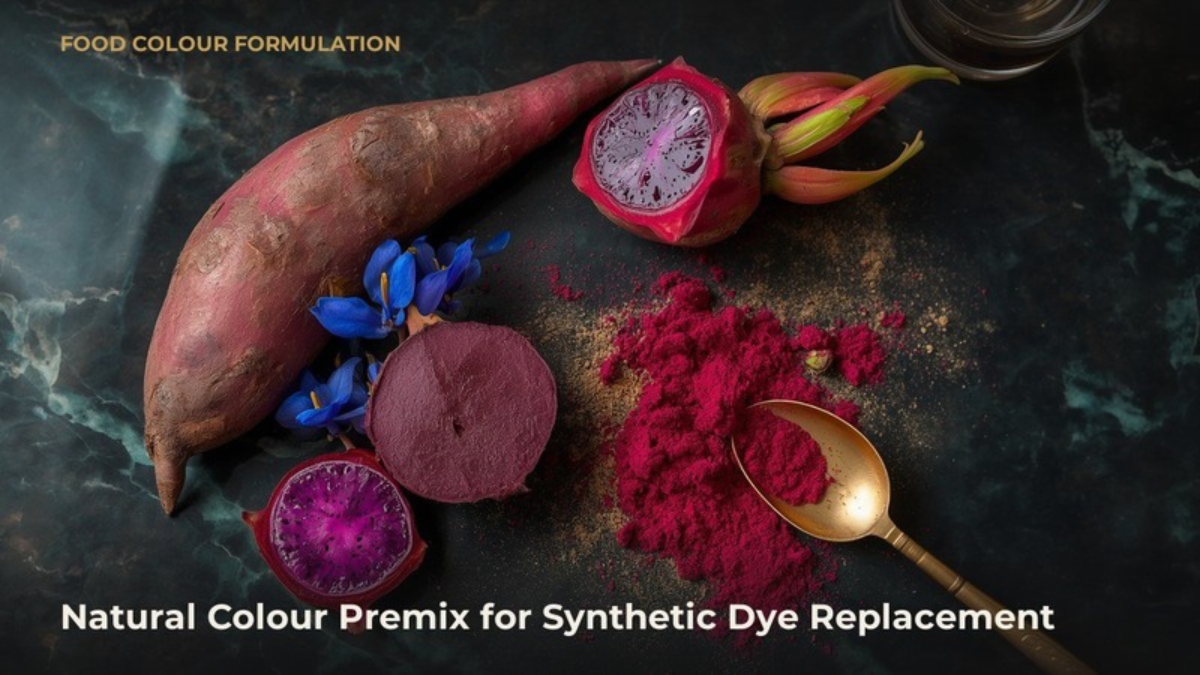
- Matrix components: purple sweet potato powder, butterfly pea flower standardised extract powder and red dragon fruit standardised extract powder.
- Physical format: powder ingredients.
- Colour components: anthocyanins are identified in purple sweet potato and butterfly pea; red dragon fruit product information identifies betacyanins.
- Dispersion: the purple sweet potato powder product information states the powder contains soluble and insoluble fibre; butterfly pea colour responds to acidity and the red dragon fruit product page describes water-soluble powder.
- Usage level (butterfly pea catalogue page): 2–6% of total weight in the listed applications.
- Certifications: FSSC 22000, JAKIM Halal, GMP, HACCP, MeSTI, and US FDA facility registration.
What question does this colour matrix answer?
Food developers assessing a plant-based alternative to synthetic colour need more than a palette description. Each colour ingredient has its own composition, dispersion behaviour and response to the finished recipe. A three-ingredient combination may be evaluated for blended shades across product categories, but performance depends on the recipe, processing and packaging. Treat it as a development concept requiring controlled trials, not as a validated ready-to-use colour system.
The three individual catalogue materials are Sweet Purple Potato (Ipomoea batatas) Powder, Butterfly Pea Flower (Clitoria ternatea L.) Standardized Extract Powder, and Red Dragon Fruit (Hylocereus polyrhizus) Standardized Extract Powder. Each should be specified and qualified independently before any combined premix is considered.
How do the three colour ingredients differ?
| Ingredient | Colour contribution and composition stated on catalogue pages | Formulation point to assess |
|---|---|---|
| Sweet purple potato powder | Purple colour; the product information identifies anthocyanins and describes the powder as containing soluble and insoluble fibre. | Assess dispersion, visible particles, texture and shade in the specific food matrix. |
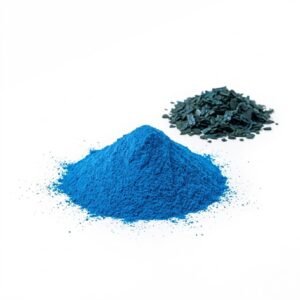
| Butterfly pea flower extract | Blue shade that shifts to violet and then pink as acidic ingredients are added; anthocyanins are described as its colour compounds in published site content. | Measure final product acidity and record the resulting shade rather than assuming a fixed blue. |
| Red dragon fruit extract | Red-purple colour associated with betacyanins, as stated on the product page. | Check colour retention through the actual heat, light and storage conditions. |
These pigments should not be treated as interchangeable. The purple sweet potato powder is a food powder with a composition and colour profile to assess against its product specification. Butterfly pea colour changes with acidity, while the red dragon fruit page identifies a different pigment family. Shade, flavour, texture and process performance therefore need to be measured in each target recipe.
What should a development trial measure?
Begin with the finished product’s required shade and its existing synthetic-colour control. Prepare separate single-ingredient controls and a combined matrix, recording the ingredient grade and lot, addition sequence, product acidity, process conditions and packaging. Assess colour and sensory attributes at the same points before and after processing and during the intended storage study. Include dispersion, sedimentation or visible specking where relevant, plus the texture contribution of purple sweet potato powder.
Development checklist
- Define the intended label declaration and target shade before selecting a blend.
- Check acidity, heat exposure, light exposure and water activity in the actual product.
- Compare the matrix with each single-ingredient control and the current synthetic-colour control.
- Record the lot-specific colour and sensory observations; do not assume the result transfers to another food category.
- Request current specifications and certificates of analysis for each ingredient.
Applications to evaluate may include beverages and cordials, bakery systems, dairy systems, ice-cream and frozen desserts, and confectionery made by the customer. Assess each intended product and production process independently.
What does standardisation mean for colour quality control?
A standardised extract and a crude botanical powder are different purchasing specifications. For the standardised butterfly pea and red dragon fruit extracts, the buyer should obtain the current marker or colour assay, method and acceptance range from the lot certificate of analysis (COA) and specification sheet. For sweet purple potato powder, review the product specification and lot documents to establish the applicable colour or marker criteria. Do not treat its colour as a controlled marker percentage without documentation.
Batch consistency is evidenced by an agreed specification and the COA for each lot, not by a colour name alone. Record the actual lot result against the agreed marker or colour criteria. A crude powder without a defined assay may differ in pigment content, so its distinction from a standardised extract is a documentation and quality-control distinction; it does not establish a different physiological effect.
What regulatory checks apply to a natural colour premix?
Food-colour authorization and permitted use depend on the specific substance, preparation and food category in each market. In the United States, 21 CFR §73.69 establishes requirements and permitted uses for butterfly pea flower extract when the ingredient meets that provision; the listing does not establish authorization for a mixture containing purple sweet potato and red dragon fruit or for every product category. The United States Electronic Code of Federal Regulations, 21 CFR §73.69, “Butterfly pea flower extract,” https://www.ecfr.gov/current/title-21/section-73.69, accessed 26 November 2026.
Before a label or product specification is finalised, check the identity and legal status of every colour ingredient, the permitted food category, use conditions, purity specifications and labelling requirements with the relevant authority or qualified regulatory adviser. Apply the same ingredient-by-ingredient review in the United Kingdom, European Union, Australia, Gulf markets, Japan, Korea and Malaysia; authorization in one market is not evidence of authorization in another. The Food Standards Agency’s food additives guidance (https://www.food.gov.uk/business-guidance/food-additives), accessed 26 November 2026, and European Commission food additives database (https://food.ec.europa.eu/food-safety/food-improvement-agents/additives/database_en), accessed 26 November 2026, provide market-specific starting points.
What information should buyers request?
For each ingredient, request the botanical identity and plant part, physical form, colour or marker specification, assay method where applicable, dispersion information, storage and packaging instructions, relevant certification documentation, and a lot-specific COA. For a proposed multi-ingredient matrix, define its own agreed specification and release criteria. Ask that the component identities and blend release limits be recorded in the buyer’s approved specification.
The ingredient-specific colour behaviour is covered in the existing butterfly pea beverage colour and acidity guide and red dragon fruit bakery colour guide. A broader purchasing framework appears in Natural Food Coloring: Stability and Bulk Purchasing.
Supplying colour ingredients and related materials in bulk
Bionutricia Extract’s published catalogue lists sweet purple potato powder, butterfly pea flower standardised extract powder, red dragon fruit standardised extract powder and roselle standardised extract powder. Bulk buyers should confirm current availability and specifications for each item. The published food ingredient supplier information describes bulk supply, powder and liquid ingredient formats, documentation including a COA per lot, packing and export paperwork details confirmed per enquiry.
Buyers can also consider Roselle (Hibiscus sabdariffa) Standardized Extract Powder and Carrot Standardized Extract Powder as separate catalogue colour ingredients. The published quality information lists FSSC 22000, JAKIM Halal, GMP, HACCP, MeSTI and US FDA facility registration. Confirm current documents and certification scope for the ingredient and lot, and ask about packing options through the contact page.
Frequently asked questions
Can Bionutricia Extract supply each of these three colour ingredients in bulk? Bionutricia Extract’s published supplier information describes bulk supply of botanical powders, with availability and specifications confirmed per enquiry and a certificate of analysis (COA) per lot. Confirm bulk availability of each of the three powders before planning a trial order.
Can these three ingredients replace synthetic dyes in every food product? No blanket substitution can be stated. A formulator needs to compare shade, flavour, dispersion, processing and target-market authorization in the specific food category.
How does acidity affect the colour matrix? The butterfly pea product information describes a blue-to-violet-to-pink shift as acidity increases. Record the finished product’s acidity and colour because the mixture’s shade depends on the target formula.
How should a buyer specify a three-ingredient colour matrix? Define the component identities, individual lot specifications, intended applications and blend release criteria. Use the current specification sheets and COAs for the component ingredients.
What should be tested during heat and storage evaluation? Assess the actual process and package, including heat exposure, light exposure, acidity, water activity, dispersion and shade over the intended storage period. Do not infer a finished-product stability result from one ingredient page.
Is butterfly pea authorization enough for the complete blend in the United States? No. The 21 CFR §73.69 listing concerns butterfly pea flower extract under stated conditions and does not establish the legal status of the other ingredients or the combined preparation. Check each ingredient and food category separately.
To discuss a combined blend, send a custom premix brief through the contact page, naming Sweet Purple Potato (Ipomoea batatas) Powder, Butterfly Pea Flower (Clitoria ternatea L.) Standardized Extract Powder and Red Dragon Fruit (Hylocereus polyrhizus) Standardized Extract Powder, with the target applications and shade.