Garlic extract powder is a 20:1 concentrated extract of the Allium sativum bulb, characterised on allicin — the organosulfur compound behind garlic’s pungency — at ≤2% per the house specification. Bionutricia Extract supplies it in bulk to B2B and OEM formulators from a JAKIM Halal, FSSC 22000, US FDA-registered, GMP, HACCP and MeSTI facility in Malaysia, with a Certificate of Analysis on every lot.
Quick facts for formulators
- Botanical / part: Allium sativum, bulb
- Type: standardized extract powder, extraction ratio 20:1
- Marker compound: allicin (HPLC) — ≤2% per the house specification, confirmed on the batch Certificate of Analysis
- Form / colour / odour: free-flowing fine powder, light yellow to white, characteristic garlic odour
- Solubility: water-soluble · Moisture: <10%
- Particle size: >85% through 60 mesh
- Dosage: typically 250–750 mg per serving of the finished formulation
- Pack sizes: 1 kg · 5 kg · 20 kg
- Clean label: vegan, non-GMO, gluten-free (<20 ppm), not irradiated, no Annex II allergens, not a novel food
- Shelf life: 2 years sealed, cool & dry · Origin: Malaysia
What is garlic extract powder?
Garlic (Allium sativum) is one of the oldest cultivated crops on record — grown for at least 5,000 years across China, India and Egypt — and, after onion, the world’s most important bulb crop. Bionutricia’s ingredient is a 20:1 concentrated extract of the bulb, produced with the patented enzymatic + ultrasonic extraction process (MY-188945-A, “Process for Preparing Nutritional Powder Extract”) and spray-dried into a water-soluble, light-yellow-to-white powder: one kilogram of extract represents roughly twenty kilograms of fresh garlic input. It is a different ingredient from culinary garlic powder (simply dried, milled garlic) and from fermented black garlic powder, which is aged until its chemistry shifts toward S-allylcysteine and sweet melanoidins — this page covers the fresh-garlic extract, characterised on allicin. See the live garlic (Allium sativum) product page.
Active compound & standardisation
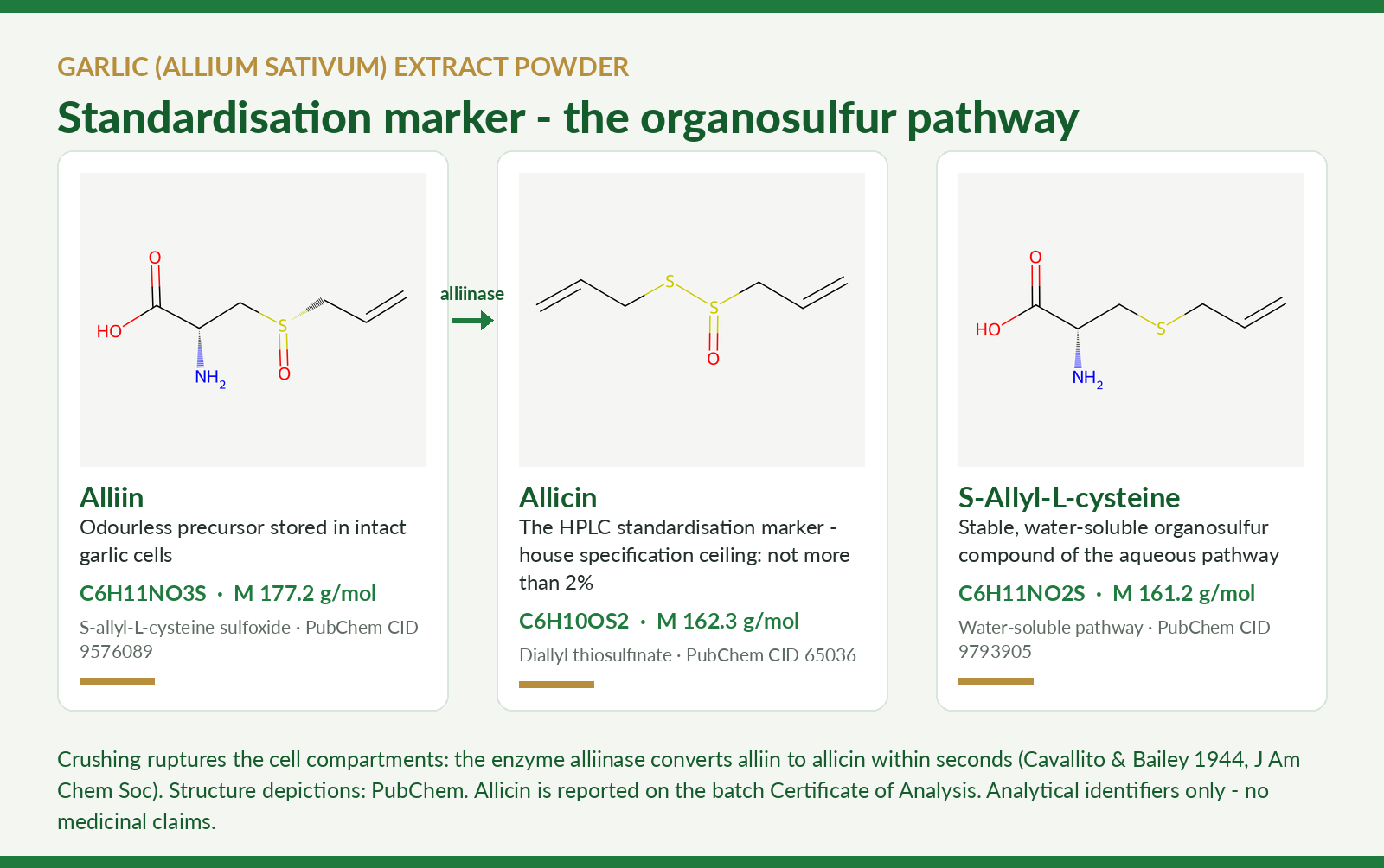
Garlic’s chemistry is a two-part system. The intact clove stores the odourless amino-acid derivative alliin; when tissue is crushed, the enzyme alliinase converts alliin into allicin — the reactive thiosulfinate first isolated by Cavallito & Bailey (1944, J Am Chem Soc) that gives fresh garlic its bite. Allicin itself is short-lived, decaying into diallyl disulfide, diallyl trisulfide, ajoene and related organosulfur compounds, while slow ageing instead accumulates the stable, water-soluble S-allylcysteine (SAC) — the marker used in aged-garlic research. Our house specification characterises the extract on allicin at ≤2% by HPLC, confirmed on each batch Certificate of Analysis, so a formulator receives a defined organosulfur fingerprint rather than an unquantified spice powder.
How garlic organosulfur compounds work in the body (mechanism)
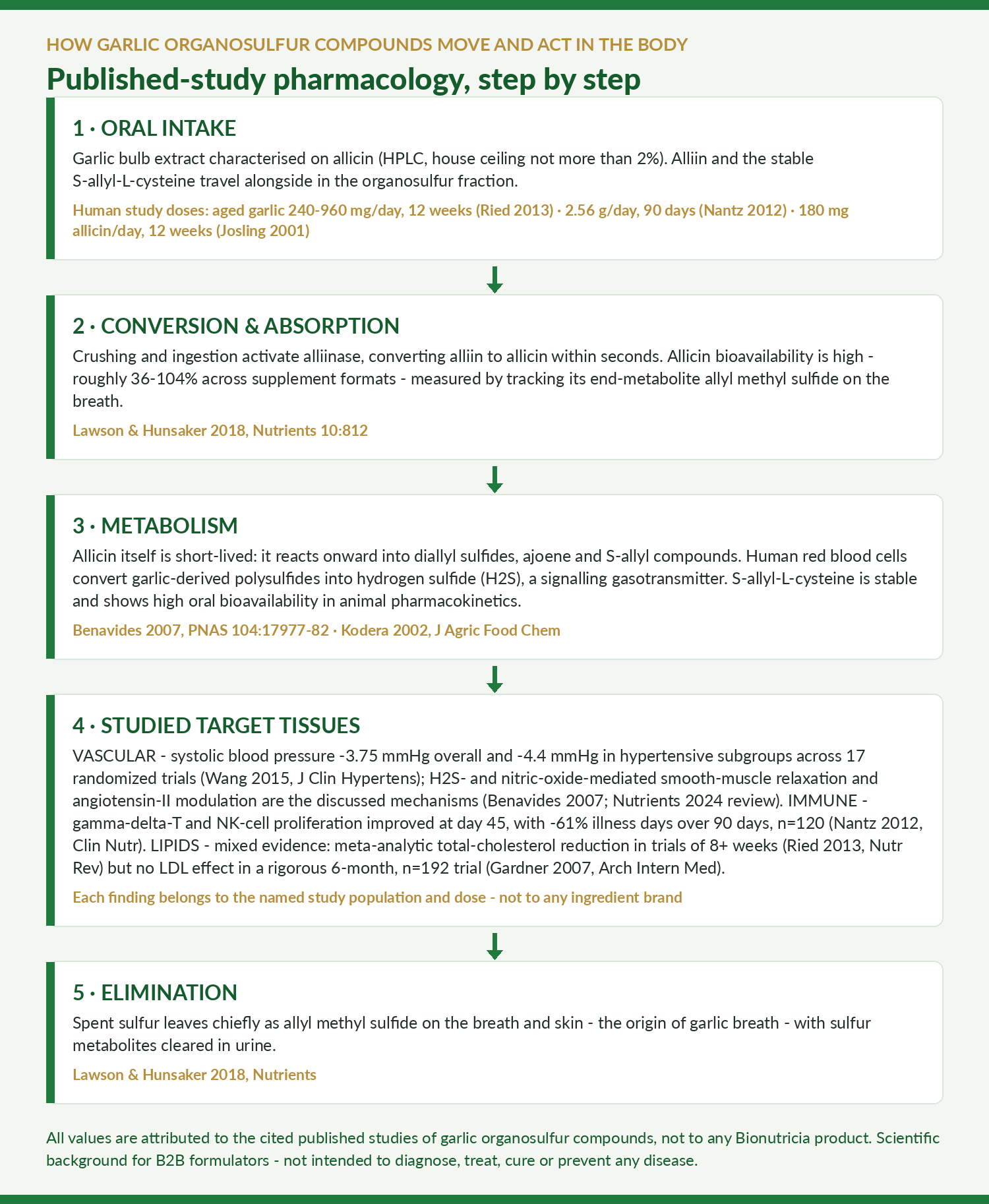
Allicin is not absorbed intact in meaningful amounts — human studies tracking its fate show rapid transformation, with allyl methyl sulfide appearing on the breath as the accepted marker of allicin bioavailability (Lawson & Wang 2005, J Agric Food Chem). The best-described vascular mechanism is that red blood cells convert garlic’s organic polysulfides into hydrogen sulfide (H₂S), a signalling molecule that relaxes vascular smooth muscle (Benavides et al. 2007, PNAS). The water-soluble S-allylcysteine is, by contrast, well absorbed and served as the pharmacokinetic marker in aged-garlic studies (Kodera et al. 2002, J Agric Food Chem). In randomized trials of aged garlic extract, Ried and colleagues also reported improved arterial stiffness and a richer gut-microbiota profile alongside the blood-pressure findings (GarGIC trial, Ried et al. 2018, Frontiers in Nutrition). Mechanism is provided as scientific background on garlic organosulfur compounds, attributed to the cited studies; it is not a claim that this ingredient treats, cures or prevents any condition.
Clinical evidence on garlic preparations
The findings below belong to the cited studies, populations and preparations, at the stated doses — they are scientific context for formulators, not performance claims for this ingredient.
| Study | Design | Result (attributed to the study) |
|---|---|---|
| Wang et al. 2015, J Clin Hypertens | Meta-analysis of 17 randomized controlled trials of garlic preparations | Systolic blood pressure −3.75 mmHg (95% CI −5.04 to −2.45) and diastolic −3.39 mmHg vs control; the systolic effect was significant in hypertensive subgroups (−4.4 mmHg) but not in normotensives |
| Ried et al. 2016 — “AGE at Heart” trial | Double-blind RCT, n=88 uncontrolled hypertensives; aged garlic extract 1.2 g/day (1.2 mg S-allylcysteine), 12 weeks | Significant systolic reduction (≈−5 mmHg) vs placebo; blood-pressure responder subgroup larger |
| Ried et al. 2018 — GarGIC trial, Front Nutr | Double-blind RCT, 49 completers with uncontrolled hypertension; aged garlic extract 1.2 g/day, 12 weeks | Systolic −10 ± 3.6 mmHg, diastolic −5.4 ± 2.3 mmHg vs placebo; arterial stiffness and gut-microbiota richness also improved |
| Updated meta-analysis 2025 (with trial sequential analysis) | Pooled RCTs of garlic supplementation in hypertension | Systolic reduction of ≈−4.2 mmHg, consistent with the earlier pooled estimates |
| Gardner et al. 2007, Arch Intern Med | RCT, n=192 adults with moderate hypercholesterolemia; raw garlic (≈4 g clove/day), powdered supplement, or aged extract vs placebo, 6 months | No statistically or clinically significant effect on LDL cholesterol or other plasma lipids in any garlic arm — an honest null result |
Evidence appraisal: the blood-pressure literature is the strongest and is concentrated in hypertensive cohorts, with modest average effects; the best lipid trial was null. The cited trials used specific preparations — aged garlic extract or garlic powder tablets — not this extract; allicin on the batch COA is the objective quality metric for this ingredient.
Typical specification
| Parameter | Value |
|---|---|
| Botanical source / part | Allium sativum, bulb |
| Type / ratio | Standardized extract powder, 20:1 |
| Appearance / colour | Free-flowing fine powder, light yellow to white |
| Odour | Characteristic |
| Marker compound | Allicin ≤ 2% (house specification, HPLC; confirmed on the batch COA) |
| Solubility | Soluble in water |
| Moisture | < 10% |
| Particle size / mesh | > 85% through 60 mesh |
| Dosage | 250–750 mg per serving (typical) |
| Heavy metals | As < 0.1 ppm · Pb < 0.2 ppm · Hg < 0.05 ppm |
| Microbiology | APC < 10⁴ cfu/g · Y&M < 10³ cfu/g · coliforms < 10² cfu/g · E. coli absent (1 g) |
| Clean label | Vegan · non-GMO · gluten-free (<20 ppm) · not irradiated · no Annex II allergens · not a novel food |
| Certifications | JAKIM Halal, FSSC 22000, US FDA registered, GMP, HACCP, MeSTI |
| Shelf life | 2 years sealed, cool & dry |
| Pack sizes | 1 kg, 5 kg, 20 kg |
| Country of origin | Malaysia |
Figures are typical specification values; the batch Certificate of Analysis carries the release data — including the allicin figure — for each production lot. Full specification on request.
Applications
Bionutricia supplies the bulk ingredient for B2B formulation; brand owners and manufacturers formulate it into their chosen finished format — capsules and tablets, sachet drink mixes and effervescents, gummies, functional beverages, and savoury systems such as seasoning blends, instant sauces, marinades and soup premixes. Because the extract is 20:1 and water-soluble, it doses compactly (typically 250–750 mg per serving) where culinary garlic powder would need gram-level additions, and the characteristic garlic note transfers cleanly into savoury applications.
Why source garlic extract from Bionutricia?
Bionutricia Extract has manufactured botanical extracts in Malaysia since 2006, running the patented enzymatic + ultrasonic extraction process (MY-188945-A) under a full halal and international food-safety stack — JAKIM Halal, FSSC 22000, US FDA registration, GMP, HACCP and MeSTI — and issuing a Certificate of Analysis with every lot. The garlic extract is freshly made to order; pre-order packing takes about 1–2 weeks. MOQ and pricing are provided on quotation via the product page.
Frequently asked questions
What is it standardised on, and is a COA available? It is a 20:1 Allium sativum bulb extract characterised on allicin by HPLC — ≤2% per the house specification — with a Certificate of Analysis issued per lot carrying the release figure.
Is this the same as culinary garlic powder? No. Culinary garlic powder is simply dried, milled garlic; this is a 20:1 concentrated extract with a defined allicin specification, made for standardised dosing in supplements and functional foods.
How is it different from fermented black garlic powder? Black garlic is aged under controlled heat and humidity until allicin-type chemistry gives way to S-allylcysteine and sweet melanoidins. This page’s ingredient is the fresh-garlic extract, characterised on allicin; both are available as separate ingredients.
Is the garlic extract halal? Yes — it is JAKIM Halal certified, produced in a facility that also holds FSSC 22000, US FDA registration, GMP, HACCP and MeSTI; documentation accompanies each shipment.
What finished formats can a brand owner make? Bionutricia supplies the bulk ingredient; customers formulate it into capsules, tablets, gummies, sachets, beverages and savoury food systems in their own facilities.
What is the typical dosage? Typically 250–750 mg per serving of the finished formulation, with the compact dose enabled by the 20:1 concentration.
What are the pack sizes, MOQ and lead time? 1 kg, 5 kg and 20 kg packs; freshly made pre-order packing takes about 1–2 weeks; MOQ and tiered pricing on quotation.
How should it be stored? Sealed in hygienic containers, cool and dry, away from pest infestation; shelf life is 2 years when properly stored.
Request a bulk garlic extract quote →