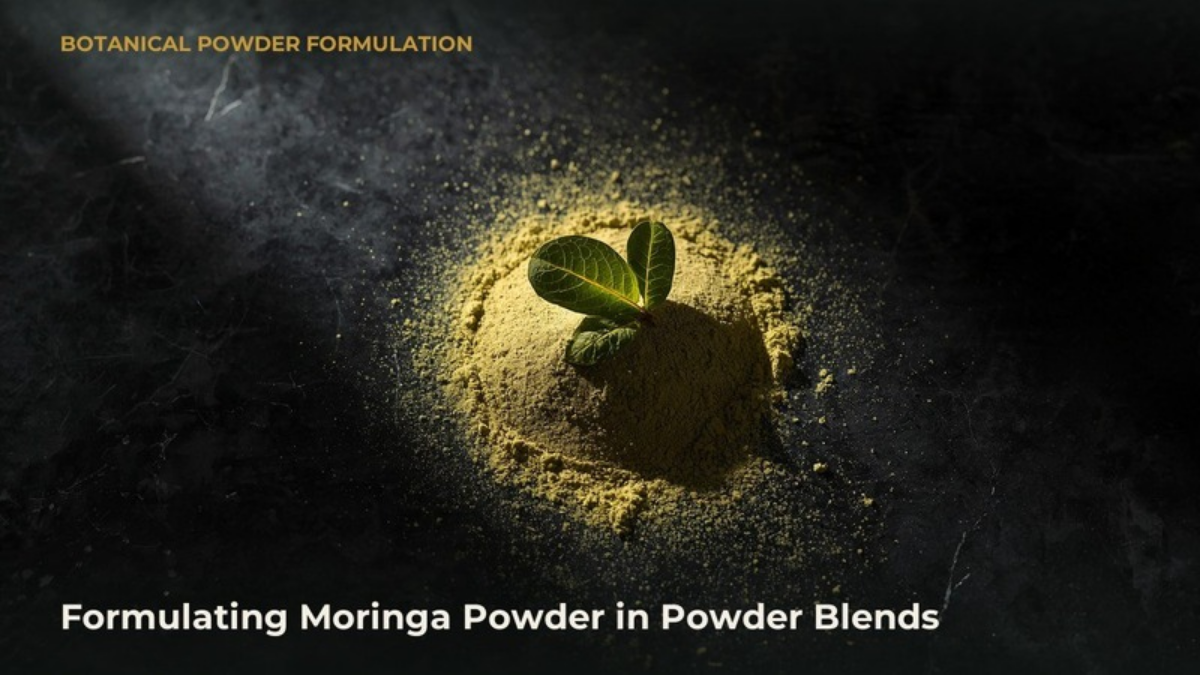
Formulating Moringa Powder in Powder Blends: Usage Level, Solubility and Processing Stability
Formulator’s summary: Moringa leaf powder (Moringa oleifera) is a whole-leaf green powder that does not dissolve like a soluble extract; assess its dispersion in the finished matrix. Its green, vegetal sensory profile can influence colour and flavour. The product specification reports moisture below 10% and particle size above 95% through 60 mesh; applications include dry powder blends, beverage and bakery systems.
Quick facts for formulators
- Physical format: whole-leaf green powder
- Standardisation: not standardised to a marker compound
- Dispersion: whole-leaf powder; assess suspension and sedimentation in the intended matrix rather than treating it as a soluble extract
- Product specification: moisture <10%; >95% through 60 mesh
- Certifications: FSSC 22000, JAKIM Halal, GMP, HACCP, MESTI, and US FDA facility registration
What is moringa leaf powder?
Moringa leaf powder is dried, milled leaf of Moringa oleifera. The product page identifies the material as a green powder and distinguishes it from a standardised extract: it has no extraction ratio and no guaranteed marker-compound percentage. For formulators, this means the purchase specification is based on botanical identity, physical characteristics and lot quality rather than an assay target for a named active.
The distinction between a standardised extract and crude herbal powder is a specification distinction. A standardised extract declares an assay marker and percentage, allowing batch acceptance against that marker; crude whole-leaf powder has no such declared active percentage. The product information states no marker standardisation. Buyers should check the lot-specific certificate of analysis (COA) and the agreed specification for identity and quality parameters. The product page lists limits for moisture, particle size, heavy metals and microbiology.
For related context, see the existing moringa leaf powder B2B buyer’s guide and the moringa powder overview. The corresponding moringa leaf powder product page presents the catalogue specification.
How should a formulator set an inclusion level?
The product specification does not provide a validated percentage for moringa leaf powder in dry-blend applications. It lists a suggested dosage of 500–1000 mg on a quantum satis basis, not a validated percentage for a particular food matrix. That mass-per-serving entry should not be translated into a general % w/w recommendation.
Set a trial plan around the product brief and evaluate the blend at its intended serving mass, sensory profile, colour target and manufacturing sequence. Record each formula version and compare samples with a control without moringa. This is a development method, not a validated inclusion rate or a claim about performance at a particular level.
What does the product specification say about dispersion?
The catalogue identifies moringa as whole-leaf powder, not a soluble extract. The published product specification does not provide a water-solubility percentage, wetting time or dispersibility result. In a liquid prepared from a dry blend, assess whether leaf particles wet, remain suspended or settle under the actual preparation conditions; do not describe the powder as fully soluble without a validated result.
For a dry blend, evaluate distribution of the green powder through the carrier and other ingredients, then inspect representative samples for visible segregation. A test protocol should record sample mass, liquid volume, mixing method, temperature, standing interval and observation method. Those variables define the test; they do not establish a result for this product.
The specification reports a particle-size criterion of greater than 95% through 60 mesh. This is a purchased-material acceptance parameter, but does not alone predict blend uniformity, flow or wetting: those outcomes also depend on the other ingredients, equipment and handling used in the buyer’s process.
How can processing and storage be qualified?
No validated thermal-retention, humidity-cycling, caking, flowability or finished-blend shelf-life figures are published in the product information. Therefore, no maximum processing temperature, storage duration or stability percentage is stated. Qualify the intended process and packaging using representative samples and lot documentation rather than infer a limit from botanical identity.
For a practical development record, compare pre-process and post-process samples using quality attributes relevant to the product: colour and sensory profile, moisture, physical blend uniformity and microbiological results where required by the product specification. For a liquid-use application, include wetting, dispersion and sedimentation observations. Define sampling points and acceptance limits before testing so subsequent production checks use the same method.
During procurement, require a current specification sheet and a lot-specific COA. The product page lists moisture below 10%, particle size greater than 95% through 60 mesh, and heavy-metal and microbiological limits. These are product-specification parameters; they do not replace process-specific stability studies or testing of the finished blend.
What should buyers check before formulation?
| Check | Published product information | Formulation relevance |
|---|---|---|
| Botanical identity and plant part | Moringa oleifera, leaves | Confirms the named leaf ingredient for the formulation record. |
| Form and standardisation | Green powder; no extraction ratio or marker standardisation | Set the blend specification around identity and physical quality rather than a marker percentage. |
| Moisture and particle size | <10% moisture; >95% through 60 mesh | Use the published criteria for incoming-lot review; qualify blend behaviour in the actual process. |
| Heavy metals and microbiology | Product page lists limits; obtain current lot COA | Check each lot against the agreed specification and destination-market requirements. |
| Blend inclusion level | No validated percentage for powder-blend applications supplied | Develop and document matrix-specific trials; do not infer a general percentage from a mass-per-serving entry. |
| Dispersion and stability | No validated solubility, flow or process-stability result supplied | Test with the intended carrier system, process conditions and packaging. |
What applications suit a whole-leaf powder?
The product page identifies greens blends and functional-food inclusions among its applications. In a powder blend, the whole-leaf material contributes green colour and a vegetal, earthy sensory character; assess these alongside the blend’s intended taste and appearance. Relevant application categories include dry powder blends, sachet drink mixes, beverages and cordials, ready-to-drink beverages, bakery systems and dairy systems.
For a dry mix intended to be reconstituted, distinguish blend uniformity while dry from dispersion after adding liquid. These are separate checks: a homogeneous dry blend does not establish that suspended leaf particles remain uniformly distributed in the prepared beverage.
How should supplier documents support quality control?
Request the product specification and a COA for the relevant lot. Compare identity, moisture, particle-size criteria, heavy-metal results and microbiological results against the agreed purchase specification. Record test-method requirements in the procurement file so incoming-lot review can be repeated consistently.
A crude whole-leaf powder and a standardised extract are different specification classes. A marker percentage is meaningful only where the ingredient is standardised to that marker and the assay is part of its specification. For this moringa powder, the published product information states no marker standardisation; buyers should not assign an unverified marker target.
Supplying moringa powder and related ingredients in bulk
Bionutricia’s catalogue lists bulk moringa leaf powder as a whole-leaf green powder, with a specification covering moisture, particle size, heavy metals and microbiology. Buyers can request the specification sheet, lot-specific COA and documentation for review. The catalogue also publishes Moringa Leaf Powder (Moringa oleifera) — Bulk Supply, which links to the existing technical guide and presents the product information.
Related catalogue items include Blue Spirulina Powder (Phycocyanin) and Coconut Water Powder; review each product’s published specification independently for a proposed matrix. Bionutricia’s published supply information covers bulk supply, custom specification and extract ratio, powder forms, COA per lot, documentation and export paperwork, and packing options. Published quality certifications include FSSC 22000, JAKIM Halal, GMP, HACCP, MESTI and US FDA facility registration.
Frequently asked questions
What inclusion level of moringa powder should a formulator use in a dry blend?
The product specification does not provide a validated percentage for dry-blend applications. Determine an application-specific trial range and document the matrix and sensory acceptance criteria; the published dosage entry should not be converted into a general percentage.
Does moringa leaf powder dissolve in water?
It is a whole-leaf powder rather than a soluble extract, and the published product information gives no solubility percentage. Assess wetting, suspension and settling in the intended liquid system.
What product data are available for moringa powder?
The product page lists botanical identity, powder form, moisture, particle size, heavy-metal and microbiological parameters. Request the current lot COA for batch review.
Does the product have a standardised active marker?
No marker-compound standardisation is stated in the product information. Treat it as whole-leaf powder and do not assign an unverified assay target.
How should processing stability be assessed?
The product information does not provide validated heat, humidity, flow or finished-blend stability results. Evaluate representative samples under the intended process and packaging conditions using predefined quality checks.
Request the certificate of analysis, specification sheet and a sample of Moringa Leaf Powder (Moringa oleifera) whole-leaf powder.