Formulating pineapple standardized extract powder in bakery: usage level, solubility and processing stability
Formulator’s summary: Pineapple standardized extract powder (Ananas comosus) is a brown powder reported as water-soluble; its warm fruit aroma and flavour suit bakery systems, beverages and cordials. The current certificate lists moisture below 10% and particle size above 95% through 60 mesh. Bakery qualification is carried out on the intended recipe and lot.
Quick facts for formulators
- Physical format: powder
- Solubility: soluble in water, as reported on the certificate of analysis for the tested lot
- Moisture: <10% on the certificate of analysis for the tested lot
- Particle size: >95% through 60 mesh on the certificate of analysis for the tested lot
- Certifications: FSSC 22000, JAKIM Halal, GMP, HACCP, MESTI, and US FDA facility registration
What is pineapple standardized extract powder?
The catalogue item is Pineapple (Ananas comosus) Standardized Extract Powder. The corresponding pineapple bulk ingredient guide covers general product information; this article focuses on the separate bakery formulation question.
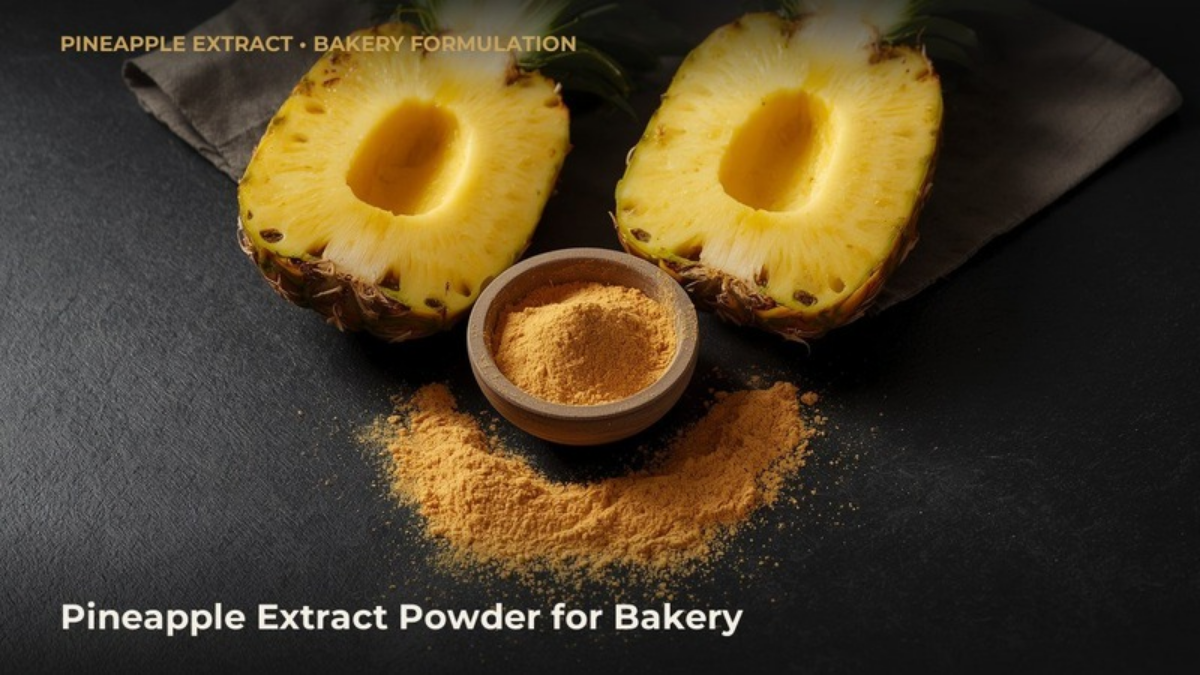
The product page identifies a powder and lists food applications. A certificate of analysis (COA) for a tested lot describes the powder as light brown, with characteristic odour and taste, soluble in water, moisture below 10% and particle size above 95% through 60 mesh. These are lot-specific certificate results, not a marker assay or a standardisation percentage.
A standardised extract and a crude fruit powder are distinct purchase specifications. A standardised grade should identify its marker, assay method and acceptance range, with batch results checked on each lot COA. A crude powder is described by its milled material and physical quality without an active-marker acceptance range. Standardisation is defined by a named marker, an assay method and an acceptance range, and these are taken from the supplier’s current marker definition rather than from the product name or an extract ratio. Buyers should require the current marker definition and lot-specific assay documentation before setting a marker-based acceptance criterion.
How should a bakery team set an initial usage level?
No validated bakery inclusion rate is set for this catalogue item, so the starting level is established by trial in the intended recipe.
Set a small bench trial around the bakery brief: choose the product type, target flavour and colour, and process sequence; then compare a control with measured trial additions chosen by the formulator. Record the ingredient lot, formula basis, mixing stage, bake schedule and sensory observations. Select the working range from the results in that matrix rather than transferring a figure from whole-fruit or peel-powder studies, which are different materials.
For a practical starting plan, keep the total formula constant across trial batches and vary only the pineapple powder addition where possible. Record whether the material is dispersed into a liquid phase first or added with the dry ingredients. This describes a test design, not a validated use level for the catalogue item.
What does the available solubility information establish?
The COA for the tested lot reports “Solubility in Water — Soluble”. Dissolution time, temperature and behaviour in dough or batter are determined in the bakery trial. Water solubility is therefore a useful incoming-material descriptor, not proof of instant dissolution or uniform distribution in a bakery matrix.
Check the powder in the actual process. In a bench assessment, record the liquid amount, mixing method, temperature and observation time; then inspect for undissolved particles, clumping or uneven colour. If the formula has limited free water, compare dry addition with a pre-dispersed addition and document the sequence. Confirm the result in the actual dough, batter, filling or icing, as its fat, sugar and moisture composition can change powder incorporation.
The product’s published pineapple powder specification should be checked against the current lot COA before scale-up. The lot certificate also reports a particle-size criterion, but particle size alone does not establish dough dispersion or finished-product uniformity.
How should processing stability be assessed?
Bake retention is established through the intended bake and cooling process, and any bakery stability limit is set from that trial data. Do not assume that water solubility predicts stability through baking. Define the quality attributes relevant to the product brief—such as aroma, taste, colour and appearance—and compare them before and after the intended bake and cooling cycle.
Use representative samples and the actual process profile. Record the oven programme, product dimensions, mixing stage, bake time, cooling conditions and evaluation time. Where the formulation depends on a specified enzyme activity or other marker, require an assay method and test the relevant attribute before and after processing; marker values and retention figures come from the lot-specific assay and the bakery trial.
For storage qualification, retain the ingredient in the stated cool, dry conditions and protect it from direct sunlight and moisture. The COA gives a two-year shelf life when properly stored for the tested lot; it does not establish the shelf life of a finished bakery product.
What should a bakery buyer check on the specification and COA?
| Check | Documented detail | Use in incoming or formulation review |
|---|---|---|
| Identity and form | Pineapple extract powder; powder form | Match the delivered item name and form to the purchase record. |
| Appearance and sensory | Light brown colour; characteristic odour and taste | Compare the lot with the current approved reference and assess in the target recipe. |
| Solubility | Reported soluble in water | Confirm behaviour in the bakery matrix rather than assuming a finished-product result. |
| Moisture and particle size | Moisture <10%; >95% through 60 mesh | Review against the lot COA and the agreed purchase specification. |
| Microbiology and heavy metals | The COA lists results and limits for the tested lot | Review the current lot certificate against the buyer’s applicable requirements. |
| Marker standardisation | Set by the current marker definition, assay method and acceptance range | Request these from the supplier if standardisation is a purchasing requirement. |
| Bakery usage and bake stability | Established by a bench trial in the intended matrix | Set a matrix-specific trial and document the process and acceptance criteria. |
- Match the product name, lot identity and current specification.
- Review the lot COA for appearance, solubility, moisture, particle size, microbiology and heavy-metal results.
- Ask the supplier to provide the marker assay basis and acceptance range when a standardisation target is required.
- Record addition order, formula basis, mixing and bake conditions in the trial file.
- Assess the baked product after cooling against a control using predefined sensory and appearance criteria.
Supplying pineapple extract powder and related ingredients in bulk
Bionutricia’s catalogue lists Pineapple (Ananas comosus) Standardized Extract Powder as a bulk ingredient. Buyers can request the current specification sheet and lot COA, review documentation and export paperwork, and confirm available packing options for the required purchase. Published supply information describes bulk supply, custom specification and extract ratio, powder forms and COA per lot; confirm item-specific details against the current product documents.
For adjacent formulation options, the catalogue also lists Pea (Pisum sativum) Protein Powder and Arabic Gum (Acacia senegal) Powder. Each has a separate specification and should be assessed for its intended role in the bakery system. Published quality certifications include FSSC 22000, JAKIM Halal, GMP, HACCP, MESTI and US FDA facility registration.
For a bakery colour-formulation comparison, see the live red dragon fruit extract powder bakery guide. Its colour and processing questions are distinct from pineapple powder’s product-specific bakery qualification.
Frequently asked questions
What usage level of pineapple standardized extract powder should be used in bakery? No validated bakery inclusion rate is set for this catalogue item. Establish the level through a documented trial in the intended recipe and record the addition basis and process conditions.
Is the pineapple extract powder soluble in water? The tested-lot COA reports that it is soluble in water. Check dispersion in the actual dough, batter or other bakery matrix.
Does the available COA give a bromelain or other marker percentage? Standardisation is defined by a named marker, an assay method and an acceptance range. A buyer requiring standardisation should obtain the current marker definition, assay method and acceptance range from the supplier.
Does the available information establish stability during baking? Bake retention is determined through the intended bake and cooling process. Assess sensory and appearance attributes through that process.
What documents should be reviewed before a bakery trial? Review the current specification sheet and lot COA, including identity, form, solubility, moisture, particle size and listed quality results. Record any marker or process data required for the project in the agreed specification.
Request the certificate of analysis, specification sheet and a sample of Pineapple (Ananas comosus) Standardized Extract Powder.