Red Dragon Fruit Standardised Extract Powder as a Natural Colour Replacement in Bakery
Formulator's summary: Red dragon fruit extract powder (Hylocereus polyrhizus, fruit) is a water-soluble magenta colour ingredient whose betacyanin pigments give a red-violet hue to bakery systems. The product's published general direction of use is 2–6% of total weight across its listed recipe applications; the bakery-specific level is set by trial in the target recipe.
Quick facts for formulators
- Botanical / part: Hylocereus polyrhizus, fruit
- Physical format: powder
- Colour marker: betacyanin / betalain pigments, identified compositionally
- Solubility: water-soluble, as stated in the published product guide
- General use direction: 2–6% of total weight “or as needed”, stated on the product page across its listed recipe applications; set the bakery-specific level by trial
- Certifications: FSSC 22000, JAKIM Halal, GMP, HACCP, MeSTI, and US FDA facility registration
What does red dragon fruit extract contribute to bakery products?
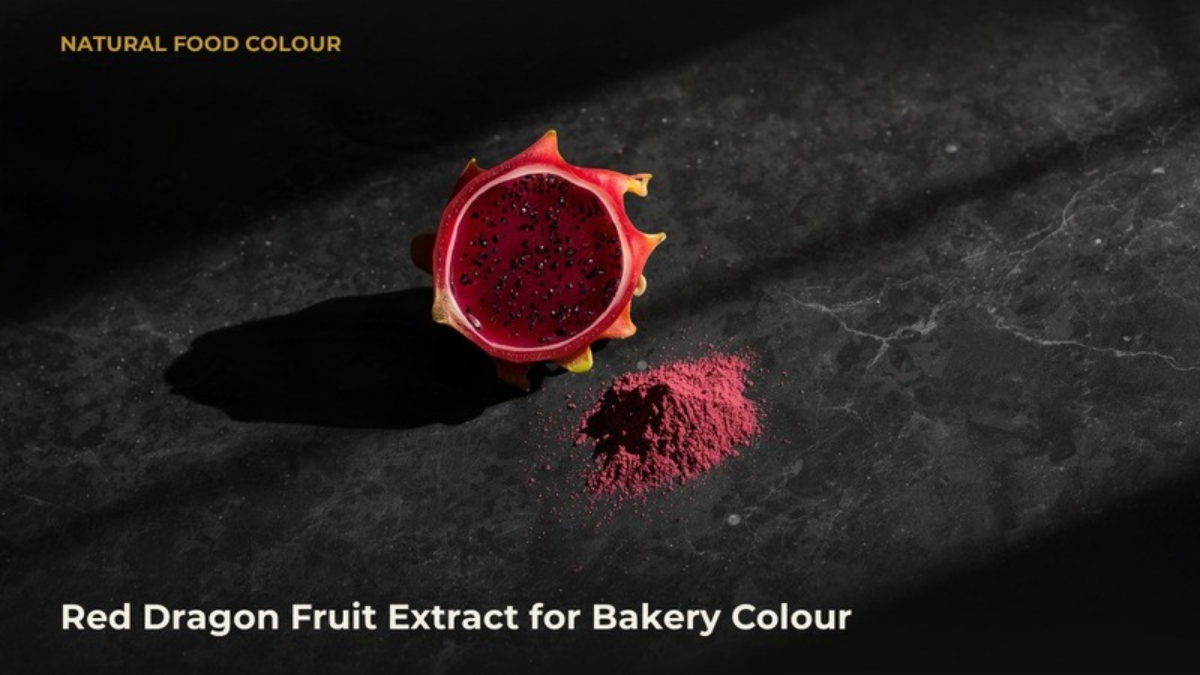
Red dragon fruit (Hylocereus polyrhizus) fruit extract powder is a plant-derived colour ingredient. The product information identifies betacyanins as the naturally occurring red-purple colourants, and the published guide describes the powder as water-soluble. In bakery formulation, it can be assessed as an alternative to synthetic red colour, but final shade depends on the recipe, processing conditions and the grade’s documented colour specification.
Colour from a fruit-derived powder also brings the ingredient’s own sensory profile. The product page describes red dragon fruit flesh as slightly sweet, and its direction of use lists cake, biscuits, kuih-muih and desserts. Product developers should assess aroma, taste and final colour in the intended dough, batter, filling or icing rather than assume equivalence with a synthetic dye.
How should a developer compare it with synthetic colour?
Comparison should be made against the current colour system using the same bakery matrix, processing schedule and finished-product assessment. Natural colour and synthetic colour are not automatically interchangeable: the target shade, label declaration, ingredient interactions and process exposure must all be considered.
| Evaluation point | Red dragon fruit extract powder | Synthetic colour control |
|---|---|---|
| Colour origin | Fruit-derived betacyanin colour; product page names betacyanin compositionally | Record the exact colour identity and grade already used in the formula |
| Powder behaviour | Published guide states water-soluble; confirm dispersion in the specific dough or batter | Follow the supplier’s stated form and incorporation instructions |
| Shade match | Assess the target colour before and after the complete bake process | Use the established control batch for direct comparison |
| Heat retention | Evaluate shade retention in pilot bakes across the full bake and cooling cycle | Use the control’s known production performance as the comparator |
| Specification basis | Require the marker assay, colour specification and COA for the lot | Record the colour strength and acceptance limits for the incumbent grade |
What does standardisation mean for colour quality control?
A standardised extract should be distinguished from a crude fruit powder through its documented specification, not through assumed performance. For this ingredient, betacyanins are identified as natural colourants on the product page. A buyer should require the current specification sheet and lot certificate of analysis (COA), and base the assay basis, method and acceptance range on what those documents record; the incoming-material limit should be set from the documented marker range and the actual lot result.
Control batch-to-batch consistency through the agreed marker range and a per-lot COA, and write those limits into the purchase specification. A crude powder without a defined assay may vary in pigment content, so the meaningful purchasing distinction is documentation: the marker, method, acceptance range and actual lot result. Do not equate an extraction ratio with a pigment assay; the two describe different attributes.
What should a bakery trial measure?
Use a controlled comparison in the actual bakery system. Record the colour ingredient grade and lot, the point of addition, mixing sequence, product dimensions, oven programme, cooling conditions and finished-product assessment time. Because use levels differ between food matrices, establish the bakery-specific trial range from the product’s general direction of use and the target recipe, and document the amount added and the acceptance criteria in the trial record.
Trial record checklist
- Set the target shade and identify the existing synthetic-colour control.
- Record the amount added and the exact formula basis in the internal trial record.
- Check dispersion and visible specking before baking.
- Compare colour at the same locations before and after the full bake and cooling cycle.
- Record any flavour or aroma difference in a structured sensory assessment.
- Repeat the assessment using the intended production process and packaging conditions.
For a clear decision, evaluate the same batch at a consistent stage and lighting condition. A visual comparison can be supported by instrumental colour measurement where the development team has that capability; the method and acceptance tolerance should be set by the product developer, not assumed from a supplier description.
How does powder solubility affect incorporation?
The published product guide describes the powder as water-soluble. That property is a useful starting point for systems with an available aqueous phase, but bakery doughs and batters vary in moisture, fat and mixing sequence. Confirm whether the powder dissolves or disperses adequately under the actual process conditions, and check for colour uniformity after mixing. Any pre-dissolution or slurry step should be validated against the recipe and production equipment.
For applications such as bakery systems, the finished shade can be affected by the surrounding ingredients and processing. A colour check in a water sample alone does not predict the result in a flour-based matrix. Keep the trial matrix representative of production and record colour at the relevant stages so that the grade can be evaluated against the synthetic control.
What documents should buyers request?
A purchasing specification should identify the botanical and plant part, powder form, colour marker, assay basis and method, solubility statement, batch acceptance criteria, storage conditions and packaging details. Ask for a COA for the lot being evaluated and the current specification sheet. Where bakery suitability is a critical requirement, ask for product-specific data that covers the intended processing profile rather than relying on general pigment literature.
Red dragon fruit extract powder differs from an unstandardised fruit powder only where the grade’s agreed markers and limits are documented and checked lot by lot. The COA should show the actual result against the agreed specification. Record the marker percentage and any bakery heat-retention range in the purchasing specification only as documented on the current specification sheet and lot COA.
Supplying red dragon fruit extract and related ingredients in bulk
Bionutricia Extract supplies red dragon fruit (Hylocereus polyrhizus) standardised extract powder as a bulk ingredient. The product page lists bakery and cake applications and gives a general direction of use of 2–6% of total weight across its listed recipe applications; the published guide describes the powder as water-soluble and identifies its betacyanin colour compositionally. Buyers should use the current specification sheet and lot COA to establish the marker assay, acceptance range and application data required for their purchasing specification.
Related colour ingredients in the published catalogue include roselle (Hibiscus sabdariffa) standardised extract powder and butterfly pea flower (Clitoria ternatea) standardised extract powder. Bionutricia’s published supply services include bulk supply, custom specification and extract ratio, powder forms, documentation, packing options and sample requests. Its quality framework includes FSSC 22000, JAKIM Halal, GMP, HACCP, MeSTI and US FDA facility registration. For the bulk-ingredient overview, see Bionutricia’s red dragon fruit extract powder guide.
Frequently asked questions
Can red dragon fruit extract replace synthetic colour in bakery? It can be evaluated as a plant-derived colour alternative, but suitability depends on target shade, formula and processing. Compare it with a synthetic-colour control in the actual bakery product.
What gives red dragon fruit extract its colour? The product information identifies betacyanin as a betalain pigment responsible for the red-purple colour. Any quantitative assay basis and result should be confirmed from the specification sheet and lot COA.
Is the powder water-soluble? Yes, the published product guide describes it as water-soluble. Confirm incorporation and colour uniformity in the intended dough, batter or filling.
What bakery use level should be tested? The product page gives a general direction of use of 2–6% of total weight across its listed recipe applications. Establish the bakery-specific level in the target recipe and document the amount used and resulting colour.
How can a buyer assess colour retention during baking? Compare pre-bake and post-bake colour in a pilot using the intended process, and request supporting specification data for the lot.
Request the certificate of analysis, specification sheet and a sample of the product.