Caramel Powder Bulk Buyer’s Guide: E150 Classes, COA and Procurement Specs
Direct answer: When buying bulk caramel powder, a manufacturer should specify the E150 caramel class (I–IV) that matches the target food or beverage system, confirm tinctorial power (colour intensity), pH range, viscosity, and moisture content on the certificate of analysis, and verify that 4-methylimidazole (4-MEI) and 5-hydroxymethylfurfural (HMF) levels fall within the regulatory limits for the destination market. The four E150 classes — plain (I), caustic sulfite (II), ammonia (III), and sulfite-ammonia (IV) — differ in solubility, colour stability, and permitted applications, so selecting the wrong class will cause formulation failures in acidic beverages, bakery, or confectionery systems. A supplier’s COA should cover identity, tinctorial power, pH, total solids, heavy metals, microbial limits, and 4-MEI content per batch. Bionutricia Extract supplies caramel powder produced under FSSC 22000, GMP, HACCP, and JAKIM halal certification, with full COA documentation for every batch.
GMP
HACCP
JAKIM Halal
US FDA
MeSTI
Quick facts for formulators
- Ingredient: Caramel powder (caramelised sugar, milled to fine powder)
- E150 classes: I (plain), II (caustic sulfite), III (ammonia), IV (sulfite-ammonia)
- Key spec parameters: Tinctorial power, pH, viscosity, moisture, particle size, 4-MEI, HMF
- Typical applications: Bakery, confectionery, beverages, dairy, sauces, seasoning blends
- Shelf life: 24 months in original sealed packaging below 25°C, RH below 65%
- Certifications: FSSC 22000, GMP, HACCP, JAKIM Halal, US FDA, MeSTI
What is caramel powder?
Caramel powder is the product of controlled caramelisation — the heating of sugars above 80°C, during which the sugar molecules break down and re-form into compounds with a characteristic brown colour and roasted, bittersweet flavour. The resulting caramel is then dried and milled into a fine, free-flowing powder. Unlike liquid caramel colour, the powder form offers shelf stability, precise dosing in dry blends, and easier handling in manufacturing environments.
The brown colour in caramel comes from melanoidins — high-molecular-weight polymers produced by the Maillard reaction and sugar pyrolysis. The principal caramelisation products include caramelan, caramelen, and caramelin, which together give caramel its characteristic hue and flavour profile. Because the powder retains these compounds in concentrated form, a small addition delivers strong colour and flavour impact.
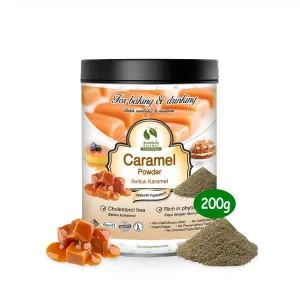
Bionutricia’s caramel powder is vegan, non-GMO, and produced without fillers, artificial flavours, additives, preservatives, or artificial colours. It is soy-free and gluten-free. See our caramel powder product page for the full ingredient declaration and usage directions.
The four E150 caramel classes explained
Caramel colours are classified into four distinct classes under the international food-additive numbering system (JECFA 1992; Codex 1996). Each class is produced with different reactants, which gives it different solubility, colour stability, and application suitability. Selecting the correct class is the single most important specification decision when buying bulk caramel powder.
| Class | Also known as | Reactants | Key properties | Typical applications |
|---|---|---|---|---|
| E150a (Class I) | Plain caramel, spirit caramel | Heat only (no ammonia or sulfite) | Lightest colour, lowest tinctorial power, stable in high-alcohol systems | Spirits, whisky, premium bakery |
| E150b (Class II) | Caustic sulfite caramel | Sulfite compounds | Reddish tone, moderate colour intensity, alcohol-stable | Liqueurs, wine, vinegar |
| E150c (Class III) | Ammonia caramel, beer caramel | Ammonia compounds | Reddish-brown, stable in acidic and saline systems, good for beer and bakery | Beer, bakery, confectionery, soy sauce |
| E150d (Class IV) | Sulfite-ammonia caramel, soft drink caramel, acid-proof caramel | Both ammonia and sulfite | Darkest colour, highest tinctorial power, acid-stable | Soft drinks, colas, acidic beverages, processed foods |
For most food and beverage manufacturers, the choice between classes comes down to the pH of the target system. Class IV (E150d) is the workhorse for acidic beverages because it resists precipitation at low pH. Class III (E150c) is preferred for bakery and beer where a warm reddish-brown tone is desired. Class I (E150a) is the cleanest option for premium and clean-label products where minimal processing is a selling point.
Key specifications for bulk caramel powder
A well-written specification sheet for bulk caramel powder should include the following parameters. Each should appear on the supplier’s certificate of analysis, confirmed per batch.
| Parameter | Why it matters | What to check |
|---|---|---|
| Tinctorial power | Measures colour intensity — the higher the value, the less powder needed to achieve the target colour | Match to your formulation’s colour target; compare across suppliers using the same method |
| pH (1% solution) | Determines compatibility with the target food system; acidic caramel in a high-pH product can cause instability | Confirm the pH range suits your application (e.g. 2.5–4.5 for beverages, 4.5–6.5 for bakery) |
| Moisture content | Affects flowability, caking tendency, and shelf life | Typically below 5%; higher moisture shortens shelf life and promotes clumping |
| Particle size | Determines dissolution rate and uniformity in dry blends | Specify mesh size (e.g. 80–100 mesh for fine powder); coarser grades may not dissolve uniformly |
| 4-MEI content | 4-Methylimidazole is a byproduct of ammonia-process caramel (Classes III and IV); regulated in many markets | Confirm ppm level meets destination-market limits (e.g. California Proposition 65, EU EFSA guidance) |
| Heavy metals | Food-safety compliance | Lead, arsenic, cadmium, mercury within Codex/EFSA/FDA limits |
| Microbial limits | Food-safety compliance | Total plate count, yeast, mould, coliforms, Salmonella, E. coli per batch |
5-Hydroxymethylfurfural (HMF) and 4-MEI: what buyers need to know
Two compounds deserve particular attention on the COA because they are both characteristic caramelisation products and regulated in major markets.
5-Hydroxymethylfurfural (HMF) is formed during the thermal degradation of hexoses and is a marker of caramelisation intensity. It is a small organic molecule whose structure is shown below. HMF levels indicate the degree of heat treatment the caramel received and can be a useful quality-consistency parameter between batches.
4-Methylimidazole (4-MEI) is a byproduct formed when ammonia is used in the caramelisation process (Classes III and IV). A 2015 study in PloS One assessed human exposure to 4-MEI via soft drink consumption, highlighting the compound as a regulatory concern for beverage manufacturers using Class IV caramel colour (PMC4333292). Regulatory bodies including EFSA have re-evaluated caramel colours as a group, and a 2018 review in Food and Chemical Toxicology surveyed updated safety data for caramel colour as a food additive (PMID 29222054). Buyers should confirm that 4-MEI levels on the COA meet the specific limits of their destination market — California’s Proposition 65, the EU EFSA opinion, and national standards in Asia each set different thresholds.
Applications in food and beverage manufacturing
Caramel powder is a dual-function ingredient: it delivers both colour and flavour. Typical applications include:
- Bakery: bread crust colour enhancement, cookie and biscuit colour, cake premixes
- Beverages: soft drinks, colas, iced tea, coffee drinks, flavoured milk, protein shakes
- Confectionery: toffee, fudge, caramel candy, chocolate coatings
- Dairy: ice cream, yoghurt, custard, pudding
- Sauces and seasonings: soy sauce, barbecue sauce, gravy bases, seasoning blends
- Dry premixes: beverage premixes, soup bases, dessert mixes where liquid caramel is impractical
Usage rates vary by application and desired colour intensity. In beverage systems, caramel powder is typically dosed at 0.1–0.5% of total volume; in bakery and confectionery, 0.2–2% of total weight. The powder form is particularly advantageous in dry blend applications where liquid caramel would introduce unwanted moisture.
How to buy caramel powder in bulk: a checklist
- E150 class — specify the class (I–IV) that matches your application’s pH and stability requirements.
- Tinctorial power — confirm the colour intensity value and the test method used.
- 4-MEI level — for Classes III and IV, verify ppm on the COA against your destination market’s regulatory limit.
- Particle size — specify mesh size for your blending or dissolution process.
- Moisture and flowability — confirm moisture content and request a sample to evaluate caking tendency.
- Certificate of analysis — identity, tinctorial power, pH, moisture, heavy metals, microbial limits, 4-MEI per batch.
- Certifications — halal (JAKIM or recognised body), GMP/HACCP or FSSC 22000 site certification.
- Packing and shelf life — foil-lined 1 kg / 5 kg / 25 kg options; confirm 24-month shelf life in sealed packaging below 25°C.
- Sensory sample — evaluate colour, aroma, and taste in your application before committing to volume.
Caramel powder from a Malaysian supplier
Bionutricia Extract supplies caramel powder from its manufacturing facility in Sungai Buloh, Malaysia, for B2B buyers in food, beverage, and supplement manufacturing. The facility operates under FSSC 22000, GMP, and HACCP certification, and products are JAKIM halal-certified — easing registration across Malaysia, Indonesia, the GCC, and other halal-regulated markets. Every batch ships with a certificate of analysis covering identity, colour intensity, pH, moisture, heavy metals, and microbial limits. Bionutricia’s extraction capability is protected under granted patent MY-188945-A (patented enzymatic ultrasonic extraction), and the company has served 239+ brand partners since its founding in 2006.
For specifications, samples, and bulk quotations, contact our team or message us on WhatsApp at +60 16-661 8510.
Related guides
- Banana Powder: What It Is, How It’s Made and How to Buy in Bulk
- Kurma (Dates): Varieties, Ingredient Formats and How to Buy in Bulk
- Knowledge: Caramel
Frequently asked questions
What is the difference between E150 caramel classes?
The four classes differ in the reactants used during caramelisation. Class I (E150a) uses heat only — the cleanest and lightest. Class II (E150b) adds sulfite for a reddish tone and alcohol stability. Class III (E150c) uses ammonia for bakery and beer applications. Class IV (E150d) uses both ammonia and sulfite, producing the darkest, most acid-stable colour for soft drinks. The class determines solubility, colour stability, and regulatory limits for byproducts like 4-MEI.
Which caramel class should I use for acidic beverages?
Class IV (E150d, sulfite-ammonia caramel) is the standard choice for acidic beverages such as soft drinks and colas because it resists precipitation at low pH. Class III (E150c) can work in mildly acidic systems like beer. Always test the caramel powder in your specific formulation to confirm colour stability under your pH and processing conditions.
Is caramel powder halal?
Caramel powder is a sugar-based ingredient; halal certification depends on the manufacturing facility. Bionutricia Extract’s caramel powder is produced in a JAKIM halal-certified plant with documentation available for buyers.
How should caramel powder be stored?
Store sealed in a cool, dry place away from sunlight. The powder is hygroscopic — reseal promptly after opening to prevent caking. Unopened shelf life is 24 months in original sealed packaging below 25°C and relative humidity below 65%.
What should I look for on the COA when buying caramel powder?
Request identity confirmation, tinctorial power (colour intensity), pH of a 1% solution, moisture content, particle size, heavy metals (lead, arsenic, cadmium, mercury), microbial limits (total plate count, yeast, mould, coliforms, Salmonella, E. coli), and 4-MEI content for Classes III and IV. Each parameter should be reported per batch.
Specifying caramel powder for a food or beverage product? Request specifications, samples and a bulk quotation