Noni fruit extract powder is a 100:1 extract of Morinda citrifolia (noni) fruit, verified for its marker compound scopoletin. Bionutricia Extract supplies it in bulk to B2B and OEM formulators from a JAKIM Halal, FSSC 22000, US FDA-registered, GMP, HACCP and MeSTI facility in Malaysia, with a Certificate of Analysis on every lot.
Quick facts for formulators
- Botanical / part: Morinda citrifolia (noni, Indian mulberry), fruit
- Extraction ratio: 100:1 · Marker compound: scopoletin
- Form / colour / odour: free-flowing light-brown powder, characteristic
- Moisture: 2–8% · Solubility: soluble in water · Particle size: >85% through 60 mesh
- Dosage: 200–500 mg
- Pack sizes: 1 kg · 5 kg · 20 kg
- Certifications: JAKIM Halal · FSSC 22000 · US FDA registered · GMP · HACCP · MeSTI · COA per lot
- Clean label: vegan, non-GMO, gluten-free (<20 ppm), no Annex II allergens
- Shelf life: 24 months sealed, cool & dry · Origin: Malaysia
What is noni fruit extract powder?
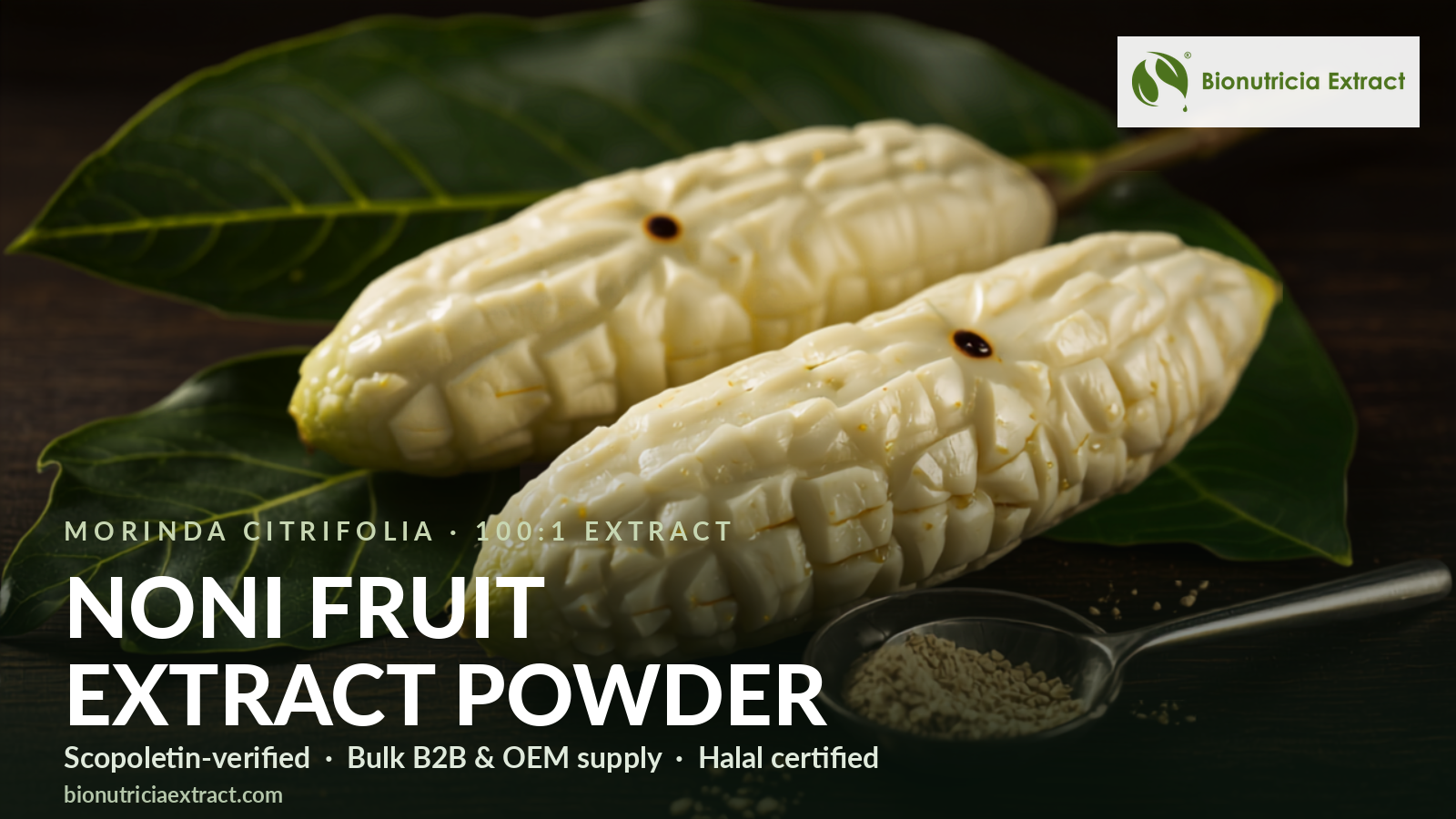
Noni (Morinda citrifolia) is a small evergreen tree of the coffee family that thrives across Southeast Asia and the Pacific, bearing an ovoid, knobbly fruit whose waxy skin is divided into polygonal sections, each carrying a tiny dark "eye". The ripe fruit is famously pungent — traders once called it cheese fruit — yet it holds a central place in Polynesian, Malay and broader Southeast Asian traditional practice, where the fruit, leaf and root have been used for generations. Modern analysis attributes noni's research interest to a distinctive phytochemical set: the coumarin scopoletin, the iridoid glycosides led by deacetylasperulosidic acid (DAA), plus flavonoids, lignans and polysaccharides. Bionutricia's extract concentrates the fruit roughly 100-fold into a stable, water-soluble, light-brown powder — converting a bulky, odorous fresh fruit into a documented, easy-to-dose B2B ingredient.
Active compounds & identity markers
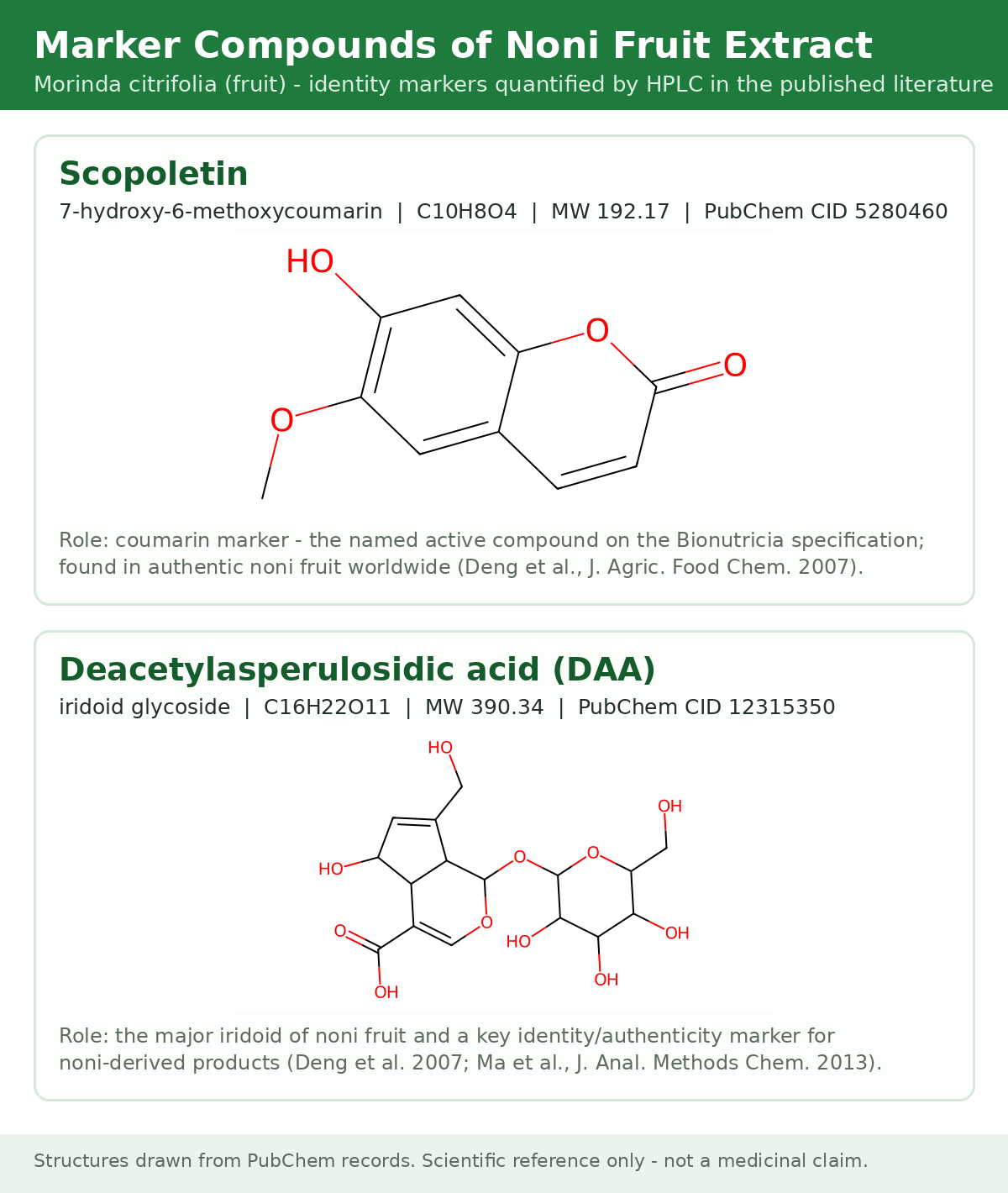
Two compounds anchor noni's identity in the analytical literature. Scopoletin (7-hydroxy-6-methoxycoumarin, C₁₀H₈O₄) is the named active compound on Bionutricia's specification and has been detected in authentic noni fruit from every tropical growing region studied. Deacetylasperulosidic acid (C₁₆H₂₂O₁₁) is the major iridoid of noni fruit, and because iridoids are relatively rare in commercial fruit juices, DAA doubles as an authenticity marker for genuine noni-derived material — both compounds are quantified by validated HPLC methods in the published literature (Deng et al., Journal of Agricultural and Food Chemistry 2007). For a technical buyer, a verified scopoletin fingerprint distinguishes true Morinda citrifolia fruit extract from diluted or substituted material.
How noni compounds behave in the body (published pharmacology)
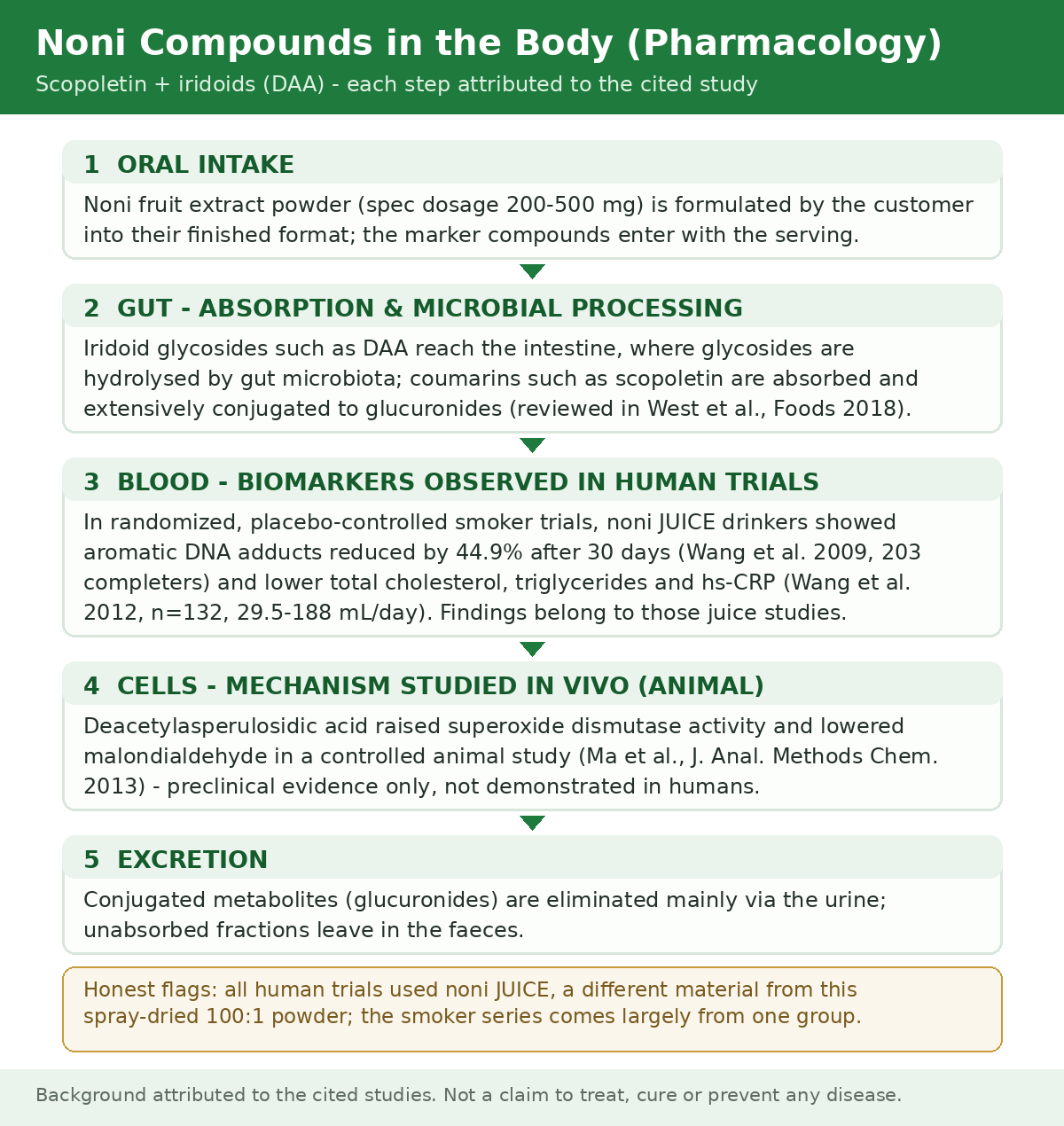
Once ingested, noni's iridoid glycosides travel to the intestine, where glycosides are hydrolysed by the gut microbiota, while coumarins such as scopoletin are absorbed and extensively conjugated to glucuronides before excretion, as reviewed in the human-intervention literature (West et al., Foods 2018). The downstream biology has been studied at two levels. In randomized, placebo-controlled trials in heavy smokers — a population under high oxidative load — drinking noni juice for 30 days reduced aromatic DNA adducts and improved plasma lipid-peroxidation markers (Wang et al. 2009; Wang et al. 2013). At the cellular level, deacetylasperulosidic acid increased superoxide dismutase activity and lowered malondialdehyde in a controlled animal study (Ma et al., Journal of Analytical Methods in Chemistry 2013) — preclinical evidence only. Mechanism is provided as scientific background on the botanical, attributed to the cited studies; it is not a claim that this ingredient treats, cures or prevents any condition.
Clinical evidence on noni
Noni is unusual among tropical fruits in having a series of randomized, placebo-controlled human trials — although, importantly, they were run on noni juice, not on spray-dried extract powder. The evidence below was generated by the cited researchers and regulators on the materials they tested; it is provided as scientific context for technical buyers — not as performance claims for this ingredient.
| Area studied | Best available human evidence | Result (attributed to the study) |
|---|---|---|
| Oxidative DNA damage in heavy smokers | Randomized, double-blind, placebo-controlled trial; 283 heavy smokers randomized, 203 completed; 29.5 mL or 118 mL noni juice daily for 30 days (Wang et al., Nutrition and Cancer 2009) | Aromatic DNA adducts fell by 44.9% in the noni juice arms versus baseline; the placebo arm showed no comparable change — a biomarker endpoint, not a disease outcome |
| Blood lipids & inflammation markers in smokers | Randomized, double-blind, placebo-controlled trial, n=132 heavy smokers; 29.5–188 mL noni juice daily for 30 days (Wang et al., The Scientific World Journal 2012) | Total cholesterol, triglycerides and hs-CRP decreased significantly among noni juice drinkers; the iridoid-free placebo juice produced no significant change |
| Regulatory recognition & safety review | EU novel-food authorisation of noni juice (Commission Decision, 2003) and EFSA's re-assessment (EFSA Journal 2009) | EFSA concluded noni fruit puree and concentrate are safe for the general population under the evaluated conditions; earlier hepatitis case reports were reviewed and no causal relationship with noni juice was established |
| Limitations (cited honestly) | Review of human intervention studies (West et al., Foods 2018) | Nearly all trials used noni juice — a different material from dried 100:1 fruit extract — and much of the smoker-trial series comes from a single industry-affiliated research group; independent replication on powdered extracts remains limited |
Trial populations, doses and preparations vary; the cited findings describe noni juice in research settings and are not extrapolated to this extract powder or to any Bionutricia finished product.
Typical specification
| Parameter | Value |
|---|---|
| Botanical source / part | Morinda citrifolia, fruit |
| Extraction ratio | 100:1 |
| Appearance / colour | Free-flowing powder, light brown |
| Odour | Characteristic |
| Marker compound | Scopoletin |
| Moisture | 2–8% |
| Solubility | Soluble in water |
| Particle size | >85% through 60 mesh |
| Dosage | 200–500 mg |
| Heavy metals (As, Pb, Cd, Hg) | As ≤ 1 ppm, Pb ≤ 2 ppm, Cd ≤ 1 ppm, Hg ≤ 0.05 ppm |
| Microbial (APC, Y&M, coliform, E. coli) | APC ≤ 10⁴ cfu/g, Y&M ≤ 10³ cfu/g, coliforms ≤ 10² cfu/g, E. coli absent |
| Certifications | JAKIM Halal, FSSC 22000, US FDA registered, GMP, HACCP, MeSTI |
| Shelf life | 24 months sealed, cool & dry |
| Pack sizes | 1 kg, 5 kg, 20 kg |
| Country of origin | Malaysia |
Full specification and a batch Certificate of Analysis are provided on request. Figures are typical values; confirm the current lot COA for release data.
Applications
As a water-soluble 100:1 concentrate dosed at 200–500 mg, noni fruit extract powder slots into the finished categories customers register in their own markets — capsules, tablets, gummies, sachet and stick-pack blends, functional beverages, and traditional-wellness formulations. Bionutricia supplies the bulk ingredient for B2B formulation; brand owners and manufacturers formulate it into their chosen finished format and register it under the product category applicable in their country. Because noni carries formal novel-food status in the EU and a long traditional-use history across Asia-Pacific, experienced buyers treat market-by-market category selection as the first formulation decision — and Bionutricia's specification, COA and certification stack are built to support that registration work.
Why source noni extract from Bionutricia?
Bionutricia Extract has manufactured standardized Malaysian botanical extracts since 2006 under a full halal and international food-safety stack (JAKIM Halal, FSSC 22000, US FDA registration, GMP, HACCP, MeSTI), issuing a Certificate of Analysis on every lot. Its enzymatic-and-ultrasonic process is patented (MY-188945-A, "Process for Preparing Nutritional Powder Extract"), concentrating noni fruit 100-fold into a clean, water-soluble powder with no added colourants, fillers or preservatives. Bulk OEM, custom standardisation and packing are available. See the live noni extract product page for ordering.
Noni sits inside a wider Malaysian tropical-botanical range from the same certified catalogue — formulators building a traditional-wellness or antioxidant line alongside noni also source our roselle extract, mangosteen peel extract, black ginger extract, pandan leaf extract and tongkat ali extract — one audit pack, one shipment.
Frequently asked questions
Verified for what / is a COA available? A 100:1 extract of Morinda citrifolia fruit verified for its marker compound scopoletin, moisture 2–8%; batch COA per lot.
Is it halal? Yes — JAKIM Halal certified; the facility is also FSSC 22000, US FDA-registered, GMP, HACCP and MeSTI. Halal documentation issued with each shipment.
Is it water-soluble? Yes — soluble in water; a free-flowing light-brown powder (>85% through 60 mesh) dosed at 200–500 mg for premixes, beverages and liquid systems.
What does 100:1 mean? About 100 kg of fresh noni fruit concentrated into 1 kg of extract powder — a compact, stable, documented alternative to handling the pungent fresh fruit.
What formats do customers make? We supply the bulk ingredient; customers formulate capsules, tablets, gummies, sachets, beverages and functional food blends registered under their market's applicable category.
How is noni regulated? At the customer's finished-product stage — in the EU, noni preparations are authorised novel foods (juice authorised 2003; EFSA's 2009 re-assessment concluded safety for the general population under the evaluated conditions). We supply the documentation for your chosen route.
MOQ & lead time? Pack sizes 1 kg, 5 kg, 20 kg; pre-order packing ~1–2 weeks. MOQ & pricing on quotation.
Storage & shelf life? Sealed hygienic containers, cool & dry, away from pests; 24 months when properly stored.